
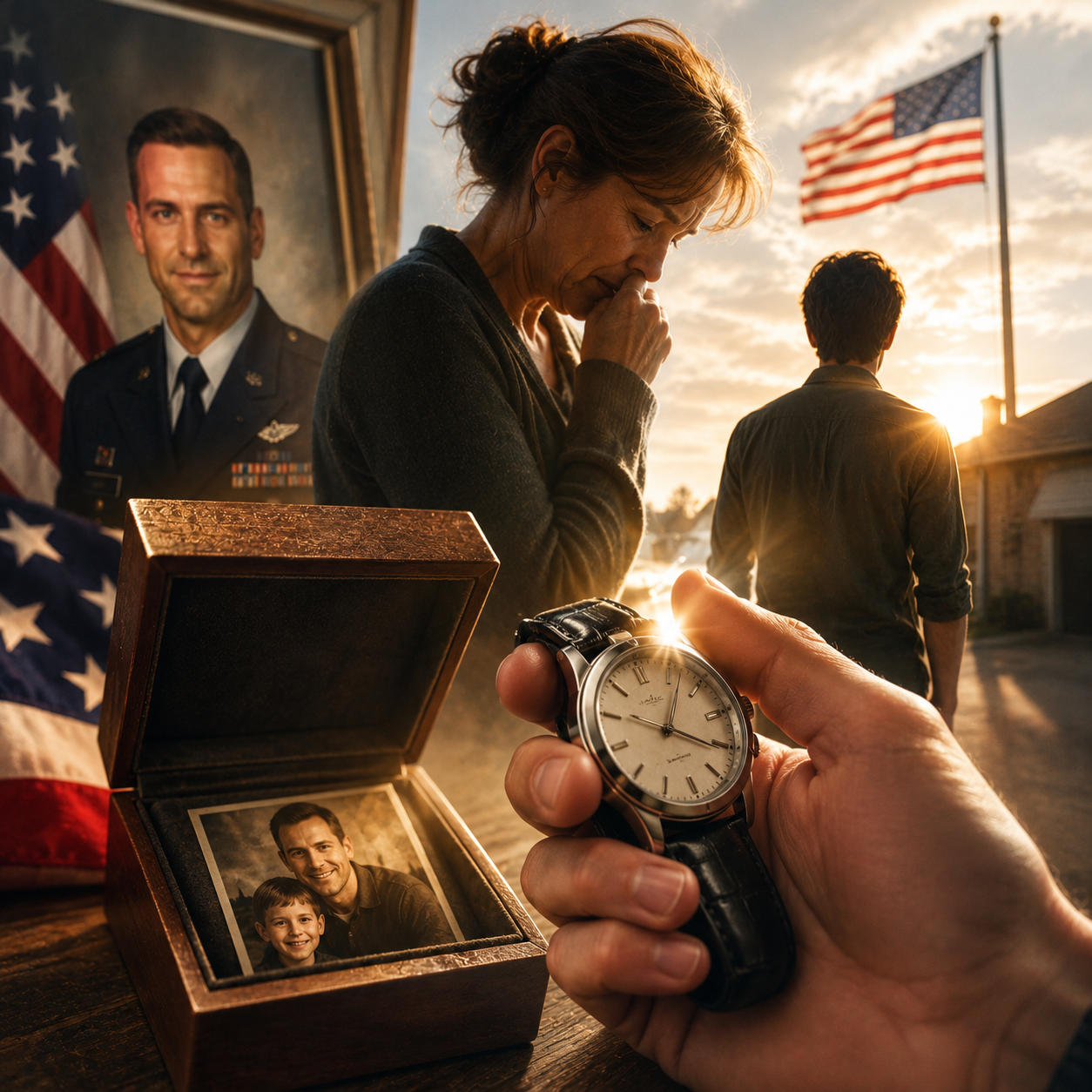
I saw betrayal.
After that, our house became a battlefield made of silence.
I moved through rooms like a ghost. She tried to feed me, and I refused. She asked about school, and I gave one-word answers. She came to my bedroom door at night and stood there without knocking. I pretended to sleep.
A month after the funeral, I asked her where she sold it.
She said, “It’s gone.”
“To who?”
“Noah.”
“To who?”
She closed her eyes. “Let it go.”
That made me angrier than anything else.
Let it go.
As if she had sold a lamp. As if my father’s watch was not the thing he had promised me with his own voice.
I searched pawn shops. I skipped school twice and rode my bike across town, showing old photos of Dad’s wrist to bored clerks behind glass counters. Nobody recognized it. Nobody cared.
When I came home, my mother was waiting in the kitchen.
“Where were you?”
“Looking for what you stole.”
Her face went pale, but she did not shout. Somehow that made it worse.
“You don’t understand,” she said.
“Then explain it.”
She looked at me for so long I thought she might. Her lips parted. Her eyes filled with something that looked almost like surrender.
Then the phone rang.
She glanced at it, saw the number, and everything in her changed.
Her face closed.
She answered in the hallway, voice low. I could not hear the words, only the tone. Fear. Anger. Pleading.
When she came back, she said, “Go to your room.”
I laughed. “I’m not a child.”
“No,” she said quietly. “But you’re still my son.”
That was the closest she came to explaining anything for ten years.
I left home at eighteen.
Not dramatically. No screaming. No grand goodbye. I got accepted to Ohio State, packed my clothes into two duffel bags, and waited for her to say something that would make me stay emotionally, even if I left physically.
She stood in the driveway with her arms folded tight around herself.
“You have everything?” she asked.
“Yeah.”
“Call when you get there.”
I looked at her and hated how tired she seemed. Hated that part of me still wanted her to hug me. Hated that I could still see my father in the shape of her grief.
“I will,” I lied.
She nodded.
Then I drove away.
For years, our relationship became a polite monthly phone call.
She would ask about classes. I would say fine. She would tell me the furnace had been repaired or Mrs. Donnelly next door had moved to Arizona. I would say okay. We never mentioned Dad’s watch.
But I thought about it constantly.
Every birthday, I imagined how it should have felt to receive it. Every milestone seemed incomplete without it. Graduation. My first real job. My first apartment. The first time I bought a suit and looked in the mirror expecting to see my father but seeing only myself.
I built my life around proving I did not need anything from my mother.
By twenty-six, I was working in Columbus as a claims investigator for an insurance company. It was not glamorous, but I was good at it. I noticed inconsistencies. I remembered details. I could sit across from someone lying and wait calmly until they became uncomfortable enough to reveal the truth.
My boss once told me I had a gift for suspicion.
I almost laughed.
Suspicion was not a gift. It was what grief left behind when love had nowhere safe to go.
The call came on a Thursday morning in November.
I was reviewing a fire damage claim when my phone buzzed.
Mom.
I almost let it ring out.
Then I answered.
“Hello?”
For a second, there was only breathing.
“Noah,” she said.
Something in her voice made me sit up.
“What happened?”
“I’m okay.”
People only say that when they are not.
“Mom.”
“I had a small incident yesterday.”
“What kind of incident?”
“A fainting spell.”
I stood up from my desk. “You fainted?”
“At the grocery store. It was nothing.”
“Were you alone?”
“No. Someone called an ambulance.”
My throat tightened. “And you didn’t call me?”
“I didn’t want to worry you.”
I closed my eyes. That sentence carried ten years of distance inside it.
“What did the doctors say?”
“They want to run more tests.”
“What tests?”
“Noah.”
“What tests?”
She was quiet.
Then she said, “They found a mass.”
The world narrowed.
I drove home that afternoon.
The town looked smaller than I remembered. The same courthouse square. The same barber shop with the striped pole. The same cracked sidewalks and maple trees dropping red leaves like old wounds.
My mother’s house looked almost unchanged except for the porch paint peeling near the steps.
She opened the door before I knocked.
For a moment, we just stared at each other.
She had aged more than I expected. Her dark hair was threaded with gray now, her face thinner, her eyes carrying the exhaustion of someone who had spent too long being strong in private.
“You came,” she said.
“Of course I came.”
Her mouth softened, almost smiled, but not quite.
The house smelled the same. Lemon cleaner. Old wood. Coffee. I hated how quickly it pulled me backward.
The next few weeks became hospitals, tests, waiting rooms, forms, phone calls, and the strange intimacy of illness. Cancer, the doctors said. Treatable, maybe. Aggressive, definitely. Decisions had to be made quickly.
I stayed.
At first, I told myself it was duty. I was her only child. There was no one else to handle appointments, insurance, medication schedules. But the truth was more complicated. Sitting beside her in sterile rooms, watching nurses tape IV lines to her fragile hands, I felt the old anger losing some of its shape.
Not disappearing.
Just becoming less useful.
One night, after her second round of treatment, I found her sitting at the kitchen table at 2 a.m. in her robe, staring at a cup of untouched tea.
“You okay?” I asked.
She gave a dry laugh. “That question has gotten difficult.”
I sat across from her.
For a while, we listened to the refrigerator hum.
Then she said, “You still hate me?”
I looked at her.
The question should have felt dramatic. Instead, it felt tired.
“I don’t know.”
She nodded like that was fair.
“I hated you for a long time,” I said.
“I know.”
“For selling it.”
Her hand tightened around the mug.
There it was. The ghost at the table.
“Dad’s watch,” I said.
She closed her eyes.
“You never told me why.”
“No.”
“Tell me now.”
She looked so small under the yellow kitchen light that for one weak second I almost took it back. But I had been sixteen in that hallway forever. Some questions do not die just because people get sick.
“Please,” I said. “I need to know.”
Her eyes opened. They were wet.
“I can’t.”
I pushed back from the table. “You can’t or you won’t?”
“Noah—”
“Ten years, Mom.”
“I know.”
“No, you don’t. You have no idea what that did to me.”
She flinched.
Good, I thought cruelly. Feel it.
“That was all I wanted,” I said. “Not money. Not the garage. Not anything else. Just one thing of his. One thing he promised me. And you sold it like it meant nothing.”
“It meant everything.”
“Then why?”
A tear slipped down her cheek.
She whispered, “Because your father asked me to.”
I stared at her.
The room seemed to tilt.
“What?”
She wiped her cheek quickly, almost angrily. “Forget I said that.”
“No.”
“I’m tired.”
“No, you don’t get to do that.”
She stood, but her legs wobbled. I reached for her automatically. She pulled away.
“Mom.”
“I said I’m tired.”
“Dad asked you to sell his watch?”
She gripped the back of the chair.
Then, very quietly, she said, “Not exactly.”
“What does that mean?”
But she would not answer.
The next morning, she acted like the conversation had never happened.
I did not.
That one sentence infected everything.
Because my father had been dead when she sold the watch. So if he had asked her to do anything, it had been before. Which meant he knew something. Which meant she knew something. Which meant the story of his death, our grief, and my decade of resentment had a locked door in the middle of it.
I started searching.
Not dramatically. Not at first. I told myself I was organizing her records for medical bills. That was partly true. Her filing cabinet was a disaster of old tax returns, insurance forms, utility receipts, and envelopes full of things she could not bring herself to throw away.
But I was looking for the watch.
Or the sale.
Or the buyer.
I found nothing for days.
Then, in the back of my father’s old desk in the garage, beneath a stack of yellowed repair invoices, I found a small manila envelope with my name written on it.
Noah.
My hands went cold.
Inside was a folded piece of paper and a photograph.
The photograph showed my father standing beside a man I did not recognize. They were younger, maybe early thirties. Dad had his arm around the man’s shoulders. Both were smiling, but not at the camera. At each other. Behind them was a lake, sunlight breaking over the water.
On the back, in Dad’s handwriting, were four words.
Ray and me, 1998.
Ray.
My father’s business partner.
Except I knew Ray. Ray Holloway had co-owned the garage with Dad until a few months before the funeral, then left town shortly after Dad died. But the man in the photo was not Ray Holloway.
I unfolded the paper.
It was a receipt.
Not from a pawn shop.
From a private estate buyer in Cleveland.
Item: Men’s Hamilton wristwatch, silver case, black leather band.
Seller: Margaret Whitaker.
Buyer: Arthur Bell.
Sale price: $1.
One dollar.
I sat there in the garage for a long time, staring at the receipt.
My mother had not sold my father’s watch for money.
She had transferred it.
To a man named Arthur Bell.
I had never heard that name in my life.
The next morning, I drove to Cleveland.
Arthur Bell was not hard to find. There were three in Ohio, but only one connected to antiques, estate sales, and private acquisitions. Bell & Crown Appraisals operated out of an old brick building near Lakewood, with brass lettering on the door and displays of pocket watches, fountain pens, and military medals in the front window.
A bell chimed when I entered.
The shop smelled like leather, dust, and polished wood.
An older woman looked up from behind the counter. “Good morning.”
“I’m looking for Arthur Bell.”
Her expression changed so slightly most people might have missed it.
“Do you have an appointment?”
“No.”
“May I ask what this is regarding?”
I placed the receipt on the counter.
Her eyes dropped to it.
Then she looked at me again, more carefully this time.
“What’s your name?”
“Noah Whitaker.”
The color left her face.
She disappeared into the back room without another word.
A minute later, a man came out.
He was in his seventies, tall and thin, wearing a charcoal suit that looked old but expensive. His white hair was combed neatly back. He moved with a cane, but his eyes were sharp.
He looked at me like he had been expecting me for ten years.
“Noah,” he said.
My name in his mouth made my skin crawl.
“You know me?”
“I knew your father.”
I swallowed. “Did you buy his watch?”
“Yes.”
“For one dollar?”
“Yes.”
“Why?”
He did not answer immediately.
Instead, he turned to the woman. “Clara, lock the front door.”
The click of the lock sounded too loud.
“I’m not here for theater,” I said. “I want the watch.”
Arthur Bell studied me.
“You look like Daniel.”
“Don’t.”
His face softened with something like regret. “Fair enough.”
“Where is it?”
“In a safe place.”
“Then get it.”
“I can’t do that.”
I laughed once. “Everyone keeps saying that.”
“Because everyone has been trying to keep you alive.”
The sentence knocked the anger out of me for half a second.
“What?”
Arthur leaned on his cane. “Your mother should have told you.”
“She didn’t tell me anything.”
“No,” he said quietly. “She chose silence. Your father predicted she would.”
Something hot rose in my chest. “Stop talking like you knew him better than I did.”
“I didn’t know him better,” Arthur said. “I knew a part of him you were too young to know.”
“Then start explaining.”
Arthur looked toward the locked door.
Then he said, “Your father did not die of a heart attack.”
I heard the words, but they did not become real immediately.
“That’s not funny.”
“It was never funny.”
“He collapsed at work.”
“Yes.”
“The hospital said—”
“The hospital said what they were told to say after the death certificate was corrected by a county medical examiner who owed favors to powerful people.”
My hands curled into fists. “You’re lying.”
“I wish I were.”
I stepped toward him. Clara moved as if to intervene, but Arthur lifted one hand.
“My father died of a heart attack,” I said.
Arthur’s voice stayed calm. “Your father was poisoned.”
The room went silent.
Outside, cars passed on wet pavement. Somewhere in the building, a clock ticked.
“No,” I said.
It came out like a child’s voice.
Arthur’s expression did not change.
“Daniel discovered something at the garage,” he said. “Something involving stolen vehicles, insurance fraud, and laundering through repair invoices. Ray Holloway was involved. So were two officers, a county official, and several men your father had known for years.”
I shook my head. “No.”
“He came to me because I had helped him appraise old vehicles before. But I used to work federal financial crimes before retiring. Daniel needed advice.”
“Ray was his friend.”
“Yes.”
“My dad trusted him.”
“Yes.”
Arthur’s eyes were sad. “That is often why betrayal works.”
I sat down without meaning to.
Arthur continued.
“Daniel gathered records. Copies of invoices. Names. Dates. VIN numbers. Payments. He hid some of it. He planned to go to federal authorities, not local police. But someone found out.”
My heart hammered so hard I felt sick.
“The watch,” I whispered.
Arthur nodded.
“Your father had the back casing modified. Inside was a micro storage chip with encrypted files. He wore it because he thought no one would suspect something so sentimental. If anything happened to him, your mother was supposed to get the watch to me.”
I looked down at the receipt.
“She sold it to you.”
“For one dollar,” Arthur said. “A legal transfer, documented. It made the chain of custody cleaner if we ever needed it.”
I thought of my mother at the door, purse strap tight in her hand.
Then don’t forgive me.
My throat closed.
“She let me hate her,” I said.
Arthur’s voice softened. “She believed hate was safer than grief with questions.”
I stood suddenly. “Where is Ray Holloway?”
Arthur’s face hardened.
“Alive.”
“Where?”
“Noah.”
“Where?”
“If you go looking for him without understanding the whole story, your mother’s sacrifice means nothing.”
“My mother lied to me for ten years.”
“Your mother buried her husband, gave up her son’s love, and lived under threat so you could grow up.”
I wanted to reject that. I wanted to stay angry because anger was easier than guilt.
But memory began rearranging itself.
The phone call in the hallway.
Her fear.
Her refusal to tell me where the watch went.
Her standing in the driveway when I left for college, looking like she had already lost me but was trying not to reach for something she had no right to keep.
“What happened to the files?” I asked.
Arthur looked away.
“That is where the story becomes complicated.”
“Of course it does.”
“The chip was damaged. Not destroyed, but corrupted. I recovered some files. Enough to scare people. Not enough to convict everyone.”
“Who knew?”
“Your mother. Me. One federal agent. And eventually, Ray.”
My stomach turned. “Ray knew she gave it to you?”
“Yes.”
“And he threatened her.”
Arthur did not answer.
That was answer enough.
I drove home in a state beyond anger.
My mother was asleep on the couch when I walked in, a blanket over her knees, one hand curled near her face. For the first time in years, I saw not the woman who had sold my father’s watch, but the woman who had stood between me and something dark while letting me despise her for it.
I wanted to wake her and demand everything.
I wanted to apologize.
I wanted to be sixteen again so I could choose differently.
Instead, I sat in the chair across from her and watched her sleep until evening.
When she woke, she saw my face and knew.
Her eyes filled before I said a word.
“You went to Arthur.”
I nodded.
She closed her eyes.
“Why didn’t you tell me?” I asked.
Her voice broke. “Because your father made me promise.”
“Dad was dead.”
“Noah.”
“You let me think you sold him for cash.”
“I know.”
“You let me hate you.”
“Yes.”
“Why?”
She looked at me then, and the answer was not dramatic. It was simple. Devastating.
“Because you were alive.”
I covered my mouth with my hand.
She began to cry, not softly, not prettily, but like something inside her had finally cracked after being held together too long.
“I wanted to tell you every day,” she said. “Every single day. But Ray came to the house after the funeral. He stood right there in this living room and told me accidents happen to teenage boys who ask too many questions. He said if you ever went looking, if I ever told you, you would end up with your father.”
I could not speak.
“So I became the villain,” she whispered. “Because villains are easier to leave than grieving mothers. And I needed you to leave, Noah. I needed you far away from here.”
Everything in me folded.
All those years I had thought she was cold, she had been terrified. All those years I had thought she did not love me enough to honor Dad’s promise, she had loved me enough to destroy herself in my eyes.
“I’m sorry,” I said.
It was not enough. It was nothing. It was a cup of water thrown at a burning house.
But she reached for me anyway.
I crossed the room and fell to my knees beside her, and my mother held me like I was sixteen again, like grief had waited ten years for permission to become love.
For three days, she told me everything.
Not all at once. Treatment had made her weak, and some memories still frightened her. But piece by piece, the truth came out.
Dad had suspected Ray for months before he died. Missing parts. Cars passing through the shop without proper records. Repair invoices billed to insurance companies for vehicles that never existed. At first, he thought Ray was cutting corners. Then he discovered VIN plates hidden in a storage unit.
When he confronted Ray, Ray laughed it off.
Dad did not.
He began making copies.
My mother found him one night at the kitchen table with papers spread everywhere and the watch opened beside him. He told her enough to scare her, not enough to implicate her. He said he was going to fix it.
That was my father. Always fixing things, even when the broken thing was dangerous.
Two weeks later, he was dead.
The official heart attack had come after he drank coffee at the garage. Arthur believed the poison triggered cardiac arrest and disappeared quickly enough to leave only ambiguous traces. The local medical examiner did the rest.
“Why didn’t Arthur go public?” I asked.
Mom gave me a tired look. “With what? A damaged chip? A grieving widow? A teenage son? Powerful men saying Daniel was stressed, overworked, paranoid?”
She was right.
Truth without proof is just another kind of helplessness.
But Arthur had not done nothing.
He had spent ten years rebuilding the files.
He tracked shell companies. Old claims. Retired officers. Dead-end businesses. Stolen vehicle reports across state lines. He built a case slowly, quietly, waiting for one final piece.
“The watch,” I said.
Mom nodded. “Your father split the encryption key.”
“What does that mean?”
“Part of it was on the chip. Part of it was somewhere else.”
“Where?”
She looked at me with exhausted eyes.
“I don’t know. Arthur doesn’t know either. Your father told me if the time ever came, you would.”
I almost laughed. “Me?”
“He said, ‘Noah will remember.’”
Remember what?
For the next week, that sentence tortured me.
Noah will remember.
Remember what? A password? A place? A phrase? I tore through every memory of my father like a desperate man searching burned ruins for jewelry.
Millie’s pancakes. Tire pressure. Football. Fishing at Lake Erie. His bad whistling. The way he tapped the watch face twice before important moments.
Tap tap.
I stopped.
The watch.
He always tapped it twice.
Not nervously. Deliberately.
Before turning the ignition on long drives. Before walking into my school conferences. Before knocking on my bedroom door when he knew I was upset.
Tap tap.
Once, when I was twelve, I asked why.
He smiled and said, “So I don’t forget what matters.”
“What matters?” I asked.
He tapped the watch again.
“Time tells the truth, kiddo. You just have to know where to look.”
At twelve, I thought he was being poetic.
At twenty-six, sitting in my childhood bedroom surrounded by old baseball cards and dust, I suddenly remembered something else.
The diner.
Millie’s.
Every Sunday, Dad ordered black coffee. I ordered pancakes. He would give me riddles while we waited.
One riddle came back so clearly it felt placed in my mind.
“What has hands but never holds, a face but never lies, and keeps secrets only sons can find?”
I had groaned. “A clock.”
He grinned. “Too easy. Try again.”
“A watch?”
“Closer.”
“What’s the answer?”
He leaned across the table and tapped his watch.
“Depends what time it is.”
I had thrown a straw wrapper at him.
He laughed for five full minutes.
The next morning, I drove to Millie’s.
It was still there, somehow. Faded red sign, chrome stools, smell of bacon grease and coffee. Millie herself was gone; her daughter ran it now, a woman named Beth who remembered Dad immediately.
“Daniel Whitaker,” she said, pressing one hand to her chest. “Lord, he was a good man.”
I asked if they had changed anything since then.
“Changed?” She laughed. “Honey, half this place is older than me.”
I sat in the booth Dad and I used every Sunday. Third from the back, near the window.
The vinyl seat was cracked. The tabletop had initials carved near the edge.
I ran my fingers underneath the table like an idiot.
Nothing.
I checked the wall. The window frame. The old jukebox nearby.
Nothing.
Beth watched me with concern. “You lose something?”
“Maybe.”
She frowned, then looked toward the wall beside our booth.
“You know, your dad did leave something here once.”
My heart stopped.
“What?”
“Not leave, exactly. He gave it to my mom for safekeeping. Years ago.”
“What was it?”
“I don’t know. An envelope maybe. Mom said if you ever came asking strange questions, I should give it to you.”
My hands went numb.
Beth disappeared into the back.
When she returned, she carried a small metal recipe box. Inside, beneath index cards stained with flour and sugar, was a sealed envelope.
On the front, in my father’s handwriting:
For Noah, when time tells the truth.
I could barely open it.
Inside was a photograph of me and Dad at the diner, both of us laughing, his watch visible on his wrist. On the back was written:
Not the date I died.
The date I became your father.
I stared at it.
The date I became your father.
My birthday.
October 14, 1999.
A date. A key.
I called Arthur from the parking lot.
“I have it,” I said.
He did not ask what.
He only said, “Come now.”
The next twenty-four hours moved like something out of someone else’s life.
Arthur contacted the federal agent who had held part of the case open quietly for years. Her name was Agent Marisol Vega, now higher ranking, sharper than anyone I had ever met, and visibly unhappy that civilians had been sitting on evidence this long.
Arthur retrieved the watch from a bank vault.
When he placed it on the table, I forgot how to breathe.
It looked smaller than memory.
Silver case. Scratched glass. Black leather strap, cracked with age.
My father’s watch.
For ten years, I had imagined finding it and feeling triumph. Instead, I felt grief so sudden and physical that I had to sit down.
Arthur opened the back casing with careful hands. Inside, hidden beneath custom metalwork, was a micro storage chip no bigger than a fingernail.
Technicians worked for hours.
The birthday unlocked the restored files.
And my father came back as evidence.
His notes. Photographs. Scanned invoices. Audio recordings of Ray joking about “clean titles” and “dead cars making better money than live ones.” Names of officers. Payment routes. Insurance claim numbers. A video recorded from the corner of the garage office where Ray, drunk and arrogant, said, “Daniel’s too decent to survive this business.”
Then another file.
A voice memo.
Dad’s voice filled the room.
“If you’re hearing this, Maggie got the watch where it needed to go. That means something happened to me.”
My mother made a sound like she had been struck.
I stood frozen.
Dad continued.
“Noah, if this ever reaches you, I’m sorry. I wanted to keep you out of the ugly parts of the world a little longer. Maybe that was foolish. Maybe fathers always think they have more time than they do.”
I pressed my fist against my mouth.
“I need you to know something. Your mother is not weak. She is not cold. If she has to make you angry to keep you safe, she will. Don’t let that anger become the story. The truth is bigger.”
My mother sobbed.
“And son,” Dad said, his voice breaking slightly, “the watch was always yours. I just needed it to do one last job first.”
That was the moment I forgave her.
Not slowly. Not perfectly. But completely enough for the wall between us to collapse.
Three weeks later, Ray Holloway walked into Whitaker Auto for the first time in years.
He had come back to town because men like Ray always mistake silence for safety. He was older now, heavier, hair silver at the temples, wearing a leather jacket and the relaxed smile of a man who believed the past belonged to him.
He did not know federal agents were already watching.
He did not know Arthur’s files had reopened everything.
He did not know my mother had agreed to meet him.
She insisted.
I argued until my throat hurt, but she only looked at me with that old iron in her eyes.
“I was afraid of him for ten years,” she said. “I won’t be afraid in my husband’s garage.”
So we staged it.
The garage looked almost exactly the same. Tools on the walls. Oil stains in the concrete. Dad’s old workbench still near the back. The sign outside still read Whitaker Auto, though the business had been leased to another mechanic for years.
Mom stood in the center of the repair bay wearing her red coat, a scarf covering her thinning hair. I stood in the office doorway, out of sight. Agent Vega and her team waited nearby.
Ray entered with a smile.
“Maggie,” he said warmly. “Been too long.”
My mother did not smile.
“Not long enough.”
He chuckled like they were old friends sharing bitterness. “Heard you were sick. Sorry about that.”
“No, you’re not.”
His smile thinned.
“You always did have a sharp tongue.”
“And you always did mistake kindness for weakness.”
Ray looked around the garage. “Place still smells like him.”
My hands curled.
Mom’s voice stayed steady. “Don’t talk about Daniel.”
Ray sighed. “That why you called me? To dig up ghosts?”
“I called you because I’m tired.”
He stepped closer. “Cancer does that.”
“I’m tired of carrying what you did.”
For the first time, Ray’s expression changed.
Careful now.
“What I did?”
“You murdered my husband.”
Silence.
Then Ray laughed softly.
“That treatment must be rough on your head.”
Mom reached into her coat pocket and pulled out the watch.
Ray stopped laughing.
Even from where I stood, I saw the blood drain from his face.
“Recognize it?” she asked.
His voice lowered. “Where did you get that?”
“It was Daniel’s.”
“That watch disappeared.”
“No,” she said. “It waited.”
Ray stared at it like it was a loaded gun.
“You stupid woman,” he whispered.
My entire body went cold.
There he was.
The man behind my childhood fracture. The shadow behind my mother’s fear. The friend my father trusted.
“You have no idea what you’re touching,” Ray said.
“I know exactly what I’m touching.”
“You should have left it buried.”
“My husband is buried,” she said. “The truth isn’t.”
Ray lunged for the watch.
I moved before thinking.
I stepped between them and shoved him back so hard he stumbled against a tool cart.
For one stunned second, he looked at me as if seeing my father’s ghost.
“Noah,” he said.
I hated my name in his mouth more than I had hated Arthur saying it.
“You remember me?” he asked, recovering.
“I remember you standing beside my father’s coffin.”
His eyes flicked to the watch, then to my mother.
“You don’t know what you’re doing.”
“Actually,” Agent Vega said, stepping from the side entrance with her badge raised, “we do.”
The garage filled with agents.
Ray’s face went slack.
Then ugly.
He looked at my mother. “You think this is over? You think I was the only one?”
Agent Vega smiled without warmth. “We were hoping you’d say something like that.”
Ray was arrested on a Friday afternoon beneath the same roof where my father had died.
The news broke two days later.
Former local business owner connected to multi-state insurance fraud ring.
Retired police officer under investigation.
County medical examiner records reopened.
Suspicious death of Daniel Whitaker reclassified pending federal review.
The town reacted the way towns do when forced to face the rot beneath a beloved story. Some people were horrified. Some claimed they always suspected. Some defended Ray until the evidence became too heavy to carry.
My father’s name returned to the newspapers.
Not as a man who died too young of natural causes.
As a man who had tried to expose corruption and paid for it.
But the public truth mattered less to me than the private one.
A month after Ray’s arrest, my mother’s treatment took a bad turn.
The doctors adjusted plans, offered possibilities, spoke in careful language. I learned that hope in hospitals is rarely clean. It comes mixed with fear, fatigue, and paperwork.
One evening, I found her on the porch wrapped in a blanket, watching snow fall onto the yard.
I sat beside her.
For a while, neither of us spoke.
Then she said, “Do you still want it?”
I looked at her.
She held out the watch.
Dad’s watch.
The strap had been replaced. The case polished carefully, though the scratches remained. Arthur had returned it after evidence processing, saying the government had everything it needed now.
My hands shook when I took it.
“It was always yours,” Mom said.
I looked at the silver face, the thin hands moving again after ten years of silence.
“I don’t know if I deserve it,” I said.
She turned to me, surprised. “Why would you say that?”
“Because I hated you.”
“You were a child.”
“I was cruel.”
“You were grieving.”
“I left you alone.”
She looked out at the snow.
“Yes,” she said.
The honesty hurt, but I was grateful for it.
Then she took my hand.
“But I pushed you away on purpose. We both paid for that choice.”
I swallowed hard.
“I’m sorry.”
“I know.”
“I should have trusted you.”
She smiled faintly. “No. I should have found a way to tell you the truth without putting you in danger. I was scared. Maybe too scared. Maybe your father would have done it better.”
“No,” I said. “He would have tried to fix everything himself and made it worse.”
She laughed then, really laughed, and for one brief second she looked like the woman in the old family photo.
I put the watch on.
It felt heavier than I expected.
Not because of metal.
Because of everything it had carried.
My father’s promise.
My mother’s sacrifice.
My own wasted anger.
Time tells the truth, kiddo.
You just have to know where to look.
My mother lived another fourteen months.
They were not easy months, but they were honest ones.
We talked more in that year than we had in the previous decade. She told me stories about Dad I had never heard. How he proposed in a laundromat because he got nervous and dropped the ring into a washing machine. How he cried the night I was born and then pretended he had allergies. How he used to stand in my bedroom doorway after long shifts just to watch me sleep.
I told her about college. About loneliness. About how many times I almost called her and did not.
We did not fix everything.
That is not how life works.
Some wounds leave scars even after the infection is gone.
But we stopped pretending the scars were the whole story.
On her last good day, I drove her to Millie’s.
She was thin by then, moving slowly, but she insisted on wearing lipstick and the blue sweater Dad had liked. We sat in the old booth. I ordered black coffee for myself and pancakes because I could not bear not to.
Mom watched me pour syrup and smiled.
“You eat like him.”
“I hope that’s a compliment.”
“It is today.”
After breakfast, she reached across the table and tapped the watch twice.
Tap tap.
My throat tightened.
“He would be proud of you,” she said.
“For what?”
“For staying.”
I looked at her hand on mine.
“I almost didn’t.”
“But you did.”
Two weeks later, she died at home, in the bedroom she had once taken the watch from.
This time, I understood that grief does not always look like tears. Sometimes it looks like a woman walking out the front door with her dead husband’s watch in her purse, choosing to be hated because love has given her no gentler weapon.
At her funeral, I wore the watch.
People told me she had been strong. Brave. Private. They said they wished they had known what she carried.
I did not tell them they had known.
They had just mistaken it for coldness.
After everyone left, I stood between my parents’ graves as the sun lowered behind the trees.
For years, I had thought the watch was the last piece of my father.
I was wrong.
It was also the hidden story of my mother.
I touched the scratched glass and finally understood the cruel mercy of time.
It takes things.
It exposes things.
And sometimes, if you survive long enough, it gives back the truth.
Not the way you wanted.
Not soon enough to spare you.
But enough to change the ending.
I still wear the watch every day.
Not because it belonged to my father.
Not only because he promised it to me.
I wear it because for ten years, I believed love had betrayed me when love had actually been standing between me and danger with tears in its eyes.
I wear it because my mother let me hate her so I could live.
I wear it because my father’s final lesson was not about justice, or revenge, or even truth.
It was about time.
And how the people who love us most are sometimes trapped inside the years we misunderstand them.
![[FULL STORY] My Son-in-Law Stole My Dead Father’s Clock—But Forgot the Cameras Were Watching](https://social-media.rabedo.com/thumbnails/1777105042_6c2409d2-ffd4-4e1e-b7de-35192b7a2649.png)
![[FULL STORY] Not Boyfriend Material: The Day I Chose Myself Instead](https://social-media.rabedo.com/thumbnails/1776870187_5084888f-2d46-4516-bad4-621bdba02b4b.png)
![[FULL STORY] My Girlfriend’s Family Urged Her to Dump Me for a ‘True Man’—Now She’s Seeing Me Shape](https://social-media.rabedo.com/thumbnails/1777018305_D1.png)