I used to think being the favorite meant I was winning.
For most of my life, it felt that way. I was the charming son, the funny son, the one who could make my mother laugh when she was exhausted and make my father shake his head even when he was angry. I broke curfew and got lectures that ended with hugs. I brought home bad grades and somehow turned them into stories about “potential.” I quit things, borrowed money, made promises, broke them, and always found a way back into my parents’ good graces.
My brother Matt was different.
Matt was reliable. Serious. Quiet. Responsible in a way that made him seem older than he was even when we were kids. He did homework without being reminded. He worked summers. He saved money. He helped Dad fix things around the house while I made excuses and disappeared with friends. He was the son people counted on, which, when I was younger, sounded like a punishment.
I thought I was the golden child.
I didn’t understand that sometimes the golden child is not the one loved most.
Sometimes he is just the one nobody expects better from.
By the time I was thirty-two, Matt was thirty-five and living the kind of life adults are supposed to build. He had a stable career as a financial analyst, a house, a wife, two kids, retirement accounts, organized documents, and a calendar that looked like proof he had never lost control of anything.
I was bartending, living with my girlfriend Jenna in her apartment, and still telling people I was almost finished with a screenplay I had been “almost finished” with for five years. I borrowed money from Mom and Dad every few months, always with a new explanation. Car trouble. Rent timing. A slow month at work. A creative opportunity. They helped because they loved me, and I let myself believe love meant the help would never stop.
Then Dad got cancer.
Stage three lung cancer.
Mom called me crying on a Tuesday morning. I was hung over, barely awake, and for the first few seconds I could not even understand what she was saying. Then the words landed, and suddenly all the fog in my head turned cold.
I drove to their house immediately.
Matt was already there.
Of course he was.
He sat at the kitchen table with Mom and Dad, medical papers spread in front of him, already making calls, already writing notes, already becoming the person everyone looked to when life turned terrifying.
I hugged Mom. I shook Dad’s hand because I didn’t know what else to do. He looked smaller than he had the last time I saw him. Not physically, maybe, but in some deeper way. Like fear had reached inside him and pulled something loose.
For the next three hours, we talked about treatment plans, insurance, specialists, chemo, survival rates, side effects, and costs. Matt had already contacted oncologists. Matt had already researched hospitals. Matt had already started organizing the future while I sat there saying things like, “Whatever you need, I’m here.”
I meant it.
But meaning it and proving it are not the same thing.
During those months, Dad fought hard. Chemo stripped him down. He lost weight, lost hair, lost energy, lost the easy confidence I had always associated with him. Mom stayed beside him every day. Matt came three times a week, sometimes more, bringing groceries, paying bills, checking insurance claims, coordinating appointments, and making sure nothing fell through the cracks.
I visited too.
I brought movies. I told stories. I made Dad laugh when I could. I played the role I had always played: the mood lifter, the distraction, the fun son.
Matt carried the weight.
Six months later, Dad went into remission.
We celebrated like we had beaten death itself. For one night, the fear lifted. Mom cooked too much food. Matt’s kids ran through the house. Dad smiled more than I had seen him smile in months.
After Matt left, Dad asked me to stay behind.
He handed me a folder.
Inside was the updated estate plan.
The house would go to Matt.
The investments would go to Matt.
Most of the life insurance would go to Matt.
I would receive a smaller portion.
Not nothing, but nowhere near equal.
I read the pages with a numb feeling rising in my throat.
“Why?” I asked.
Dad looked exhausted.
“Because Matt has proven he can handle it.”
“And I haven’t.”
He did not deny it.
“Ethan, we love you. But love does not erase reality. You’re thirty-two. You still borrow money from us. You’re still unstable. If we leave you the house or the investments, we don’t believe you’ll keep them.”
The words humiliated me because I could not honestly call them false.
I left angry anyway.
For two weeks, I ignored my parents’ calls.
That was the kind of man I was then. My father had survived cancer, tried to have an honest conversation about the future, and I punished him for not rewarding the version of myself I had not become.
Matt called me eventually.
“You’re acting like a child,” he said.
“They’re giving you everything.”
“No,” he replied. “They’re giving responsibility to the person who has been responsible.”
I hung up on him because the truth sounded better when I could stop hearing it.
When Dad’s cancer came back two years later, it came back worse. Stage four. Liver. Limited time.
This time, I tried.
I showed up more. I sat through chemo appointments. I brought groceries. I held Dad’s hand when he was sick. Part of me wanted to be a better son. Another part of me, the uglier part, hoped he would see that I had changed enough to rewrite the will.
He didn’t.
Dad died at home eight months later.
Mom, Matt, and I were all there.
I cried harder than I expected. Not just because I lost my father, but because I finally understood I had wasted years being loved without becoming trustworthy. I had mistaken forgiveness for approval. I had mistaken being welcomed back for being respected.
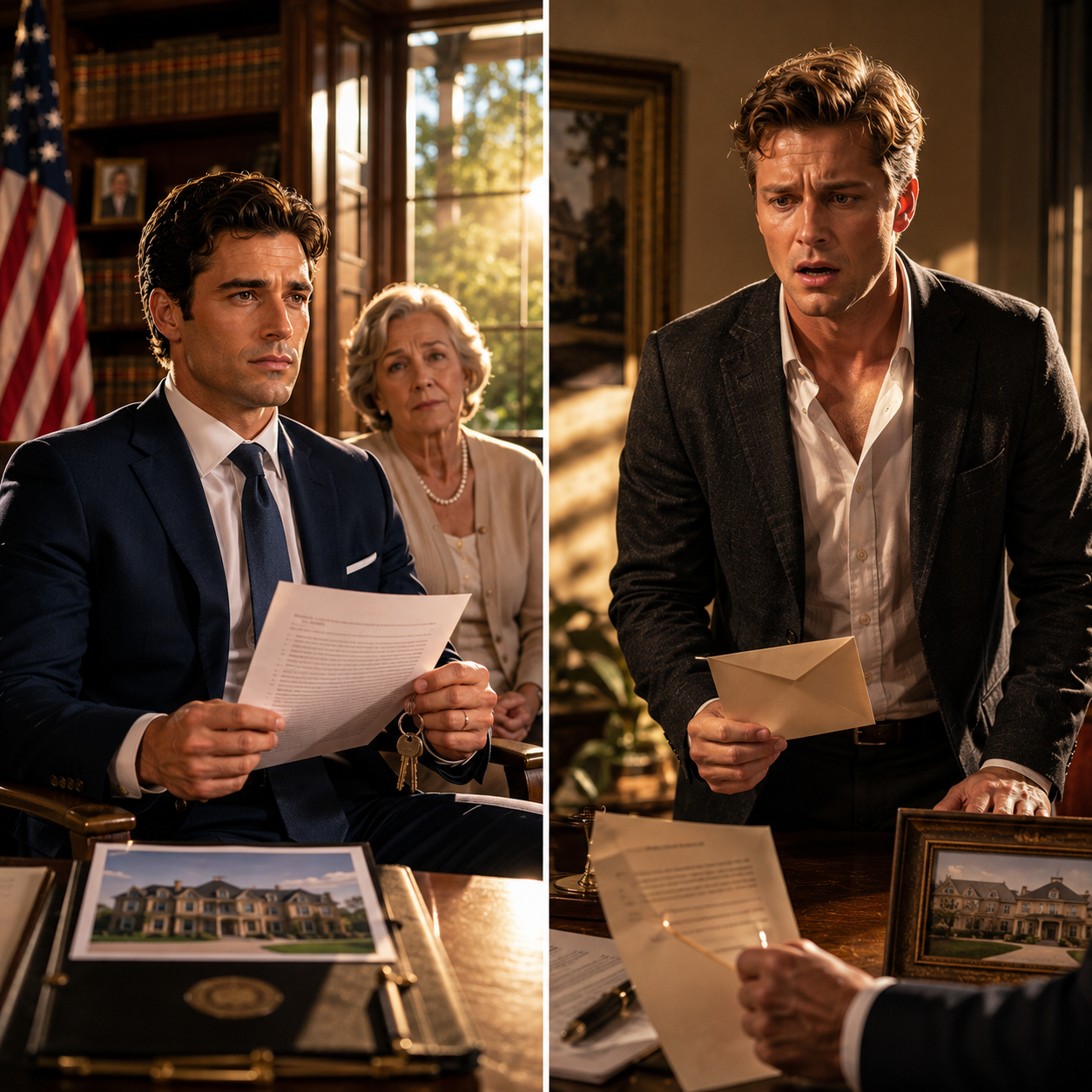
At the lawyer’s office, the will said exactly what Dad had told me.
Matt received the house, the investments, and most of the insurance.
I received one hundred and fifty thousand dollars.
A large amount of money to many people.
But sitting there beside my brother, it felt like a verdict.
In the parking lot, I confronted him.
“You could split it evenly.”
Matt looked tired.
“No.”
“That’s it?”
“That’s it. Dad made his decision.”
“We’re brothers.”
“We are. And I love you. But Dad chose based on who we actually are, not who we wish we were.”
Then Matt told me something I never forgot.
After I disappeared for two weeks when Dad first showed me the will, Dad wanted to write me out completely. Matt convinced him not to. Matt convinced him to leave me the life insurance portion, to give me one last safety net.
I should have thanked him.
Instead, I hated him for knowing me accurately.
In the year after Dad died, I spent the money almost exactly the way everyone feared I would. I paid debts, bought a car, took Jenna on vacation, invested in a friend’s failed startup, loaned money to people who vanished, and told myself I was finally living.
By the end of the year, most of it was gone.
Jenna left after that.
She said I had become bitter. She said I blamed Matt for consequences I had earned. She said she could not watch me turn grief into self-destruction.
She was right.
Then I lost my job for showing up drunk.
Then I lost my apartment.
Then I called Matt and asked for help.
He said no.
Not because he hated me.
Because he loved me enough to stop rescuing me from myself.
At the time, I called it cruelty.
Now I know it was the first honest kindness anyone had given me in years.
The real turning point came when Mom got sick with pneumonia. Matt called and told me to come to the hospital. She looked tiny in that bed, fragile in a way that scared me more than Dad’s illness had, because by then I had already lost one parent and I knew the universe did not owe me more time with the other.
I sat beside her and apologized.
“For everything,” I said. “For not being the son you wanted.”
Mom looked at me with tired eyes.
“I never wanted you to be different,” she said. “I wanted you to try.”
“I did try.”
She shook her head gently.
“Did you? Or did you want credit for showing up?”
That sentence broke through something.
A year later, I got sober.
Not instantly. Not beautifully. Sobriety did not arrive like a sunrise. It came after shame, failure, meetings, relapses, apologies, and days where I wanted to crawl out of my own skin. But eventually, I got a sponsor. I worked the steps. I stopped telling the story where everyone had wronged me and started telling the one where I had choices.
Then I called Matt.
“I want to apologize,” I said.
“For what specifically?” he asked.
And for the first time, I answered like a man instead of a victim.
“For being a terrible brother. For blaming you. For wasting what Dad left me. For thinking love meant nobody should ever tell me no.”
Matt invited me over that weekend.
We sat in his backyard drinking lemonade, and I told him everything. The drinking. The resentment. The jealousy. The way I had hated him because he represented everything I had refused to become.
He listened.
When I finished, he said, “I’m proud of you.”
I almost cried.
Not because everything was fixed.
Because for once, I had done something worth respecting.
Today, I am thirty-seven. Matt is forty. Mom is sixty-eight and still lives with him. She is healthy, happy, and surrounded by grandkids who adore her. I manage a coffee shop. It is not glamorous, but it is honest work. My apartment is small, clean, and mine. My bills are paid with money I earn. I have two years of sobriety.
I do not have the house.
I do not have the investments.
I do not have the life I once believed I deserved just because I was born into the family.
But I have peace.
Matt and I have dinner once a month now. Sometimes at his house, sometimes at a restaurant. He does not throw my past in my face. He treats me like his brother. Not like a project. Not like a failure. Just his brother.
Mom still worries about me.
“Are you okay?” she asks every time.
“I’m okay,” I tell her. “Really.”
Sometimes she says Dad would be proud of me now.
I hope that is true.
For a long time, I thought Matt took everything from me. The house. The inheritance. Our mother’s future. Dad’s trust.
But Matt did not take anything.
I lost it long before the will was read.
I lost it through every excuse, every borrowed dollar, every ignored responsibility, every time I chose charm over character and called it personality.
The inheritance only made the truth official.
Dad knew me better than I knew myself. If he had split everything equally, I would have destroyed my half. I know that now. I would have sold what should have been protected, spent what should have been invested, and blamed everyone else when it was gone.
Instead, he gave me enough to survive and not enough to ruin everything.
At the time, I called that rejection.
Now I understand it was love with boundaries.
I thought being the golden child meant I could get away with anything.
What it really meant was that people had stopped expecting me to grow.
Now I am growing.
Late.
Slowly.
Imperfectly.
But honestly.
Matt got the house. He got the inheritance. He got to be the son Dad trusted.
And I got something I never earned as the favorite.
A chance to become someone I can respect.
In the end, that was the inheritance I actually needed.
![[FULL STORY] My Girlfriend Texted I'm Using Our 'Vacation Fund' To Bail My Ex Out Of Jail You](https://social.rabedo.com/storage/thumbnails/1777545415_10.png)
![[FULL STORY] My Fiancee Thought My Bank Account Was Her Personal Playground Until I Cleared The Apartment And Left Her The Bill.](https://social.rabedo.com/storage/thumbnails/1777187439_C15.png)