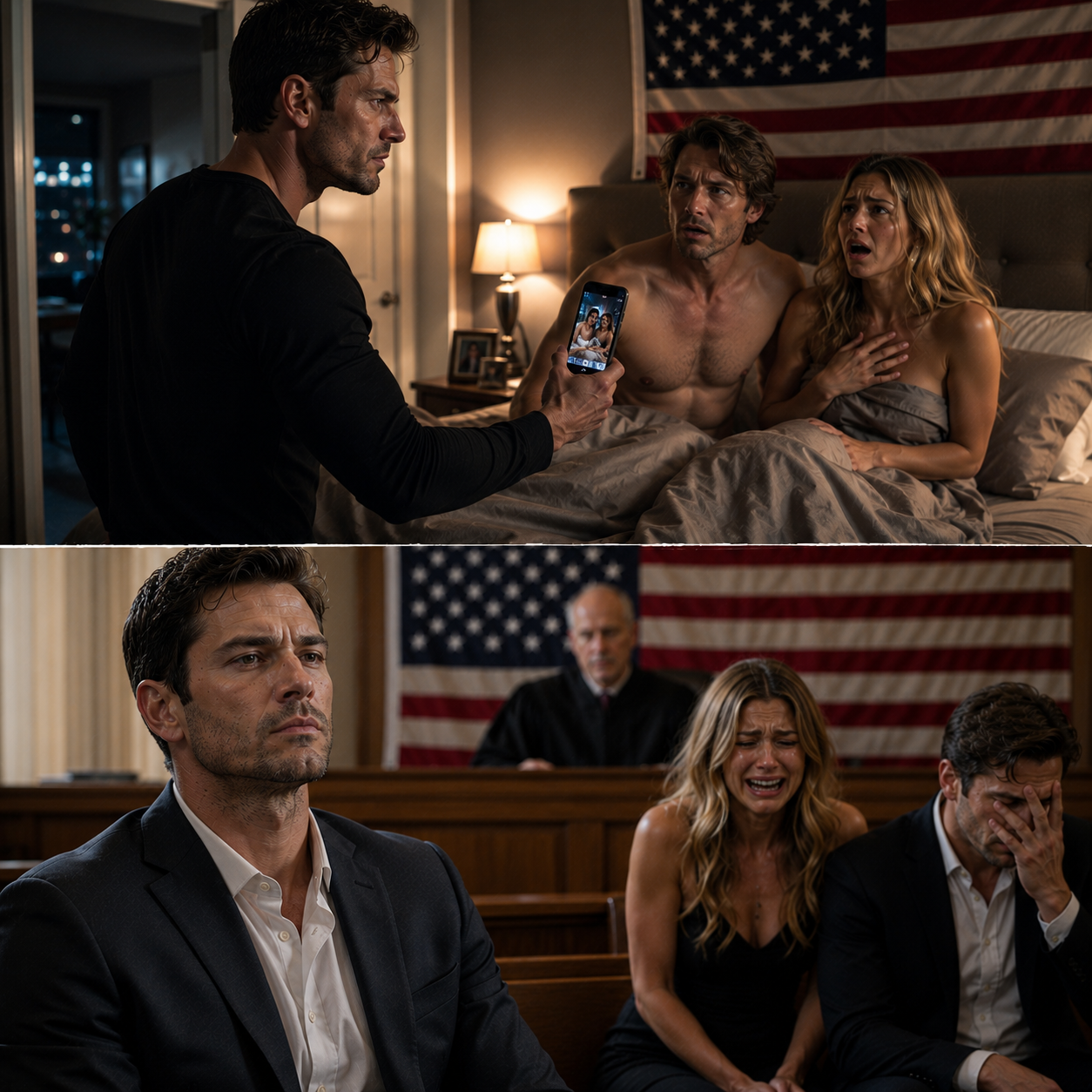
The human mind has a fascinating, desperate capacity for revisionist history when confronted with total ruin. When Serena walked out of my life, she genuinely believed she was the heroine of a romance novel, escaping a dull existence to embrace a passionate destiny. Now that the destiny had manifested as a federal investigation, a ruined reputation, and financial destitution, she was frantically trying to rewrite her past.
I called my parents immediately after receiving Marcus's email. My mother, Eleanor, answered on the first ring, her voice calm but layered with a deep, maternal concern.
"Lance," she said softly. "She’s here. She’s sitting on the rocking chair on the porch. She’s soaked to the bone, Lance. She isn't shouting or causing a scene. She just keeps saying she needs to tell you she’s sorry."
My father’s deep voice echoed in the background. "I’ve got my hand on the phone to call the sheriff, son. She doesn't belong on our property anymore."
"Don't call the police, Dad," I said, keeping my voice entirely steady. "Tell her I will meet her. One time. But not at your house, and not anywhere she recognizes. Tell her to go to the public nature reserve off Highway 9 at noon tomorrow. If she isn't there alone, I won't step out of my car."
"Are you sure about this, Lance?" my mother asked.
"Yes, Mom. A system cannot be officially locked until all active processes are formally terminated. I’m going to terminate the process."
The next day, the weather was brutally clear—the sun was blinding, casting sharp, unforgiving shadows across the gravel parking lot of the nature reserve. It was a vast, open space with no hidden corners, no crowds, and no sentimentality. Just a few concrete benches overlooking a dead salt marsh.
Serena was already there when I pulled up in my rented sedan. She was sitting on the edge of a concrete bench, her shoulders hunched inward as if she were trying to occupy as little space in the universe as possible. The transformation was jarring. The expensive clothes were gone, replaced by a faded, oversized hooded sweatshirt and worn-out jeans. Her hair, which she used to spend hundreds of dollars maintaining, was tied back in a messy, neglected knot. The arrogant, defensive smirk she had worn in my kitchen months ago had been completely wiped clean, replaced by the hollow, sunken look of someone who hadn't slept a full night in weeks.
I opened my car door, walked measuredly across the gravel, and stopped exactly five feet away from her. I didn't sit down. I kept my hands casually in the pockets of my trench coat.
She looked up, her eyes instantly filling with heavy tears the moment they landed on me. "Lance," she whispered, her voice cracking under the weight of an immense emotional exhaustion. "You... you actually came."
"You asked to speak with me, Serena. I am here. You have my undivided attention," I said, my tone as neutral as a courtroom transcript.
She let out a ragged, trembling breath, her hands shaking violently as she pressed them together between her knees. "I don't even know how to begin to ask for your forgiveness. Everything... everything exploded, Lance. Julian... he lied about who he was. He used me. He tried to tell the federal agents that I helped him hide the cash in the penthouse. I swear to you, Lance, on my life, I didn't know anything about his illegal business! I was just stupid. I was so incredibly stupid."
"I know," I said simply.
She blinked through her tears, looking up at me with a sudden, desperate ray of hope. "You... you believe me?"
"My belief is irrelevant. The federal prosecutors received an un-redacted, verified ledger of your personal and shared financial timelines forty-eight hours ago. It completely cleared you of any structural knowledge of Julian’s syndicate. His plea deal was rejected this morning based on prosecutorial perjury. You are no longer a target of the investigation."
Serena gasped, her hand flying to her mouth as a massive sob shook her entire frame. "You... you did that? You saved me, Lance? Even after what I said to you? Even after I walked out?"
"Do not mistake data management for salvation, Serena," I said, my voice dropping into a cold, diamond-hard clarity that instantly froze her tears. "I didn't do it for you. I did it because Julian Vance attempted to use a timeline that involved my former household to manipulate a federal record. I don't allow sloppy criminals to corrupt my files. You were simply a beneficiary of a system cleanup."
The brief flash of hope in her eyes vanished, replaced by a profound, hollow realization of just how far away I truly was. She looked at me, realizing that the man standing before her wasn't a wounded, vengeful ex-husband. I was a stranger who felt absolutely nothing for her.
"I ruined everything, didn't I?" she whispered, staring down at the concrete ground. "I sat in that kitchen and called you boring. I called you pathetic because you gave me a life where nothing went wrong. I thought... I thought excitement meant love. I thought chaos meant being alive. But it wasn't fire, Lance. It was just an open grave. I miss our mornings. I miss the quiet. I miss the safety of knowing exactly who you were every single day."
"When someone shows you who they are, believe them, Serena," I replied, quoting the old philosophy with absolute conviction. "You stood in our kitchen and showed me exactly who you were. You told me that peace was a prison. You explicitly demanded a life of danger and unpredictability. You cannot step into the storm and then complain that it's raining."
"Can we... is there any version of the future where we can just talk?" she begged, reaching out a hand slightly toward me, though she didn't dare touch my coat. "I'm not asking to move back in. I’m not asking for your money. I just... I need someone steady, Lance. I am drowning."
"The anchor you threw away cannot be recalled from the bottom of the ocean, Serena," I said, stepping back half a foot to firmly re-establish my boundary. "Our marriage didn't just end; it was entirely decommissioned. I have liquidated the suburban house. I have relocated permanently to a different state. This is the last time you will ever see my face or hear my voice."
She didn't shout. She didn't argue. She just sat there, nodding slowly, a profound, crushing acceptance washing over her face. She finally understood that my lack of anger wasn't a mask; it was total, unyielding indifference.
"Goodbye, Lance," she whispered.
"Goodbye, Serena. Enjoy the life you chose."
I turned around without waiting for her to stand up. I walked back across the gravel parking lot, climbed into my car, and drove away. I didn't look in the rearview mirror. I didn't check to see if she was watching me leave.
That evening, I sat on the balcony of my high-rise apartment, watching the sun dip below the ocean horizon, painting the sky in deep shades of gold and purple. My phone was silent. My apartment was pristine. My routines were entirely my own.
I had officially legally changed my name to Atlas Vance—taking a private family maternal surname—completely disconnecting myself from the past. I had launched my own independent cybersecurity consultancy firm, servicing high-end private clients who paid exorbitant retainers for my absolute discretion and structural precision. My life is quiet. My mornings are entirely predictable. My coffee is always served at exactly 6:00 AM in absolute, beautiful silence.
People often mistake loud, chaotic men for strong men. They think that drama equals passion and that stability equals weakness. But they are entirely wrong. Noise is cheap. Chaos is sloppy. True power lies in the quiet, calculated discipline of a man who knows exactly who he is, builds his own world, and refuses to let the madness of others breach his walls.
The storm has officially passed, the system is clean, and for the first time in my entire life, the quiet feels absolutely magnificent.
![[FULL STORY] My Fiancee Stole My Identity To Fund Her Secret Lifestyle, So I Canceled Our Wedding And Let The Law Handle Her Secrets.](https://social-media.rabedo.com/thumbnails/1777350261_B6.png)

![[FULL STORY] She Gave Away My Birthday Surprise to Her Coworker… Then Expected Me to Wait in the Hotel](https://social-media.rabedo.com/thumbnails/1776914020_790dd0bd-4369-4806-9400-919d4e9f0357.png)