
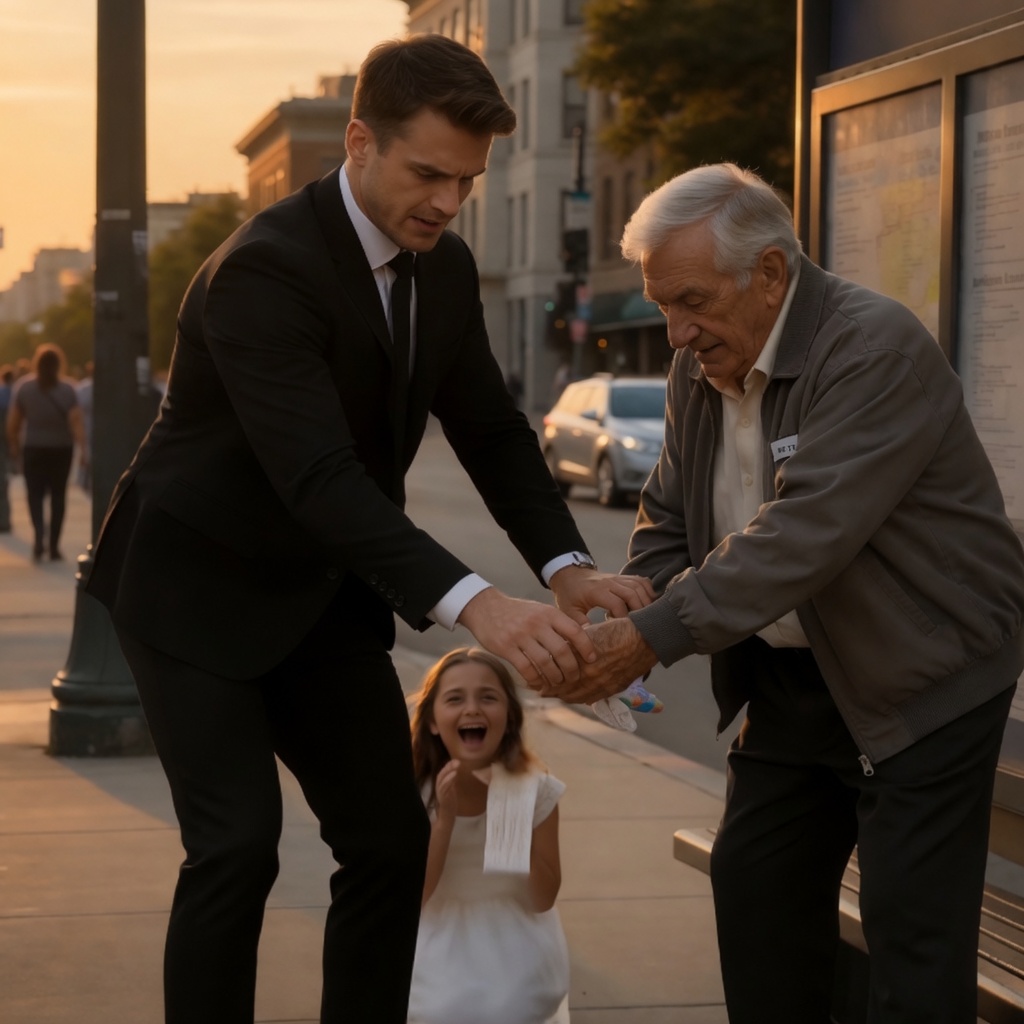
“No… no…”
Her fingers shook as she reached into the puddle.
“Move, old man.”
The businessman’s voice came cold and impatient.
Arthur Bennett stumbled backward slightly from the shove. One hand tightened around the small wrapped gift he carried while the other instinctively reached for the bus pole beside him to steady himself.
People nearby glanced over.
Then looked away again.
Because cities teach people not to stare too long at humiliation.
Arthur lowered his eyes immediately, embarrassed more than angry.
“Please,” he said quietly. “We’re late.”
The businessman adjusted the sleeve of his expensive navy coat like touching Arthur had dirtied him somehow. He was maybe in his forties, clean-shaven, sharp-faced, carrying the kind of leather briefcase that cost more than most families’ monthly rent.
He glanced once at Rosie’s soaked dress.
Then at Arthur’s worn shoes.
“Take another bus.”
Rosie looked up at him through tears.
“But they’re calling names already.”
Her voice cracked so badly that several passengers near the door shifted uncomfortably.
The man sighed loudly.
As if her sadness was inconveniencing him personally.
Behind him, the bus doors folded open with a mechanical hiss.
The driver leaned halfway out.
“Come on, folks, let’s move—”
Then he stopped.
His eyes landed on the gift box in Arthur’s hands.
More specifically—
The name written carefully across the small white tag taped to it.
Arthur Bennett.
The driver’s expression changed instantly.
“Wait.”
The businessman closed his eyes briefly in frustration.
“Oh, come on.”
But the driver was already stepping down from the bus.
Rainwater reflected the city lights beneath his shoes as he walked toward Arthur slowly, staring harder with every step.
“Sir,” he asked quietly, “is your name Arthur Bennett?”
Arthur looked confused.
“Yes…”
Rosie was still trying to wipe mud from the ruined ticket with the sleeve of her dress.
Arthur gave an awkward little smile.
“I used to drive this route years ago.”
The driver bent down to help pick up the ticket.
And that was when he saw it.
Inside the plastic sleeve protecting the bus pass sat an old transit authority ID card.
Water-stained.
Faded.
Edges curled from age.
But still recognizable.
The younger version of Arthur Bennett smiled proudly from the photograph in an old driver’s uniform.
The driver froze.
His face went pale.
“Oh my God.”
Arthur immediately looked uncomfortable with the attention.
“It’s old.”
The driver looked back at him slowly.
“You’re Arthur Bennett.”
The businessman folded his arms.
“And?”
The driver ignored him completely.
“You drove the South Chicago line.”
Arthur nodded once.
“For a long time.”
“How long?”
Arthur thought for a second.
“Thirty-seven years, I think.”
A woman standing near the front seats gasped softly.
“Arthur?”
Arthur looked toward her voice.
The woman stepped down from the bus slowly, staring at him in disbelief.
“Marlene Davis.”
Arthur blinked.
Then recognition softened his face.
“Marlene…”
Tears filled her eyes instantly.
“You waited for my son after surgery every single morning.”
Arthur looked embarrassed.
“It wasn’t a problem.”
“He walked with crutches,” she whispered emotionally. “Every other driver left him behind.”
The businessman shifted impatiently.
“Can we please move this along?”
But now more passengers were paying attention.
An older man near the back stood up suddenly.
“No way,” he muttered. “Arthur Bennett?”
Another passenger leaned into the aisle.
“The blizzard driver?”
Someone else said, “My grandmother used to talk about him.”
Rosie slowly stopped crying.
She looked between all the adults in confusion.
“Grandpa?”
Arthur rubbed the back of his neck awkwardly.
“It’s nothing.”
But the driver shook his head firmly.
“No, sir. It’s not.”
He turned toward the passengers.
“This man drove this route through every winter storm for almost forty years.”
Another voice came from the bus.
“He used to carry extra gloves for homeless riders.”
“He paid bus fare for kids.”
“He stopped fights.”
“He knew everybody’s names.”
A woman near the window laughed through tears.
“He once drove me to the hospital when I went into labor.”
Rosie stared at Arthur like she was discovering an entirely different person hidden inside her quiet grandfather.
At home Arthur barely spoke about his old job.
He spent most mornings sitting near the apartment window with coffee in one hand and crossword puzzles in the other. Sometimes he fed pigeons from the fire escape. Sometimes he fixed old radios nobody else wanted.
Rosie had never imagined strangers remembered him like this.
The businessman finally snapped.
“Are we seriously doing this right now?”
That changed the mood immediately.
The driver turned toward him slowly.
“You pushed him?”
The man scoffed.
“He was blocking the entrance.”
Rosie stood up fast.
“You knocked his ticket into the puddle!”
Her small voice echoed louder than expected in the silence.
“And now we’re late because of you!”
The businessman opened his mouth—
Then stopped.
Because suddenly every person near the bus was looking at him differently now.
Not impressed.
Not intimidated.
Ashamed for him.
Arthur gently touched Rosie’s shoulder.
“It’s alright, sweetheart.”
“No it isn’t,” she whispered fiercely.
The driver looked down at her soaked dress.
“What ceremony are you heading to?”
Arthur smiled softly despite everything.
“She won the city scholarship award.”
The driver’s eyebrows shot upward.
“Seriously?”
Rosie nodded shyly.
Arthur’s face filled with quiet pride.
“She’s top of her class.”
The businessman muttered under his breath.
“Wonderful. Can we go now?”
The driver stared at him.
Then at Arthur.
Then at Rosie holding the ruined bus ticket like it mattered more than gold.
And maybe to her, it did.
Because poor people learn early that tiny things decide entire futures.
Missed buses.
Lost tickets.
Late arrivals.
One small disaster can ruin a day you spent months waiting for.
The driver made a decision instantly.
“Everybody off at the next stop,” he called toward the bus. “We’re making a detour.”
The businessman laughed sharply.
“You can’t delay a public route for this.”
The driver looked him dead in the eye.
“I just did.”
A few passengers actually clapped quietly.
The businessman’s face reddened.
“This is ridiculous.”
“No,” the driver said calmly. “What’s ridiculous is a man spending his entire life helping strangers and getting shoved into traffic for being old.”
Complete silence.
Arthur looked horrified by the attention.
“Please don’t argue because of me.”
But an older passenger spoke up immediately.
“Arthur once waited forty minutes while I searched for my wallet in the snow.”
Another voice:
“He drove my daughter home free after school for almost a year.”
“He stayed late during Christmas Eve storms.”
“He talked people down during panic attacks.”
The stories kept coming now.
Tiny memories.
Forgotten kindnesses.
Moments Arthur himself probably barely remembered.
But other people did.
That was the strange thing about kindness.
The person giving it often forgets first.
Rosie tugged gently on Arthur’s sleeve.
“Grandpa…”
Arthur looked down at her.
“Hmm?”
“You’re famous.”
Several passengers laughed warmly.
Arthur shook his head immediately.
“No, sweetheart.”
But the driver smiled softly.
“In this city? A little.”
Arthur lowered his eyes.
“All I did was drive buses.”
“No,” Marlene said firmly. “You carried people.”
That sentence hit the entire sidewalk differently.
Because everyone understood exactly what she meant.
Arthur had carried exhausted nurses home after night shifts.
Carried children safely through dangerous neighborhoods.
Carried lonely old people through winters.
Carried strangers through heartbreak, funerals, job interviews, bad days, ordinary days.
For thirty-seven years, Arthur Bennett had quietly carried pieces of other people’s lives.
And most of them never thanked him properly.
The businessman looked increasingly uncomfortable beneath the growing silence.
He checked his watch.
Nobody cared.
For once, money had lost the room.
The driver stepped aside from the bus entrance.
“Mr. Bennett,” he said carefully, “you and your granddaughter are riding up front.”
Arthur immediately shook his head.
“No special treatment.”
“You earned it.”
Rosie grabbed Arthur’s hand excitedly.
“Please, Grandpa!”
Arthur hesitated.
Then finally nodded once.
The driver helped him onto the bus carefully.
And as Arthur climbed those steps, something strange happened.
Passengers started applauding.
Not loudly.
Not dramatically.
Softly.
Respectfully.
Arthur froze halfway up the stairs.
His eyes immediately filled.
Because old age does something cruel to people sometimes.
It convinces them they’ve been forgotten.
Rosie squeezed his hand.
“They remember you.”
Arthur swallowed hard.
“Yes,” he whispered. “I guess they do.”
The bus pulled away from the curb moments later, leaving the businessman standing alone under the streetlights.
Inside, Rosie sat beside Arthur in the front section while passengers continued sharing stories about him.
One woman remembered Arthur carrying her sleeping son off the bus during a snowstorm so she could manage groceries.
A construction worker remembered Arthur stopping a fight between gang members without raising his voice once.
Another passenger remembered Arthur buying winter boots for a teenage runaway who used to sleep near the station.
Rosie listened to every story wide-eyed.
“Why didn’t you ever tell me any of this?”
Arthur smiled faintly.
“Because helping people isn’t something you brag about.”
The driver glanced at him in the mirror.
“My father used to say you treated every passenger like family.”
Arthur looked surprised.
“Your father rode my route?”
The driver laughed.
“He became a driver because of you.”
Arthur blinked slowly.
“What’s his name?”
“Henry Lopez.”
Arthur suddenly smiled.
“The mechanic’s son.”
“That’s him.”
Arthur leaned back quietly.
“Your father used to sit behind me every morning asking questions about buses.”
“He still talks about you.”
Rosie looked unbelievably proud now.
“My grandpa inspired bus drivers?”
Arthur chuckled softly.
“I guess I did.”
The city moved outside the windows in streaks of gold and rain.
Chicago evenings always looked beautiful from buses.
Arthur had believed that even during the hardest years.
Especially during the hardest years.
Rosie rested her head gently against his shoulder.
“You miss driving?”
Arthur stayed quiet a long moment.
Then nodded slightly.
“Sometimes.”
“What do you miss most?”
Arthur looked out the rain-streaked window thoughtfully.
“The people.”
Rosie frowned.
“Even rude ones?”
Arthur laughed quietly.
“Especially rude ones.”
“Why?”
“Because sometimes rude people are hurting too.”
Rosie thought about that seriously.
Arthur continued softly.
“When you drive a bus long enough, you start seeing things people hide.”
“Like what?”
“Loneliness.”
The bus grew quieter around him.
Arthur rarely talked this much.
“People think cities are crowded,” he said softly. “But some of the loneliest people in the world live surrounded by millions.”
Rosie held his arm tighter.
Arthur smiled gently.
“That’s why I always tried learning names.”
The driver nodded from the front seat.
“My father said you memorized every regular rider.”
Arthur shrugged modestly.
“Most of them.”
“Why?”
Arthur looked surprised by the question.
“So people knew someone noticed if they disappeared.”
Silence followed that sentence.
Heavy.
Beautiful.
Human.
Because suddenly everybody understood Arthur Bennett a little better.
He hadn’t just driven buses.
He had paid attention to people the world stopped seeing.
An elderly man living alone.
A teenager hiding bruises.
A woman crying quietly after work.
A homeless veteran riding loops to stay warm.
Arthur noticed them.
And sometimes being noticed saves people more than they admit.
Rosie looked at him with tears returning to her eyes.
“You’re really good, Grandpa.”
Arthur smiled sadly.
“I made mistakes too.”
“But you helped people.”
Arthur looked down at his wrinkled hands.
“When I was young, my father told me something.”
“What?”
“He said there are two kinds of people in this world.”
Rosie waited quietly.
“People who make life heavier.”
Arthur squeezed her hand gently.
“And people who carry a little of the weight.”
The bus fell completely silent.
Even passengers pretending not to listen were listening now.
Rosie whispered:
“You carried it.”
Arthur looked away quickly toward the window because suddenly his eyes burned too much to look at her.
After a while, the driver spoke again.
“You know,” he said quietly, “the transit office still tells new hires stories about you.”
Arthur stared at him.
“They do?”
“The Christmas storm rescue.”
Arthur groaned softly.
“Oh no.”
Passengers laughed.
Rosie sat up immediately.
“What rescue?”
Arthur shook his head.
“It sounds bigger than it was.”
The driver grinned.
“Your grandpa drove through a snowstorm to rescue trapped passengers after another bus broke down.”
Rosie gasped.
Arthur sighed.
“The heating died.”
“And?”
“And people were freezing.”
“So what did you do?”
Arthur rubbed his forehead sheepishly.
“I tied scarves around my tires and drove slowly enough to get everyone home.”
The passengers burst into laughter and applause again.
Rosie looked at him like he was a superhero.
Arthur muttered under his breath:
“It wasn’t safe.”
The driver laughed loudly.
“Transit headquarters still hates that story.”
For the first time all evening, Arthur laughed freely too.
And Rosie realized something painful.
Her grandfather had once been surrounded by people every day.
Now most days he sat alone in a tiny apartment while the world rushed past without him.
Old age had shrunk his world quietly.
Until tonight.
Until strangers suddenly reminded him his life mattered.
The bus finally turned toward the school auditorium.
Lights glowed warmly ahead.
Cars packed the parking lot.
Rosie gasped.
“We made it!”
Arthur looked relieved enough to cry again.
The driver pulled directly beside the entrance.
When the doors opened, Rosie jumped up immediately.
Then paused.
She turned back toward the bus full of strangers.
“Thank you.”
The passengers smiled warmly.
One woman called out:
“Go win your award, sweetheart!”
Arthur stood slowly with the driver helping him down the steps.
Before Arthur could leave, the driver stopped him gently.
“Mr. Bennett?”
Arthur turned.
The driver held out the old bus ticket carefully dried with napkins.
“You should keep this.”
Arthur accepted it quietly.
“Thank you.”
Then the driver surprised him by saluting softly.
Not joking.
Not dramatically.
Respectfully.
Arthur’s throat tightened instantly.
He nodded once in return.
Rosie grabbed his hand and pulled him toward the school entrance.
Inside the auditorium, the ceremony had already begun.
Rows of parents filled the seats.
Children in formal uniforms lined the stage nervously.
As Rosie and Arthur hurried inside, the announcer’s voice echoed through the room.
“…and next, our city scholarship recipient…”
Rosie froze.
“…Rosie Bennett.”
Arthur looked at her instantly.
“Go.”
Rosie panicked.
“My dress is wet!”
“You still earned it.”
“I look terrible!”
Arthur crouched slowly despite his aching knees and fixed the crooked collar of her dress carefully.
Then he smiled.
“You look brave.”
Rosie’s eyes filled immediately.
Arthur kissed her forehead gently.
“Now go show them who you are.”
Rosie walked toward the stage trembling.
The auditorium turned to look at the soaked little girl arriving late beside an old man in a worn brown jacket.
Whispers spread briefly.
Then Rosie climbed the stage steps.
The principal smiled kindly.
“We’re glad you made it.”
Rosie accepted the scholarship plaque with shaking hands.
Then she looked down at Arthur standing near the back wall.
Small.
Quiet.
Trying not to be noticed again.
And suddenly Rosie understood something.
People like Arthur Bennett spend their entire lives making sure other people arrive safely at important moments.
But nobody ever stops to clap for them.
Until they’re almost forgotten.
Rosie turned suddenly toward the microphone.
“My grandpa got me here.”
The room quieted.
Rosie pointed toward Arthur.
“He drove buses in Chicago for thirty-seven years.”
Arthur’s eyes widened in horror.
“Rosie…”
But she kept going.
“And everybody remembers him because he helped them.”
The auditorium stayed completely silent now.
Rosie held the scholarship plaque tightly.
“He says he only drove buses.”
Her voice cracked.
“But I think he carried people home.”
Arthur broke completely at that sentence.
He looked down immediately, shoulders trembling.
And then—
Someone started clapping.
One person.
Then another.
Then the entire auditorium rose slowly to its feet.
Arthur Bennett stood frozen near the back wall while hundreds of strangers applauded the quiet old bus driver who spent most of his life making sure nobody rode alone.
![[FULL STORY] My Girlfriend Tried to Dump Me on Instagram Live — Then Security Told Her She Wasn’t Even on the Lease](https://social.rabedo.com/storage/thumbnails/1777878259_55e931ac-5525-43ac-94dd-c64319978123.jpg)
![[FULL STORY] She Laughed With Her Friends, "He's So Obsessed With Me. No Matter How Much I Push Him Away, He](https://social.rabedo.com/storage/thumbnails/1777365195_13.png)

![[FULL STORY] She Planned the Divorce for Months… But Forgot I Could Read the Numbers Too](https://social.rabedo.com/storage/thumbnails/1777711513_688009394_1929032381383261_2613494136017860152_n.jpg)
.jpeg)