Zachary Miller learned something terrifying at twenty-three years old.
People can love the idea of you without ever truly seeing you.
The realization arrived quietly on Thanksgiving night beneath warm kitchen lights and the smell of leftover turkey cooling on the counter.
Not through screaming.
Not through cruelty.
Through absence.
That was somehow worse.
Two days before Thanksgiving, Zach collapsed at work.
One second he stood inside the cramped stockroom of the retail store where he worked evenings after university classes.
The next second his knees hit concrete hard enough rattling shelves nearby.
At first he thought exhaustion finally caught him.
For months his life operated on caffeine, stress, and four-hour sleep schedules. Between internship applications, university deadlines, and long shifts unloading inventory trucks, his body constantly felt stretched thin.
But when he opened his eyes again, his manager crouched beside him already calling emergency services.
The pain inside his stomach felt wrong.
Sharp.
Burning.
Like something tearing slowly beneath his ribs.
At the hospital, doctors moved quickly.
Blood tests.
Fluids.
Monitors.
Eventually an exhausted emergency room physician explained the problem clearly.
Bleeding ulcer.
Bad enough requiring immediate treatment.
Potentially dangerous if ignored longer.
Zach lay there staring at fluorescent ceiling lights while nurses adjusted IV lines beside him.
Then came the sentence he didn’t expect hearing.
“You’re not leaving before Thanksgiving.”
His phone battery hovered near death when they admitted him officially.
Still, he managed sending one message into the family group chat before the screen went black.
In hospital. Bleeding ulcer. Staying overnight. Will update.
Then the phone died.
And Zach made the mistake that would haunt him afterward.
He assumed someone would notice his absence.
His family wasn’t physically abusive.
Not violent.
Not openly hateful.
They were simply indifferent in the quietest possible way.
After Zach’s mother died from cancer when he was ten years old, his aunt Maryanne took him into her home.
And to her credit, she fulfilled every obligation.
He had food.
Clothes.
School supplies.
A bedroom.
But even as a child, Zach sensed something emotionally distant beneath the surface.
Like he existed inside the house because of responsibility instead of attachment.
He became the easy kid naturally.
The quiet one.
The polite one.
The child who learned early that asking for attention usually resulted in disappointment.
So eventually he stopped asking.
Instead he focused on grades, scholarships, work, and survival.
Still, deep down he believed Thanksgiving might be different.
At minimum, he assumed someone would ask where he was once dinner started and his chair remained empty.
Nobody did.
Thanksgiving evening, the hospital discharged him around 5:45 p.m.
The nurse handed him a small brown paper bag filled with prescriptions and instructions about bland food and avoiding stress.
Avoiding stress almost made him laugh.
His stomach still burned constantly and weakness lingered through every movement.
But more than anything else, he wanted home.
Or at least what he still imagined home might feel like.
An Uber dropped him outside the house shortly after sunset.
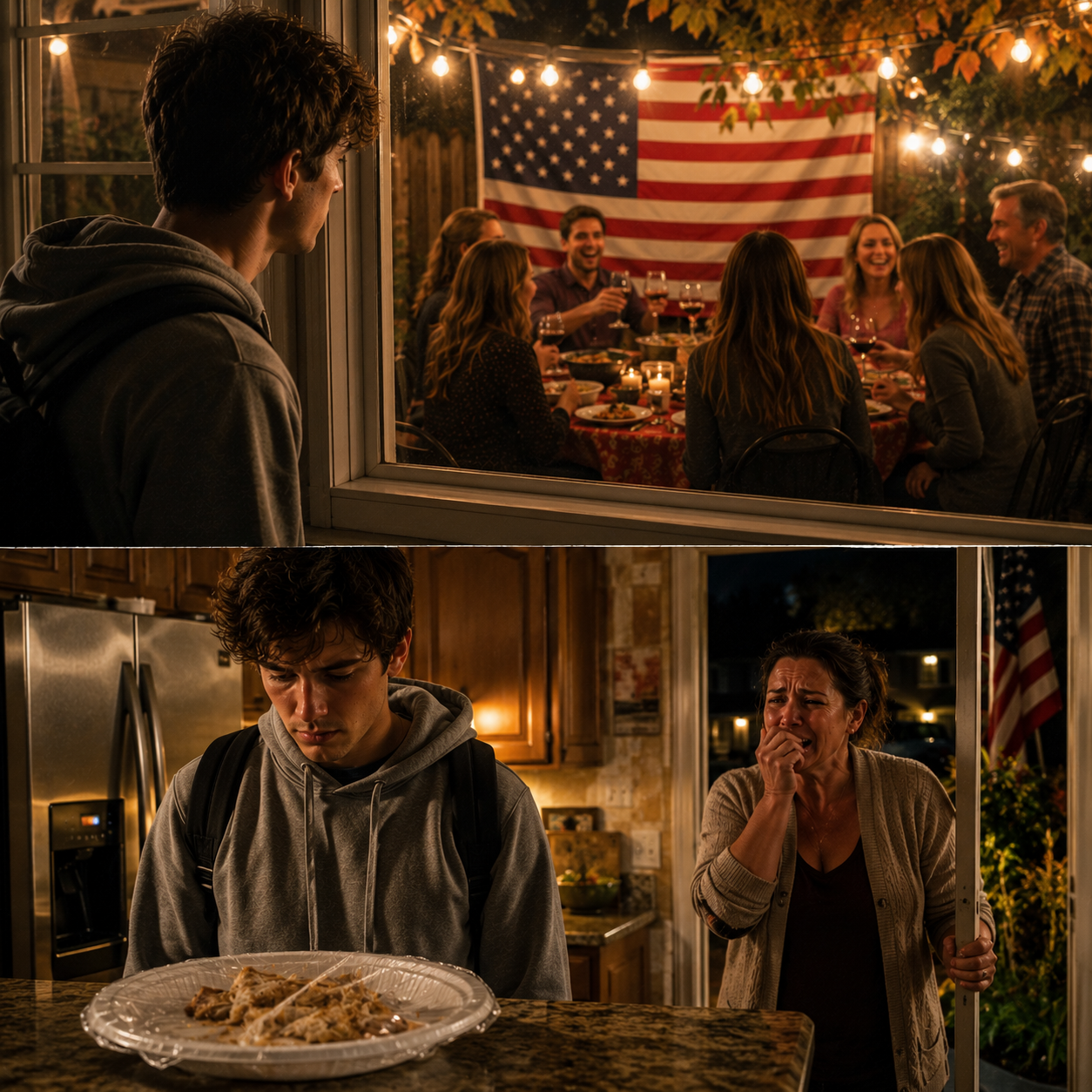
Warm yellow light glowed through windows while distant laughter drifted from the backyard.
For one hopeful second, Zach smiled slightly.
Maybe they noticed.
Maybe they worried.
Maybe someone would rush over asking if he was alright.
Instead the living room stood empty.
The sound of conversation and laughter came entirely from outside beneath the backyard string lights only used during holidays.
Zach stepped quietly into the kitchen.
And that was where everything changed permanently.
A paper plate sat beside the sink wrapped in plastic.
Black Sharpie letters stretched across the top.
For the dog.
Zach stared at the plate silently.
Turkey scraps.
Sweet potatoes.
Half a dinner roll.
Not for him.
For the dog.
Meanwhile the refrigerator overflowed with neatly labeled leftovers prepared carefully for everyone else.
Ben.
Lisa.
Uncle Marty.
Even neighbors.
His name appeared nowhere.
Not even as an afterthought.
Just one plate intended for the family dog sitting where dinner should have been.
The realization settled slowly.
Nobody expected him coming home.
Nobody wondered where he was.
Nobody cared enough checking.
Outside, laughter exploded again while someone shouted about opening another wine bottle.
Inside the kitchen, Zach stood alone still wearing a hospital bracelet beneath his jacket sleeve.
Then he walked toward his room.
Or what used to be his room.
The moment he opened the door, his stomach dropped.
Boxes covered the floor.
Holiday decorations stacked against walls.
Wrapping paper tubes leaning across furniture.
His bed was gone entirely.
Even his pillow disappeared.
They already converted the room into storage space while he still technically lived there.
Like he had slowly faded into clutter nobody needed anymore.
Zach stood frozen several seconds staring into the room.
Then quietly backed away without making noise.
No confrontation.
No dramatic scene.
He simply sat at the kitchen table alone while laughter continued outside uninterrupted.
Eventually he opened a drawer, pulled out a sticky note, and wrote one sentence.
Next time feed the dog yourself. He deserves better company.
Then he stuck the note to the refrigerator door, grabbed his bag, and walked out the front door forever.
Nobody noticed him leaving either.
That part hurt most later.
The university library stayed open twenty-four hours during finals week, so Zach rode buses across town and settled into a quiet corner near vending machines while weak fluorescent lighting buzzed overhead.
His phone finally charged enough turning back on.
That was when he confirmed something even worse.
The message absolutely went through.
Timestamped clearly two nights earlier.
In hospital. Bleeding ulcer. Staying overnight. Will update.
No responses.
Not even a thumbs-up reaction.
Meanwhile dozens of other family messages filled the chat around it.
Pie photos.
Arguments about turkey recipes.
Videos of drunken dancing.
Memes.
Jokes.
His hospitalization simply vanished beneath holiday noise like his existence carried no emotional weight whatsoever.
Zach scrolled upward hoping maybe someone texted separately.
Nothing.
Not from Maryanne.
Not from his cousins.
Nobody.
He sat there until nearly three in the morning staring at the glowing screen while something inside him finally stopped trying.
The next morning he rented temporary student housing using leftover university credit from an old dorm contract.
The building barely qualified as livable.
Mold stains.
Broken heater.
Mattress springs poking through fabric.
But it was quiet.
And for the first time in years, quiet felt safer than family.
Around noon the following day, Zach turned his phone back on briefly.
Three missed calls.
Several texts.
The most important came from his cousin Lisa.
What the hell did you say to Aunt Maryanne? She’s crying in the driveway.
Zach reread the message twice.
Crying in the driveway.
Not because he spent Thanksgiving hospitalized alone.
Not because nobody noticed.
Because of one sticky note.
Suddenly his absence mattered only after discomfort reached them emotionally.
Hours later he sat inside a cheap diner eating plain oatmeal when Aunt Maryanne entered unexpectedly.
She looked exhausted.
No makeup.
Hair messy.
Not polished like usual.
She sat across from him quietly while tension settled heavily between them.
Finally she spoke.
“I saw the note.”
Not hello.
Not are you okay.
Just the note.
Then she explained the plate.
Apparently his cousin Ben created it as part of some stupid online joke involving feeding Thanksgiving leftovers to the dog.
Everyone forgot the plate remained on the counter.
Forgot.
That word repeated endlessly afterward.
Zach interrupted quietly.
“I texted from the hospital.”
Maryanne froze.
Then Zach unlocked his phone and showed her the group chat directly.
The message sat there clearly visible between pie photos and arguments about cranberry sauce.
Maryanne stared at the screen like someone punched her.
“I didn’t see it.”
“You didn’t notice I disappeared either.”
She had no response for that.
Eventually she admitted something difficult.
“You remind me too much of your mother.”
The confession changed everything unexpectedly.
Maryanne explained losing Zach’s mother destroyed parts of her emotionally she never repaired correctly.
Taking Zach in felt like both love and grief tangled together permanently.
The older he became, the more he resembled her sister.
Same expressions.
Same quietness.
Same tendency hiding pain silently.
And somewhere along the way, Maryanne emotionally pulled back before attachment could hurt again.
It wasn’t hatred.
Not even indifference entirely.
It was fear.
Fear disguised as distance for so many years that eventually everyone else inside the family copied her behavior without realizing it.
Because if Maryanne treated Zach like background noise emotionally, everyone else followed naturally.
Still, understanding didn’t erase damage.
Zach finally said the truth sitting heavy inside him for years.
“I kept showing up and nobody even saw me.”
Maryanne cried quietly after that.
Not dramatic sobbing.
Just exhausted tears from someone realizing too late what neglect actually cost.
Then she slid an envelope across the table.
Inside sat a grocery gift card and an old Thanksgiving photograph with Zach’s name written carefully on the back.
Tiny gestures.
Late gestures.
But real.
For the first time in years, the conversation felt honest instead of performative.
Still, Zach made one thing clear before leaving.
“I’m not coming back.”
Maryanne nodded slowly.
“I understand.”
Over the next month Zach rebuilt his life carefully.
Tiny studio apartment above a laundromat.
Secondhand furniture.
Cheap cookware.
A mattress from a thrift store.
Nothing impressive.
But every inch belonged entirely to him.
No waiting for someone noticing him.
No shrinking himself inside other people’s emotional blind spots.
One evening he pinned two things above his desk.
A childhood photo with his mother before cancer hollowed her body into someone barely recognizable.
And a sticky note containing three words.
Not invisible anymore.
Eventually Maryanne visited quietly carrying groceries and old photo albums.
No guilt trips.
No dramatic speeches.
Just soup containers, memories, and honest apologies.
For the first time, Zach saw her not as the aunt who failed him but as another damaged person drowning in unresolved grief for years.
That didn’t erase pain.
But it explained parts of it.
Before leaving that evening, Maryanne stood awkwardly beside the apartment door and said softly, “I’m sorry for making you feel optional.”
Optional.
That word carried more honesty than any apology beforehand.
Because that was the truth.
Zach existed inside the family like someone assumed permanent regardless of neglect.
Always there.
Always quiet.
Always understanding.
Until suddenly he wasn’t.
Months later Zach realized something important.
The hospital wasn’t the moment his family failed him.
The failure happened slowly across years of emotional invisibility everyone normalized because he never complained loudly enough forcing acknowledgment.
Thanksgiving simply exposed the truth clearly.
And strangely enough, the bleeding ulcer might have saved him emotionally.
Because collapsing finally forced him seeing the difference between being housed and being loved.
Between existing inside a family and actually belonging there.
The final message Zach ever sent into the old family group chat remained painfully simple.
You didn’t lose me. You just never kept me.
Then he left the conversation permanently.
And for the first time in his life, the silence afterward didn’t feel lonely anymore.
It felt free.


![[FULL STORY] My Roommate Always Stole the Guys I Liked, So This Time I Let Her Try With the One Man She Couldn’t Take](https://social.rabedo.com/storage/thumbnails/1777638089_6a00b61a-8714-4dad-b9e7-5fca3a886907.png)
![[FULL STORY] They Forced Me to Sign Divorce Papers While I Was 8 Months Pregnant… They Didn’t Know It Would Cost Them $16 Million](https://social.rabedo.com/storage/thumbnails/1776756165_D70.jpeg)
![[FULL STORY] My Fiancée-To-Be Filmed Me Sleeping To Mock Me As A "Placeholder" On TikTok, So I Gifted Her Family The Truth For Thanksgiving.](https://social.rabedo.com/storage/thumbnails/1777343054_S5.png)