
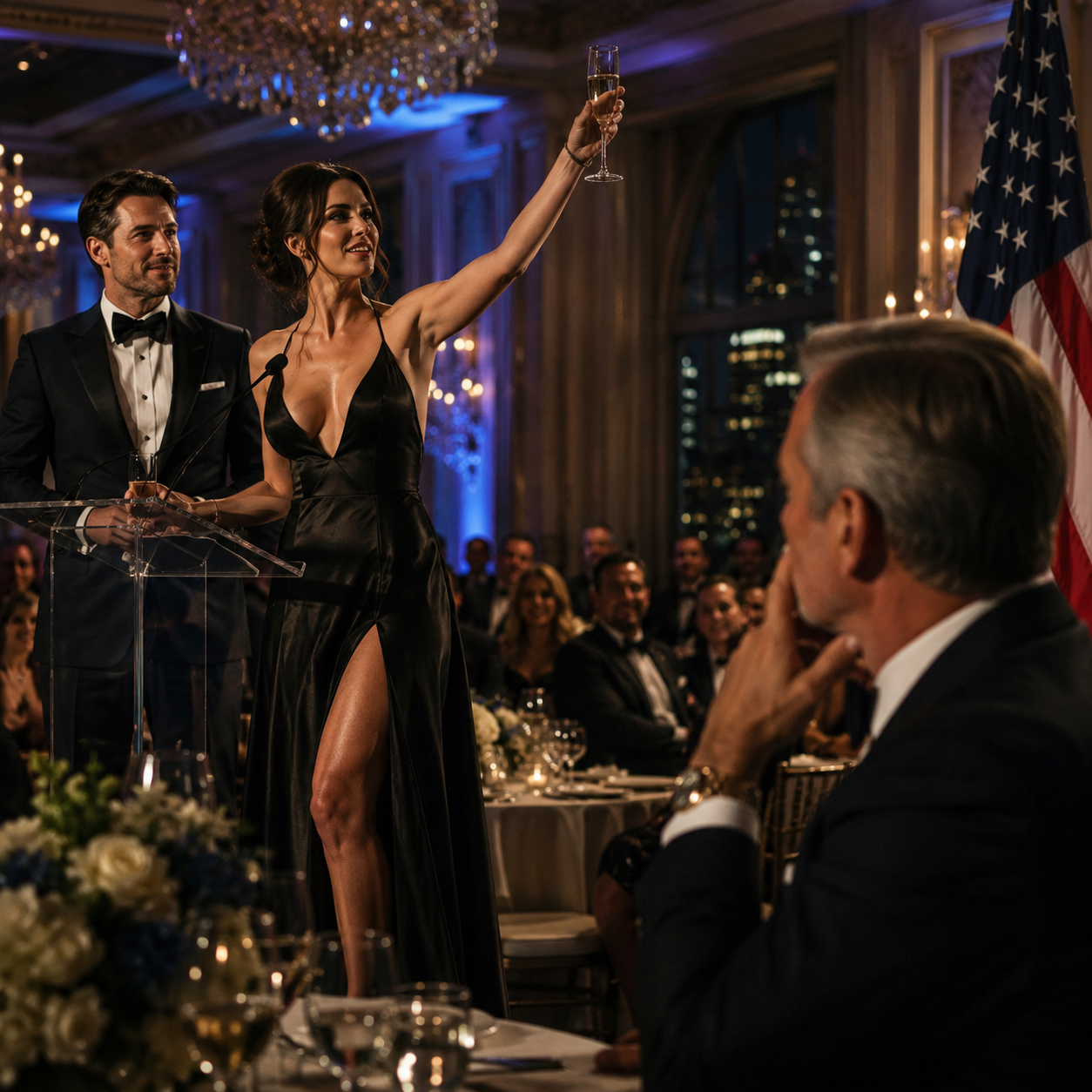
At the charity gala, my wife stood up and toasted her lover in front of 300 people. Said he was the man who truly knows how to treat a woman. I didn't make a scene. I just left and started pulling threads. Within days, the foundation she ran was under investigation. Turns out she'd been stealing for years.
My name is Lawrence Drummond. I'm 59 years old and for the past 22 years, I've been one of the most successful venture capital investors in Silicon Valley. I've funded 17 unicorns, three of which went public and made me wealthier than I ever needed to be. But money was never the point. The point was building something that mattered, backing brilliant minds who could change the world.
That's why I created the Innovation Forward Foundation 19 years ago. I wanted to give kids from underrepresented communities a real shot at STEM careers. Kids who had the brains but not the connections, the drive but not the resources. I built it for nothing, structured it through a complex web of trusts and LLCs that kept my name buried deep in the paperwork.
I didn't want recognition. I wanted results. Cassandra, my wife of 27 years, became the public face almost immediately. She was perfect for it. Charming, photogenic, great with donors. She could work a room like nobody's business. At first, I thought it was brilliant. She handled the spotlight while I handled the strategy. A partnership.
Except somewhere along the way, she started believing her own press releases. Started thinking she was the architect instead of the ambassador. Started making decisions without consulting me, bringing in new board members I'd never vetted, restructuring programs I'd spent years developing. And then came Brett Fontane.
He showed up about three years ago as a strategic consultant after our board had explicitly rejected his proposal for corporate lobbying services. Too aggressive, too unethical, they'd said. I'd personally signed off on that rejection. But Cassandra brought him back through a side door, gave him an advisory role that somehow came with a foundation email, travel privileges, and access to our donor network.
I let slide, trusted her judgment. Big mistake. The $15 million gala is 2 days away. It's supposed to be our signature event of the year, celebrating innovation and opportunity. The venue's booked, the sponsors confirmed, the media scheduled. 300 of the most influential people in tech and philanthropy will be there.
What none of them know, what even Cassandra doesn't know, is that I'm donor number 217. The anonymous benefactor who's been funding 73% of the foundation's operating budget for the past 19 years. The ghost in the machine. I'm sitting in my home office right now, looking at an envelope that arrived this morning. No return address.
Inside is a single sheet of paper with DNA test results and a USB drive. The results confirm what the anonymous letter claimed. Philip, my oldest son, isn't biologically mine. The USB drive contains 3 years of financial records showing systematic embezzlement from the foundation.
And tomorrow night, my wife is going to stand on a stage I paid for and toast the man who helped her steal from the organization I built. She just doesn't know I'll be watching. The Fairmont ballroom sparkled like a jewel box. Crystal chandeliers I'd personally selected cast warm light across 300 faces in designer suits and gowns.
The Innovation Forward Foundation's 10th annual gala. My creation, my vision, my money. Though only three people in this room knew that last part. I stood near the back, deliberately positioned where the lighting was dim. Black tie, no flash, just another face in the crowd. That's how I'd always preferred it. Cassandra said I lack presence.
What I lacked was the need for applause. The program was running smoothly, dinner finished, speeches delivered, checks written. The evening should have been winding down. Instead, Cassandra stood from the head table and tapped her champagne flute with a practiced smile that used to make my chest tighten. Now it just made me tired.
"If I could have everyone's attention," she called out. Her voice carried the performative warmth she'd perfected over the years. "I know we've already heard wonderful words tonight, but I need to take a moment for something personal." The room quieted. I stayed perfectly still. She gestured to the man beside her. Brett Fontaine rose, adjusting his tuxedo jacket that fit just a bit too snugly across the shoulders.
He had that eager look of a man who thought he'd finally made it to the big leagues. "This foundation has changed so many lives," Cassandra continued, her hand finding Brett's arm. "But it wouldn't be what it is without the tireless dedication of people who truly understand what it means to serve. Brett has been my rock, my partner in every sense.
And tonight, I want to acknowledge that publicly." She raised her glass higher. The cameras from three local news outlets swiveled to capture the moment. "To the man who truly treats a woman right," she said, her eyes locked on Brett's face. "To the man who actually sees me, values me, and stands beside me in building something that matters. To Brett Fontaine.
" The applause started immediately, scattered at first, then building. Brett pulled her into an embrace that lasted 3 seconds too long for professional courtesy. She laughed into his shoulder, radiant, victorious. I didn't move, didn't blink, just watched as 300 people celebrated my wife publicly claiming another man at an event I'd funded with $15 million over the past decade.
Then Then and walked toward the exit. No hesitation, no scene. I simply place my untouched bourbon on a passing server's tray, button my jacket, and headed for the marble foyer. My footsteps echoed in the sudden quiet of the corridor. Mr. Drummond. Sir, please wait. I recognized the voice.
Gerald Hutchins, the gala chair, former VP at Google, current board member, generally competent administrator. He came through the ballroom doors at a near run, his face pale despite the exertion. I stopped at the valet stand, but didn't turn around. Sir, he said, slightly breathless, please. I didn't know. I swear to God, I didn't know she was going to He paused, struggling for words.
Please don't pull the funding. The foundation needs you. The kids we serve need you. I handed my ticket to the valet, then finally looked at Hutchins. He was sweating despite the cool evening air. Gerald, I said quietly, check your email in exactly 12 minutes. You'll find a formal notice from donor 217 requesting immediate suspension of all disbursements pending an ethics review.
His face went from pale to gray. Sir, we have 3 weeks of operating capital. If you suspend, then you have 3 weeks to figure out where $2.3 million in foundation funds disappeared to over the past 36 months. I paused as my car pulled up. Or you can ask Cassandra. I'm sure she'll have a very compelling explanation. I got into the car and didn't look back.
Behind me, I heard Gerald say something, but the door was already closing. As we pulled away, I could see the marquee sign still glowing. Innovation Forward Foundation, building tomorrow's leaders today. Tomorrow, they'd learn who actually built it, and who was about to tear it all down. The house was dark when I got home. Not surprising.
Cassandra would be celebrating her moment of triumph for hours yet, Probably at some overpriced wine bar with Brett and whatever sycophants wanted to bask in her reflected glory. I parked in the circular driveway and sat for a moment, engine ticking as it cooled, looking at the place we'd built together 23 years ago. Correction, the place I'd built.
She'd picked out furniture. Inside, I went straight to my study and locked the door. The wall safe behind the Rothko painting held what I needed. I pulled out the leather portfolio I'd been assembling for 6 months, ever since Tyler had mentioned something odd about foundation finances during a Christmas dinner conversation.
Tyler, my youngest, 23, finishing his MBA at Stanford, sharp as they come. He'd been interning with a venture capital firm last summer and happened to review some of our foundation's public tax filings for case study. Found discrepancies that didn't make sense. Equipment purchases that seemed inflated, consulting fees that exceeded industry standards by 300%.
I told him I'd look into it. What I didn't tell him was that I already had been, quietly, for 8 months before that. The portfolio contained everything. Bank statements showing wire transfers to shell companies in Delaware and Nevada. Brett Fontaine's real employment history, including a 4-year gap that turned out to be a stint in federal prison for securities fraud under his birth name, Brett Gilmore.
Email chains between Cassandra and Brett discussing revenue opportunities and monetizing donor relationships. Invoices for services never rendered. And the DNA results, sitting on top like a cherry on a poisoned sundae. I'd suspected about Philip for years. The way Cassandra always changed the subject when I mentioned how different he looked from Melissa and Tyler.
How she'd been distant that entire year before Philip was born. How she'd spent months visiting her sister in Boston when she was barely showing. The test confirmed it. Philip's biological father was James Ashworth, my former business partner at the venture firm. James, who died in a skiing accident in Aspen 15 years ago.
James, who Cassandra had worked with closely during our early years. Back when we were all young and hungry and stupid enough to think success came without consequences. Did she love him? Did she plan to leave me? I'd never know. James took those answers with him off that black diamond run. But Philip was his son, not mine.
28 years of birthdays, graduations, teaching him to drive, paying for Yale Law School, and none of it mattered because the fundamental premise was a lie. I should have been angry. Instead, I felt a strange sort of clarity. This wasn't about emotion. This was about structural integrity. You don't fix a building with a rotten foundation.
You condemn it and start over. My phone buzzed. A text from Gerald Hutchins. Emergency board meeting called for 9:00 a.m. tomorrow. Please reconsider. We can work through this. I didn't respond. Instead, I opened my laptop and accessed the foundation's donor management system. My credentials still worked. Cassandra had never thought to lock me out of the system I designed. Sloppy.
Her arrogance had always been her weakness. I pulled up donor 217's profile. Anonymous benefactor. Contributions totaling $15.3 million over 19 years. Structured through a daisy chain of trusts take a forensic accountant months to unravel. But the kill switch was simple. I clicked suspend all recurring donations. Then I drafted an email to the board's legal counsel, attaching a compressed file marked financial irregularities.
Urgent. The file contained copies of everything in my portfolio. Everything except the DNA results. That revelation would come later, when it would hurt the most. The email sent with a soft whoosh. I poured myself two fingers of Macallan and walked to the window. The city lights stretched out below, millions of people living their lives, completely unaware that in this house, in this moment, I was systematically dismantling everything my wife thought she'd built.
She wanted the spotlight, wanted the applause, the accolades, the public adoration. Fine. Let her have it. Let her stand in that light while I removed every support beam beneath her feet. By morning, the board would know. By afternoon, the media would be circling. By next week, federal investigators would be asking questions about those shell companies.
And Cassandra would finally understand that the man she'd dismissed as boring, as too calculated, as lacking spontaneity, that man had been 10 steps ahead the entire time. I raised my glass to my reflection in the window. "To the architect," I said quietly, "the one nobody saw coming." The emergency board meeting started without me.
I watched it remotely from my home office, camera off, microphone muted. Just another anonymous participant in the video grid. They didn't know I was there. They never did. Gerald Hutchins looked like he'd aged 5 years overnight. His tie was loose, hair uncombed, reading glasses sliding down his nose as he shuffled through printed documents.
The conference room at Foundation headquarters was packed. All 12 board members present, plus legal counsel and the CFO, Amanda Price. "Let's get straight to it," Gerald said, his voice rough. "At 11:47 last night, donor 217 suspended all funding indefinitely. This represents 71% of our annual operating budget." The room erupted.
Questions overlapped, voices rising in panic. "How is that even possible? Can he just pull out without notice? What about the grant agreements?" Amanda raised her hand and the room quieted. She was good in a crisis, I'd give her that. Former CFO at Cisco, brought her on 3 years ago specifically because she was thorough and wouldn't be intimidated by board politics.
The donor agreement includes a clause allowing immediate suspension if the donor perceives a breach of ethical standards or fiduciary responsibility, she said. It's ironclad. We signed it 19 years ago. What breach? Someone asked. What happened? Gerald's face told the story before his words did. Donor 217 also sent a package to our legal counsel.
It contains evidence of financial irregularities dating back 36 months. Shell companies receiving foundation funds, inflated invoicing, possible embezzlement. The silence was absolute. How much are we talking about? A board member asked quietly. Preliminary review suggests 2.3 million dollars. More silence, then chaos. I watched Cassandra's face in the video feed.
She joined from home, hair perfect despite the early hour, sitting in what used to be her shared office. She looked confused, then alarmed, then calculating. I could practically see her mind working, trying to figure out how to spin this. This is clearly a misunderstanding, she said, her voice smooth. Our accounting has always been transparent.
If there are questions about vendor payments, I'm happy to. The package includes email communications between you and Brett Fontaine, Amanda interrupted. Cold, factual, discussing quote maximizing revenue extraction and creative fund allocation. Your words, Mrs. Drummond. Cassandra's face went very still. I'd like to speak with legal counsel privately, she said.
That's not how this works, Gerald replied. We're past private conversations. The donor has demanded a full forensic audit. We've retained Morrison and Associates to conduct the review. "Who is donor 217?" someone asked. "Can we just talk to them directly? Explain the situation." "The donor wishes to remain anonymous." Gerald said.
"That's part of the original agreement." I almost smiled. Almost. My phone buzzed. A text from Tyler. "Dad, what the hell is happening? Melissa just called me freaking out. Mom's foundation is imploding on Twitter. Then Melissa, Dad, please call me. I can't reach Mom. People are saying she stole money." Then, finally, the one I'd been waiting for.
"Dad, this is Philip. We need to talk. Something's wrong." Philip. My son who wasn't my son. The oldest, the achiever, the one who'd follow my footsteps into finance and deal making. The one who looked nothing like me because he wasn't mine. I should call him back. Explain. Prepare him for what was coming. Instead, I opened my email and found the message I drafted 3 weeks ago.
The one addressed to all three of my children. The one that started with "There are things you need to know about your mother and me." My finger hovered over the send button. Not yet. This particular bomb needed better timing. Let the foundation collapse first. Let Cassandra scramble to control the narrative.
Let her call in favors and try to paint herself as the victim. Let her exhaust every play in her playbook. Then, when she thought she'd weathered the worst of it, when she'd managed to convince people it was just accounting errors or overzealous prosecutors or a misunderstanding, that's when I'd tell the children the truth. All of it.
On the video call, Gerald was reading a prepared statement. "Effective immediately, Cassandra Drummond is placed on administrative leave pending the results of the forensic audit. All foundation credit cards and accounts are frozen. Brett Fontaine's contract is terminated and we're referring his file to federal prosecutors.
Cassandra's face filled the screen. You can't do this. I built this foundation. I've given 5 years of my life. You've given nothing, Gerald said quietly. And we're starting to understand exactly how much nothing you gave while taking everything else. The meeting adjourned. Screens went dark. I sat in my study watching the morning light creep across my desk and allowed myself one small moment of satisfaction.
Phase one complete. The media feeding frenzy started at noon. By 1:00 p.m., three news vans were parked outside Foundation headquarters. By 3:00 p.m., Cassandra's face was on every major news site between San Francisco and New York. Tech philanthropist accused of embezzlement. Foundation executive under investigation for fraud.
$15 million charity scandal rocks Silicon Valley. I watched it unfold from my study. Three monitors showing different news feeds simultaneously. CNN had dug up Brett's prison record within hours. A reporter from the San Jose Mercury News had already connected the Delaware shell companies to Cassandra's maiden name.
The Wall Street Journal was running a timeline of suspicious transactions. They were doing my work for me, and they didn't even know it. My phone buzzed constantly. Texts, calls, emails from colleagues, former business partners, people I hadn't spoken to in years. Everyone wanted to know if I'd heard about Cassandra, if I was okay, if there was anything they could do.
I ignored them all except one. Daniel Park, my oldest friend and a federal prosecutor in the Northern District. We'd known each other since Stanford, had stayed close through three decades of diverging careers. He texted, "Coffee? I'm buying." We met at a quiet cafe in Los Altos, far enough from Palo Alto that we wouldn't run into anyone from the tech world.
Daniel looked tired. He always did. Prosecuting white-collar crime aged you in dog years. This is your doing, he said, not as a question. The embezzlement is her doing. I just made sure people found out about it. Daniel stirred his coffee slowly, considering. How much evidence do you have? Enough to convict. Bank records, emails, wire transfers, testimony from vendors who were paid kickbacks, and that's just the financial side. There's more.
I pulled out a USB drive and slid it across the table. Brett Fontaine served 4 years for securities fraud under the name Brett Gilmore. Cassandra knew about his record when she hired him. There are emails discussing how to hide his background from the board. Daniel pocketed the drive without looking at it.
You know I can't officially accept this from you. Good thing we're just having coffee then. He smiled slightly. She's going to lawyer up. Probably already has. Let her. Discovery is going to be fascinating. Doug, I need to ask you something. And I need you to be straight with me. Daniel leaned forward. Is this about the money or is this about the affair? It's about the truth, I said.
She stood on a stage I paid for, toasted a man she was sleeping with and stealing for, and did it in front of 300 people who thought they were supporting a charitable cause. She turned something good into her personal game. That ends now. You could have just divorced her quietly.
Quietly doesn't fix what she broke. Those shell companies, that missing money, it should have been going to STEM scholarships. Instead, it paid for Brett's lifestyle and Cassandra's delusions of grandeur. Daniel was quiet for a long moment. The kids know. As of yesterday. Philip, Melissa, and Tyler. They know about the embezzlement.
How they take it? Tyler wants to help. Melissa is devastated. Philip I paused. Philip asked me if I'd known all along, if I'd been waiting for the right moment to destroy her. What did you tell him? I told him I've been building foundations my entire career. I know how to dismantle them, too. Daniel finished his coffee.
She's going to fight this. Her lawyers will argue accounting errors, misunderstandings, blame Brett for everything. She can argue whatever she wants. The evidence doesn't care about her narrative. And when the press comes after you, when they start asking why the mysterious donor 217 pulled funding the same night she gave that toast, when they connect you to this, then I'll tell them the truth.
I'm the man who built the foundation she destroyed. I'm the donor who watched his money get stolen. I'm the husband who was publicly humiliated. And I'm the one who made sure there were consequences. Daniel stood to leave. For what it's worth, I think you're doing the right thing. She needs to answer for this. It's not about what I think she needs.
It's about what those kids we were supposed to help deserved. They deserved better than having their future stolen by someone's ego and greed. That evening, Cassandra finally came home. I heard her car in the driveway around 8:00 p.m. Heard the front door open and close. She walked into my study without knocking, still wearing the clothes from this morning, makeup smudged, hair disheveled. "We need to talk," she said.
"No, we don't." "Lawrence, please. This is getting out of control. The media is destroying me. The board has frozen my accounts. I can't even access my own." "They're not your accounts," I interrupted. "They never were. They're foundation accounts. You just had signing privileges. Past tense. You did this." Her voice was sharp, accusatory.
"You sent that package to the board. You pulled the funding. You're sabotaging me because you're jealous of Brett." I looked at her, really looked at her, and felt nothing. No anger, no pain, just a vast emptiness where 27 years of marriage used to be. "I'm not jealous of Brett," I said quietly. "I pity him.
He's a convicted felon who thought he could con his way into legitimacy through you. And you were arrogant enough to think you could steal from a foundation I built and I'd never notice." "I didn't steal anything." "Those were legitimate expenses, consulting fees." "2.3 million dollars in consulting fees to shell companies you and Brett created.
That's not consulting, Cassandra. That's fraud." Her face changed then. The performance dropped away. And I saw a calculation in her eyes. "What do you want?" she asked. "Money? I'll pay it back." "A divorce?" "Fine. Just make this stop." "I want you to understand something. This isn't negotiable. You're going to be indicted.
You're going to be prosecuted. And you're going to face the consequences of what you did." "You sanctimonious bastard." she hissed. "You built that foundation to stroke your own ego, to play God with other people's lives. You never cared about those kids. You cared about control." "Maybe.
" I said, "but I didn't steal from them. That's the difference between us." She stared at me for a long moment, then turned and walked out. 3 hours later, her lawyer called mine. The war had officially begun. Tyler called me at 6:00 a.m. 2 days after the story broke. I was already awake. Hadn't really slept since this started.
Coffee in hand, watching the sunrise through my study window, mentally preparing for another day of controlled demolition. "Dad, we have a problem." Tyler said without preamble. His voice had that tight quality it got when he was stressed. "What kind of problem?" "Someone leaked the DNA results. Philip just called me. There's a reporter from TechCrunch asking him questions about his biological father.
" I was silent for 3 seconds while my mind processed the implications. "How did they get the results?" "I don't know, but they have them. Philip said the reporter quoted specific numbers from the paternity test. Dad, this is about to go public. I sat down heavily. This wasn't supposed to happen yet.
The DNA revelation was supposed to come later, on my terms, after the criminal case was built. Not now, not like this. Where's Philip? At his apartment in Boston. He's not answering mom's calls. He's Dad, he's pretty messed up about this. I'll handle it. Don't talk to any reporters. Tell Melissa the same thing. I hung up and immediately called my attorney.
Marcus answered on the second ring. I know, he said before I could speak. I've already had three media inquiries about James Ashworth and Philip's paternity. Someone leaked from the medical lab. Probably got paid a significant amount for those records. Can we stop publication? On what grounds? It's factual information.
Obtained unethically, yes, but not illegally enough to get an injunction. And honestly, Doug, trying to suppress it will just make it a bigger story. He was right. I knew he was right. But Philip deserved better than finding out the world knew his father wasn't his father through a goddamn tech blog. I booked a flight to Boston.
Philip's apartment was in Cambridge, a modern building near MIT, where he'd done his undergrad before law school. He buzzed me up without asking why I was there. When he opened the door, he looked like he hadn't slept either. When were you going to tell me? He asked. No hello, no preamble, just a question that had probably been eating him alive for the past 2 hours.
I told you 3 days ago, in my study, with your brother and sister. No, you told me 3 days ago. The world found out this morning. There's a difference. He was right. He was absolutely right, and I had no good answer for him. I'm sorry, I said. The medical records were supposed to be confidential. Someone broke that confidence. For money, I'm guessing.
Everything comes back to money, doesn't it? Philip laughed bitterly. Mom stole money. You used money to build a foundation. Someone sold my DNA results for money. It's all just transactions. Philip, do you know what the comments are saying? They're calling me the bastard son. They're speculating about whether Mom was cheating throughout the marriage.
They're asking if you're going to disown me. I stepped into the apartment and closed the door behind me. Are you worried I will? I don't know what to be worried about anymore. My entire life is a lie. My mother is a criminal. My father isn't my father. And the man who is my biological father has been dead for 15 years. So, I can't even ask him what the hell happened.
He sat on the couch, head in his hands. I sat beside him, unsure what to say, how to fix this. You can't fix genetics. You can't undo 28 years of deception. James Ashworth was my business partner. I said finally. We started Drummond Ashworth Ventures together in 1992. He was brilliant, charismatic, had a gift for seeing potential in companies before anyone else did.
He was also reckless and impulsive, and had a habit of making decisions without thinking about consequences. Philip looked up. Like sleeping with his partner's wife. I don't know if it was like that. I don't know if your mother seduced him, or if he pursued her, or if they fell into it accidentally. I just know it happened. And you're the result.
And you never suspected? I suspected something was wrong during that year. Your mother was distant, secretive. But I didn't suspect this specifically. Not until you were older, and I started noticing you didn't look like me. Didn't have my mannerisms. Small things that added up over time.
Why didn't you test sooner? Because I was afraid. I admitted. Afraid of confirmation. Afraid of what it would mean. And because by the time I was seriously considering it, you were already my son. Testing felt like it would only create problems without solving anything. But you tested eventually. After your mother started stealing. After Brett.
After I realized the entire foundation of our marriage was built on lies. At that point, I needed to know everything. Needed to understand the full scope of what I was dealing with. Philip was quiet for a long moment. Do you regret raising me? Never. Not for a single moment. Even knowing I'm not yours. You were mine, I said firmly.
Biology is just one type of inheritance. I gave you everything else. My time, my knowledge, my support. James gave you DNA. I gave you a life. But mom, your mother made choices. Selfish choices. Those choices don't define you, Philip. They don't erase the person you've become. He looked at me with eyes that were James Ashworth's eyes.
I could see it now, clear as day, and said, "The reporter asked me if I was going to sue you. For emotional damages or fraud or something. Are you worried I will?" No. "Why not?" Because you're better than that. And because, despite everything, I trust you. Philip nodded slowly. The reporter also asked if I blamed you for mom's crimes. For turning her in.
What did you tell him? I told him no comment. But for the record, dad, I don't blame you. She made her choices. You're just making sure she faces them. I put a hand on her shoulder. This is going to get worse before it gets better. The media will dig into everything. Your childhood, your relationship with your mother, speculation about James.
It's going to be invasive and painful. Can't be worse than what's already happened. It can always be worse. But we'll get through it. All of us. Even mom. That depends on whether she learns to tell the truth for once in her life. My phone buzzed. A text from Marcus. Cassandra just gave an interview to NBC.
She's claiming you're framing her out of revenge. Says you've been psychologically abusive for years. I showed Philip the text. He read it and shook his head. And so begins, he said. So it does. The discovery process was a beautiful thing to watch. Cassandra's lawyers tried everything. Motions to suppress evidence, claims of illegal search and seizure, arguments about marital privilege.
Every single motion was denied. Federal prosecutors don't file charges unless the case is airtight, and Daniel Park had built something stronger than airtight. He'd built something surgical. I sat in his office 3 weeks after the initial news broke, reviewing the final indictment before it went to the grand jury. 18 counts.
Wire fraud, mail fraud, money laundering, tax evasion, conspiracy to defraud a charitable organization. "She's looking at 20 years if convicted on all counts," Daniel said, sliding the document across his desk. "What's the realistic sentence?" "8 to 12, probably. If she pleads guilty and shows remorse, maybe six.
But Lawrence, I need to ask you something. Are you prepared for what comes next?" "What do you mean?" "Her defense is going to center on you. They'll paint you as a controlling husband who orchestrated this entire investigation out of jealousy. They'll argue you manipulated the foundation's finances to frame her. They'll drag your name through every kind of mud they can find." "Let them try." "I'm serious.
They're going to subpoena your personal emails, your financial records, your therapy notes if you've ever been to a therapist. They'll interview your colleagues, your friends, anyone who might say something that supports their narrative." "Daniel, I've spent 35 years in venture capital. I've survived hostile takeovers, competitor espionage, and SEC investigations.
Whatever her lawyers throw at me, I've seen worse." He nodded slowly. "Okay, but what about the kids? They're going to be called to testify. Both sides will want them." That made me pause. "Can we avoid that?" "Not likely. They're witnesses to the family dynamic, to Cassandra's behavior, to the foundation's operations.
Philip worked there one summer during law school. Melissa volunteered there for two years. Tyler's business case study identified some of the financial irregularities. They're all relevant. I thought about Philip, still processing the revelation that I wasn't his biological father. Melissa, who cried for 3 days straight when she learned about her mother's crimes.
Tyler, who'd thrown himself into helping build the case because action was the only way he knew how to cope. We'll handle it, I said. They're stronger than Cassandra thinks. Speaking of strength, Daniel said, pulling out another folder. We found something else. Want to see it? He opened the folder. Inside were photographs, surveillance shots from a private investigator.
Cassandra and Brett, but not in San Francisco. These were dated from 3 years ago, taken in Portland, Oregon. We traced the shell company registrations, Daniel explained. One of them was filed in person at a Portland office. Security footage shows Cassandra and Brett there together signing documents. 3 years ago, Lawrence. This wasn't a recent thing.
I study the photos. Cassandra looked younger, happier. Brett looked like a man who thought he'd found his golden ticket. How long were they planning this? Based on the paper trail, at least 4 years. Maybe longer. They were patient, methodical. Small amounts at first, testing the system. When nobody noticed, they got bolder.
For years, while I was funding scholarships and building programs, she was systematically robbing them. There's one more thing, Daniel said quietly. We found life insurance policies. She took out two policies on you, 18 months apart. Combined value, $12 million. You're listed as unaware of the policies. The room went very cold.
Are you suggesting? I'm not suggesting anything, but the FBI has flagged it suspicious. Two large policies, neither disclosed to you, both purchased during the same period she was embezzling funds with Brett. It's a data point. She wouldn't wouldn't she? Lawrence, this woman stole from sick kids. She lied about her son's paternity for three decades.
She's capable of more than you think. I sat back in my chair processing. The policies could be innocent. Wealthy spouses often carried insurance on each other. Or they could be something darker, planning for a future where I wasn't in the picture anymore. What do we do with this information? Right now? Nothing. But if her lawyers try to paint her as a victim, we reserve the right to introduce it as evidence of premeditation and malice.
I looked at Daniel. You think she was planning to kill me? I think she was planning for every contingency, whether that included your death or just your irrelevance, I can't say. But those policies exist and they tell a story. I left his office feeling something I hadn't felt in weeks, genuine anger. Not the cold, calculated fury that had driven me to expose her crimes.
Real, hot anger at the depth of her betrayal. She hadn't just stolen money, she'd stolen trust, family, decades of shared life. And she'd done it with such calculated precision that she'd even insured against the risk of my interference. My phone buzzed. A text from Tyler. Mom's lawyer called. She wants to meet with all of us.
Says she needs to explain everything before the trial. What should I tell him? I typed back, tell him no. She had 27 years to explain. She chose lies instead. Cassandra's bail hearing was a circus. Media packed the courthouse. Cameras lined the steps, reporters shouting questions as her legal team tried to hustle her through the side entrance.
She wore a conservative navy suit, minimal makeup, hair pulled back. The costume of a woman trying to look sympathetic. I watched from the back of the courtroom gallery, baseball cap pulled low, unnoticed in the crowd. I wanted to see how she played this. The prosecution argued she was a flight risk, significant financial resources, connections abroad, facing decades in prison.
They requested bail be set at $5 million cash. Her lawyer countered that she was a pillar of the community, a dedicated philanthropist, a mother of three who devoted her life to public service. Flight risk was absurd. She had roots here, family, obligations. The judge, a stern woman in her 60s named Patricia Holbrook, looked unimpressed. "Mrs.
Drummond," Judge Holbrook said, "you're accused of stealing $2.3 million from a charitable foundation dedicated to helping disadvantaged children. The evidence appears substantial. Why should I believe you'll appear for trial?" Cassandra stood, and I could see her lawyer wince slightly. He hadn't wanted her to speak.
"Your Honor, I understand how this looks, but I swear to you, I never intended to harm anyone. Those funds were legitimate expenses, administrative costs that got miscategorized. My husband," her voice faltered perfectly, "my husband is a controlling man who's using this situation to destroy me because I wanted a divorce.
" There was the victim narrative. "These charges have nothing to do with marital disputes," Judge Holbrook said dryly. "They have to do with 18 felony counts of fraud and embezzlement." "But, Your Honor, he's the one who filed the complaints. He's the one who turned over private financial records. This is a vendetta, not a prosecution." "Mrs.
Drummond, that's enough. Bail is set at $3 million cash or bond. You'll surrender your passport immediately. Electronic monitoring is mandatory. Next case. The gavel came down. Cassandra looked stunned. She'd expected sympathy, gotten procedure instead. As she was led out, her eyes swept the gallery. For just a moment, they locked with mine.
Recognition flashed across her face, followed by something harder. Hatred, maybe, or fear. I didn't look away, just held her gaze until she turned and disappeared through the side door. Outside, I waited near my car as the media scrum continued on the courthouse steps. My phone rang. Philip, "Dad, I saw you on the news.
You were at the hearing." "Background only. Wanted to see how she'd handle herself." "And?" "She tried to play victim. Didn't work." Philip was quiet for a moment. "Melissa wants to post bail for her. She's been calling me all morning, crying, saying we can't let Mom sit in jail." "That's Melissa's money. Her choice.
But if we post bail, doesn't that make us complicit? Like we're supporting what she did." "No, it makes you her children. You're allowed to love someone even when they've done terrible things. That's not complicity, it's humanity. Would you post bail for her?" "No, but I'm not a child. I'm the man she betrayed.
Different relationship, different obligations." "Tyler says posting bail is stupid. Says we'd be throwing money away because she'll probably flee anyway." "Tyler's practical, sometimes too practical. What do you think?" Another long pause. "I think I'm angrier. For everything. The lies, the stealing, the way she's trying to make you the villain. But I also think" He stopped.
"I think she's still my mom, and I don't want her scared and alone." "Then help Melissa post bail. Be there when she gets out. Show her you still care, even if you don't condone what she did." "What about you? Would you care if we do that?" "Philip, I want you to do what helps you sleep at night.
This isn't about taking sides. It's about you figuring out who you want to be in this situation. After we hung up, I sat in my car watching the courthouse slowly empty. Reporters packed up equipment. Lawyers dispersed to their next appointments. Life moved on as it always did. My phone buzzed again. An email from Gerald Hutchins at the foundation.
Lawrence, the board has voted unanimously to rename the foundation in your honor. The Drummond Innovation Foundation. We'd like to announce it at a press conference next week. Will you attend? I stared at the email for a long time. They wanted to put my name on it. Make me visible. Turn me from ghost in a monument.
Everything I'd avoided for 19 years. I typed back, "No. Keep the name Innovation Forward. Keep the mission focused on the kids, not the donors. That was always the point." Because in the end, that was the difference between Cassandra and me. She'd wanted her name in lights. I just wanted the lights to shine on people who deserved them. Cassandra pleaded guilty 4 months later.
Her lawyers had run out of motions, out of strategies, out of ways to spin the evidence into something defensible. The deal was 7 years in federal prison, restitution of $2.3 million plus interest, and permanent ban from any nonprofit board or charitable organization. Brett took a separate deal.
10 years, cooperating witness against Cassandra in exchange for reduced sentencing recommendations. Honor among thieves, apparently. Only lasted until the first plea offer arrived. The sentencing hearing was brief. Cassandra made a statement, carefully worded, lawyer approved, expressing regret without actually admitting fault.
Judge Holbrook looked unimpressed and handed down the sentence without modification. I didn't attend. Neither did Philip, Melissa, or Tyler. We'd said our goodbyes in our own ways. Philip had visited her once in custody, come home afterward, and said he told her he loved her, but couldn't support what she'd done.
Melissa had written a letter that she never sent. Tyler simply moved forward, which was his way of coping. The foundation restructured under new leadership. Gerald Hutchins stayed on as chair, Amanda Price as CFO. They implemented financial controls that would make embezzlement virtually impossible. Within 8 months, donor confidence had returned.
Within a year, we'd exceeded our previous funding levels. Philip and I had dinner once a month now. We didn't talk about biology or paternity or James Ashworth. We talked about cases he was working on, investments I was considering, life moving forward. He was my son in every way that mattered. DNA didn't change that.
The divorce was finalized while Cassandra was in custody. She signed the papers without contesting. I kept the house, the investments, everything I built. She kept nothing because she'd earned nothing. I never went back to that ballroom. Never attended another gala. Instead, I funded scholarships quietly, anonymously, the way I always had. Let others take the credit.
Let the spotlight shine on the kids who deserved it. Some men build empires and put their names on buildings. I'd learned a different lesson. The strongest foundations are the ones nobody sees until something tries to destroy them. And mine had held firm. The coffee shop in Palo Alto was quiet on a Tuesday morning.
I sat on my usual corner booth, laptop open, reviewing quarterly reports from the foundation. Enrollment in our STEM programs was up 43%. Scholarship applications had tripled. The scandal, ironically, had brought attention to the cause. Tyler slid into the booth across from me, coffee in hand. He'd finished his MBA and was working a clean energy startup I'd helped fund. Shark kid. Practical.
He'd get far. "Philip's engaged." Tyler said without preamble. "I know. He called me yesterday. Rachel seems like a good person. He wants you to walk him down the aisle." I looked up from my laptop. "He said that?" "Well, he said Dad should give me away if he's willing. Those were his exact words." Something in my chest loosened slightly.
"Tell him I'd be honored." Melissa joined us 5 minutes later, fresh from a morning yoga class. She'd moved back to California, was working in educational technology, seemed healthier than she'd been in years. "Mom called me yesterday," Melissa said quietly. We both looked at her. "From prison?" Tyler asked. "Yeah, she wanted me to visit.
Said she's been in therapy, working through things, wants to apologize properly." "Are you going?" I asked. "I don't know. Maybe. Eventually." Melissa stirred her latte slowly. "She's still my mom, even if she's even if she did terrible things." "That's fair," I said. "You don't have to decide today.
" We sat in comfortable silence for a moment. My three kids, well, two biological, one not, but that distinction had stopped mattering somewhere along the way. They were who they'd always been, mine. "The foundation wants to do a 20-year anniversary event," I said, changing the subject. "Gerald's pushing for something big, donor recognition, media coverage, the whole thing.
" "Are you going?" Melissa asked. "Probably not. Never been my style." "Dad," Tyler said, leaning forward. "You built that foundation. You saved it when Mom tried to destroy it. You don't have to hide anymore." "I'm not hiding. I'm just choosing where I stand." "And where is that?" I closed my laptop and looked at my children, strong, smart, resilient despite everything they'd been through.
"Right here," I said, "with the people who matter. Everything else is just noise." Tyler smiled. Melissa reached over and squeezed my hand. And for the first time in a very long time, I felt something close to peace. The foundation would continue. The scholarships would get funded. Kids who needed opportunities would get them and my name would stay where it had always been, in the background, supporting the structure, invisible but essential.
Some legacies are measured in buildings and monuments. Others are measured in lives changed, futures built, foundations that hold firm when everything else collapses. I chose in the second path and I'd do it again.
![[FULL STORY] She Asked Me To Disappear When Her Ex Came Back — I Found Out He Was Destroying Lives For A Living](https://social.rabedo.com/storage/thumbnails/1777361209_A4.png)
![[FULL STORY] She Told Me to Step My Game Up — So I Removed Her From Everything I Paid For](https://social.rabedo.com/storage/thumbnails/1776414041_671800449_978674831351386_3478751464949451631_n.jpg)
![[FULL STORY] My girlfriend announced she was "accepting applications" for a summer fling on Instagram while I was away, so I rejected her request permanently.](https://social.rabedo.com/storage/thumbnails/1777014440_M6.png)
![[FULL STORY] During A Fight She Said, “He’s The Love Of My Life—Not You.”...](https://social.rabedo.com/storage/thumbnails/1776661406_64979904-8b74-429b-be3b-8dc5cedbee28.png)