
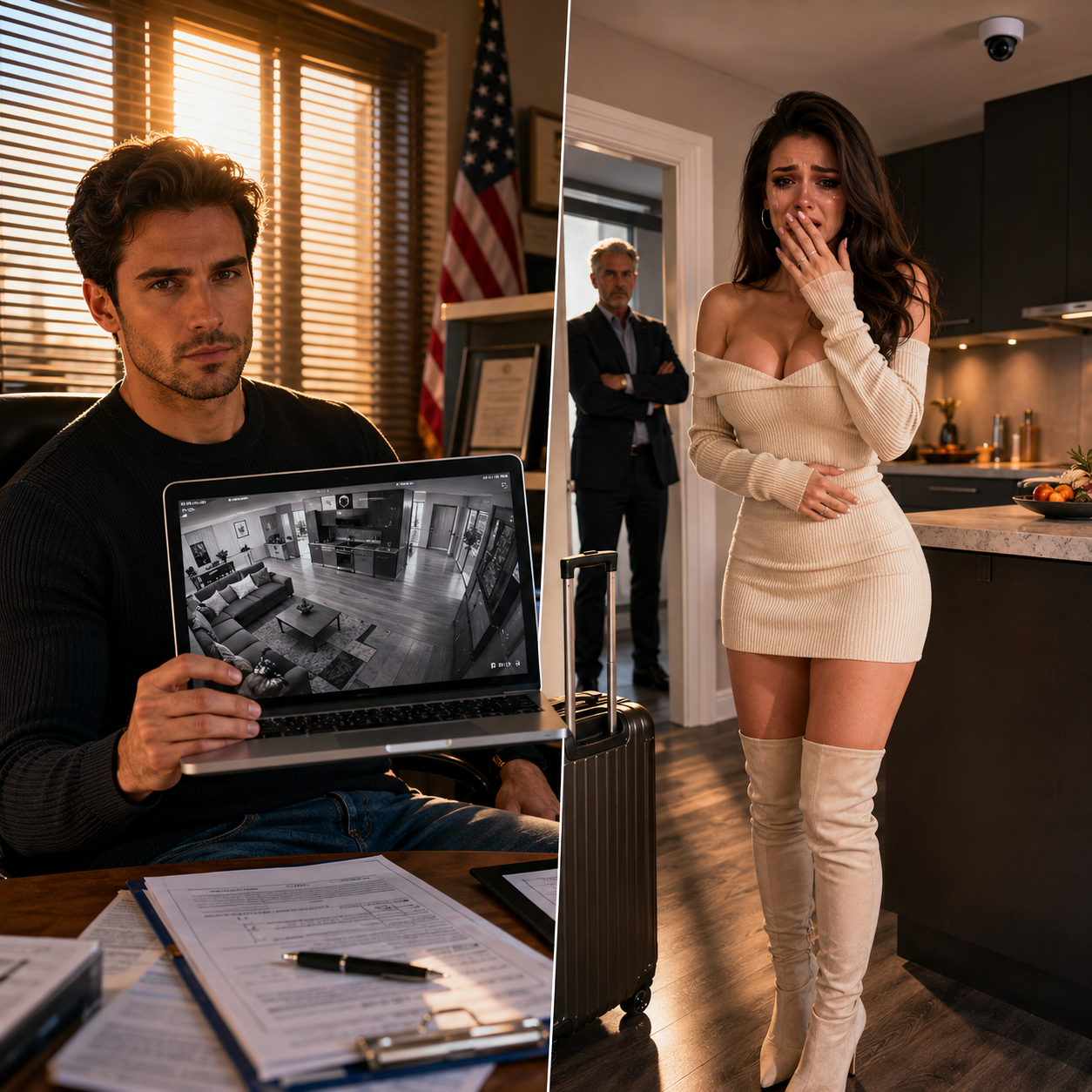
My girlfriend told our landlord I was abusive so she could get me kicked out of our apartment.
When Frank Morrison called me at work that Thursday afternoon, I knew something was wrong before he even finished saying my name. Frank was not the type of man who called tenants during business hours to chat. He owned eight units in a small downtown Portland complex, and he ran them the way a retired firefighter ran everything: clean, direct, professional, and allergic to unnecessary drama.
“David,” he said, his voice lower than usual, “I need you to stop by my office when you get home. We have a situation.”
A situation.
That word sat in my stomach for the rest of the afternoon.
By the time I reached his office at six, I had replayed every recent argument with Rachel in my head. We had been together almost two years, living together for eighteen months, and the relationship had been falling apart for longer than I wanted to admit. Still, I never imagined she would do what she did.
Frank was sitting behind his desk with his hands folded, looking like a man who hated the conversation he was about to have.
“Rachel called me today,” he said. “She says there has been domestic violence in your apartment.”
For a second, the room went completely silent.
Not quiet.
Silent.
The kind of silence where your body understands danger before your mind catches up.
“What exactly did she tell you?” I asked.
Frank studied my face. “She said this morning’s argument got physical. That you grabbed her arms, shoved her against the kitchen counter, and scared her badly enough that she left the apartment.”
I didn’t shout. I didn’t pound the desk. I didn’t do any of the things an angry man might do when he has just been accused of something that can ruin his life.
I sat very still.
Because I understood immediately that my reaction mattered.
“Frank,” I said carefully, “that never happened.”
He looked like he wanted to believe me. But wanting to believe someone and protecting yourself legally are two different things.
“I’ve never seen anything from you that worried me,” he said. “But I can’t ignore a tenant reporting violence. If I dismiss it and something happens later, that’s on me.”
“I understand,” I said. “But she’s lying.”
“Can you prove that?”
That was when I remembered the cameras.
The apartment had come with a basic security system already installed when we moved in. Two cameras covered the common areas, mostly because the neighborhood had been dealing with break-ins. They recorded video and audio to a DVR that kept thirty days of footage. Both Rachel and I had signed the addendum acknowledging it when we signed the lease.
That morning’s argument had happened in the kitchen.
In full view.
With audio.
“Yes,” I said. “I can prove it.”
Frank leaned back slowly. “How?”
“The security footage.”
His expression changed.
Not relief exactly.
More like a man seeing a narrow bridge appear over a very deep hole.
“Bring it tomorrow,” he said. “Seven o’clock. My office.”
When I got home that night, Rachel was packing a suitcase.
She looked up when I walked in, and for half a second, I saw fear in her eyes. Not fear of me. Fear of consequences.
“Going somewhere?” I asked.
“To my sister’s,” she said. “I need space.”
“Space from what?”
She zipped the suitcase too hard. “From your anger issues.”
I looked at her for a long moment.
Rachel had always been emotional, but lately something darker had grown underneath it. She had become controlling with money, suspicious of my female coworkers, and strangely obsessed with who would keep the apartment if we ever broke up. At the time, I thought it was insecurity. I didn’t know she was planning something.
“What did you tell Frank?” I asked.
Her jaw tightened.
“I told him the truth.”
“Which truth? Because if you need help remembering, I can pull up the security footage from this morning.”
The color drained from her face.
Those few seconds told me everything.
“They don’t record everything,” she said.
“They recorded enough.”
“You can’t use that. I didn’t consent.”
“You signed the same lease addendum I did.”
She grabbed her suitcase and pushed past me toward the door.
“Frank won’t care about your stupid cameras.”
I didn’t follow her.
I didn’t argue.
I let her leave.
That was the first night I truly understood how dangerous a desperate liar can be. Rachel was not just trying to win an argument anymore. She was trying to rewrite reality. She wanted a version of events where I was the monster, she was the victim, and everyone else would help her remove me from the home we had built together.
The strangest part was how calm I became.
The fear was there, buried deep, but it didn’t control me. I knew that if I reacted emotionally, I would give her exactly what she wanted. So I opened my laptop, pulled the DVR footage, and watched the entire argument from beginning to end.
There we were.
Breakfast still on the counter.
Rachel standing by the sink, furious because I would not agree to empty our car savings to pay for her sister’s wedding dress.
Two thousand dollars.
Eight months of saving.
She called it an emergency. I called it someone else’s responsibility. She said half the money was hers. I said she could take her half if she wanted, but I would not co-sign debt for the rest.
Then she slammed her coffee mug down and stormed out.
That was it.
No grabbing.
No shoving.
No physical contact at all.
At the moment she claimed I pushed her against the counter, I was sitting at the kitchen table at least four feet away.
I watched it twice.
Then a third time.
Not because I doubted myself, but because the footage felt like oxygen.
The next day, her sister Jenny called me.
“David,” she said coldly, “Rachel told me what you did.”
I closed my eyes.
“She lied to you.”
“She has bruises.”
“Then ask her where they came from,” I said. “Because they didn’t come from me.”
“She said you grabbed her.”
“I have footage proving I never touched her.”
Jenny went quiet.
That silence told me she had expected denial.
She had not expected evidence.
Friday night, I sat across from Frank Morrison in his office and played the footage.
He watched every second.
He paused it.
Rewound it.
Asked questions.
I answered calmly.
When it ended, he sat back and rubbed his jaw.
“There’s no physical contact,” he said.
“No.”
“You’re not even near her.”
“No.”
He replayed the exact section Rachel had described. There she was by the counter. There I was seated at the table.
Frank exhaled heavily.
“This contradicts her story completely.”
“That’s because her story is false.”
He looked troubled, and I understood why. False accusations don’t just harm the accused. They also make it harder for real victims to be believed. Rachel had taken something serious, something that destroys lives, and tried to weaponize it because she wanted control of an apartment.
Frank handled it by the book.
He told Rachel she had one week to file a police report or withdraw the complaint. If she filed, the footage would go to police. If she refused, he would consider the complaint withdrawn. If the investigation proved she lied, she would be the one leaving.
Rachel called me Saturday morning.
Her voice was small.
“Frank says I have to file a police report or drop it.”
“That’s right.”
“I don’t want police involved.”
“Then you shouldn’t have accused me of a crime.”
“I was upset,” she whispered. “I exaggerated.”
I almost laughed, but there was nothing funny about it.
“You exaggerated being shoved against a counter?”
She started crying.
“Can we just work on us?”
“No,” I said.
That single word felt like cutting a rope that had been around my chest for months.
“This relationship is over. You tried to get me removed from my home with a false domestic violence accusation. There is no working on that.”
“I panicked.”
“You planned.”
She had no answer.
By Monday, Rachel withdrew the complaint.
Frank showed her the footage himself. According to him, she barely spoke afterward. Once the truth was visible on a screen, all her emotional performance collapsed. She could cry, explain, soften the language, call it a misunderstanding, but the footage remained what it was.
The truth.
Rachel moved out the following weekend.
I helped carry boxes to her car, which surprised her.
“You’re being really nice about this,” she said.
“I’m not being nice,” I replied. “I’m being done.”
She looked down at the pavement.
“I really am sorry.”
“I hope you mean that,” I said. “And I hope you get help before you do this to someone else.”
For the first time, she didn’t argue.
Months later, I learned the rest from Jenny.
Rachel had been talking to an ex-boyfriend from college. She had built some fantasy where I would be forced out, she would keep the apartment, and he would move in like they were picking up an old love story.
Except he was married.
With children.
And apparently wanted nothing to do with her once the fantasy became inconvenient.
That was the part that stayed with me.
She had risked destroying my reputation, my housing, and possibly my freedom for a fantasy that didn’t even exist.
Three months after that, Rachel sent me a long apology letter. She wrote about therapy, accountability, shame, and how she had finally understood the damage she could have caused. She thanked me for not pursuing legal action.
I never responded.
Some doors do not need to be reopened just because someone knocks politely.
A year later, Frank helped me buy a duplex in the same neighborhood. He recommended me to the seller as a reliable tenant and told me during closing that the way I handled Rachel’s accusation had changed how he managed all his properties.
“Better cameras now,” he said. “Longer recording windows. Protects everyone.”
I nodded.
Because that was the lesson.
Not revenge.
Not bitterness.
Documentation.
Facts.
Calm.
Rachel taught me something I will never forget. Chemistry can make you ignore warning signs, but character decides what someone does when they don’t get their way. A person who lies about small things to control a situation may lie about something life-changing when the stakes get higher.
I was lucky.
Not because Rachel told the truth.
She didn’t.
I was lucky because the truth had been recorded before she could bury it.

![[FULL STORY] SHE CALLED HER EX A BACKUP PLAN, SO I LET HIM KNOW HE’D BEEN PROMOTED](https://social.rabedo.com/storage/thumbnails/1777817608_688060664_1929882981298201_3623511085065309861_n.jpg)

![[FULL STORY] My girlfriend said she needed to talk to me.I thought it would be another argument about something.](https://social.rabedo.com/storage/thumbnails/1776999745_R13.png)
![[FULL STORY] Everyone Mocked the Man I Married — Then They Realized He Was a Billionaire](https://social.rabedo.com/storage/thumbnails/1776842566_ChatGPT Image 14_21_36 22 thg 4, 2026.png)