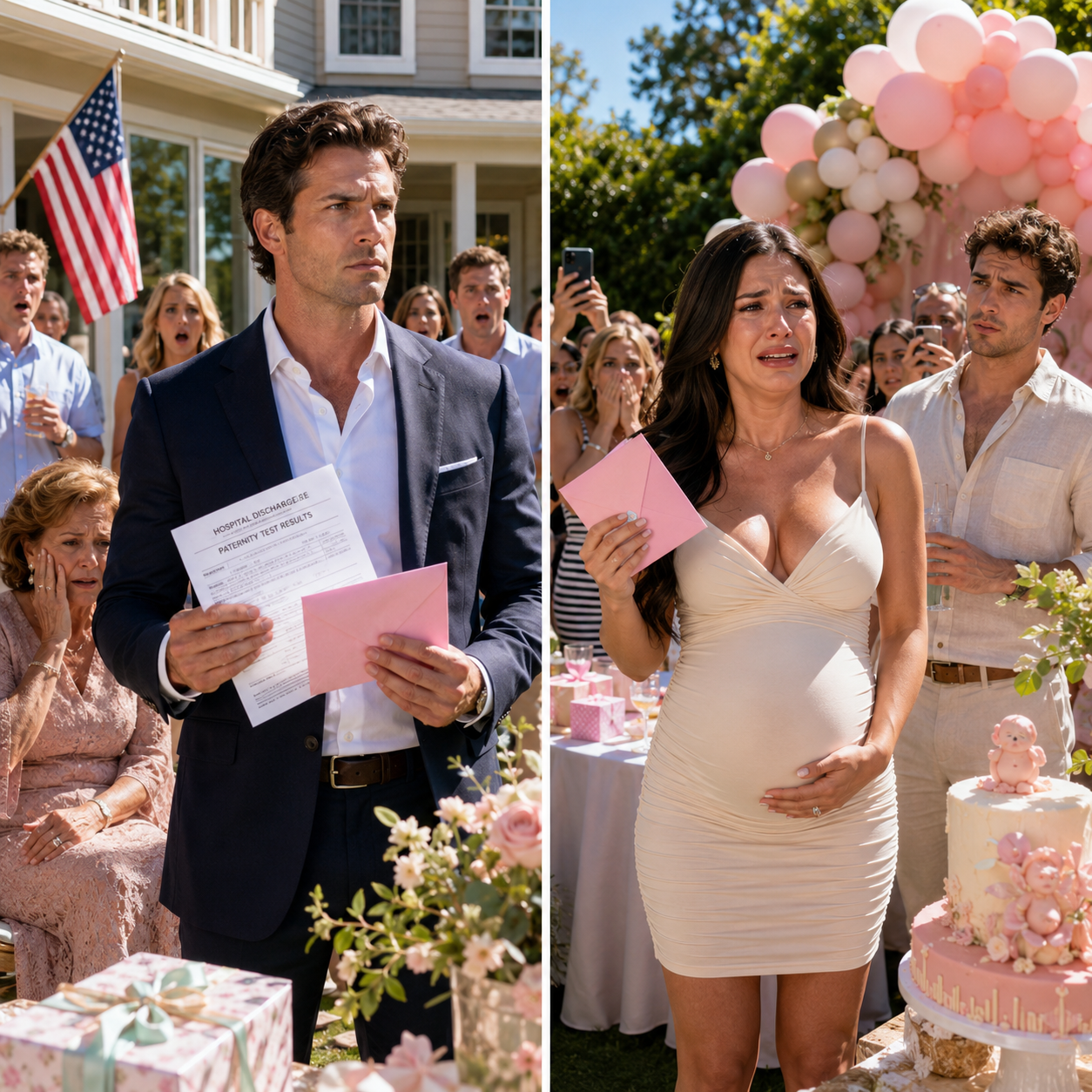
My fiancée stood in front of forty-seven people at our baby shower, one hand resting on her stomach and the other holding a pink envelope, smiling like she was about to give me the happiest surprise of my life.
The backyard was packed with family, friends, coworkers, and people Marissa had insisted “needed to be there for the memory.” My mother was already crying before anything happened. My sister Claire stood near the dessert table, watching Marissa with the same cautious look she used when one of her children got too quiet in another room. Talia, Marissa’s best friend, had her phone raised and recording, because apparently even private family joy needed to be turned into content. And near the drink table stood Nathan Cross, Marissa’s ex-fiancé, looking far too comfortable for a man who was supposedly only there because he was “like family.”
Marissa tapped the pink envelope against her palm and looked around the yard as if she were gathering the room into her control. She was good at that. She knew how to make silence feel sacred. She knew how to make people lean forward. She knew how to make herself look fragile right before asking for something unreasonable.
“Before we open gifts,” she said softly, “there’s something Evan doesn’t know yet.”
A warm, excited hush fell over everyone. My mother pressed both hands to her chest. Someone whispered, “Oh my gosh.” Talia adjusted her phone angle. Nathan stared down into his drink.
Marissa turned toward me with tears shining in her eyes.
Fake tears, but skilled ones.
“I know this may shock you,” she said, her voice trembling beautifully, “but I didn’t want you to hear it from anyone else.”
That was the funny part.
I already had heard it from someone else.
Three days earlier, a hospital records clerk named Denise had accidentally emailed me Marissa’s discharge summary because Marissa had listed me as her emergency contact back when she still believed she controlled the entire story. I had read the ultrasound notes, the OB consult, the admission history, and the sentence that turned my blood cold.
Patient unsure of paternity.
Late January travel.
I was not with Marissa in late January. I was in Raleigh for a work conference. Marissa had been in Charleston with Talia. Nathan lived in Charleston.
So when Marissa stood in my backyard, in front of my family, preparing to turn betrayal into a public performance, I did not panic. I did not shout. I did not shake. I simply watched her the way I watched claimants at work when their dates stopped lining up.
My name is Evan Keller. I am thirty-five years old. I work as a claims investigator in Charlotte, North Carolina. My job is not dramatic. I do not carry a badge. I do not chase people through parking lots. I read files, compare dates, verify statements, and find the tiny cracks people forget to seal when they lie.
Marissa forgot that about me.
She forgot because I was useful to her. Reliable men are often mistaken for blind men. Quiet men are often mistaken for weak men. And I had been quiet for a long time.
When Marissa first told me she was pregnant, I believed her completely. I came home from work and found her sitting at the kitchen island in one of my old sweatshirts, a pregnancy test beside her sparkling water. Her face was pale, her eyes wide, and when she whispered, “I’m pregnant,” my whole future rearranged itself around that tiny white stick.
We had planned children after marriage, not before, but life does not always respect calendars. I hugged her. She cried into my shirt. I told her we would figure it out.
That became the phrase she used against me.
We would figure it out when she wanted to move the wedding up. We would figure it out when she wanted me to pay the remaining deposits early. We would figure it out when she talked about quitting work after the baby came. We would figure it out when she hinted that her name should eventually be added to my house deed because she needed “security as the mother of my child.”
I said yes more than I should have, not because I was foolish, but because I thought I was protecting my family.
Then the dates began to shift.
First, the due date was December 3. Then it became November 21. Then one night at dinner, she told my mother she was “almost sixteen weeks,” even though by the timeline she had given me, she should have been closer to thirteen.
My mother missed it.
I did not.
Marissa also refused to let me attend appointments. First, she said it was just bloodwork. Then her mother was going. Then Talia was taking her. Then she claimed the clinic did not allow partners in the ultrasound room, which sounded wrong enough that I called and asked generally. The receptionist sounded confused.
“Of course partners are allowed,” she said. “As long as the patient approves.”
That was when I created the note in my phone.
Timeline.
I did not know yet what I was building. I only knew future me might need it.
Then Nathan came back.
He appeared at Marissa’s parents’ Sunday brunch like a ghost who had never been buried properly. Pale linen shirt, expensive watch, charming smile, and the confidence of a man who had been forgiven too many times by people with money. Marissa squeezed my arm and whispered, “Don’t be weird,” before I had even spoken.
That told me everything.
From that day forward, I stopped asking for reassurance and started collecting facts. A man who begs for the truth from a liar usually gets theater. A man who documents quietly gets leverage.
The hospital file arrived on a Thursday morning. I stared at the attachment for a long time before opening it. I knew it had been sent by mistake. I also knew my fiancée had been hiding appointments, shifting dates, inviting her ex into our lives, and asking me to financially commit to a baby she privately admitted might not be mine.
So I opened it.
Fourteen pages. That was all it took to destroy the life she had been staging.
When I read the words “patient unsure of paternity,” I did not explode. I sat at my desk, hands still, breathing even, feeling something colder than anger settle inside me. Anger burns fast. Clarity lasts longer.
I called a lawyer named Lydia Hart.
She told me not to confront Marissa alone. She told me not to sign anything. Not the birth certificate. Not the deed. Not another wedding payment. Not one more document that could be twisted into proof of acceptance.
“Document everything,” Lydia said.
That was the first peaceful sentence I had heard in weeks.
So I did.
By the time Marissa stood at the baby shower with the pink envelope, I already knew the trap. She was not confessing. She was building a stage. If she could force me to promise, in front of everyone, that I would raise the child no matter what a test said later, then refusal would make me look cruel. She would become the frightened pregnant woman. I would become the cold man abandoning a baby.
She had miscalculated one thing.
I was done protecting her image.
Marissa touched her stomach and let one tear fall.
“The doctors moved my due date,” she said. “And because of that, we realized the baby may have been conceived earlier than we thought.”
The yard went still.
Then she looked directly at me.
“Evan, I need you to promise, in front of everyone we love, that no matter what any test says someday, you will still be this baby’s father.”
There it was.
The noose, wrapped in pink ribbon.
I took one slow breath.
“Are you finished?” I asked.
Her face flickered. “What?”
“Are you finished with the announcement?”
The silence changed. It no longer belonged to her.
“Evan,” she whispered, “this is hard for me too.”
“I’m sure.”
Talia lowered her phone. “Maybe don’t make this ugly.”
I looked at her. “Keep recording.”
That was when Marissa’s face changed.
I stepped forward and pulled the folded discharge summary from my jacket pocket. Not the whole file. Only the page my attorney told me I could show if Marissa made a public claim first. The unnecessary medical details were blacked out. The relevant lines were not.
“Three days ago,” I said, “a hospital records clerk accidentally emailed me Marissa’s discharge summary because she listed me as her partner contact. The file says she was sixteen weeks and four days pregnant. It also says she told the hospital conception likely happened during late January travel and that she was unsure of paternity.”
Marissa went white.
My mother sat down hard in the nearest chair.
“In late January,” I continued, “I was in Raleigh for work. Marissa was in Charleston with Talia. Nathan lives in Charleston.”
Someone gasped.
Nathan stared at the ground.
Marissa’s first words were not an apology.
“You invaded my privacy.”
I almost laughed.
“That is what you’re choosing?”
Her voice cracked. “You had no right to read my medical file.”
“You had no right to tell me this baby was mine while privately admitting you did not know.”
Her father stepped forward. “Marissa?”
She turned toward him, suddenly smaller. “Dad, it’s complicated.”
“No,” I said. “Complicated is choosing a crib. Complicated is picking a daycare. This was simple. You knew there was a real chance I was not the father, and you let me pay wedding deposits, prepare a nursery, host this shower, and tell my parents they were becoming grandparents.”
My mother covered her mouth. That was the moment my anger almost broke through. Not for myself. For her. For the blanket she had knitted. For the tiny socks she had bought. For every joyful phone call Marissa had accepted while knowing she might be lying to an entire family.
Marissa began crying for real then, or at least close enough. “I was scared,” she said. “I thought if I told you, you would leave.”
“I am leaving because you didn’t tell me.”
That sentence ended us.
She looked around for help, but nobody moved. Talia stared at her phone. Nathan looked like a man calculating exits. Her mother had one hand over her heart, staring at her daughter as if the woman in front of her had just become a stranger.
“Please don’t do this here,” Marissa whispered.
“You chose here,” I said. “You chose my backyard, my family, and forty-seven witnesses. I’m only telling the truth in the room you created.”
Then I gave her the rest.
“The engagement is over. The wedding is canceled. I have already informed the venue no further payments will come from my account. You will collect your belongings by appointment through my attorney. You will not be staying here tonight.”
Her head snapped up. “You can’t kick me out.”
“You kept your apartment.”
The shock on her face was almost silent.
“You renewed your lease through August,” I said. “Your mother mentioned the renter’s insurance last week.”
Marissa looked betrayed by facts themselves.
Claire stepped beside me. “Marissa, you should leave.”
Talia finally found her voice. “She’s pregnant.”
Claire looked at her coldly. “Pregnancy is not permission to manipulate people.”
Nathan tried to speak. “Look, man—”
I turned to him. “You do not get a line in this scene.”
For once, he obeyed.
Marissa’s father walked over to Nathan and asked the question everyone was thinking.
“Are you the father?”
Nathan lifted both hands, his charm gone. “I don’t know.”
It was the first honest thing I had ever heard him say.
Marissa broke after that. Not gracefully. Not cinematically. She sobbed, begged, blamed stress, blamed fear, blamed me for being “emotionally unavailable,” blamed Nathan for confusing her, blamed Talia for encouraging her not to say anything yet. But every excuse collapsed under the same simple truth.
She had known.
She had chosen the lie anyway.
Her parents took her home. Nathan left alone. Talia deleted the video in front of my sister, though Claire had already made sure enough people had seen what mattered. My mother hugged me in the kitchen afterward and cried into my shoulder, not because I had lost Marissa, but because she realized how close I had come to losing myself trying to save a future built on fraud.
The weeks after were quiet in a brutal way.
The wedding deposits were mostly gone, but Lydia recovered what she could. Marissa tried to send messages through friends. I did not answer. She wrote one long email saying she still believed I could be the baby’s father “in the ways that mattered.” I forwarded it to my attorney.
When the paternity test was finally done, the result confirmed what the timeline already knew.
Nathan was the father.
I expected the news to hurt more than it did. Instead, it felt like a locked door finally clicking shut. Marissa had not only betrayed me; she had tried to draft me into another man’s consequences while making my family applaud.
Months later, I repainted the nursery. Not because I wanted to erase the baby. The baby had done nothing wrong. I repainted it because the room had become a monument to a lie. Sage green became deep blue. The crib I had assembled was donated to a family shelter. My mother’s yellow duck blanket went into a cedar chest, not thrown away, not forgotten, just saved for a future that would not begin with deception.
People asked if I hated Marissa.
I do not.
Hate takes energy, and she had already taken enough.
What I learned was simpler than hate and harder than forgiveness. I learned that love without truth is just a contract written in disappearing ink. I learned that staying calm does not mean staying passive. And I learned that sometimes the strongest thing a man can do is stand perfectly still while someone else’s performance falls apart around him.
Marissa wanted a public promise.
She got a public ending.
And for the first time in months, when everyone finally left my backyard and the pink balloons sagged in the evening heat, I stood alone in the quiet and felt no panic at all.
Only relief.
![[FULL STORY] She Said Her Love Language Was Acts of Service… So I Gave Her the Final One She Didn’t Expect](https://social.rabedo.com/storage/thumbnails/1777138074_997fd3ee-6111-4c78-8ff6-708fff2d61c2.png)
![[FULL STORY] At a family barbecue, she loudly teased, "If we ever tie the knot, he'd be fortunate if I stay…](https://social.rabedo.com/storage/thumbnails/1777345504_D3.png)
![[FULL STORY] My Wife Got Pregnant By Her Ex, Then Begged Me To Take Her Back After He Left Her For Her Best Friend](https://social.rabedo.com/storage/thumbnails/1777823705_686209225_943653805178672_1684553857711266602_n.jpg)