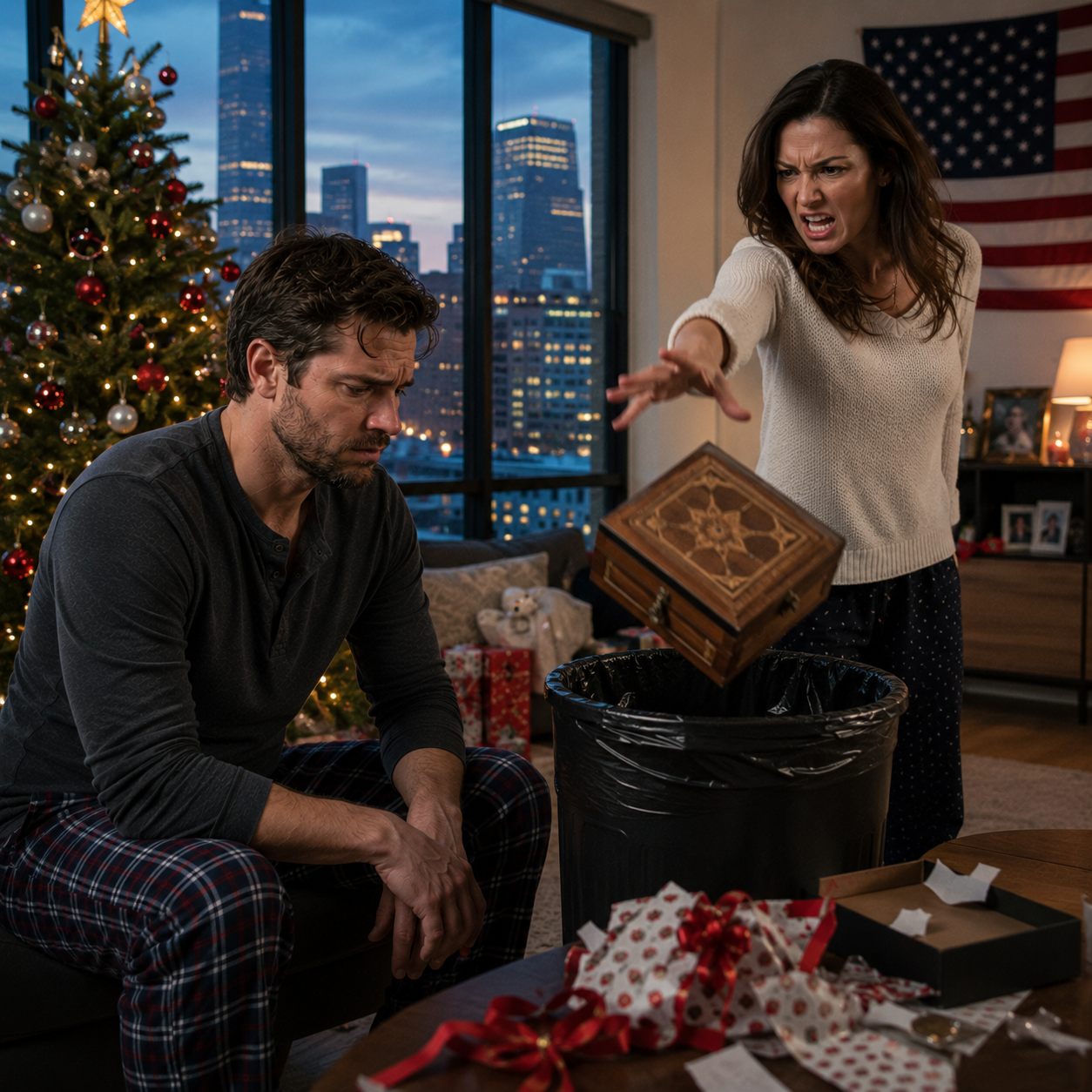

My name is Ethan Mercer, and the strange thing about betrayal is that most people imagine it arriving like a car crash. Loud. Violent. Impossible to ignore. But the truth is uglier than that. Real betrayal arrives quietly. It slips into your life disguised as jokes, little dismissals, crossed boundaries, and moments that make you uncomfortable enough to notice but not uncomfortable enough to leave. It grows slowly inside the spaces where respect used to live until one day you wake up and realize the person beside you stopped protecting your dignity a long time ago.
That realization came for me at 4:41 in the morning while another man slept in my bed wearing my shirt.
But the story started years before that.
I was thirty-four years old when everything collapsed. I worked as an operations consultant for a restaurant group in Charlotte, North Carolina, and my entire career revolved around fixing systems before they failed completely. I reviewed numbers, tracked losses, identified inefficiencies, and solved problems people ignored until they became disasters. I trusted patterns more than promises because patterns rarely lied. Looking back now, I should have recognized the pattern in my own relationship sooner. I just didn’t want to believe the woman I loved was capable of turning me into a background character inside my own life.
Her name was Riley Shaw.
When I met her, she felt like sunlight. That sounds dramatic, but anyone who has ever fallen hard understands what I mean. Riley had that rare ability to make people feel instantly important. She remembered tiny details about conversations, laughed with her whole body, touched your arm when she spoke, and carried herself with the effortless confidence of someone used to being adored. Men noticed her. Women trusted her. Rooms opened around her naturally.
We met during a charity trivia night downtown after she mocked my team for missing an easy eighties movie question. I fired back with something sarcastic, she laughed, and by the end of the night she had stolen half my fries and my attention. Our first six months together felt easy in the dangerous way easy things do. She moved through my life naturally. Toothbrush in my bathroom. Sweatshirt on my couch. Coffee orders memorized. Weekend routines forming without discussion.
At the time, I thought peace meant compatibility.
What I didn’t understand was that peace without boundaries eventually becomes permission.
The house mattered more than Riley ever understood. I bought it before her, before us, before any fantasy about marriage or shared futures entered the picture. It was a brick ranch outside Charlotte with hardwood floors, a screened porch, and a detached garage I converted into a workshop. I spent years saving for it. Every wall carried evidence of my effort. I refinished floors myself, rebuilt the back deck with my brother Marcus, and planted crape myrtles along the driveway because my mother insisted Southern homes should always have something blooming.
Owning that house meant stability to me. It meant independence. It meant proof that my life belonged to me.
Riley loved the house immediately. Or maybe she loved what the house represented. Space. Comfort. Security. A place big enough for parties, friends, and endless gatherings that made her feel surrounded and admired. She called it cozy online. Called it warm. Called it home long before she actually lived there.
Then there was Drew.
Every disaster has a warning sign wearing a smile.
Drew Callahan entered my life through Riley’s stories long before I met him in person. College best friend. Creative strategist. Emotional support human. According to Riley, they had “survived their twenties together,” which sounded meaningful until I realized it mostly meant drinking, vacations, brunches, and mutual emotional dependency disguised as friendship.
The first time I asked if they had ever dated, Riley laughed too fast.
“Not really.”
That answer stayed with me because honest people don’t usually answer simple questions with technical loopholes.
Apparently they kissed once during college, decided it felt weird, and stayed friends. Riley emphasized constantly that Drew was basically family, which is the kind of phrase people use when they want you to stop asking questions before you discover there are better ones to ask.
I accepted it because I loved her.
That is how people slowly surrender their instincts. Not through weakness. Through hope.
For the first year, Drew mostly annoyed me. He showed up too often, stayed too long, and treated my house with the relaxed entitlement of someone who never heard the word no enough growing up. He wore expensive sneakers through my living room, opened drinks without asking, and joked constantly about me being “Corporate Ethan,” as though having responsibilities was some tragic personality flaw.
Riley laughed every single time.
That part mattered more than the jokes themselves.
Disrespect grows where it gets rewarded.
At first I told myself I was overreacting. Drew was charismatic, and charismatic people survive by making everyone else feel unreasonable for noticing their behavior. If I objected, Riley became defensive immediately. If I mentioned boundaries, she accused me of insecurity. If I pointed out something inappropriate, she sighed like I was exhausting her.
“Please don’t start.”
That sentence became the soundtrack of our relationship.
Please don’t start.
Not because I was screaming. Not because I was controlling. But because I kept noticing things she preferred ignored.
The birthday cookout should have been my final warning. I spent two days preparing everything because Riley loved hosting. I decorated the backyard, grilled food for twenty people, hung lights across the fence, and bought her the gold bracelet she once admired in a boutique window months earlier.
When she opened it, she cried.
For a moment, it felt perfect.
Then Drew gave her his present.
A framed beach photo of the two of them wrapped around each other laughing like a couple on vacation. Intimate. Personal. Possessive in a subtle enough way that anyone questioning it could immediately be labeled insecure.
The entire backyard shifted when she opened it.
Riley stared at the picture like it was sacred.
“Oh my God, Drew. I forgot about this.”
He smiled slowly. “I didn’t. That was the summer you were actually fun.”
Everybody laughed except me.
Later that night, I told Riley the gift felt inappropriate.
She rolled her eyes and accused me of overthinking.
Again.
Always again.
The problem with repeated disrespect is not the size of each individual moment. It is the accumulated message underneath them. Eventually you stop arguing about isolated incidents because you finally understand the incidents are connected.
By the second year, Riley moved into my house officially. I imagined that would create stronger boundaries. Instead, it erased the remaining ones.
Drew started coming over while I was at work.
At first Riley mentioned it casually. Then she stopped mentioning it at all. I’d come home and find signs of him everywhere. Missing beer. Moved blankets. New food containers. His gaming profile mysteriously added to my PlayStation.
One afternoon I walked into my kitchen and found him barefoot eating cereal from one of my bowls while Riley changed upstairs. He looked at me like I had interrupted him.
“Hey, man,” he said casually. “We ran out of oat milk.”
Not Riley.
We.
That word stayed with me all night.
When I confronted Riley, she accused me of being territorial.
Territorial.
As though wanting another grown man not to behave like he lived inside my house was some primitive emotional defect.
That was when I nearly ended the relationship the first time. Not because of Drew specifically, but because of Riley’s reflexive instinct to protect his comfort over my dignity. But then she cried, apologized halfway, promised she understood my perspective, and convinced me things would improve.
For a while, they did.
That is the danger of temporary change. It gives hope just enough oxygen to survive longer than it should.
Then came Atlanta.
I was supposed to spend three days there fixing supply chain problems for one of our restaurant locations. Before leaving, Riley asked if she could host a “small celebration” Saturday night for her friend Maren’s promotion. She promised maybe eight people. Ten maximum.
I agreed on one condition.
“No one sleeps over unless we discuss it first.”
She kissed me and laughed softly. “I’m not twenty-two, Ethan.”
Saturday night ended earlier than expected. By six in the evening, the work crisis was resolved and my Sunday meetings were canceled. I texted Riley saying I might drive back that night.
No response.
I assumed she was busy with the party.
What I found when I got home shortly after eleven looked less like a gathering and more like a fraternity reunion sponsored by bad decisions.
Cars lined the street. Music shook the windows. Strangers stood in my driveway drinking from red cups. Somebody sat on the hood of my truck smoking.
The moment I stepped inside, I knew every agreement we made had been ignored.
The kitchen smelled like liquor and sweat. Bottles covered the counters. Someone opened the expensive bourbon I was saving for my father’s birthday. A woman I had never met sat on my kitchen counter FaceTiming somebody while salsa dried across the floor.
Then I found Riley dancing in the living room.
And standing behind her was Drew.
Wearing my flannel.
Not a similar flannel.
Mine.
The same blue-and-black shirt I’d owned for years with a tiny paint stain near the cuff from repainting the hallway.
He raised his drink when he saw me.
“The king returns.”
I stared at him for several seconds before asking the only question that mattered.
“Why are you wearing my clothes?”
Riley answered before he could.
“Someone spilled beer on him. I told him he could borrow something.”
Not a big deal.
That phrase again.
The national anthem of selfish people.
I looked around at strangers in my home and said calmly, “Party’s over.”
Riley’s smile vanished instantly.
“Ethan, don’t do this.”
“Do what?”
“Embarrass me.”
There it was.
Not concern for my feelings.
Not concern for my house.
Embarrassment.
Her image mattered more than the disrespect standing directly behind her wearing my shirt.
I walked to the speaker and turned the music off.
Then I politely asked everyone to leave.
No yelling. No threats. No dramatic meltdown. Just calm authority.
And that somehow angered Riley more than screaming would have.
Because emotionally manipulative people survive chaos better than clarity.
Within fifteen minutes, almost everybody was gone.
Except Drew.
Of course.
He remained standing in my living room holding a drink like he was waiting for intermission to end.
When I told him to remove my shirt, Riley reacted like I was being unreasonable.
When I told him to leave, she refused.
“He’s staying tonight.”
Not a request.
A declaration.
In my house.
That was the exact moment something inside me changed permanently.
I stopped emotionally participating.
The argument ended internally before she even realized it.
I simply said, “Fine,” grabbed my bag, and walked toward the guest room.
Riley followed me, confused by my calmness.
“You’re just going to sleep?”
“Yes.”
“You’re being cold.”
“No,” I said quietly. “I’m tired.”
That part was true.
I was exhausted.
Not from work.
From years of explaining basic respect to someone determined to interpret boundaries as oppression.
I didn’t sleep.
I lay awake listening to muffled voices in the kitchen, footsteps in the hallway, and eventually the sound of my bedroom door closing after one in the morning.
At 4:41 a.m., I walked past the bedroom and saw them.
Riley asleep on my side of the bed.
Drew shirtless on the other side wearing my gray sleep shirt.
That image should have triggered rage.
Instead it triggered certainty.
That is the terrifying thing about calm men. People mistake silence for weakness because they don’t realize silence often means the decision has already been made.
Riley woke first and immediately started explaining.
“Nothing happened.”
Drew told me to relax.
Riley accused me of making things weird.
I laughed once.
Then I told them both to go back to sleep.
The confusion on Riley’s face was almost painful to watch. She expected an explosion. Tears. Shouting. Negotiation.
Instead I closed the guest room door, opened my laptop, and began dismantling our life together piece by piece.
First came the security footage.
Drew arriving early carrying a duffel bag.
Not a charger.
Not an overnight emergency kit.
A bag.
Then footage of Riley and Drew disappearing together into the detached garage laughing while his hand rested comfortably against the small of her back.
Then the thermostat adjustment in my bedroom after one in the morning despite Riley hating cold temperatures.
Then the text logs.
Then the receipts.
Then finally the group chat.
The messages didn’t prove sex.
They proved something worse.
Disrespect.
“Perfect. I call big bed if I pass out.”
“You already act like you live here.”
“Poor Ethan.”
“He likes rules. It gives him purpose.”
That was enough.
Because betrayal is not measured exclusively by bodies touching.
Sometimes betrayal is allowing another person to slowly occupy your partner’s emotional loyalty while you continue paying the mortgage.
At 5:52 in the morning, I called my brother Marcus.
“Relationship’s dead,” I told him. “Need your truck.”
He didn’t ask questions.
“I’ll be there in thirty.”
Then I called my friend Nolan, who owned a moving company.
Then a realtor.
Then I made coffee.
People always react strangely when I mention the coffee, but practical things continue even while your life collapses. I had a long morning ahead. Long mornings require caffeine.
By seven-fifteen, movers were loading my furniture into trucks while Riley and Drew still slept peacefully in my bedroom.
At 7:42, the movers entered the room.
That finally woke them up.
Riley screamed when she realized strangers were dismantling the bed frame around her.
“What is happening?”
I stood calmly in the hallway.
“They’re taking the bed.”
Drew stared at me like I’d lost my mind.
Riley accused me of humiliating her again.
Again.
Always her humiliation.
Never my pain.
Never my betrayal.
Never the fact another man spent the night in my bed while she defended him repeatedly.
When she insisted I was overreacting, I showed her the screenshots.
The group chat.
The jokes.
The messages.
Her face changed immediately because she finally understood something crucial.
The issue was no longer whether she could manipulate the situation emotionally.
The evidence had removed interpretation from the equation.
Then the movers carried the bed away piece by piece while Drew stood there wearing my shirt and Riley cried in the middle of the emptying room.
I removed everything I owned from that house over the next several hours.
The couch.
The dining table.
The television.
The porch furniture.
The kitchen appliances.
The garage tools.
The Wi-Fi.
The shared cards.
The streaming accounts.
The phone plan.
Every layer of comfort they casually relied on vanished one decision at a time.
Riley followed me through the hollowing house alternating between rage and panic.
“You’re destroying everything!”
“No,” I said quietly. “I’m removing myself from it.”
That sentence finally silenced her.
Because deep down she understood the truth.
She never believed I would leave.
That was the foundation underneath all her behavior. She assumed my patience was infinite. Assumed my stability guaranteed her safety no matter how disrespectful things became.
People like Riley confuse calmness with permanent tolerance.
They discover the difference too late.
At one point Drew tried defending her.
“You make everything feel like a business transaction.”
I looked at him for several seconds before answering.
“You’re thirty years old sitting in another man’s house wearing his clothes after sleeping in his bed with a duffel bag you brought intentionally. I don’t think you’re qualified to discuss maturity.”
Even Riley turned and stared at him after I mentioned the bag.
That was the moment I think she finally realized Drew enjoyed the game far more than he ever intended to share responsibility for the consequences.
And of course he disappeared almost immediately afterward.
Men like Drew always do.
He loved the excitement of emotional boundary-crossing. Loved the attention. Loved feeling chosen over another man.
But accountability?
Housing?
Real commitment?
Those things require character.
By noon, my house echoed empty around them.
I left Riley standing in the middle of the living room surrounded by the remains of the life she thought would always be there waiting for her.
That afternoon my phone exploded with missed calls and messages.
Most of them came from Riley.
“Please answer.”
“This is insane.”
“You can’t just walk away.”
Then the important one.
“Drew left.”
Of course he did.
That was when her fantasy collapsed completely.
Because Drew loved access, not responsibility.
He enjoyed sleeping in my bed far more than he enjoyed the idea of helping her rebuild after she destroyed the relationship financing her stability.
Over the next several weeks, Riley tried controlling the narrative. She called me controlling, emotionally unavailable, financially abusive. But stories fall apart when too many witnesses exist.
Maren eventually admitted several people thought Drew’s behavior was inappropriate long before I came home.
Riley’s mother called me one evening and apologized quietly after hearing the full truth.
“She has always confused attention with love,” she said sadly.
That sentence stayed with me.
The house sold quickly.
A young couple bought it over asking price.
Riley moved into a small apartment her parents helped her afford after Drew conveniently vanished to Miami for a brand event and posted online about “toxic dynamics.”
Cowards always become philosophers after consequences arrive.
Months later, Riley sent me a long email admitting everything she finally understood. She admitted she loved the emotional excitement Drew created because it required nothing serious from her. She admitted she relied on my stability while treating it like background noise instead of something valuable. She admitted the morning I emptied the house was the first time she realized how much of her life depended on things she never respected until they disappeared.
I read the email twice.
Then archived it.
No response felt necessary.
Because closure is overrated.
Understanding is enough.
Sometimes people ask if I regret leaving so absolutely.
The answer is no.
I regret staying as long as I did.
I regret every moment I explained away disrespect because I loved someone enough to doubt my own instincts.
I regret every time I confused patience with virtue.
But leaving?
No.
Not for one second.
Because peace returned afterward.
Real peace.
The kind that does not require swallowing discomfort daily just to maintain a relationship.
The kind where your home feels like yours again.
The kind where you stop negotiating your own dignity for companionship.
A few months ago, Marcus and I drove past my old neighborhood. The new owners painted the front door navy blue. Kids’ bikes sat near the garage. A dog slept on the porch while the crape myrtles bloomed beside the driveway.
Marcus glanced over at me.
“You okay?”
I looked at the house for a long moment before nodding.
“Yeah,” I said honestly.
And I was.
Because the most important thing I took from that house was never the furniture.
It was the lesson.
Love is not measured by how much disrespect you tolerate before finally breaking.
Boundaries are not cruelty.
Calmness is not weakness.
And if someone repeatedly makes you feel like a guest inside the life you built, the solution is not arguing harder.
The solution is leaving with everything that belongs to you.
So when Riley let another man sleep in my bed and expected me to debate whether anything happened, I asked myself a better question instead.
Why was I still providing the bed at all?
Then I took it.
Along with everything else that was mine.