"You’re an embarrassment, Julian. Look at you. You look like a substitute teacher who wandered into the wrong party."
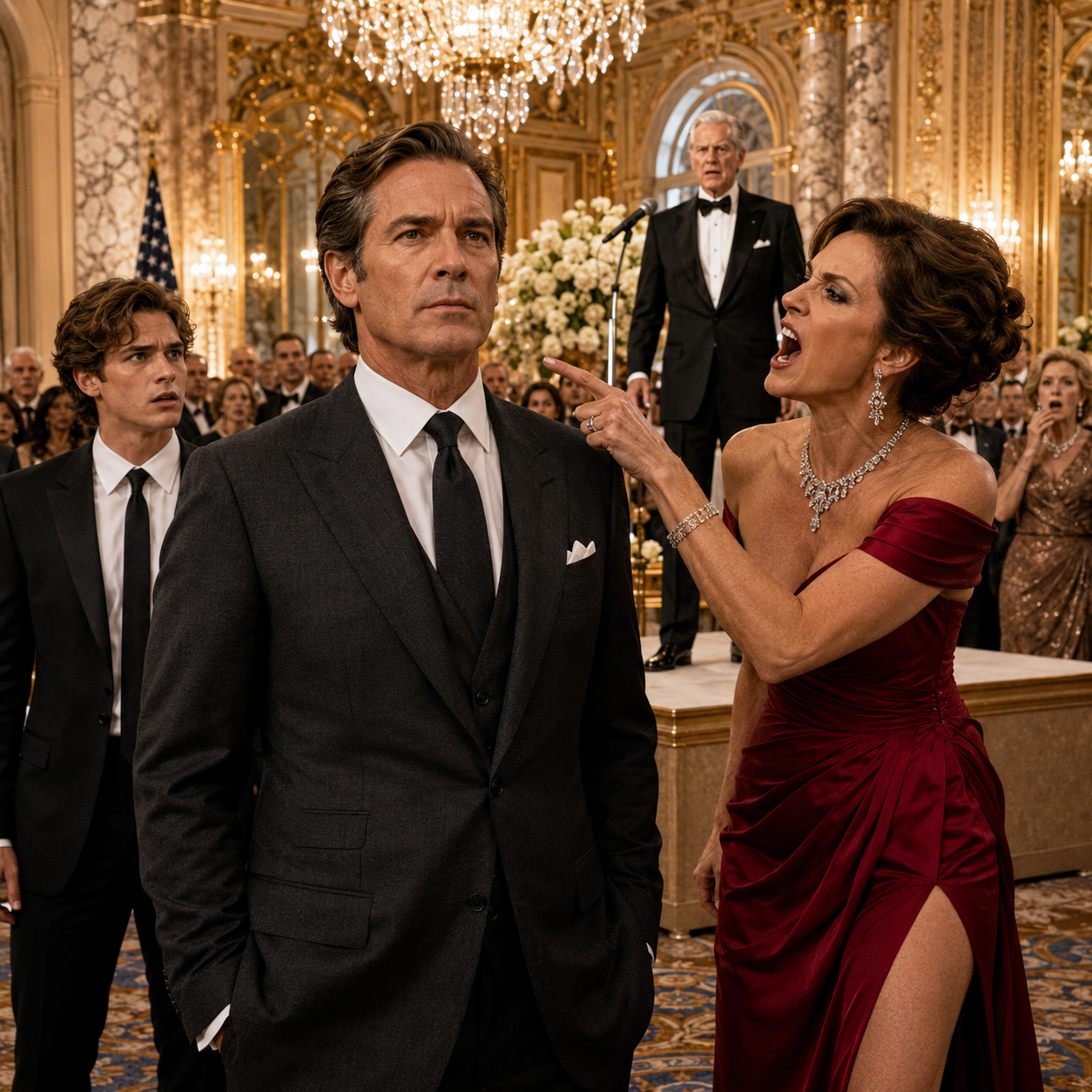
My wife, Lydia, didn’t whisper. She said it with that sharp, melodic edge she used when she wanted to make sure the people around us—people with names like Sterling, Vanderbilt, and Hearst—knew she was superior to the man holding her hand. She adjusted her diamond necklace, a piece that cost more than the average American home, and sighed with theatrical exhaustion.
I didn't flinch. I didn't even look at her. I just adjusted the sleeves of my charcoal suit. It was a bespoke piece from a master tailor in Savile Row, crafted eighteen years ago. It didn't have a flashy logo. It didn't scream "new money." It whispered "legacy." But to Lydia, who measured worth by the price tag currently hanging in a boutique window, it was just... old.
"I’m comfortable, Lydia," I said calmly. "And we’re here for your brother’s wedding. Let’s focus on him."
"Comfortable? We are at the Pierre Hotel. The Governor is ten feet away. And you’re wearing a suit older than our son," she hissed, her eyes scanning the room for someone more 'useful' to talk to. "I don’t know why I expected anything else. You’ve always been content with being invisible."
She didn't wait for a reply. She never did. She glided away, her silk gown trailing behind her like the tail of a peacock, leaving me standing near the mahogany bar.
My name is Julian Thorne. For twenty-five years, I was a 'Special Situations Architect.' That’s a polite way of saying I was the person governments and Fortune 500 CEOs called when their world was about to end. I’ve stopped bank runs in Singapore, negotiated hostage releases in corporate boardrooms, and buried scandals that would have toppled regimes.
But for the last seven years, I’ve been "retired." To Lydia, that meant I was a man who had "given up." She saw my quiet days in my home office as a sign of weakness. She saw my refusal to engage in the toxic social climbing of the New York elite as a personal insult to her ambitions.
I watched her across the room. She was laughing with a group of women, gesturing toward me and shaking her head. I knew that look. She was telling them her favorite story: the tragic tale of the brilliant woman tethered to a "mediocre, unambitious husband."
"Is she still doing it?"
I turned. My son, Leo, was standing there. At twenty-four, he had my height and his mother’s sharp features, but thankfully, none of her cruelty. He was an associate at a top-tier private equity firm, a job Lydia claimed she got for him through her "connections."
"She’s just being herself, Leo," I said, taking a sip of sparkling water.
"Dad, she’s telling the Whitmore sisters that you lost our 'real' fortune in the 2018 crash and that she’s been the one keeping us afloat with her 'consulting' work," Leo said, his jaw tight. "It’s a lie. We both know it."
"Let her have her stage, Leo. A stage built on sand doesn't last long."
"But it’s not just the stories, Dad. She’s... she’s talking to lawyers. I saw a file in her dressing room. She thinks because you’re 'just a consultant,' she can take everything in a divorce. She has no idea who you actually are."
I looked at my son. "Do you?"
He hesitated. "I know you’re not the man she describes. I know the way people look at you when they think I’m not watching. But even I don't know the full scope."
I patted his shoulder. "Tonight, the lights are going to get very bright, Leo. Make sure you’re standing in the right spot."
Just then, the music swelled. The ceremony was over, and the reception was beginning. The host of the evening, Marcus Sterling—a man who owned half the skyline and had a reputation for being a ruthless recluse—stepped onto the dais. The room went silent. You could hear a pin drop on the marble floor.
Lydia was in the front row, preening, waiting for Marcus to acknowledge her family. She had spent months trying to get an invitation to his private gala, and this wedding was her foot in the door.
Marcus scanned the crowd. His eyes were cold, calculating. He looked over the politicians, the celebrities, and the heirs. Then, his gaze locked onto me.
The man who hadn't smiled in a decade suddenly froze. His face went pale. He didn't look at the bride. He didn't look at the groom. He stepped off the dais and began walking straight toward the bar. Straight toward the "embarrassment" in the old suit.
Lydia stepped forward, a practiced smile on her face, thinking he was coming to greet her. "Mr. Sterling, such a beautiful—"
He didn't even see her. He brushed past her so quickly she nearly stumbled. He stopped two feet in front of me, and to the horror of every socialite in the room, the most powerful man in New York bowed his head.
"Sir," Marcus whispered, his voice trembling with a mixture of shock and profound respect. "I was told you were dead. If I had known you were here, I would have met you at the door myself."
The silence in the room wasn't just quiet anymore. It was heavy. It was suffocating. I felt Lydia’s gaze burning into the back of my neck, but I didn't turn around. I just smiled at Marcus.
"I’m not dead, Marcus," I said, my voice carrying further than I intended. "I’ve just been enjoying the peace. Although, apparently, my suit is a bit out of fashion for your party."
Marcus looked at my suit, then at the stunned crowd, and finally at Lydia, who looked like she had just seen a ghost.
"Fashion?" Marcus barked a short, incredulous laugh. "This man could buy the building we are standing in with a phone call, and he could burn it down with a text message. Who dared to comment on his suit?"
The room felt like it was tilting. But I wasn't done. Not even close. Because I knew that what Marcus just said was only the spark. The fire was about to become an inferno, and Lydia was standing right in the center of it...

![[FULL STORY] My girlfriend demanded privacy in our home to be with her male "best friend", then a frantic gift changed everything.](https://social.rabedo.com/storage/thumbnails/1776913784_18.png)