
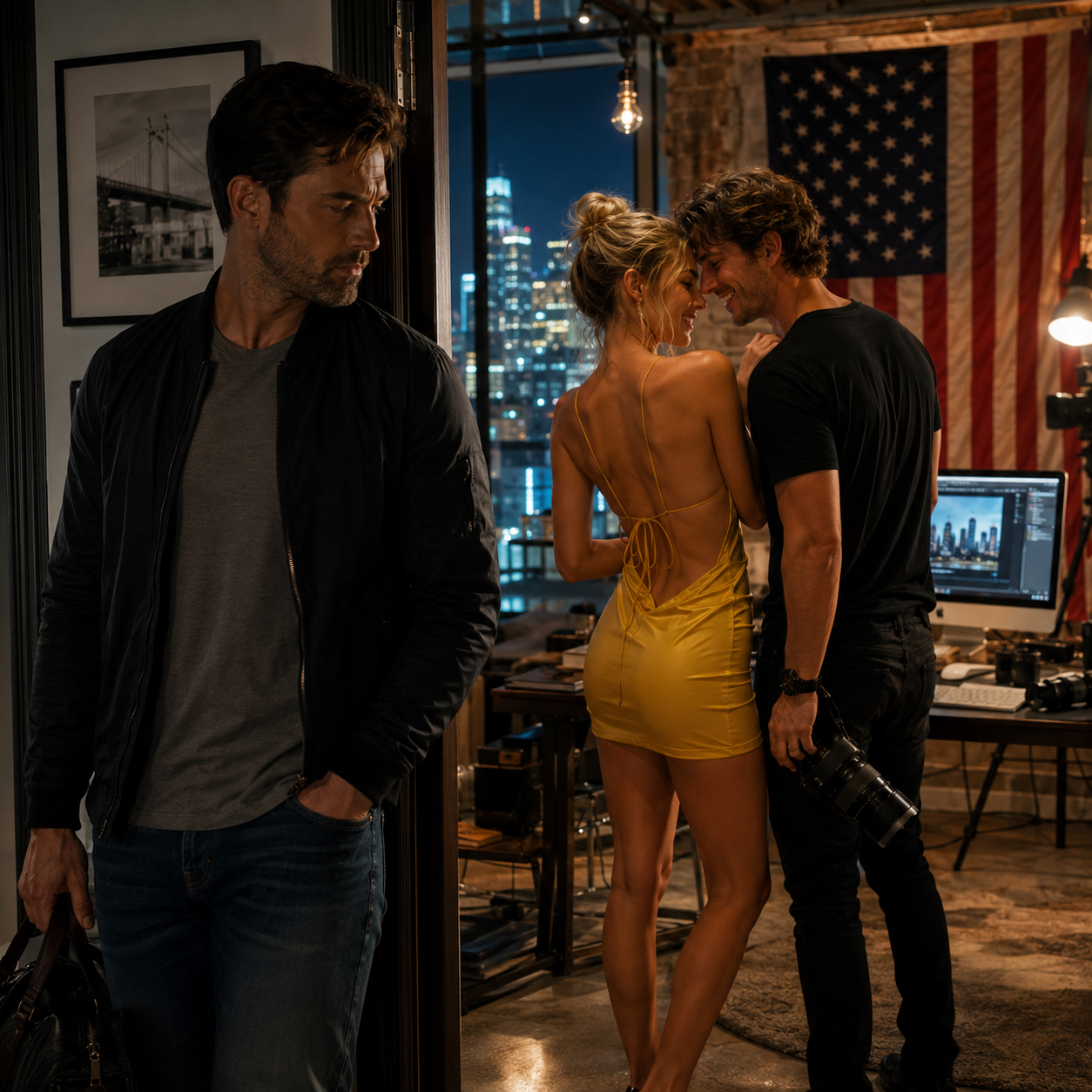
She called me wallpaper. Said I blended into the background while her creative partner made her feel alive. I heard every word standing 10 ft away. That night, I didn't fight, didn't yell. I just started planning. By dawn, I'd erase myself from her life completely. No warning, no goodbye. My name is Caleb Mitchell.
I'm 41 years old and I've been an engineering project designer for 17 years. I built my career on precision, on measuring twice and cutting once. On understanding that every beam, every angle, every calculation matters. What I didn't calculate was how a marriage could collapse while looking perfectly sound from the outside.
It was a Tuesday evening in October when everything shifted. I came home early from the site. Some supply delay pushed our inspection back a day. The house was quiet except for the low hum of Amber's voice drifting from the home office. She'd converted into her photography studio {slash} content creation cave. I wasn't trying to eavesdrop.
I was just standing in the hallway, jacket half off, when I heard her laugh. Not the polite chuckle she gave me anymore. The real one. The one I hadn't heard in maybe 2 years. "Lance, stop." She said, her voice warm and playful. "You're impossible." I froze. Lance Drummond. The art director from that advertising agency downtown.
The guy whose company she'd been doing freelance photography work for the past 8 months. The guy she mentioned maybe a little too often during dinners where she actually talked. "I'm serious though." Amber continued and I could hear her pacing, the old floorboards creaking under her feet. "Caleb's just he's like furniture, you know? He's there, solid, dependable, but you don't really see furniture after a while.
It just blends into the background." My hand tightened around my truck keys. "But you." She went on, her voice dropping lower, intimate. "You make me feel like I'm not just some housewife playing photographer. Like I'm actually somebody." I should have walked in right then. Should have confronted her, demanded answers, made her look me in the eye while she explained why the man who paid for her camera equipment and her studio lighting and her trips to photography workshops was now furniture.
Instead, I walked backward, quietly, out the front door I just came through. Sat in my truck in the driveway for 20 minutes, staring at the steering wheel, the keys still in my hand. When I finally went back inside, Amber was in the kitchen, phone down, smile casual. "Hey babe." She said, barely looking up from her laptop where she was editing photos. "Didn't hear you come in.
How was work?" "Fine." I said, "Same as always." She nodded, already back to adjusting exposure levels on a shot of some downtown mural. "That's good. I'm ordering Thai for dinner. That okay?" "Sure." Furniture doesn't complain. Furniture doesn't make waves. Furniture just sits there, solid and dependable, exactly where you left it.
That night, I lay awake next to her, listening to her breathe, feeling the distance between us even though our shoulders were almost touching. And I started planning. The next morning, I woke up at 5:30 like always. Amber was still asleep, face buried in her pillow, one arm thrown across the space where I'd been lying.
I watched her for a moment, tried to remember when I'd stopped being her husband and started being her furniture. I got dressed quietly, skipped breakfast, and headed to the office early. But I wasn't thinking about work. I was thinking about Lance. About the way Amber's voice had changed when she said his name.
About how long this had been going on right under my nose. At my desk, I opened a browser in private mode and did something I'd never done before. I logged into our joint bank account from my personal laptop, bypassing the shared password manager we'd always used. Started scrolling through transactions from the past 6 months. There. September 14th.
Caruso's Steakhouse. $247. Amber had told me she was at a photography networking event that night. I'd been working late on the Henderson project, didn't get home until almost midnight. I kept scrolling. August 23rd. The Riverside Inn. Room charge one night. $312. She'd said she was doing a sunset photo shoot 2 hours north, that the drive back would be too dangerous in the dark, that she'd crash at a cheap motel.
The Riverside Inn wasn't cheap. My jaw tightened. I pulled up her credit card statement next. The one she thought I never checked because I trusted her to handle her business expenses. July 17th. Victoria's Secret. $193. She hadn't worn anything new to bed in months. At least not for me. June 9th. Wine delivery. Premium selection. $85.
We had half a case gathering dust in our kitchen. Who was she sharing wine with? I sat back in my chair, staring at the screen. The evidence wasn't just there. It was everywhere. I'd just been too comfortable, too trusting, too much like the dependable furniture she described to actually look. My phone buzzed.
Text from Amber. Running to a client meeting downtown. Won't be home until late. Love you. Love you. Two words she typed out habit, not feeling. I didn't respond. Instead, I opened a new document and started making a list. Bank accounts, property titles, insurance policies, retirement funds. Every single asset we'd built together over 15 years of marriage.
Everything that had my name attached to it. Then I called my lawyer. Well, not my lawyer. My dad's lawyer. Robert Carver. A guy who'd handled my father's estate when he passed 3 years ago. A guy I trusted. A guy who understood discretion. "Caleb." Robert said when he picked up, his voice warm and surprised. "It's been a while. Everything okay?" "I need to talk to you about some legal documents.
" I said, keeping my voice low even though I was alone in my office. "Estate planning. Asset transfers. That sort of thing." There was a pause. Robert had been practicing family law for 30 years. He knew exactly what that sort of thing meant. "How soon can you come in?" he asked. "Today. Lunch. On my time." We met at a diner three blocks from his office.
I brought printouts of everything. Bank statements, credit card receipts, property deeds. Robert spread them across the table. His expression neutral, but his eyes sharp. "How long has this been going on?" he asked quietly. "I don't know." I admitted. "Months maybe. Could be longer." "And you want to protect yourself?" "I want to disappear." I said.
The words came out harder than I expected. "Legally. Financially. Completely." Robert looked at me over his reading glasses. "That's not easy to do, Caleb. Especially when you're married." "I'm aware." I said. "But I'm also aware that if I confront her now, this turns into a war. Lawyers. Custody fights over assets.
Years of fighting. I don't want that." "What do you want?" I leaned forward. "I want to give her everything. The house. The cars. The accounts. All of it. And then I want to walk away so cleanly she won't even know I'm gone until it's too late to stop me." Robert was quiet for a long moment. Then he nodded slowly. "That.
" he said, "I can do." Robert worked fast. Faster than I expected. Within 4 days, he had everything drawn up. Quick claim deeds. Account transfer authorizations. Beneficiary changes on the life insurance. Even the car titles signed over to Amber's name only. "You understand what you're doing here." Robert said during our second meeting, sliding the documents across his desk.
"You're giving her everything. The house alone is worth 400,000. Your retirement account, another 120. She walks away with over half a million in assets and you walk away with nothing but your truck and whatever cash you can carry." "I understand." I said. "And you're sure about this?" I thought about the way Amber had looked at me that morning over coffee. Not with contempt.
Not with anger. Just with nothing. Like I was a chair she'd stopped noticing years ago. "I'm sure." He handed me a pen. "Then sign." I signed every document, dated them, had them notarized right there in his office. Robert placed them in a Manila envelope and handed it to me. "These get filed the day after you leave." he said. "Not before.
If she catches wind of this early, she could block the transfers. You need to be gone before she knows what's happening." "I will be." That night, I came home to an empty house. Amber had left a note on the kitchen counter. Dinner with clients. Don't wait up. Clients. Right. I went upstairs to our bedroom.
Pulled a duffel bag from the top shelf of the closet. Started packing. Not much. A week's worth of clothes. Toiletries. My grandfather's watch. The photo album from my dad's military service. The one thing in this house that actually mattered to me. I left everything else. The wedding photos on the dresser. The camping gear we hadn't used in 5 years.
The coffee maker I bought her for her birthday because she said the old one was too slow. Let her keep it all. Let her drown in the house we built together while I started fresh somewhere she'd never think to look. At 4:00 in the morning, I made one final pass through the house. Checked every drawer, every closet, made sure I wasn't leaving anything behind that could trace back to where I was going.
Then I stopped in the kitchen. Stared at the freezer for a long moment. Opened it. Pulled out the bag of frozen peas we had in there for months. The one Amber used when she twisted her ankle last spring. I took off my wedding ring. Dropped it into the bag. Buried it deep under the vegetables. Then put the bag back in the freezer and closed the door.
She'd find it eventually. Or she wouldn't. Either way, it didn't matter anymore. I walked out to my truck at 5:48 in the morning. The sky was just starting to lighten, that pale gray before dawn. No warning, no goodbye. By sunrise, I'd erase myself from her life, left everything behind, started the engine, pulled out of the driveway, didn't look back, not once.
When Amber woke up 3 hours later, the house would be silent, my side of the bed cold, my truck gone, and she'd have no idea that the man she called furniture had just walked out of her life forever. Amber woke to sunlight streaming through the bedroom window and reached across the bed out of habit. Her hand found cool sheets, empty space.
She blinked groggy. Caleb was usually up early, but he always left the coffee maker running. The house was silent, no hum from the kitchen, no sound of shower, nothing. She sat up, checked her phone, 8:30, late for her, but she'd been up past midnight editing photos from yesterday's shoot with Lance. "Caleb?" she called out. No answer.
She got up, pulled on a robe, padded downstairs. The kitchen was untouched, no coffee, no dishes in the sink. His work boots were gone from by the door, probably left early for a site inspection, she thought. He did that sometimes when concrete pours were scheduled. She made her own coffee, checked her phone, no text from him.
That was unusual. Caleb always texted, "Heading out early. Running late. Love you." Little check-ins that she'd stopped reading months ago. She opened Instagram, scrolled through comments on last night's post. One of her photography pieces, a moody urban landscape shot she'd taken with Lance in the warehouse district.
300 likes already, not bad. It wasn't until she went upstairs to grab her camera that she noticed. The closet, his side, empty, not messy, not ransacked, just empty. His hanging shirts gone, his work pants gone, the shelf where he kept his boots and his old baseball caps cleared. Her heart started beating faster.
She yanked open his dresser drawers, nothing, just bare wood and that faint smell of the cedar blocks he always kept in there. "What the hell?" she whispered. She ran back downstairs, checked the garage. His toolbox was still there, his workbench, but his truck gone, his jacket gone. She called his phone, straight to voicemail, called again, same thing.
She stood in the middle of the garage breathing hard, trying to make sense of it. People didn't just leave, not like this. Not Caleb. Caleb was steady, reliable, predictable to a fault. She went back inside, started going through the house systematically. His office cleaned out, the filing cabinet where he kept important papers empty.
Even the junk drawer in the kitchen had been sorted like someone had gone through and taken only what they needed. That's when the panic started to set in. She grabbed her laptop, logged into their joint bank account. The balance was still there, all of it, but when she clicked on the account details, her name was the only one listed.
Caleb's name had been removed. She clicked over to the mortgage account, same thing, only her name. Car titles, insurance, utilities, everything had been transferred to her, everything. The house, the vehicles, the accounts, he'd given her everything and vanished. Her hands were shaking as she dialed his number again. Voicemail.
"Caleb, what the hell is going on?" she said, her voice rising. "Where are you? Call me back. Now." She hung up, stared at the phone. Then she called Lance. "Hey, beautiful." he answered, his voice warm and easy. "Miss me already?" "Lance, I need you to come over." she said, her voice tight. "Something's wrong. Caleb's gone.
" "Gone? What do you mean gone?" "I mean gone. His stuff, his truck, everything. He's just gone." There was a pause on the other end. "You're serious?" "Yes, I'm serious. Can you come over or not?" "I'm on my way." She hung up, walked to the kitchen window, stared out at the empty driveway, tried to remember the last thing Caleb had said to her.
She couldn't. Amber filed a missing person report on day three, not because she was genuinely worried about me, but because Lance told her to over coffee that morning. "It looks better if people start asking questions." he said, sitting on our couch with my favorite mug in his hand. You call the police, file reports, do everything a concerned wife should do. It covers your bases.
" She nodded, already rehearsing what she'd say, the tear she'd cry, the confusion she'd perform. The police arrived that afternoon, two officers, one older with gray threading through his hair and tired eyes, one younger who kept glancing at Amber like he recognized her from somewhere, probably Instagram. She had 43,000 followers.
"Mrs. Mitchell," the older officer said, pulling out notepad, "when did you last see your husband?" "3 days ago." Amber said, her voice carefully measured. "I went to bed around midnight. He was already asleep. When I woke up the next morning, he was just gone. All his clothes, his truck, everything.
" "Any arguments recently? Financial problems? Anything unusual in his behavior?" "No." she lied smoothly. "Everything was completely normal. We had dinner together two nights before, watched a movie. He seemed fine. I don't understand what happened." The younger officer walked through the house, checking rooms, opening closets.
He came back shaking his head. "No signs of struggle or forced entry, ma'am. Looks like he packed a bag and left on his own." "But why would he do that?" Amber asked, letting her voice crack just enough. "We were happy. This doesn't make any sense." The older officer exchanged a glance with his partner. They looked like they'd seen this before, too many times. "Mrs.
Mitchell, we see this sometimes." he said gently. "Men who just walk away, midlife crisis, work stress, depression they hide. Sometimes they come back after a few days. Sometimes they don't, but without evidence of foul play, there's not much we can legally do." "So, you're not going to look for him?" Her panic was becoming real now.
"We'll file the report, check hospitals, run his information through our databases. But, ma'am, if an adult wants to disappear and there's no crime involved, we can't force them back." They left. Amber stood in the doorway watching their cruiser pull away, feeling genuine fear settle in her chest for the first time.
By week two, she'd started posting on social media, carefully at first. A black and white photo of our wedding day with a caption, "Missing you more than words. Please come home safe." Sad emoji, praying hands, heart. The comments came fast. "Oh my god, hope he's okay." "Sending prayers to both of you. Stay strong, girl.
" Then someone started digging. Some internet detective with too much time found the photos she'd posted with Lance over the past 6 months, the client meetings that looked suspiciously like romantic dinners, the creative collaborations at wine bars, the sponsored posts where she tagged Lance with little hearts and inside jokes. One comment cut deep.
"Maybe he got tired of being your backdrop while you played photographer with your boy toy. Just saying." Amber deleted it immediately, but more came flooding in faster than she could remove them. "Notice how she's not actually sad in these photos. It's all performance. Her husband disappears and she's doing a photo shoot about it.
This whole thing screams guilty conscience." She disabled comments, made her account private, but the damage was done. Her follower count started dropping, 50 people a day at first, then hundreds. The audience she'd spent 3 years building evaporated in 2 weeks. Brand deals vanished overnight. The yoga mat company sent a cold email, "We've decided to go in a different direction.
" Her skin care partnership ended without explanation, just a termination notice. Photography clients started canceling. "We're going with someone else. Budget issues. Change of plans." Lance stopped coming around as much, stopped answering her calls quickly. When she finally confronted him one evening in her kitchen, he barely looked up from his phone.
"Babe, this is a lot." he said casually. "The missing husband situation, police asking questions, all this online drama. I didn't sign up for this level of mess." "You said you loved me." Amber shot back, desperation creeping in her voice. "I said I enjoyed spending time with you." Lance corrected, finally meeting her eyes. They were cold, calculating.
"There's a difference, and right now, being associated with you is bad for my brand." She stared at him. "So, that's it? After everything?" "I think we need space until this blows over." he said, already heading for the door. "You understand, right?" He left without kissing her goodbye, didn't even look back.
Amber stood alone in the house that now felt enormous and suffocating. The silence pressed against her ears like deep water. By week three, loneliness had developed teeth. She'd wake at 3:00 in the morning reaching across the bed out of habit, finding only cold sheets. She'd make coffee for two, then stare at the second cup before pouring it down the sink.
She'd set the table for dinner and realize halfway through eating that she was completely alone. One afternoon, desperate for something to numb the ache, she opened the freezer looking for ice cream. That's when she saw the bag of frozen peas, the one from last spring when she'd twisted her ankle and I'd held it against the swelling while she complained about missing a photo shoot.
She pulled it out. It felt heavier than it should have, wrong somehow. Confused, she tore the bag open over the sink. My wedding ring tumbled out and hit the counter with a metallic sound that echoed in the silent kitchen. She picked it up with shaking hands, staring at the gold band like it was evidence from a crime scene.
The inscription inside was still visible. Forever starts today. He knew. He'd known everything about Lance, about her lies, about all of it. And he'd still left quietly. Left the ring like a final statement. Left her with everything except himself. The tears came then. Real ones for the first time. Ugly, choking sobs that echoed through the empty rooms and got swallowed by silence.
But I was already three states away, building something new, and I didn't hear a single tear fall. I ended up in Montana, Flathead County to be specific. A place so far removed from the life I'd left behind that it might as well have been on another planet entirely. The Veteran's Shelter Project had been my father's dream long before it became mine.
He talked about it constantly in the months before he died. This vision of building a place where guys who'd served their country and then fallen through the cracks to get back on their feet with dignity and purpose. He'd started a fund for it over five years. Saved $20,000 from his pension, one careful dollar at a time.
Left it all to me in his will with one simple request written in a shaky handwriting. Finish what I started, son. Give them the second chance I wish I could have given more of my brothers. I'd sat on that money for three years, too buried in my comfortable marriage and my safe routine to do anything meaningful with it.
Too comfortable being furniture to build something that actually mattered. Now, standing in front of a half-built structure with lumber stacked high and the smell of fresh sawdust thick in the mountain air, I finally understood what he'd been trying to tell me all along. The site manager was a guy named Hank Ralston, 60-something with weathered skin and sharp eyes that missed nothing.
Former Army Ranger with a pronounced limp from an IED blast in Kandahar that had killed three of his squad and left him with a titanium rod in his left leg. He looked me over when I showed up on a Tuesday morning. My truck covered in road dust and packed with everything I owned. You lost? Hank asked, not unkindly.
No, sir, I said, meeting his eyes directly. I'm looking for the shelter project. Heard you might need help building it. You know how to swing a hammer? I'm a structural engineer, I said. I know how to read blueprints and make sure things don't fall down. I can learn the rest pretty quickly. Hank studied me for a long moment. Those eyes that had seen too much taking my full measure. Then he nodded once.
Good enough. You got a place to stay? Not yet. There's a trailer out back. Hasn't been used in about a year. Needs cleaning and probably smells like mice, but it's got heat and running water. You help us build this thing right, you can stay there rent-free. We get meal deliveries when the food truck comes through twice a day.
That work for you? I shook his hand. His grip was iron despite his age. That works perfectly. That first week was brutal in ways I hadn't anticipated. My body wasn't remotely used to physical labor anymore. I'd spent 17 years behind a desk calculating loads and reviewing plans. Actually lifting heavy beams, hauling sheets of drywall, digging post holes in half-frozen Montana ground was a completely different animal.
My hands blistered raw by day two. My back screamed in protest by day three. I collapsed in that musty trailer every night, too exhausted to think, too bone-tired to dream, and woke up before dawn to do it all over again. But it was honest work, real work, the kind where you could see tangible progress at the end of every single day.
A wall that hadn't existed in the morning. A roof beam secured solid against the wind. A foundation poured level and true. The other volunteers were a mixed crew, veterans mostly, guys who'd been exactly where these future residents were headed. Guys who understood intimately what it meant to lose everything and desperately need someone to extend a hand up instead of a handout.
One of them was a man named Gus Merrick, former Marine with quiet intensity that commanded respect without asking for it. Delta Force before that, though he didn't talk about those years and his service file was mostly redacted. He'd come back from three tours. Couldn't adjust to civilian life. Spent five years drifting through VA hospitals and shelters before a program in Oregon gave him structure and purpose again.
Now he paid it forward, one hammer swing at a time. Gus sat beside me during lunch break at the end of my second week, handing me a sandwich wrapped in paper. You're running from something, he said. Not a question. A flat statement of observed fact. I didn't answer immediately. Just unwrapped the sandwich and took a bite. Turkey and Swiss.
Simple and good. It's okay, Gus continued, settling onto the lumber pile like we'd known each other for years. Half the guys here are running from something. Bad marriages, bad decisions, bad memories that won't let go. The trick isn't stopping the running. It's figuring out if you're running away from something or running towards something.
There's a real difference between those two. What's the difference? I asked quietly. Gus looked out at the mountains stretching endlessly in every direction, at the skeleton of the building rising against the big sky. Running away, you're still looking over your shoulder every single day.
Still letting whatever you left behind define where you're going. Running towards something, you're building something new with real purpose, creating instead of just escaping. You're building something new here, Caleb. I paused, set down the sandwich carefully, looked at the structure rising around us, at the walls that would soon shelter people who desperately needed them.
Yeah, I said, meaning every word. I think I am. Gus nodded slowly, satisfied. Good, because the world's already got enough broken men wandering around lost. What it actually needs is men who know how to rebuild, how to take what's shattered and make it strong again. That night, I sat on the trailer steps watching the sun set over the mountains in streaks of orange and deep purple.
My phone, the burner I bought at a gas station in Idaho, sat beside me. It had exactly three contacts saved. Robert Carver, the lawyer. Emergency Services. That was it. No messages. No missed calls. No social media accounts. No connection whatsoever to the life I'd methodically erase myself from. Just silence.
Clean, clear, honest silence that didn't demand anything from me except presence. And for the first time in more years than I could count, I felt like I could actually breathe deep. Like my lungs were finally getting the oxygen they'd been starved of. The mountains didn't care who I used to be. The work didn't judge my past.
The men here didn't ask questions they didn't need answers to. I was just Caleb, a guy with a hammer and a purpose. And that was enough. Three years passed like water through fingers. Three years of sawdust and sweat, of walls raised and roofs secured, of men finding their footing again in a world that had forgotten them.
I'd changed in ways Amber wouldn't recognize. My hands are calloused now, scarred from honest work. My shoulders broader from lifting beams. My face leaner, weathered by Montana wind and sun. I'd grown a beard, kept it trimmed but present, and let the silver come in at the temples without fighting it.
The shelter was finished now, operational. 24 beds filled with veterans getting their second chance, just like my father had dreamed. I'd stayed on as assistant manager, helping Hank coordinate supplies and maintenance. It wasn't glamorous work, but it mattered. Every morning, I woke up knowing I was part of something larger than myself.
One Tuesday afternoon, a photographer showed up. Young guy with expensive equipment saying he worked for a regional outdoors magazine doing a feature on community rebuilding projects across Montana. Mind if I get some shots of the crew working? He asked Hank. Hank shrugged. Long as you don't get in the way.
I was hauling reclaimed lumber with another volunteer when the photographer started clicking. Didn't think much of it. Just kept working, focused on the task at hand. Two months later, Gus walked up to me during lunch holding a magazine. You see this? He asked, opening it to a marked page.
There I was, mid-lift, lumber on my shoulder, squinting against the sun. The photo was candid, unposed, real. The caption read, Volunteers haul reclaimed wood during renovation of the Flathead County Veteran's Shelter. No name. No identification. Just a man doing honest work. Looks good, I said, handing it back. Gus studied me.
You worried someone might recognize you? No, I said, and meant it. That man in the photo isn't the same one who left. Let them look. They won't find who they're searching for. What I didn't know was that three states away, in a bookstore in Boulder, Colorado, Amber was about to flip through that exact same magazine while waiting out a rainstorm.
Meanwhile, back in the house that used to be ours, Amber had rebuilt a version of her life. Not the one she'd wanted, but the one she'd earned through her choices. The followers never came back. The brand deals stayed gone. She had to get a regular job at a photography studio editing other people's work for $12 an hour.
The house was too big, too expensive, too full of ghosts. She tried dating. Lance had moved to California without a backward glance. Other men had come and gone, but none stayed. They all sensed something broken in her that she couldn't quite hide. On this particular Tuesday, she ducked into a bookstore to escape the rain.
Wandered to the magazine section out of habit. Picked up an outdoors publication she'd never normally read. Flipped through pages of wilderness cabins and hiking trails. Was about to put it back when she saw the photo. Third page in, half spread showing volunteers at a shelter project. Her breath stopped.
The man in the photo had a beard, silver at the temples, different clothes, different posture, but she knew those eyes, knew the way he held his shoulders, knew him in her bones. Caleb. The magazine slipped from her fingers, pages scattering on the tile floor. A clerk asked if she was okay. She didn't answer, just stared at the photo like it might dissolve if she looked away. He was alive.
Not just alive, but well, building something, contributing. The photo showed strength, purpose, peace. Everything she'd never given him space to be. She gathered the pages with shaking hands, bought the magazine, drove home in silence. That night, she sat at the kitchen table under harsh light, studying every detail of the photograph.
The background showed mountains. The caption mentioned Flathead County, Montana. He'd gone to Montana. For the first time in 3 years, Amber made a decision that wasn't about self-preservation or image management. She was going to find him. Not to bring him back. Not to apologize, though she owed him that and more, but to see with her own eyes what he'd become without her weight dragging him down.
She booked a flight for Friday. Amber arrived in Flathead County on a Friday afternoon, rented a car at the airport, drove through mountain roads she'd never seen before, following directions to the veteran shelter that the magazine article had mentioned. She rehearsed what she'd say a hundred times on the plane.
Apologies, explanations, justifications for why she'd come all this way. None of them sounded right in her head. The shelter sat at the end of a gravel road, surrounded by pine trees and mountains. It was larger than she'd expected, well-built, solid, the kind of structure that spoke of care and precision in every beam and nail.
She parked across the road and waited, watched volunteers come and go, saw men working on an addition to the main building. Her hands gripped the steering wheel, so tight her knuckles went white. Then she saw him. Caleb stepped out of the main building carrying lumber on his shoulder like it weighed nothing.
He'd changed so much it almost hurt to look at him. The beard was new, streaked with silver. His shoulders were broader, his arms muscled from work. He moved with a confidence she'd never seen in him before, like he'd finally grown into himself. He wore work boots and a flannel shirt, faded jeans with actual dirt on them.
Not the carefully pressed clothes he used to wear to the office. Not the man who'd measured his life in spreadsheets and structural calculations. This was someone new, someone whole. Amber's hands shook as she opened the car door. She'd waited 3 hours, but now that the moment was here, her courage nearly failed her. She stepped onto the gravel.
The sound of her boots on stone seemed impossibly loud. Caleb looked up, saw her. For a long moment, neither of them moved, just stood there across 50 ft of Montana earth, 3 years of silence hanging between them like smoke. Then Caleb set down the lumber carefully, wiped his hands on his jeans, and walked toward her.
Not fast, not slow, just steady, the way he'd always been, except now that steadiness came from strength instead of habit. He stopped about 10 ft away, close enough to talk, far enough to maintain distance. "Amber," he said. His voice was different, too. Deeper, calmer, like he'd found something solid at his center. "Caleb.
" Her voice came out barely above a whisper. "I saw your photo in a magazine. I had to. I needed to see if it was really you." "It's me," he said simply. She looked at him, really looked, and saw what the photo had only hinted at. This man didn't need her, didn't need anything from her. He'd built a life without her, and it fit him better than their marriage ever had.
"I'm sorry," she said, the words tumbling out. "For everything. For Lance. For treating you like you didn't matter. For not seeing what I had until it was gone." Caleb was quiet for a moment, not angry, not hurt, just thoughtful. "I appreciate you saying that," he said finally. "I do. But Amber, I didn't come here to wait for your apology.
I came here to build something that matters, and I did that." "I know," she said, tears starting to fall. "I can see it. You look happy, real, like you finally found where you belong." "I did find it," Caleb confirmed. "Took losing everything to figure out what actually mattered. Turns out it wasn't the house or the job or the marriage.
It was purpose, dignity, building something with my own hands that helps people." Amber wiped her eyes. "Do you hate me?" Caleb considered that, really considered it. "No," he said honestly. "I don't hate you. Hating you would mean you still had power over my life. You don't. You're just someone I used to know, someone who taught me what I didn't want to be.
" That hurt worse than anger would have, worse than shouting or accusations, the complete absence of emotion, the finality of it. "Is there any chance?" She started. "No," Caleb said, not unkindly but firmly. "There's no chance. That version of me died 3 years ago. The man standing here now doesn't fit in your world, and frankly, I don't want to.
I like my life. I like who I am. I'm not going back to being furniture." Amber nodded, accepting what she'd known deep down was true. "What should I do?" "Go home," Caleb said. "Build something real. Stop performing for cameras and actually live. Find someone who sees you, not your follower count. Be better than you were.
" He turned to walk away, then paused and looked back one more time. "I hope you find what you're looking for, Amber. I really do. Just understand it's not here. It was never here." Then he walked back to his work, picked up the lumber, and disappeared into the building. Amber stood alone on the gravel road, watching the shelter that had become his home, and finally understood what she'd thrown away.
She got her car and drove back to the airport, booked the next flight home. And somewhere over Colorado, looking out at clouds and sky, she made a decision. She was going to delete her Instagram, get a real job, stop chasing validation from strangers. Maybe, just maybe, learn to see herself as something more than content.
It was too late for her and Caleb. That story was over, but her own story, her real story, might just be beginning. Eight months after Amber's visit, I met Sarah Crawford at a volunteer orientation for the shelter. She was there representing a local nonprofit that provided job training for veterans transitioning back into civilian life.
She had kind eyes and a quiet strength that reminded me of the mountains. No pretense, no performance, just genuine presence. We started talking over coffee during a break. She told me about her late husband, a firefighter who'd died responding to a wildfire 4 years ago, about raising their two kids alone, about finding purpose in helping others, even while carrying her own grief.
"You don't talk much about your past," she observed during our third coffee meeting, which had stopped being about work and started being something else entirely. "There's not much worth talking about," I said. "That person doesn't exist anymore." She nodded like she understood completely. "I get that.
Sometimes you have to burn down the old version to make room for who you're meant to be." We took it slow, no rushing, no grand declarations, just two people who'd been through fire learning to trust warmth again. Her kids, Emma and Jack, were cautious at first, testing me, seeing if I was real or just another person who'd leave.
I didn't push, just showed up, helped with homework, fixed the leaky sink in their kitchen, taught Jack how to change a tire, listened to Emma talk about her art projects. Six months in, Emma asked me directly, "Are you going to marry our mom?" I looked at Sarah, who was watching from the kitchen doorway with an expression I couldn't quite read.
"I don't know," I told them all honestly, "but I know I'm not going anywhere. Whether your mom wants to marry me or not, I'm staying. You can count on that." Sarah smiled. That was the moment I knew. We got married on a Saturday morning in October at the shelter my father had dreamed of building. Small ceremony. Hank officiated. Gus stood as my best man.
Emma and Jack stood with their mother, both of them grinning. No photographer, no social media, no performance for an audience that didn't matter. Just us, just real. After the ceremony, we all worked together on the new expansion. Even Emma and Jack helped paint, getting more on themselves than the walls, but laughing the whole time.
That night, sitting on our porch with Sarah beside me, her hand in mine, I thought about the man I used to be, the one who'd accepted being invisible, who'd believed that steadiness meant disappearing into the background. "What are you thinking about?" Sarah asked softly. "Just that sometimes losing everything is the only way to find what actually matters," I said. She squeezed my hand.
"I'm glad you found it." "Me, too." Somewhere, three states away, Amber had deleted her social media accounts and started working as a school photographer. Not glamorous, not viral, but honest work that made kids smile. She'd sent a card when she heard about my wedding through mutual acquaintances who still lived in our old town. Just three words inside.
"I'm happy for you." I believed her. Hoped she'd find her own version of this peace. But that was her journey now. Mine was here, in this moment, with this woman and these kids and this life I'd built with my own scarred hands. The past was gone. The future was uncertain. But right now, in this moment, I was exactly where I belonged.
For years after I disappeared from Amber's life, I stood in the backyard of the house Sarah and I had bought together. Watching Emma practice her college entrance speech while Jack threw a baseball against the back fence with the rhythm only a 15-year-old could maintain. The house wasn't large, 1,500 square feet on the edge of town with a view of the mountains, but it was ours.
Every nail, every paint stroke, every memory being built inside these walls. Sarah came out onto the porch carrying two glasses of lemonade, her hair pulled back, wearing one of my old flannel shirts over her jeans. She handed me a glass and leaned against the railing beside me. Emma's nervous about the interview, she said quietly. She'll do great, I assured her.
She's got your strength and your steadiness, Sarah added, squeezing my arm. The shelter had expanded again. 24 beds had become 40. We'd added a job training center, a mental health clinic, and a woodworking shop where veterans could learn a trade while rebuilding their lives. My father's 20,000 had grown into something he never could have imagined.
Hank had retired last year, passed the director position to me. I'd been terrified at first, but Gus had reminded me of something important. You already know how to lead, he'd said. You've been doing it by example for 4 years. Now you just have the title to match. Last month, we broken ground on a project I've been planning for 2 years.
A residential building for aging veterans who needed more care than the shelter could provide. 16 units with full-time medical staff and common areas designed for dignity and community. We were naming it after my father, the Daniel Mitchell Veterans Care Center. My phone buzzed. A text from Robert Carver, my lawyer.
The one who'd helped me disappear all those years ago. Heard about the new center. Your old man will be proud. Hell, I'm proud. You built something that matters, Caleb. I smiled and pocketed the phone. Good news? Sarah asked. Just someone reminding me how far I've come, I said. That evening, after dinner, Emma pulled me aside.
Can I ask you something personal? Always. Do you ever regret it? Leaving your old life the way you did? I thought about that. Really considered it. Thought about the man I used to be. The invisible husband. The furniture that Amber stopped seeing. No, I said honestly. Not for a second. That life was killing me slowly.
Leaving saved me. Let me hear. To your mom. To you and Jack. To work that actually matters. I'd do it again exactly the same way. Emma nodded, satisfied. Good. Because we're really glad you stayed. She hugged me quickly, then went back to her homework. Later that night, lying in bed with Sarah's head on my chest, I stared at the ceiling and thought about the journey that had brought me here.
Somewhere out there, Amber was building her own version of redemption. I'd heard through old contacts that she was dating someone. A teacher. Quiet guy who made her laugh. I hoped it was real this time. Hoped she'd learn what I had to learn the hard way. That being seen isn't about being perfect or performing.
It's about being genuine. About showing up as yourself and trusting that's enough. You're thinking too loud, Sarah murmured sleepily. Sorry, I said, kissing her forehead. What about? Just grateful, I said. For second chances. For finding real purpose. For you. She smiled against my chest. We're the lucky ones. She was right.
I'd walked away from everything I thought to find me. House, marriage, career, identity. And in losing all of that, I'd found something infinitely more valuable. I found myself. The mountains outside our window stood silent and strong, just like they had every night for the past 4 years. Constant. Unchanging. Witnesses to the man I'd become.
Tomorrow I'd wake up early. Help Jack with his math homework before school. Kiss Sarah goodbye before heading to the shelter. Spend the day building something that mattered alongside men who understood the value of second chances. This was my life now. Not perfect. Not glamorous. Not the kind that generated likes or followers or viral moments.
But it was real. It was mine. It was built on a foundation of dignity and purpose and honest work. And that was more than enough. That was everything.
![[FULL STORY] “If You Love Me, You’ll Accept It” — So I Let Her, Then Let Reality Handle the Rest](https://social.rabedo.com/storage/thumbnails/1776865735_d389931f-3bfa-4b9d-96a6-664fac8e3885.png)
![[FULL STORY] I Came Home Early With Roses for Our Anniversary… and Found a Trail of Clothes to My Bedroom](https://social.rabedo.com/storage/thumbnails/1776415152_667800241_975630324989170_5973868620952632626_n (1).jpg)
![[FULL STORY] She Chose the Yacht Life… Until I Chose Myself Instead](https://social.rabedo.com/storage/thumbnails/1776763072_08af7d63-2b8a-4973-a2c3-eb59c2d36c21.png)