
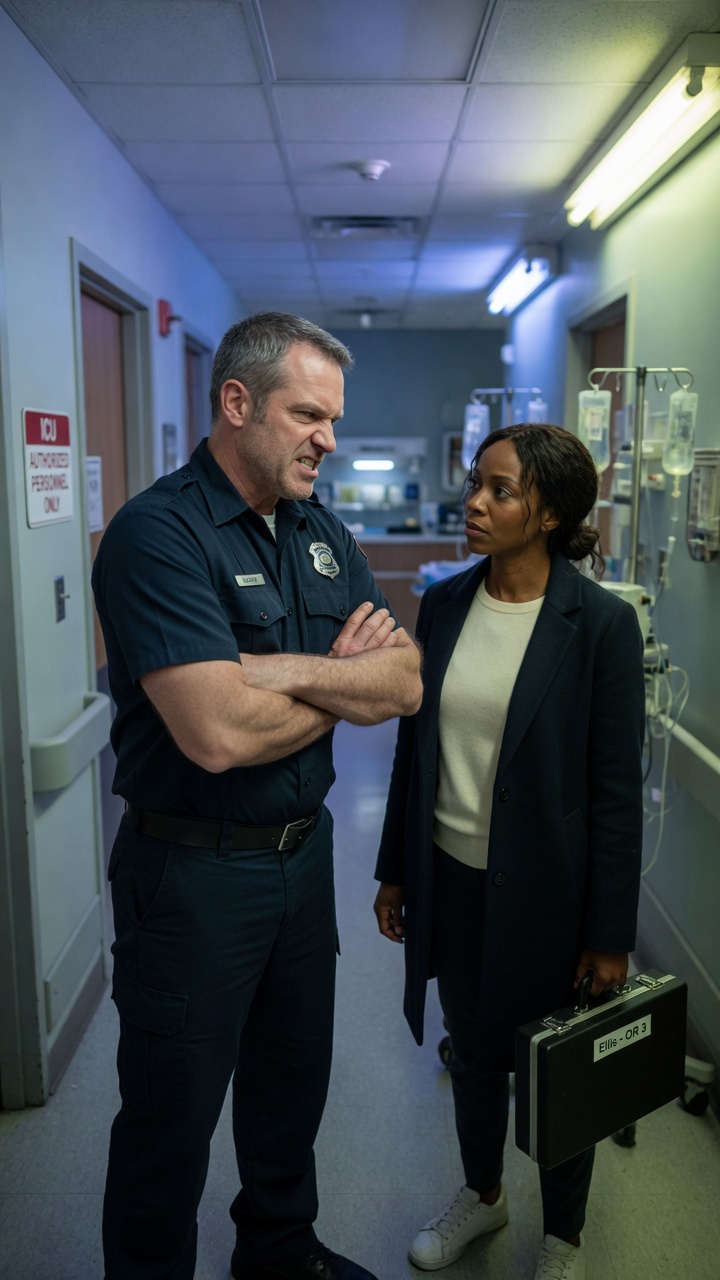
The first mistake Carl Mason made that morning was believing the woman at the ICU doors looked too tired to matter.
The second was assuming that mattered more than the badge clipped inside her coat.
By sunrise, St. Catherine’s Medical Center was already trembling under the weight of secrets. Ambulances screamed into the emergency bay. Nurses moved like shadows beneath fluorescent lights. Monitors beeped from behind glass walls, calling out the fragile rhythm of lives that had not yet decided whether they were staying.
On the twelfth floor, behind two restricted doors and a security checkpoint, Mayor Richard Langford was dying.
Not publicly.
Not yet.
To the city, he was still recovering from what his office had called “a minor cardiac episode.” His press secretary had issued a statement at 4:12 a.m. promising that the mayor was alert, stable, and surrounded by excellent medical staff.
None of that was true.
The mayor was unconscious.
His blood pressure had crashed twice.
His heart had torn in a place most surgeons only saw in textbooks, and the only person within reach who had successfully repaired that kind of damage more than once was stepping out of a black sedan at the ambulance entrance with rain on her shoulders and seventeen minutes of sleep behind her eyes.
Dr. Naomi Ellis did not look like anyone’s miracle.
She wore black travel pants, a plain cream sweater beneath a navy coat, and sneakers because she had changed in the back of a government aircraft somewhere over Kentucky. Her hair was pulled into a low bun, not perfectly, because perfection belonged to people who had not spent the night reading scans at thirty thousand feet. Her face was bare except for exhaustion, and in her right hand she carried a narrow black surgical case.
It did not look expensive.
It did not look dramatic.
It looked like something a person might carry through an airport without attracting attention.
That was the point.
Naomi paused under the hospital awning and looked up at the building. St. Catherine’s rose above downtown Westbridge like a monument to confidence: glass, steel, white stone, warm lights burning in patient rooms against a wet gray morning. There were banners along the entrance.
COMPASSION. EXCELLENCE. TRUST.
Naomi stared at the word trust for one second longer than the others.
Then she walked inside.
The lobby smelled of coffee, antiseptic, rainwater, and panic wearing perfume. A young resident hurried past with a stack of files pressed against his chest. A woman in a winter coat cried quietly near the information desk. Two police officers stood near the elevators, speaking low into radios.
Naomi moved past them without slowing.
She had been inside enough hospitals to know the difference between normal urgency and institutional fear. Normal urgency moved with purpose. This was different. This was a building pretending not to collapse.
At the security desk, a middle-aged woman looked up.
“Can I help you?”
“Dr. Naomi Ellis,” Naomi said. “I’m here for Mayor Langford. Cardiothoracic consult. ICU surgical authorization.”
The woman blinked, then checked her screen.
Naomi watched her fingers freeze over the keyboard.
“Yes,” the woman whispered, suddenly sitting straighter. “Yes, Doctor. They’ve been calling down every two minutes.”
“I need the ICU.”
“Twelfth floor. Elevator bank C. Security checkpoint outside the unit.”
The woman reached for a visitor badge.
Naomi lifted a hand gently. “I won’t need that.”
The woman hesitated.
Naomi opened her coat just enough for the woman to see the laminated federal medical clearance clipped inside.
The woman’s face changed instantly.
Not admiration.
Fear.
That reaction told Naomi more than she wanted to know.
“Yes, ma’am,” the woman said. “Of course.”
Naomi continued toward the elevators.
Behind her, someone whispered her name into a phone.
The elevator ride took forty-one seconds. Naomi counted because she needed something controlled to focus on. She rolled her shoulders once. She flexed her fingers. She pictured the mayor’s CT scan again: the tear, the swelling, the impossible angle. A mistake in the first ten minutes could kill him. A delay before incision could do the same.
When the doors opened onto the twelfth floor, the air changed.
ICU air always had its own weather. Cold. Dry. Too clean. Too full of machines trying to negotiate with death.
Two nurses stood at the far desk, speaking rapidly. One looked toward Naomi, then away, then back again. A pair of hospital security guards stood outside the restricted ICU entrance beneath a sign that read AUTHORIZED PERSONNEL ONLY.
The older guard had a square jaw, thick arms, and the bored posture of a man who believed the uniform gave him weight. His nameplate read MASON.
Carl Mason.
Naomi approached him calmly.
“Good morning,” she said. “Dr. Naomi Ellis. I’m cleared for the Langford case.”
Carl looked at her face.
Then at her clothes.
Then at the black case in her hand.
His eyes narrowed with a speed that felt practiced.
“ICU is restricted.”
“Yes,” Naomi said. “I know.”
“You family?”
“No. Surgeon.”
The younger guard beside Carl glanced up quickly. He was maybe twenty-five, nervous around the eyes. His nameplate read HILL.
Carl gave a short laugh.
Not loud.
Enough.
“Surgeon,” he repeated.
Naomi did not react.
“I need to enter now,” she said.
Carl shifted his body half an inch to block the door more fully.
“You got hospital ID?”
“My credentials were sent ahead. You can call Dr. Patel, Chief Medical Officer, or Dr. Greene in cardiothoracic.”
Carl looked at the case again.
“What’s in the bag?”
“Surgical instruments.”
His expression hardened.
“You can’t bring random equipment into an ICU.”
“It is not random equipment.”
“Open it.”
Naomi’s eyes settled on his.
“No.”
The younger guard shifted.
Carl’s face tightened. “Excuse me?”
“No,” Naomi repeated. “This case is sterile-sealed. It is logged, cleared, and registered for use in an emergency procedure. You can verify it with the surgical team, but you are not opening it in a hallway.”
Carl stared at her for three long seconds.
Behind the nurses’ station, conversations were slowing.
Naomi could feel attention gathering.
She hated that part most.
Not the insult. Not the disbelief. She had been doubted in better rooms by more polished men than Carl Mason. What she hated was the pause that always followed, the moment when other people noticed something wrong and began deciding whether silence would be more comfortable than courage.
Carl folded his arms.
“Listen, ma’am. We’ve got a high-profile patient in there. We can’t just let anybody walk in claiming to be a doctor.”
“Then verify me.”
“I’m doing that.”
“No,” Naomi said quietly. “You’re blocking me.”
His jaw moved.
That word hit him harder than it should have.
Blocking.
It named the thing he wanted to pretend was procedure.
A nurse stepped forward from the desk. “Mason, Dr. Greene said they’re waiting for an outside surgeon—”
Carl snapped a hand toward her without looking away from Naomi.
“I’ve got it.”
The nurse stopped.
Naomi saw it immediately.
Not hesitation.
Training.
This floor had learned to let Carl Mason have the first and last word.
Naomi looked back at him.
“Call upstairs,” she said. “Call the operating suite. Call the chief medical officer. Call anyone you need. But do it now.”
Carl smiled, and there was no humor in it.
“You’re in a hurry.”
“Yes.”
“Why?”
Naomi stared at him.
“Because a man is dying.”
Carl’s eyes flickered, but only for a moment.
“Everybody’s dying,” he said. “Doesn’t mean rules don’t apply.”
The younger guard, Hill, swallowed.
Naomi turned slightly toward him.
“Officer Hill, would you please contact Dr. Anika Patel and tell her Dr. Ellis is at the ICU checkpoint?”
Hill straightened. “Uh—yes, ma’am.”
Carl’s head whipped toward him.
“Don’t touch that radio.”
Hill froze.
The hallway went still.
Naomi exhaled through her nose.
“Mr. Mason,” she said, “I am going to say this clearly. If you continue delaying me without verifying my credentials, you may be interfering with emergency medical care.”
Carl stepped closer.
He was taller than her.
He wanted her to notice.
“You threatening me?”
“No. I’m documenting the risk.”
His eyes dropped again to her coat, her shoes, her case.
Then came the sentence.
The one that changed everything.
“You people always come in here thinking if you sound educated, everybody’s supposed to jump.”
The hallway seemed to lose oxygen.
The nurse at the desk looked down.
Hill closed his eyes briefly.
Naomi stood very still.
For a moment, she was not on the twelfth floor of St. Catherine’s Medical Center. She was fourteen years old again, standing beside her mother at a reception desk while a woman with pearl earrings explained that the specialist was very busy, and maybe they should try the county clinic first. She was twenty-six, in surgical rounds, being asked if she was there to transport the patient. She was thirty-three, holding retractors during a transplant while a visiting surgeon told her she was surprisingly articulate with anatomy.
Old rooms.
Different lights.
Same rot.
Naomi looked at Carl Mason and lowered her voice.
“You should call your supervisor.”
Carl smiled wider.
“I am the supervisor.”
“No,” she said. “You are a guard standing between a patient and the surgeon called to save him.”
His smile vanished.
A door opened down the hall. A woman in scrubs stepped out, pale and breathless.
“We need Dr. Ellis,” she said. “Now.”
Naomi turned toward her. “I’m Dr. Ellis.”
The woman’s relief flashed so fast it almost broke her face.
“Oh thank God.”
Carl lifted a hand and blocked Naomi again.
“Hold on.”
The woman stared at him. “Mason, what are you doing?”
“My job.”
“She’s expected.”
“She hasn’t shown me hospital ID.”
The woman pointed toward the ICU doors. “The mayor’s pressure is dropping. Dr. Greene is asking for her by name.”
“Then Dr. Greene can come identify her.”
Naomi’s fingers tightened once around the handle of the surgical case.
Not from fear.
From calculation.
Every second had a sound now.
Every second was blood moving in the wrong direction inside a man’s chest.
“Mr. Mason,” Naomi said, “this is your final opportunity to verify my credentials before your obstruction becomes part of the medical record.”
That should have stopped him.
It did not.
Because small men rarely recognize the edge of the cliff when they are the ones walking toward it.
Carl reached for the black case.
Naomi moved it behind her.
His face darkened.
“What are you hiding?”
“Sterile surgical tools.”
“I said open it.”
“And I said no.”
His hand closed around the case handle.
For one cold second, neither of them moved.
The hallway saw it.
The nurses saw it.
Hill saw it.
Carl Mason, hospital security supervisor, had placed his hand on a surgeon’s sterile emergency case during a cardiac crisis and decided his pride mattered more than a dying man.
Naomi looked down at his hand.
Then up at his face.
“Let go.”
Carl leaned closer.
“You don’t give orders here.”
A monitor alarm shrieked somewhere behind the ICU doors.
One long, sharp sound.
Then another.
The woman in scrubs spun toward the doors. “He’s crashing!”
The hallway erupted.
Nurses ran. A resident shoved through a side door. Someone shouted for pressors. Someone else yelled, “Call the OR!”
Naomi pulled once on the case.
Carl held it.
Not tightly enough to take it.
Just enough to prove he could.
That was the third mistake.
Naomi’s eyes changed.
Not dramatically.
Just enough.
All warmth disappeared.
“Mr. Mason,” she said softly, “you have three seconds to remove your hand.”
Carl scoffed.
“One.”
Hill whispered, “Sir…”
“Two.”
Carl looked around and realized too late that no one was smiling.
“Three.”
Naomi released the case.
Carl stumbled half a step backward with it.
Then Naomi reached inside her coat and removed a slim black credential wallet.
She opened it with one hand.
The gold seal caught the fluorescent light.
For a moment, Carl’s expression showed only confusion.
Then he read the first line.
DR. NAOMI ELLIS
CHIEF, ADVANCED CARDIOTHORACIC RECONSTRUCTION
NATIONAL HEART INSTITUTE
His eyes moved lower.
FEDERAL EMERGENCY SURGICAL RESPONSE AUTHORIZATION
Then lower still.
SPECIAL MEDICAL OVERSIGHT TASK FORCE
The color drained from his face.
Naomi did not raise her voice.
“That case,” she said, “is federal medical equipment assigned to an emergency procedure requested by the governor’s office, the mayor’s medical proxy, and your hospital’s chief medical officer.”
Carl’s mouth opened.
No sound came out.
Naomi stepped closer.
“You grabbed it in a public hallway after refusing to verify my identity.”
“I didn’t know—”
“You chose not to know.”
The ICU doors burst open.
Dr. Malcolm Greene, gray-haired, sweating, and furious, rushed into the hall.
When he saw Naomi, relief hit him so hard he nearly sagged.
“Dr. Ellis.”
Naomi looked at the case in Carl’s hand.
Dr. Greene followed her gaze.
His face went white.
“What the hell is he doing with your kit?”
Carl immediately shoved the case toward Naomi.
Naomi took it, but did not move yet.
“Has the hybrid OR been prepped?” she asked.
“Yes,” Greene said. “Team is scrubbed. We need you now.”
“Blood products?”
“Ready.”
“Perfusion?”
“Standing by.”
“Imaging?”
“Loaded.”
Naomi nodded once.
Then she looked at Carl.
“This is not over.”
Carl swallowed.
“I apologize if there was confusion—”
Naomi’s eyes hardened.
“There was no confusion.”
She turned and walked through the ICU doors.
No one stopped her this time.
The unit beyond was chaos under glass. Nurses moved fast around bed twelve. Mayor Richard Langford lay pale beneath bright lights, tubes and wires turning his body into a battlefield. His wife stood behind the glass wall with both hands pressed against her mouth. A young man Naomi recognized from press conferences—Evan Langford, the mayor’s son—was crying silently beside a hospital chaplain.
Naomi washed her hands.
Scrubbed.
Gloved.
Became still.
That was the part people never understood about surgery. It was not adrenaline. Not really. Adrenaline was messy. Surgery required something colder. A narrowing of the world until only the next necessary action remained.
She entered the operating room twelve minutes later.
The mayor’s chest was opened at 7:18 a.m.
At 7:23, Naomi saw the tear.
At 7:24, Dr. Greene whispered, “Can you repair that?”
Naomi did not answer immediately.
She studied the damage.
The angle was worse than the scan.
The tissue was fragile.
The margin was almost impossible.
But almost impossible was still not impossible.
“Yes,” she said.
Then she began.
Outside the OR, Carl Mason stood in the hallway with both hands hanging uselessly at his sides.
No one had told him where to go.
No one had needed to.
The nurses no longer looked at him with fear. That was the first thing he noticed. They looked at him with something colder. Distance. Like he had become a spill on the floor no one wanted to step in.
Hill stood three feet away, pale and silent.
Carl tried to breathe normally.
It didn’t work.
“She should have shown ID,” he muttered.
Hill looked at him.
“She tried.”
Carl turned on him. “Don’t start.”
“She asked you to verify her.”
“I was protecting the mayor.”
Hill’s voice dropped.
“No. You were protecting your ego.”
Carl stared at him.
For a second, the old instinct rose in him. The threat. The posture. The look that made younger guards shut up.
But Hill did not look away this time.
That scared Carl more than the credential had.
At the far end of the hall, elevator doors opened.
Three people stepped out.
The first was Dr. Anika Patel, Chief Medical Officer of St. Catherine’s, wearing a white coat over navy scrubs and an expression sharp enough to cut glass.
The second was a tall woman in a charcoal suit carrying a leather folder.
The third was a man with an earpiece and a federal badge clipped to his belt.
Carl’s stomach dropped.
Dr. Patel walked directly to him.
“Mr. Mason.”
“Doctor, I can explain—”
“No,” she said. “You cannot.”
The woman in the charcoal suit looked at Hill.
“Were you present during the interaction?”
Hill hesitated.
Carl’s eyes snapped toward him.
For years, that had been enough.
Not today.
Hill nodded. “Yes, ma’am.”
“Did Dr. Ellis identify herself?”
“Yes.”
“Did she request credential verification?”
“Yes.”
“Did Mr. Mason permit you to contact the medical team?”
Hill swallowed.
“No.”
Carl’s heart began pounding.
The woman wrote something down.
Carl pointed toward the ICU. “She refused to open the case.”
Dr. Patel’s face turned colder.
“Because opening a sterile surgical case in a public hallway would contaminate it.”
Carl’s mouth dried.
“I didn’t know that.”
“You supervise ICU access,” Patel said. “You absolutely should.”
The woman in the suit opened her folder.
“Mr. Mason, I’m Deputy Inspector Rachel Vale with the Office of Civil Rights Medical Access Division.”
Carl blinked.
He had never heard of that division.
That made it worse.
“We are conducting a formal review of St. Catherine’s Medical Center regarding delayed access incidents, discriminatory screening patterns, security overreach, and obstruction of emergency medical care.”
The words seemed too large for the hallway.
Carl heard only pieces.
Formal review.
Discriminatory.
Obstruction.
Emergency medical care.
He looked at Dr. Patel, waiting for her to dismiss it, to say this was a misunderstanding, to protect the hospital the way the hospital had always protected itself.
Dr. Patel did not.
Instead, she looked exhausted.
Like a woman who had known a storm was coming and had failed to stop the roof from blowing off.
“This morning,” Deputy Inspector Vale continued, “was not planned as a field test. Dr. Ellis was brought here because the mayor’s condition required her expertise.”
Carl exhaled.
For one wild second, relief moved through him.
Then Vale said, “But your conduct has just become the clearest real-time example we’ve documented.”
Carl’s knees felt weak.
“I didn’t know who she was.”
Vale looked at him.
“That is precisely the problem.”
The OR doors stayed closed for two hours and forty-nine minutes.
During that time, the hospital changed.
It did not happen loudly at first.
A nurse from pediatrics came down to give a statement. Then a respiratory therapist. Then a Black mother whose teenage son had waited forty minutes for a security escort while his oxygen levels dropped because someone decided she seemed “agitated.” Then an elderly man who had been asked three times if he was sure he was on the donor list because the front desk couldn’t find his “type of insurance,” though his chart had been active for eleven years.
People had been waiting for permission to speak.
Naomi Ellis’s confrontation cracked something open.
By 9:30 a.m., federal investigators had taken control of the security office.
By 9:47, Carl’s access badge was disabled.
By 10:02, hospital counsel arrived, speaking in careful sentences and sweating through his collar.
By 10:11, Mayor Langford’s office issued no statement because no one knew whether the mayor would live.
Inside OR 4, Naomi’s world had narrowed to a beating field of blood, thread, tissue, clamps, suction, breath.
“Pressure dropping,” anesthesia said.
“I see it,” Naomi replied.
Her hands did not rush.
“More suction.”
Dr. Greene watched from the opposite side, assisting but no longer leading. He had performed twenty thousand surgeries in his life. He had trained half the department. But Naomi Ellis moved in that chest like she had mapped the damage before it existed.
“Patch,” she said.
A nurse placed it in her palm.
The room quieted.
Even machines seemed to wait.
Naomi leaned closer.
One stitch.
Then another.
Then another.
Her shoulders burned. Her back screamed. Her eyes remained fixed.
At 10:26 a.m., the bleeding slowed.
At 10:31, it stopped.
At 10:34, the mayor’s pressure rose.
No one cheered.
Operating rooms did not allow that kind of arrogance.
But Dr. Greene looked at Naomi over his mask, and his eyes were wet.
“You did it,” he whispered.
Naomi tied the final knot.
“No,” she said. “He did.”
The mayor’s heart beat beneath her hands.
Weak.
Bruised.
Alive.
Naomi stepped out of the OR at 11:08 a.m.
Mayor Langford’s wife saw her first.
She stood so quickly the chair behind her hit the wall.
Naomi removed her surgical cap.
“He survived the repair,” she said. “He’s critical, but stable. The next twenty-four hours matter.”
Mrs. Langford made a sound that was almost a sob, almost a prayer.
Then she crossed the hallway and hugged Naomi before anyone could stop her.
Naomi stood still for half a second.
Then gently returned the embrace.
“Thank you,” the woman whispered. “Thank you.”
Naomi closed her eyes briefly.
“You’re welcome.”
When Mrs. Langford stepped back, her face changed.
She looked past Naomi toward the security checkpoint.
Toward Carl Mason, now seated in a chair outside an administrative office with no radio, no badge, no authority.
“What happened out here?” she asked.
Naomi followed her gaze.
Deputy Inspector Vale stepped forward.
“Mrs. Langford, we need to speak privately.”
But Mrs. Langford was not looking at Vale.
She was looking at Naomi.
Naomi understood the question behind the question.
Did they almost cost me my husband?
Naomi said nothing.
Silence answered.
Mrs. Langford turned pale.
The private meeting happened in a conference room on the tenth floor.
Naomi attended only because Vale asked her to.
Around the table sat Dr. Patel, hospital counsel, two federal investigators, Mrs. Langford, the mayor’s chief of staff, Dr. Greene, Officer Hill, and Carl Mason.
Carl looked smaller without his badge.
That was the thing about borrowed power. Once removed, it left a person strangely naked.
Vale placed a tablet in the center of the table.
“This recording begins at 6:42 a.m.”
Carl’s eyes snapped toward the screen.
Naomi did not look away.
The video came from the ICU hallway camera. Then Hill’s body microphone. Then a fixed access camera above the doors.
Everything was there.
Naomi identifying herself.
Carl questioning her.
Naomi requesting verification.
Carl refusing Hill permission to call.
Carl saying, “You people always come in here thinking if you sound educated, everybody’s supposed to jump.”
Mrs. Langford flinched as if slapped.
Hospital counsel closed his eyes.
Dr. Patel covered her mouth with one hand.
Carl leaned forward.
“That’s out of context.”
Vale paused the video.
The still image on the tablet showed Carl’s hand on Naomi’s surgical case.
“No,” Vale said. “It is not.”
Carl’s voice cracked. “I was doing security screening.”
“You did not screen,” Vale replied. “You obstructed.”
“She wouldn’t open the case.”
“She explained why.”
“I didn’t believe she was a surgeon.”
There it was.
Plain.
Ugly.
Unavoidable.
Naomi looked at him then.
Carl seemed to realize what he had said only after the room absorbed it.
He tried again.
“I mean, she didn’t look—”
He stopped.
But the sentence finished itself.
She didn’t look like what?
Like authority?
Like expertise?
Like the person everyone was waiting for?
Like someone whose delay could matter?
Mrs. Langford pushed back from the table.
“My husband could have died because you didn’t like how she looked?”
Carl turned to her desperately.
“No, ma’am. I swear, I was protecting him.”
Naomi’s voice entered softly.
“No, Mr. Mason. You were protecting the picture in your head.”
The room went silent.
Carl stared at her.
Naomi’s face was calm, but her eyes were not gentle.
“You saw a Black woman in travel clothes carrying a case, and you decided suspicion made more sense than competence. You had multiple ways to verify me. You refused all of them. Not because of safety. Because verification might prove you wrong.”
Carl’s lips trembled.
Dr. Patel looked down.
Vale opened another folder.
“This is not an isolated incident.”
Hospital counsel stiffened.
“Deputy Inspector—”
Vale ignored him.
“Over the past thirty months, St. Catherine’s has received forty-six complaints involving security delays at restricted care units. Thirty-eight involved Black patients, Black relatives, Black physicians, or nonwhite medical staff. Twenty-four were dismissed internally as communication issues. Eleven involved delayed treatment. Three ended in severe harm.”
The air left the room.
Mrs. Langford slowly sat back down.
Dr. Greene whispered, “Three?”
Vale turned a page.
“One involved a pregnant woman barred from Labor and Delivery for seventeen minutes because security insisted she was not the patient listed, despite matching wristband records. One involved a dialysis patient’s son denied access to provide medication history. And one involved a cardiac patient whose daughter was removed from the ICU waiting area after staff labeled her aggressive.”
Naomi’s hands went still in her lap.
She knew before Vale said the name.
She had known from the moment St. Catherine’s appeared on the federal review list.
But knowing did not protect the body from impact.
Vale’s voice softened.
“The patient’s name was Lorraine Ellis.”
No one moved.
Carl frowned, confused.
Naomi looked at the table.
Dr. Patel turned slowly toward her.
“Naomi…”
Naomi inhaled once.
“My mother,” she said.
The words did not shake.
That made them worse.
Mrs. Langford covered her mouth.
Naomi continued, “Four years ago, my mother was brought to this hospital with chest pain. My sister arrived ten minutes later with her medication list and prior surgical history. Security removed her from the cardiac waiting area because she demanded updates. They called her disruptive.”
Her eyes lifted to Carl.
“She was grieving. She was terrified. She was not disruptive.”
No one spoke.
“My mother’s chart was incomplete for thirty-two minutes. Her anticoagulant history was missing. That delay contributed to a treatment error.”
Dr. Patel’s face had gone gray.
“I didn’t know she was your mother.”
Naomi looked at her.
“I know.”
That was not forgiveness.
It was a blade.
Vale placed another document on the table.
“Lorraine Ellis’s case was one of the incidents that triggered the federal review.”
Carl shook his head.
“I wasn’t involved in that.”
Naomi turned to him.
“No. But you were part of the same culture that made it possible.”
Carl looked down.
For the first time, he had no answer.
The powerful thing about truth is that it does not always arrive screaming.
Sometimes it sits in a conference room under fluorescent lights and waits while everyone recognizes themselves.
Dr. Patel spoke quietly.
“Deputy Inspector, what happens now?”
Vale closed the folder.
“Security leadership is suspended pending review. Access protocols are frozen and replaced by federal emergency procedures. Complaint records will be audited. Any staff member found to have falsified, minimized, or retaliated against reports will be referred for prosecution or licensing action where applicable.”
Hospital counsel started to object.
Mrs. Langford turned on him.
“Don’t.”
One word.
Enough.
He shut his mouth.
Carl looked at Naomi.
“I’m sorry,” he said.
It sounded small.
Not fake exactly.
Just late.
Naomi studied him for a long moment.
“Sorry is what you say when you bump into someone in a hallway,” she replied. “You delayed emergency care because you thought your doubt was more important than my credentials.”
His face crumpled slightly.
“I didn’t mean for anyone to get hurt.”
Naomi leaned forward.
“That has never brought anyone back.”
Carl’s eyes filled.
But Naomi had no interest in his tears.
There were too many graves watered by the regret of people who only understood harm after consequences arrived.
The mayor woke thirty-one hours later.
His first words were not dramatic. They rarely are.
He asked for water.
Then his wife.
Then, after Dr. Greene explained the surgery, he asked for the woman who had saved his life.
Naomi entered his ICU room at 6:40 p.m. the following evening.
Mayor Langford looked smaller than he did on television. Pale. Bruised. Alive in the fragile way people are alive after being pulled back from the edge.
“Dr. Ellis,” he rasped.
“Mayor.”
“They tell me I owe you my life.”
Naomi checked his monitor.
“You owe your ICU team most of it. I was just the person holding the needle at the right moment.”
He smiled weakly.
“My wife says you’re modest.”
“No,” Naomi said. “Accurate.”
He tried to laugh and winced.
Then his expression changed.
“They told me what happened outside the unit.”
Naomi said nothing.
The mayor looked toward the glass wall where Carl Mason had once stood guard like a gatekeeper to someone else’s fate.
“I built half my career on this hospital,” Langford said. “Fundraisers. Expansion grants. Ribbon cuttings. I stood in the lobby and called it the soul of this city.”
Naomi looked at him.
“Hospitals are very good at looking holy from the outside.”
He closed his eyes.
“My office buried complaints.”
Naomi did not soften.
“Yes.”
He opened his eyes.
“You knew?”
“I suspected. The review confirmed patterns.”
The mayor swallowed.
“My chief of staff said some complaints were politically motivated.”
“Some pain is inconvenient to hear,” Naomi said. “That doesn’t make it false.”
He stared at the ceiling.
For a moment, he was not the mayor.
Just a man lying beneath machines, realizing the system he praised had nearly killed him because it had practiced on people with less protection first.
“What do I do?” he asked quietly.
Naomi’s answer came without hesitation.
“You tell the truth before someone else has to drag it out of you.”
Three days later, Mayor Langford held a press conference from a wheelchair.
He looked weak.
That made the statement stronger.
His wife stood behind him. Dr. Patel stood to one side, pale and silent. Deputy Inspector Vale stood to the other. Naomi stood in the back of the room, not on stage, because she had refused every request to become part of the performance.
The mayor told the city he had nearly died.
Then he told them why.
Not all of it. Federal investigations had limits. But enough.
He said a surgeon had been delayed by hospital security despite proper authorization.
He said the delay reflected a broader pattern.
He said the city would cooperate fully.
He said families who had filed complaints deserved answers.
He said the name Lorraine Ellis.
Naomi closed her eyes when he did.
For four years, her mother’s death had existed in paperwork as a complication.
A delay.
A miscommunication.
A regrettable event.
Now her name existed in the mouth of a mayor on live television.
Not enough.
But something.
Reporters shouted questions.
“Was this racism?”
“Will hospital leadership resign?”
“Who was the surgeon?”
“Is St. Catherine’s under federal investigation?”
The mayor looked tired.
Then he answered the only question that mattered.
“Yes,” he said. “This was a failure of dignity before it became a failure of medicine.”
The room went quiet.
Naomi opened her eyes.
Across the hospital, Carl Mason watched the press conference from a break room he no longer had permission to enter. His suspension papers sat folded in his hand. He had come back to collect his things under supervision.
No radio.
No keys.
No badge.
Just a cardboard box and the strange emptiness of a man discovering that authority had never been character.
Hill stood near the door.
Carl looked at him.
“You gave a statement.”
Hill nodded.
“You didn’t have to.”
“Yes,” Hill said. “I did.”
Carl’s face twisted.
“I trained you.”
Hill’s expression stayed steady.
“That’s what scared me.”
Carl looked away first.
Two federal agents escorted him out through a side entrance.
No crowd.
No shouting.
No dramatic arrest.
Just a man leaving a building he once believed belonged to him.
That was enough.
A week later, Naomi returned to St. Catherine’s one final time.
Not for surgery.
Not for testimony.
For her mother.
Deputy Inspector Vale had arranged access to the old cardiac waiting area where Lorraine Ellis had spent her final conscious hours. The chairs had been replaced since then. The walls repainted. A coffee machine hummed in the corner as if nothing terrible had ever happened there.
Naomi stood in the center of the room with her sister, Camille.
Camille was younger by six years and had their mother’s eyes. She had been the one removed from the waiting area. The one security called aggressive. The one who had screamed that their mother was allergic to a medication no one had written down.
For years, Camille had carried guilt like a second spine.
“I kept thinking if I had stayed calmer,” Camille whispered, “they would’ve listened.”
Naomi turned to her.
“No.”
Camille’s face broke.
Naomi took her hand.
“They trained you to blame your volume instead of their silence.”
Camille began to cry.
Naomi pulled her close.
For a long time, neither sister spoke.
Through the window, the city moved below them. Cars slid through late afternoon traffic. People crossed streets with coffee cups and grocery bags and phones pressed to their ears, unaware of how many lives could change behind hospital glass.
Camille wiped her face.
“Mom would’ve hated all this attention.”
Naomi smiled faintly.
“Mom once wrote a three-page letter to the school board because my history textbook skipped Reconstruction.”
Camille laughed through tears.
“Okay. She would’ve loved the investigation.”
“She would’ve brought snacks.”
They both laughed then.
Small.
Broken.
Real.
Behind them, Deputy Inspector Vale waited near the door, giving them space.
When Naomi finally turned, Vale held out a folder.
“What’s that?”
“Preliminary action list,” Vale said. “Security restructuring. Mandatory bias reporting. Emergency credential verification reforms. Patient advocate access. External complaint hotline. Criminal referrals pending.”
Naomi took the folder but did not open it.
“Will it hold?”
Vale exhaled.
“If people keep pushing.”
Naomi looked back at the waiting room.
“They always make justice sound like a door.”
Vale said nothing.
Naomi’s voice softened.
“It’s not. It’s a hallway. One locked door after another.”
Vale nodded.
“Your mother opened one.”
Naomi’s throat tightened.
“No,” she said. “She knocked. They refused to answer.”
She looked toward the ICU elevators.
“So I came back with the key.”
The following month, St. Catherine’s removed the banners from its lobby.
COMPASSION. EXCELLENCE. TRUST.
For two weeks, the walls stood blank.
Then new signs appeared.
Not slogans.
Instructions.
HOW TO REQUEST A PATIENT ADVOCATE.
HOW TO VERIFY MEDICAL STAFF CREDENTIALS.
HOW TO FILE A COMPLAINT WITHOUT RETALIATION.
EMERGENCY ACCESS CANNOT BE DENIED WITHOUT CLINICAL REVIEW.
Some people called it ugly.
Naomi called it honest.
Dr. Patel resigned before the federal report became public. Three administrators followed. Two security supervisors were referred for prosecution over falsified incident reports. Carl Mason lost his license to work in healthcare security and later testified under subpoena about pressure from hospital leadership to “control optics” around high-profile patients and “difficult families.”
Officer Hill stayed.
Six months later, he became part of the hospital’s restructured patient access team.
He sent Naomi one email.
You told him he chose not to know. I think a lot of us did. I’m trying not to anymore.
Naomi read it once.
Then she saved it.
Not because it fixed anything.
Because sometimes accountability began as a sentence someone was finally willing to write.
Mayor Langford survived.
Recovery changed him, or nearly dying did, or shame did. Naomi did not pretend to know which. He pushed through a citywide medical equity ordinance requiring independent review boards for hospitals receiving public funds. Critics called it political theater. Families who had buried loved ones called it overdue.
On the day the ordinance passed, Naomi received a package at her office.
Inside was a framed copy of the bill’s first page.
At the bottom, handwritten in black ink, was a note from the mayor.
Dr. Ellis, you saved one life in the operating room and many more outside it. I am sorry it took my life being endangered for me to see whose lives had already been treated as negotiable.
Naomi stared at the note for a long time.
Then she placed it in a drawer.
Not on the wall.
She did not need to look at his apology every day.
She needed the law to work.
That evening, Naomi drove to the cemetery where her mother was buried beneath a maple tree.
The grass was damp from spring rain. The sky had the soft purple color her mother used to call God showing off. Naomi carried no flowers. Lorraine Ellis had disliked cut flowers.
“They’re already dying,” she used to say. “Bring me something with roots.”
So Naomi brought a small pot of lavender.
She knelt beside the grave and pressed the pot into the soil.
For a while, she said nothing.
Then she told her mother about the mayor.
About Camille laughing again.
About the investigation.
About the waiting room signs.
About the guard who blocked her.
At that, she almost smiled.
“You would’ve told me to eat him alive politely,” she whispered.
The wind moved through the maple leaves.
Naomi sat back on her heels.
“I tried.”
A bird called somewhere beyond the hill.
For the first time in years, the silence around her mother’s grave did not feel like a sealed room.
It felt like an opening.
Naomi stood as the sun lowered.
Before leaving, she touched the top of the headstone.
DR. LORRAINE ELLIS
BELOVED MOTHER, TEACHER, AND TRUTH-TELLER
Naomi had paid extra for the final word.
Her sister had cried when she saw it.
Her mother would have pretended not to.
As Naomi walked back to her car, her phone buzzed.
A hospital in Atlanta needed a consult.
A child with a rare vascular defect.
Emergency transfer possible.
Naomi looked once more at the grave.
Then she answered.
“This is Dr. Ellis.”
Her voice was steady.
The world, as always, was already breaking somewhere else.
And as always, she was needed.
Behind her, lavender moved softly in the wind.
At St. Catherine’s, the ICU doors still opened and closed.
But now, every person who approached them saw the new sign mounted beside the security desk.
VERIFY BEFORE YOU DENY.
Four words.
Simple.
Sharp.
Too late for Lorraine Ellis.
Just in time, maybe, for someone else.
And somewhere in the memory of that bright, terrible morning, Carl Mason’s mistake remained exactly what it had been from the beginning.
Not loud at first.
Not dramatic.
Just one assumption.
One blocked doorway.
One Black woman he thought did not belong.
Until the doors opened, the truth walked through, and the whole hospital learned who had really been standing in the way.

![[FULL STORY] She Trusted Her Family—Until She Discovered Her Grandson Wasn’t Hers and They Were After Her Fortune](https://social.rabedo.com/storage/thumbnails/1776396676_D21.jpeg)
![[FULL STORY] My Girlfriend Said I Don't See You As A Boyfriend Anymore—Just A Roommate Who Pays](https://social.rabedo.com/storage/thumbnails/1777947563_25-.jpg)

![[FULL STORY] My Fiancée Declared: "I Won't Agree to a Prenup Either You Believe in Me, or We're Done](https://social.rabedo.com/storage/thumbnails/1776740751_9.png)