The first thing Detective Marcus Hale noticed about the woman cleaning the evidence room was that she did not look afraid enough.
That bothered him.
People were supposed to look uncomfortable down there.
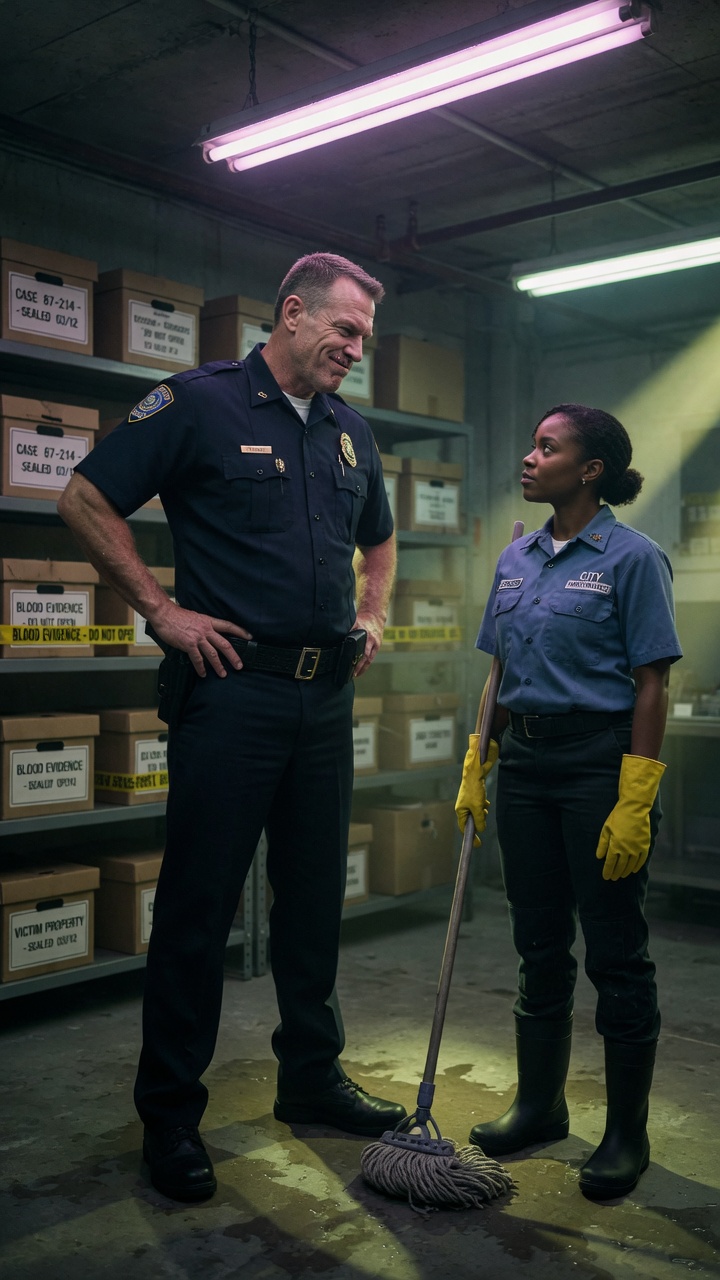
The basement level of the Briar County Sheriff’s Department had a way of doing that to people. It sat beneath the main building like a second memory nobody wanted to admit existed. Low ceiling. Flickering lights. Gray concrete walls sweating from old pipes. Rows of steel shelves stacked with sealed boxes, plastic bins, tagged weapons, bloodstained clothes, broken phones, rusted tools, and forgotten lives reduced to barcodes.
Most people walked into that room and lowered their voices.
Most people understood they were standing among ghosts.
But this woman moved through it like she belonged.
She wore a faded blue cleaning-company shirt tucked into black work pants, rubber gloves, and old sneakers that made almost no sound against the floor. Her hair was pulled into a low bun. Her face was calm. Her eyes were focused. Not wandering. Not nervous. Focused.
She was mopping near Cage Three when Hale came in with two younger deputies behind him.
He had not expected anyone to be there.
That irritated him too.
The evidence room was his place after hours. Not officially, of course. Officially, it belonged to the department. Officially, access required logged entry, double authorization, and a valid case number.
But official rules were for people without history.
Marcus Hale had history.
Twenty-seven years in Briar County. Fifteen as a detective. Three sheriffs served under. Two internal investigations survived. One reputation carefully built out of fear, favors, and knowing where every old file was buried.
He stopped at the bottom of the stairs and stared at the woman.
She did not stop mopping.
One of the younger deputies, a red-haired kid named Collins, leaned toward him.
“Detective? You know her?”
Hale did not answer right away.
He let the silence stretch.
He liked letting people feel the weight of his attention.
Finally, he said, “I know what she’s supposed to be doing.”
The woman glanced up.
Just once.
Then went back to the floor.
No apology.
No nervous smile.
No “sorry, sir.”
Hale’s jaw tightened.
“Hey.”
The mop moved once more across the concrete.
Then she stopped.
Slowly, she turned.
“Yes?”
Her voice was steady.
That made it worse.
Hale walked farther into the evidence room, his shoes clicking in a way that announced ownership. Deputy Collins followed. Deputy Marlowe, the quieter one, stayed near the stairs.
“What are you doing down here?” Hale asked.
She looked at the mop in her hand.
“Cleaning.”
Collins snorted.
Hale smiled.
Not because it was funny.
Because he had an audience.
“Cleaning,” he repeated. “That what they told you to say?”
The woman looked at him for a moment.
“It’s what I’m doing.”
Her answer was simple.
Too simple.
Hale took another step toward her.
“You got a name?”
“Lena.”
“Lena what?”
“Lena from maintenance.”
Collins laughed under his breath.
Hale looked around the room, then back at her.
“Well, Lena from maintenance, this is a restricted evidence area.”
“I know.”
“You know?”
“Yes.”
“You always this comfortable around evidence?”
She placed the mop into the yellow bucket and wrung it carefully.
“I’m comfortable around floors.”
Collins laughed louder this time.
Hale did not.
He studied her.
Something about her tone bothered him. Not disrespect exactly. Worse. She sounded as if she was letting him perform.
And Marcus Hale hated feeling observed.
He pointed toward Cage Three.
“You were too close to that shelf.”
Lena looked at the locked cage behind her.
“I was cleaning the floor in front of it.”
“You reading labels?”
“No.”
“You sure?”
“Yes.”
“You people always sure until somebody checks the camera.”
The words landed flat and ugly in the cold room.
Deputy Marlowe looked down.
Collins shifted but did not speak.
Lena’s face did not change.
That bothered Hale most of all.
He wanted a flinch.
A flash of anger.
A crack he could use.
Instead, she looked at him the way a doctor might look at a symptom.
“You can check the camera,” she said.
Hale tilted his head.
“Don’t tell me what I can check.”
“I didn’t.”
“No, you just got clever.”
Lena picked up the mop again.
“I’m almost done.”
Hale stepped into her path.
“No. You’re done when I say you’re done.”
For the first time, her eyes settled fully on him.
They were dark, direct, and tired in a way that did not belong to the late hour.
Not tired from cleaning.
Tired from waiting.
Hale felt the smallest pinch of unease.
He buried it under contempt.
“You new?”
“Yes.”
“Where’d they find you?”
Lena did not answer immediately.
Collins laughed again, eager now.
“Probably that temp place over on Maple. They send anybody with a pulse.”
Hale smiled, grateful for the opening.
“Anybody with a pulse and a badge scanner they don’t know how to use.”
Lena looked toward the door.
“My supervisor checked me in.”
“Name?”
“Mr. Keller.”
Hale nodded slowly.
“Night facilities manager. Drunk by nine most evenings. Great reference.”
Marlowe finally spoke quietly.
“Detective, she’s probably just doing her job.”
Hale turned on him.
The look alone shut him up.
Then Hale faced Lena again.
“You know what’s funny?”
Lena said nothing.
“I’ve worked homicide longer than you’ve probably been cleaning offices. I can tell when somebody is somewhere they shouldn’t be.”
He stepped closer.
“This room eats people who get curious.”
The fluorescent light above them buzzed.
Somewhere in the walls, old pipes knocked.
Lena held his gaze.
“Does it?”
The question was soft.
Too soft.
Hale stared at her.
“What’s that supposed to mean?”
“Nothing.”
“It didn’t sound like nothing.”
She lowered her eyes to the wet floor.
“I meant evidence rooms preserve things. They don’t eat them.”
For one second, the room changed.
Not visibly.
But Hale felt it.
A small shift under his feet.
Like a floorboard giving way.
He looked at her again, more carefully now.
“Who talks like that?”
Lena resumed mopping.
“Someone who wants to finish before the floor dries uneven.”
Collins chuckled.
Hale did not.
He moved past her toward the back shelves, pretending to inspect the labels. His eyes flicked toward Cage Three.
Old homicide overflow.
Restricted.
Closed cases.
Legacy boxes.
A place nobody entered without him knowing.
The woman had been cleaning near the bottom shelf.
The bottom shelf held forgotten things.
Or things that were supposed to be forgotten.
Hale turned back.
“Stay away from Cage Three.”
Lena dipped the mop again.
“Is there a reason?”
Hale smiled.
“There are dead people in there.”
She looked up.
“There are dead people all over this room.”
Deputy Marlowe looked at her sharply.
Collins stopped laughing.
Hale’s smile faded.
Lena’s expression remained calm.
“That’s what evidence means,” she said.
Hale walked toward her until he stood close enough for her to smell the coffee on his breath.
“You got a mouth on you for somebody holding a mop.”
Lena did not step back.
“And you talk a lot for somebody standing in a room full of microphones.”
Hale froze.
Only for a second.
Then he laughed too loudly.
“Microphones?”
She nodded toward the ceiling.
“Cameras. Audio. Motion log. That’s standard evidence storage now, isn’t it?”
Hale stared at her.
Collins glanced upward.
Marlowe did too.
There were cameras in the room.
Old ones.
Half of them useless.
The audio had not worked in years.
Or so Hale thought.
He leaned closer.
“You read the department manual before applying to scrub toilets?”
Lena finally smiled.
Barely.
“No.”
That tiny smile hit Hale harder than any insult.
He pointed at the stairs.
“Get out.”
Lena looked at the unfinished floor.
“I still have this section.”
“I said get out.”
She placed the mop carefully against the bucket.
Then she removed her gloves.
Slowly.
Not because she was scared.
Because she wanted him to notice.
“I’ll report that you stopped the scheduled cleaning.”
Hale laughed.
“To who?”
“My supervisor.”
“Tell him Detective Hale said the evidence room is secure.”
Lena picked up the bucket handle.
“You’re Detective Hale?”
His expression sharpened.
“That’s right.”
“Marcus Hale?”
Now the unease returned.
Stronger.
“You know me?”
She looked at him for a second too long.
“People mention you.”
Hale smiled again, but this time it was thinner.
“I bet they do.”
Lena rolled the bucket toward the stairs.
As she passed him, Hale said, “One more thing.”
She stopped.
He pointed toward the small trash bag on her cart.
“Leave that.”
“It’s trash.”
“Evidence room trash doesn’t leave without inspection.”
She nodded.
“Of course.”
No argument.
No hesitation.
She lifted the small clear liner from the cart and handed it to him.
Hale took it.
Inside were paper towels, dust, an empty disinfectant wipe packet, and one broken rubber band.
Nothing.
Still, he held it up like a trophy.
“See? That’s procedure.”
Lena looked at the bag.
Then at him.
“Is it?”
He did not like that question either.
She turned and walked up the stairs, leaving the basement colder than before.
Collins laughed once she was gone.
“Man, she had an attitude.”
Hale did not respond.
His eyes remained on the stairwell.
Marlowe cleared his throat.
“Detective?”
Hale turned.
“What?”
“You want me to log that?”
“Log what?”
“The cleaning interruption.”
Hale stared at him until the young deputy looked away.
“No.”
Collins smirked.
Hale walked to Cage Three and checked the lock.
Still secured.
He crouched near the bottom shelf.
The boxes sat exactly where they always had.
Old cardboard. Faded labels. Yellowing tape.
CASE 01-447B.
CROSS, SAMUEL.
HOMICIDE OF LAW ENFORCEMENT OFFICER.
CLOSED.
Hale stared at the name.
Samuel Cross.
Even after twenty-two years, the dead man had a way of making the room feel smaller.
Detective Samuel Cross had been a problem long before he became a body.
Too careful.
Too curious.
Too clean.
He had asked questions about missing drug money, altered witness statements, planted weapons, and why certain evidence tags never matched court records.
Then one November night, he was found shot behind an abandoned mechanic’s garage on Route 9.
Official story: gang retaliation.
Unofficial truth: he had opened the wrong door.
Hale stood slowly.
“Lock up,” he told Collins.
Then he left the evidence room without looking back.
He did not notice the tiny black device hidden beneath the rim of the cleaning cart’s wheel.
He did not notice the blue light blinking once.
And he did not know that upstairs, in the women’s restroom with the broken hand dryer, Lena from maintenance was standing at the sink, peeling off the temporary name patch from her shirt.
Underneath, clipped flat against her waistband, was a state-issued credential.
LENA CROSS.
FORENSIC EVIDENCE AUDITOR.
SPECIAL REVIEW DIVISION.
OFFICE OF THE ATTORNEY GENERAL.
She stared at herself in the mirror.
For twenty-two years, people had said her father’s case was solved.
For twenty-two years, they had told her mother to move on.
For twenty-two years, every request for access had disappeared into the same bureaucratic fog.
File unavailable.
Evidence degraded.
Records incomplete.
No basis for reopening.
But two months ago, a retired clerk from Briar County sent a letter to the attorney general’s office.
Not an email.
Not a phone call.
A letter.
Three pages, handwritten.
I am dying, and I cannot take this with me.
Detective Samuel Cross was murdered by someone inside the department.
The evidence is still there.
Look under the wrong name.
That was all it took.
Not justice.
Not truth.
Just one person running out of time.
The state attorney general approved a quiet preliminary audit of Briar County’s evidence storage. Officially, it was part of a statewide modernization program. Unofficially, Lena requested the assignment before anyone could stop her.
Her supervisors argued.
Conflict of interest.
Emotional proximity.
Legal risk.
Lena listened to all of it.
Then she asked one question.
“If I’m too close to the case to find the truth, why was everyone else far enough away to lose it?”
No one had a good answer.
So they gave her one week undercover.
One week to determine whether evidence still existed.
One week before formal warrants, subpoenas, cameras, reporters, lawyers, and panic ruined the trail.
Tonight was night one.
And Marcus Hale had just confirmed three things.
He knew Cage Three mattered.
He knew her father’s box mattered.
And he was afraid of someone with a mop.
Lena removed the cleaning shirt, folded it, and placed it into her backpack.
Underneath, she wore a plain black blouse.
Her phone buzzed.
A message from Deputy Attorney General Miriam Vale.
STATUS?
Lena typed:
Confirmed Hale sensitive to Cage Three. Cross box present. Access protocols compromised. Audio bait successful.
A pause.
Then Vale replied:
Do not engage Hale alone again.
Lena looked at the message.
Then at her reflection.
She could still hear Hale’s voice.
This room eats people who get curious.
She typed back:
Too late.
The next morning, Briar County woke beneath a hard rain.
Water ran through gutters and gathered in potholes outside the sheriff’s department. The building looked almost respectable from the street. Brick front. Flagpole. Memorial plaque. Bronze letters spelling HONOR, DUTY, SERVICE above the entrance.
Lena arrived through the side door at 5:42 a.m., wearing the cleaning uniform again.
Night facilities manager Keller barely looked up from his desk.
“You’re early.”
“I like empty buildings.”
He grunted.
“Basement again?”
“Third floor first.”
“Fine by me.”
He waved her through with his access card.
No ID check.
No escort.
No log note.
Briar County did not have an evidence problem.
It had an arrogance problem.
Lena cleaned the third-floor hallway until Keller disappeared into the break room. Then she took the service stairs down one level, crossed through records, and entered the file archive using a key she was not supposed to have.
The retired clerk’s letter had included one clue.
Look under the wrong name.
For two hours, Lena searched.
Not Cross.
Not Samuel.
Not officer homicide.
Not Route 9.
She searched the old misfiled overflow boxes marked by year.
1999.
2000.
2001.
Her father died in 2002, but corruption rarely started with the murder. Murder was usually the cleanup.
She found the first wrong name at 7:13 a.m.
CASE 01-447B was not only listed under Cross.
It appeared in an archived transfer log under:
CROSSING, SAM.
Property damage.
No victim.
No suspect.
No evidence.
A typo too convenient to be accidental.
Lena photographed the page.
Then another.
Then another.
By 8:05, she found a second entry.
Evidence transfer, 2004.
Item 01-447B-12 moved to Cold Storage Annex.
Authorized by M. Hale.
Her pulse changed.
She read it twice.
Then a third time.
Marcus Hale had transferred evidence from her father’s murder two years after the case was supposedly closed.
She sent the image to Miriam Vale.
The reply came quickly.
Can you identify item 12?
Lena checked the original intake list.
01-447B-12.
Cassette tape recovered from victim’s vehicle.
Lena stopped breathing.
Her father had a habit her mother used to hate.
He recorded voice notes on tiny cassette tapes while driving. Case thoughts. Grocery reminders. Songs he heard on the radio. Birthday ideas. Anything.
After he died, investigators told the family no recorder was found in his car.
Her mother had asked twice.
Naomi Cross had stood in the sheriff’s department lobby wearing a black dress and a funeral scarf, asking for her husband’s recorder because she wanted to hear his voice one more time.
They told her it was not there.
Lena gripped the archive table until the edge dug into her palm.
Item 12 existed.
It had existed.
And Marcus Hale had moved it.
The archive door opened behind her.
Lena turned.
Deputy Marlowe stood there holding a stack of folders.
His eyes widened when he saw her.
“You’re not supposed to be in here.”
Lena’s face went blank.
“Supplies.”
He looked at the open file drawer.
“At a records table?”
She did not answer.
He stepped inside and closed the door behind him.
He was young. Maybe twenty-six. Brown hair. Nervous eyes. A man not yet fully ruined but working in a place eager to finish the job.
“You were in the evidence room last night,” he said.
“Yes.”
“And now records.”
“Yes.”
“I should call this in.”
“You should.”
He hesitated.
That hesitation told Lena more than his words.
“You won’t,” she said.
His face tightened.
“You don’t know me.”
“No,” Lena said. “But I know what people look like when they’re trying to decide whether to be brave.”
Marlowe swallowed.
Rain tapped against the small high window.
“I don’t want trouble.”
“That’s usually how trouble survives.”
He looked toward the hall.
“If Hale finds you in here—”
“He already found me.”
“No,” Marlowe said quietly. “I mean if he finds out you’re looking for that case.”
Lena went still.
Marlowe looked down at the folders in his hands.
“You know the Cross case?”
He did not answer.
“Marlowe.”
His eyes flicked up.
“You knew my father?”
The question left her mouth before she could stop it.
His face changed.
“Your father?”
Lena realized the mistake immediately.
Too much.
Too soon.
Marlowe stared at her.
“You’re Samuel Cross’s daughter?”
For one second, the entire operation balanced on a thread.
Lena could deny it.
She should deny it.
Instead, she said nothing.
Marlowe’s shoulders sagged.
“Oh God.”
He set the folders down slowly.
“My dad knew him,” he whispered. “My father was a patrol deputy back then. He quit six months after Detective Cross died.”
“Why?”
Marlowe rubbed his face.
“He said the department got quiet in the wrong way.”
Lena stared at him.
“What does that mean?”
“I don’t know. I was a kid.”
“Ask him.”
“He’s dead.”
The answer softened something in her, but only for a second.
“Did he ever mention a cassette tape?”
Marlowe looked toward the door again.
“No.”
“Evidence moved to Cold Storage Annex?”
His eyes sharpened.
“The annex flooded in 2011.”
“I know.”
“No, I mean they used that as an excuse. A lot of stuff vanished after that.”
“Vanishes where?”
Marlowe hesitated.
Then lowered his voice.
“There’s an old sub-basement under the vehicle bay. Not on the public floor plan. They call it the cage. Retired guys used it for overflow before digital tracking.”
Lena’s heartbeat picked up.
“Who has access?”
“Hale. Sheriff Danton. Maybe two others.”
Danton.
The current sheriff had been a lieutenant when her father died.
He had stood beside her mother at the funeral and promised the department would never stop honoring Samuel’s sacrifice.
Lena remembered his hand on her shoulder.
Too heavy.
Too cold.
She was nine years old.
She had wanted to bite him.
“Can you get me in?” she asked.
Marlowe’s eyes widened.
“No.”
“Can you?”
“You don’t understand.”
“I understand enough.”
“No, you don’t.” His voice shook now. “People who ask about Cross don’t last here.”
Lena stepped closer.
“My father didn’t last here.”
Marlowe looked at her for a long moment.
Something in him gave way.
Not courage.
Not yet.
Shame.
“There’s a maintenance panel near the old vehicle wash. It opens into the sub-basement corridor. No camera in that section because the wiring’s dead.”
“When?”
“Hale leaves for lunch at one. Danton has a county budget meeting. You’d have maybe fifteen minutes.”
“I need thirty.”
“You’ll get fifteen.”
Lena nodded.
Marlowe grabbed the folders and opened the door.
Before leaving, he turned back.
“My father used to say Samuel Cross was the only honest man in a room full of mirrors.”
Lena felt the words hit somewhere deep.
Marlowe left.
Lena stood alone in the archive, surrounded by boxes that had lied for twenty-two years.
At 1:07 p.m., she entered the sub-basement.
The maintenance panel opened harder than Marlowe promised, scraping loudly against the concrete. Lena slipped through sideways, flashlight between her teeth, heart steady but loud.
The air below smelled different.
Old water.
Dust.
Motor oil.
Rot.
She moved through a narrow passage under exposed pipes until she reached a chain-link door secured with a padlock older than some of the deputies upstairs.
Marlowe had given her the code on a folded receipt.
7-4-2-9.
The lock opened.
Inside, shelves lined the walls.
Not official shelves.
Forgotten shelves.
The kind nobody dusted because dust helped the lie.
Boxes sat stacked in crooked rows. Some had proper evidence labels. Some had handwritten names. Some had no markings at all.
Lena scanned fast.
CROSS.
CROSSING.
SAM.
ROUTE 9.
447B.
Nothing.
Her phone timer showed eleven minutes left.
She checked lower shelves.
Middle shelves.
A rusted filing cabinet.
At minute nine, she found it.
Not under Cross.
Not under Samuel.
Under a name she had not thought about in years.
BIRDWATCH.
Her father’s nickname for her.
When Lena was little, she used to sit at the kitchen window and identify birds from a library book while he cooked dinner badly and loudly. Cardinals. Wrens. Blue jays. Sparrows.
He called her Birdwatch.
Nobody outside the family knew that.
The box was small, water-stained, and sealed with brittle brown tape.
Her hands trembled as she cut it open.
Inside were three things.
A cracked leather notebook.
A cassette tape in a plastic case.
And a small evidence bag containing a brass key.
Lena stared at the tape.
Her father’s handwriting covered the label.
IF FOUND, GIVE TO NAOMI.
Her mother.
For a moment, Lena was nine years old again, sitting on the stairs while adults whispered downstairs and her mother made a sound that did not seem human.
Then footsteps sounded above her.
Heavy.
Slow.
Coming down.
Lena froze.
A flashlight beam moved across the passage outside the cage.
Then Marcus Hale’s voice cut through the dark.
“I know you’re in here.”
Lena slipped the cassette into her inside pocket.
The notebook followed.
The key stayed in her hand.
Hale appeared at the cage door, gun drawn but pointed low.
His face looked different down here.
No audience now.
No young deputies to impress.
Only the truth and the woman holding it.
“You really should’ve stayed with the mop,” he said.
Lena slid the box back slightly with her foot.
Hale saw the movement.
His eyes went to the shelf.
Then to her pocket.
For the first time, she saw real fear in him.
Not fear of her.
Fear of what she had found.
“You don’t know what you’re touching,” he said.
Lena’s voice was steady.
“I know exactly what I’m touching.”
“You’re trespassing in a secured police storage area.”
“You mean the secret sub-basement you keep off the floor plan?”
His jaw tightened.
“Give me what you took.”
“No.”
His hand tightened around the gun.
“You think your father was a hero?”
There it was.
The mistake.
Lena felt the recorder clipped beneath her collar vibrate softly.
Streaming.
Live.
To Miriam Vale.
To the attorney general’s server.
To three state investigators waiting two blocks away for probable cause.
Lena looked at Hale.
“I think you’re about to tell me.”
He smiled, but it was ugly and strained.
“Samuel Cross was a self-righteous son of a bitch who thought paperwork made him bulletproof.”
Lena said nothing.
“He couldn’t leave things alone. Drug seizures. Cash logs. Informants. He thought he could pull one thread and not hang himself with it.”
“Who killed him?”
Hale laughed.
“You came all this way and still think I’m stupid?”
“Yes.”
His smile vanished.
Lena took one step closer to the cage door.
“You’ve been scared of a dead man for twenty-two years.”
Hale lifted the gun slightly.
“Careful.”
“No,” Lena said. “You be careful. Because every word you say from this point forward is either evidence or confession.”
His eyes flicked toward her collar.
Then he understood.
Not everything.
Enough.
His face drained.
“You’re wired.”
Lena held his gaze.
“You talk too much for someone standing in a room full of microphones.”
The words returned to him from the night before.
His own mockery reversed.
For half a second, he looked like he might shoot her anyway.
Then another voice spoke from behind him.
“Detective Hale.”
He turned.
Deputy Marlowe stood at the far end of the passage, both hands visible, face pale.
Behind him were three people in dark jackets.
STATE ATTORNEY GENERAL INVESTIGATIONS.
Miriam Vale stepped forward first.
Gray-haired, calm, terrifying.
“Lower the weapon.”
Hale’s mouth opened.
Miriam repeated, “Now.”
Hale looked from her to Lena.
Then to Marlowe.
“You stupid kid.”
Marlowe flinched, but did not move.
State investigators stepped in and took Hale’s gun.
He did not resist.
Men like him rarely resisted when the room finally belonged to someone else.
They preferred paperwork.
Lawyers.
Technicalities.
Miriam entered the cage and looked at Lena.
“You have it?”
Lena touched her pocket.
“Yes.”
“Are you hurt?”
“No.”
Miriam studied her face.
“That was not an answer.”
Lena looked at Hale.
“Not by him.”
They brought everyone upstairs.
Not quietly.
That was Miriam Vale’s decision.
If corruption survives in basements, she once told Lena, sunlight should be part of the warrant.
By 2:03 p.m., state investigators flooded the Briar County Sheriff’s Department.
By 2:10, Sheriff Danton’s budget meeting was interrupted by two agents with a warrant.
By 2:17, every entrance to the evidence room was sealed.
By 2:24, Detective Marcus Hale was seated in Interview Room Two, no badge, no gun, no belt.
And by 2:31, the department knew the woman they had watched mopping the floor was not maintenance.
She walked through the homicide bullpen in her black blouse, credential clipped where everyone could see it now.
LENA CROSS.
Forensic Evidence Auditor.
Special Review Division.
Some deputies stared.
Some looked away.
A few looked ashamed.
Collins, the young deputy who had laughed the night before, stood frozen beside his desk.
Lena stopped in front of him.
His face turned red.
“I didn’t know,” he said.
Lena looked at him.
“That’s what everyone says after they’ve already chosen.”
He lowered his eyes.
She walked on.
In the evidence room, Miriam stood beside the table while a state technician prepared the cassette.
Lena’s mother was on video call from Nashville.
Naomi Cross was seventy-two now. Her hair had gone silver. Her hands, once strong from braiding Lena’s hair and kneading dough and gripping grief by the throat, trembled around the phone.
“Are you sure?” Naomi asked.
Lena stood over the cassette player.
“No.”
Her mother gave a sad smile.
“You always were honest when it hurt.”
Lena swallowed.
Miriam nodded to the technician.
The cassette clicked.
Static filled the room.
Then her father’s voice came through.
Rough.
Breathless.
Alive.
“Naomi, if you’re hearing this, I’m sorry.”
Lena gripped the table.
Her mother covered her mouth.
Samuel Cross breathed hard on the tape. In the background, an engine ticked softly. Rain struck glass.
“I don’t have much time. I found the ledger. Danton’s crew has been moving seizure money through fake informant payments. Hale is part of it. Greer too. I thought Sheriff Bell was the top, but it’s Danton. It’s always been Danton.”
Miriam’s face tightened.
The room was silent except for the dead man speaking.
“I left the key where Birdwatch would know to look. Not because I want her in this. God forgive me, I don’t. But because someday they’ll tell her I was reckless. They’ll tell her I got myself killed. They’ll tell her to move on.”
His voice cracked.
“Baby girl, don’t believe people who profit from your silence.”
Lena closed her eyes.
A sound escaped her mother.
A sob shaped like twenty-two years.
The tape continued.
“If I don’t come home, tell Lena I saw the red-tailed hawk today. The one by the water tower. She’ll know. Tell her I was thinking of her.”
Lena pressed her fist to her mouth.
The tape rustled.
Then a distant voice.
Male.
Sharp.
“Sam!”
Her father whispered, “Danton’s here.”
Another voice, closer now.
“Put it down, Cross.”
Samuel’s breathing changed.
Then he said, very clearly, “No.”
A gunshot cracked through the room.
Naomi screamed through the phone.
Lena’s knees weakened, but Miriam caught her arm.
On the tape, there was a thud.
Rain.
Footsteps.
Then Sheriff Danton’s younger voice said, “Find the tape.”
Hale’s voice answered, “He had a recorder in the car.”
Danton said, “Then make it disappear.”
The tape ended in static.
No one moved.
No one breathed.
For twenty-two years, Samuel Cross had been buried under a lie.
Now his killers had convicted themselves with his last breath.
Miriam turned to the state investigators.
“Arrest Danton.”
They found Sheriff Danton in his office, standing behind his desk as if furniture could protect him.
He was older now, heavier, with white hair and a flag pin on his lapel. The kind of man who had spent decades being photographed at charity breakfasts and police memorials.
When Lena entered behind the investigators, his eyes went directly to her.
For a moment, he did not see the credential.
He saw the child from the funeral.
The little girl in a black dress who refused to cry while everyone watched.
“Lena,” he said softly.
She hated the sound of her name in his mouth.
State Investigator Ruiz stepped forward.
“Sheriff Robert Danton, you are under arrest for conspiracy, obstruction of justice, evidence tampering, and the murder of Detective Samuel Cross.”
Danton did not look at Ruiz.
He looked at Lena.
“You don’t understand what your father was going to do.”
Lena’s face remained still.
“He was going to expose you.”
Danton’s eyes hardened.
“He was going to destroy this department.”
“No,” Lena said. “You did that.”
The words landed with quiet force.
Outside the office, deputies gathered in the hall.
Some shocked.
Some frightened.
Some old enough to remember.
Danton looked past her at them.
“You think this is justice?” he demanded. “You think digging up a dead man helps anyone?”
Lena stepped closer.
“No. I think burying him helped you.”
His face twisted.
“You have no idea what this county was like back then.”
“I know exactly what men say when they want history to excuse murder.”
For the first time, his confidence cracked.
Ruiz moved behind him with handcuffs.
Danton resisted just slightly.
Not enough to fight.
Enough to show he still thought obedience should be negotiated.
The cuffs clicked around his wrists.
The sound was small.
To Lena, it was thunder.
As they led him out, he stopped beside her.
His voice dropped low.
“Your father should have stayed in his lane.”
Lena looked at him for a long moment.
Then she said, “That was his lane.”
Danton had no answer.
They walked him through the bullpen.
No back exit.
No private elevator.
No hidden route.
The sheriff who had spoken at Samuel Cross’s funeral was led past the memorial wall where Samuel’s photograph still hung.
Young face.
Kind eyes.
Badge polished.
Below the photo, the plaque read:
DETECTIVE SAMUEL E. CROSS
END OF WATCH: NOVEMBER 14, 2002
KILLED IN THE LINE OF DUTY
Lena stopped beneath it after Danton disappeared through the doors.
For years, she hated that phrase.
Killed in the line of duty.
It sounded noble and empty.
Now she understood it differently.
Her father had died doing his duty.
The department had simply lied about whose line he crossed.
Marcus Hale took three days to break.
At first, he asked for a lawyer.
Then he blamed Danton.
Then Greer.
Then dead men.
Then time.
By the fourth day, when prosecutors showed him the cassette transcript, the hidden transfer logs, the retired clerk’s letter, and the new forensic match between Danton’s old service weapon and the bullet recovered from Samuel Cross’s body, Hale began bargaining.
Men like Hale always did.
They believed truth was just another room they could talk their way out of.
He offered names.
Accounts.
Locations.
A hunting cabin where Danton stored old ledgers in a rusted gun safe.
The original cash logs Samuel had copied.
A list of informants who never existed.
Three judges who took campaign money.
Two prosecutors who looked away.
One former sheriff who died rich.
By the end of the month, Briar County was no longer a department.
It was a crime scene with patrol cars.
Reporters filled the sidewalks.
The governor appointed an outside administrator.
The attorney general announced a statewide review of cold cases involving officer deaths, informant deaths, and lost evidence.
Lena did not attend every press conference.
She attended only one.
The day they corrected her father’s record.
Her mother stood beside her in the front row, wearing the same pearl earrings Samuel had bought her for their tenth anniversary. Lena had asked if wearing them would hurt.
Naomi Cross said, “Everything hurts. I might as well look beautiful.”
Miriam Vale took the podium.
Behind her stood a large photograph of Samuel Cross.
Not the official department portrait.
A family photo.
Samuel at a park, sleeves rolled up, holding nine-year-old Lena on his shoulders while both of them laughed at something outside the frame.
Miriam spoke plainly.
“Detective Samuel Cross was not killed by gang retaliation. He was murdered because he uncovered corruption inside the Briar County Sheriff’s Department. His evidence was hidden. His family was lied to. His case was intentionally buried by the very people sworn to investigate it.”
Cameras flashed.
Lena held her mother’s hand.
Miriam continued.
“Today, the state formally reopens and corrects the record. Detective Cross died protecting the truth. And the truth survived him.”
Naomi squeezed Lena’s hand so hard it hurt.
Lena welcomed the pain.
After the ceremony, reporters shouted questions.
“Ms. Cross, how do you feel?”
“Do you forgive the department?”
“What would you say to Detective Hale?”
“Was going undercover worth it?”
Lena stopped.
She had planned to say nothing.
Then she turned toward the cameras.
“I was nine years old when men in uniforms told my mother my father’s murder was solved.”
The shouting stopped.
“They told us to trust the department. They told us to stop asking questions. They told us grief was making us imagine things.”
Her voice remained steady.
“Twenty-two years later, I walked into that same building wearing a cleaning uniform, and one of those men mocked me because he thought I was invisible.”
She paused.
“That was his mistake.”
Naomi began to cry beside her.
Lena continued.
“Invisible people hear everything. Forgotten rooms keep everything. And buried truth does not rot. It waits.”
No one spoke.
Lena looked directly into the nearest camera.
“My father’s name was Detective Samuel Cross. He was not reckless. He was not confused. He was not killed by strangers.”
Her voice lowered.
“He was murdered because he refused to become one of them.”
Then she walked away.
Six months later, Lena returned to the Briar County evidence room one final time.
It looked different now.
New lights.
New cameras.
New locks.
New shelves.
Every box scanned.
Every item photographed.
Every entry backed up outside the county.
The basement no longer smelled like rot.
It smelled like paint, metal, and the sharp beginning of accountability.
Marlowe met her near Cage Three.
He was still a deputy, but different now. Straighter. Quieter. Less afraid of silence.
“I thought you’d never come back,” he said.
“I thought about not coming.”
“What changed?”
Lena looked at the shelf where her father’s box had once sat.
“I wanted to see it clean.”
Marlowe nodded.
After a moment, he said, “They’re naming the training room after him.”
Lena looked at him.
“My father?”
“Yeah. The new administrator approved it yesterday.”
Lena did not know what to say.
Marlowe looked embarrassed.
“I know it doesn’t fix anything.”
“No,” she said. “It doesn’t.”
He nodded.
“But it matters.”
He looked up.
Lena gave him the smallest smile.
“It matters.”
They stood in silence for a while.
Then Marlowe handed her a small cardboard box.
“This was in temporary storage. State cleared it for release to your family.”
Lena opened it.
Inside was her father’s old leather notebook, the cassette tape, the brass key, and a sealed evidence tag.
Also, one thing she had not seen before.
A folded drawing.
She opened it carefully.
It was a child’s drawing of a red bird sitting on a blue house.
In the corner, written in crooked nine-year-old handwriting:
For Daddy’s office.
Lena remembered making it.
She did not remember him keeping it.
The paper blurred.
Marlowe looked away politely.
Lena folded the drawing and held it to her chest.
That night, she took the box to her mother’s house.
They sat at the kitchen table under warm yellow light while rain tapped softly against the windows.
Naomi held the drawing for a long time.
“He kept everything you gave him,” she whispered.
Lena looked down at the cassette.
“I wish we had heard it sooner.”
Her mother nodded.
“So do I.”
“I keep thinking if I’d found it years ago—”
“You were a child.”
“I grew up.”
“And the people who hid it grew older too.” Naomi reached across the table and took her daughter’s hand. “Baby, don’t punish yourself for needing time to become strong enough to open the door they locked.”
Lena looked at her mother.
For twenty-two years, she had imagined justice as something loud.
A courtroom gasping.
A guilty man in handcuffs.
A headline.
A confession.
But now, sitting in her mother’s kitchen with her father’s voice on a cassette between them, justice felt quieter.
It felt like her mother finally sleeping without the television on.
It felt like a file corrected.
A name cleared.
A room cleaned.
A locked cage opened.
Naomi touched the brass key.
“What does it open?”
Lena smiled faintly.
“The right door.”
Her mother laughed through tears.
It was the first time Lena had heard that laugh in years without sadness swallowing it whole.
Later, after her mother went to bed, Lena sat alone at the kitchen table and played the beginning of the tape one more time.
Not the gunshot.
Never that part again.
Only his voice.
“Naomi, if you’re hearing this, I’m sorry.”
She stopped it there.
For a long time, she sat with the sound of him alive.
Then she took out her phone and opened a new file.
Case Review Proposal.
Briar County Unresolved Deaths.
She stared at the blank page.
There would be more names.
More rooms.
More families told to move on.
More evidence mislabeled under wrong names.
More people who had been invisible long enough to hear everything.
Lena placed her father’s notebook beside the phone.
On the first page, in his handwriting, was one sentence underlined twice.
The truth does not need permission. It needs protection.
Lena read it once.
Then again.
Then she began to type.
Outside, rain fell over Briar County.
Over the courthouse.
Over the sheriff’s department.
Over the evidence room that had once swallowed her father’s voice and then, finally, gave it back.
And somewhere in that cleaned basement, beneath new lights and working cameras, Cage Three stood open.
Empty.
Waiting for nothing.
Hiding nothing.
For the first time in twenty-two years, the room had no secrets left to keep.
![[FULL STORY] She Said the Miami Trip Was “Girls Only” — Then Instagram Showed Her Ex Carrying Her Bags](https://social.rabedo.com/storage/thumbnails/1776593025_80cc5509-bc8d-4564-bd8d-52bcf1c76f28.png)
![[FULL STORY] My Girlfriend Broke Up After Two Years Saying She Wasn’t Ready For Something Serious. I Started ...](https://social.rabedo.com/storage/thumbnails/1777186194_C12.png)
![[FULL STORY] My Wife Served Divorce Papers At My Birthday Party Saying She Found Someone Better. Six Months Later](https://social.rabedo.com/storage/thumbnails/1777218095_C6.png)
![[FULL STORY] My Wife Got Pregnant By Her Ex, Then Begged Me To Take Her Back After He Left Her For Her Best Friend](https://social.rabedo.com/storage/thumbnails/1777823705_686209225_943653805178672_1684553857711266602_n.jpg)