The first time Lena Carter walked into the Millhaven Police Department, she was nine years old and holding her mother’s hand so tightly her fingers hurt. The second time, she was thirty-one, alone, and carrying the file that would destroy the man who had lied over her father’s grave.
The building looked smaller than she remembered.
That bothered her more than she expected.
For twenty-two years, it had lived in her memory like a fortress, all brick and glass and uniforms and voices too cold for a grieving child. In her nightmares, the front doors were always taller. The lobby lights were always harsher. The badge behind the front desk always seemed to look down at her like an eye that never blinked.
But now, on a gray Tuesday morning in late October, the Millhaven Police Department sat at the corner of Harrison and Third like any aging city building that had survived too many budgets and too little shame. Its flag snapped in the cold wind. Its windows reflected a dull sky. A cracked stone sign near the steps read TO PROTECT AND SERVE.
Lena stopped in front of it.
For a moment, she saw her mother standing there twenty-two years earlier in a black dress, her lipstick smudged from crying, asking a desk sergeant why her husband’s name had been released to the papers before the family had even seen his body.
The sergeant had not looked at her.
“Ma’am, the report speaks for itself,” he had said.
That report had followed Lena’s father into the ground.
Marcus Carter, forty-two, paramedic, father, husband, church deacon, Little League coach, and the man who taught Lena how to check the oil in a car before he taught her how to ride a bike, had been declared drunk, reckless, and responsible for his own death.
The official version said he stole an ambulance from County General after midnight, drove too fast through a storm, lost control on Old Quarry Road, and crashed into a ravine.
The official version said his blood alcohol level was high.
The official version said no other vehicles were involved.
The official version said case closed.
Lena’s mother never believed it.
Neither did Lena.
But disbelief meant nothing when the people holding the file also held the power to lock it away.
Lena adjusted the strap of her leather bag and climbed the steps.
Inside, the station smelled of burnt coffee, printer ink, wet wool, and institutional fatigue. A television mounted in the corner played muted news. Two patrol officers stood near the vending machine, laughing about something on one of their phones. A woman with a toddler slept upright on a bench beneath a poster about domestic violence resources. Behind the front desk, a young officer looked up as Lena approached.
His eyes dropped to her coat, her bag, her face.
Then his smile arrived late.
“Can I help you?”
“Yes,” Lena said. “I’m here to request access to a closed case file.”
“Records department is online now.”
“This file is not online.”
His fingers hovered over the keyboard. “Case number?”
Lena removed a folded sheet from her bag and placed it on the counter.
“Millhaven PD case 01-4479. Death investigation. Marcus Elijah Carter. October 18, 2001.”
The officer’s expression changed.
Not much.
Enough.
He looked at the paper again, then at her.
“You family?”
“Daughter.”
He swallowed.
“Hold on.”
He picked up the phone and turned slightly away. Lena watched his reflection in the glass divider. His voice dropped. His shoulders stiffened. He said the name Carter once, then listened for a long time.
When he hung up, he did not look at her immediately.
“The chief will speak with you.”
Lena nodded.
“I’ll wait.”
“No,” the officer said. “He said now.”
The hallway to the chief’s office had been renovated since Lena was a child. New paint. New framed commendations. New photographs of smiling officers at charity events. But beneath the updates, the building still carried the same message: we decide what happened here.
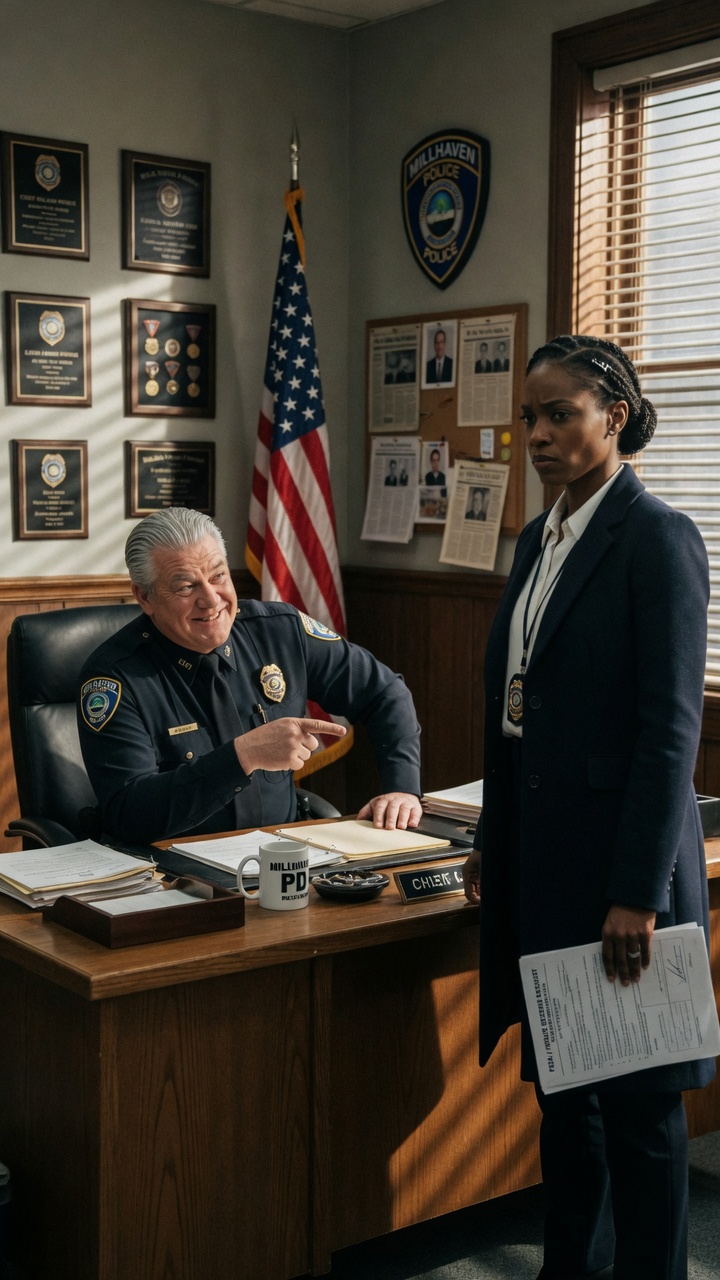
Chief Roland Pierce’s door was open.
He sat behind a wide desk beneath a wall of plaques, photographs, and awards polished into importance. He was in his late fifties, broad-faced, silver-haired, with the heavy calm of a man who had spent decades being obeyed before finishing sentences. His uniform was immaculate. His badge caught the overhead light.
Lena knew that badge.
Not this exact one.
The shape of it.
The power of it.
The way it had hovered over her childhood like a locked gate.
Pierce did not stand when she entered.
“Lena Carter,” he said.
Not a question.
“Chief Pierce.”
His mouth curved. “You look like your mother.”
“That’s usually a compliment.”
“It was meant as one.”
“No,” Lena said quietly. “It wasn’t.”
The smile faded for half a second, then returned colder.
He gestured to the chair across from him. “Sit.”
“I’ll stand.”
His eyebrows rose slightly.
There it was. The first tiny offense. Not enough to name. Enough to remember.
Pierce leaned back.
“You’re here about your father.”
“I’m here for the file.”
“The file has been closed for over twenty years.”
“I know.”
“There’s nothing in it that will help you.”
“That sounds like an opinion.”
“It’s experience.”
“It’s obstruction if you refuse a lawful request.”
Pierce laughed softly.
Not loudly.
That would have been too honest.
He gave her the kind of laugh powerful men use when they want witnesses to understand the conversation has already been decided.
“Ms. Carter, I’ve been dealing with this department’s ghosts longer than you’ve been old enough to drive. Every few years, someone comes in convinced the past owes them a different ending. Usually it’s a widow. Sometimes a brother. Sometimes a child who grew up on bedtime stories about how daddy couldn’t possibly have done what the evidence says he did.”
Lena’s face remained still.
Pierce watched for damage.
He wanted to see it land.
It did.
She simply refused to give him the pleasure of watching the wound bleed.
“My father was not drunk,” she said.
Pierce sighed.
“There it is.”
The words were soft.
Cruel because they were tired.
He opened a drawer and removed a thin file folder. Not the file. A summary. Lena recognized the difference instantly.
“Marcus Carter had alcohol in his system. He drove a county ambulance off an unlit road during a storm. Tragic. Embarrassing. But not complicated.”
“You released that statement before the toxicology report was complete.”
Pierce’s eyes sharpened.
“You’ve been doing homework.”
“I learned from the department.”
His jaw shifted.
Lena continued. “You also sealed the dispatch logs from that night. The radio transcript has missing time. The ambulance GPS was listed as damaged, but the repair invoice shows the unit was recovered intact. The responding officer’s original notes were replaced with a typed supplement three days later.”
For the first time, Pierce sat forward.
“You don’t know what you’re talking about.”
“I know exactly what I’m talking about.”
“No,” he said. “You know just enough to build a fantasy.”
Lena reached into her bag and removed a public records request, already signed and dated. She placed it on his desk.
“I am requesting the full investigative file, including original reports, dispatch audio, evidence photographs, toxicology chain of custody, and all supplemental notes.”
Pierce looked at the paper as if she had placed something dirty on his desk.
“Denied.”
“You haven’t reviewed it.”
“I don’t need to.”
“Then put the denial in writing.”
He smiled again.
This time, uglier.
“You think law school words scare me?”
“I didn’t go to law school.”
“Then where’d you learn to talk like that?”
Lena looked at him.
“In rooms where men like you thought volume was evidence.”
The silence that followed was sharp enough to cut.
Outside the office, someone stopped walking.
Pierce noticed.
So did Lena.
His voice lowered.
“Careful, Ms. Carter.”
“With what?”
“With turning grief into accusations.”
Lena leaned forward slightly.
“My grief has better records than your department.”
His face hardened.
There it was.
The mask cracking.
Pierce picked up the public records request between two fingers.
“For twenty-two years,” he said, “your family has dragged this department through whispers, church gossip, online nonsense, and every kind of ugly accusation because your mother couldn’t accept that her husband died a disgrace.”
Lena’s fingers curled once at her side.
Just once.
Pierce saw it and smiled.
“Your father wasn’t a hero that night. He was a man who made a bad choice. The sooner you stop digging, the sooner you can stop embarrassing his memory.”
Lena’s voice came out calm.
“You should not have said that.”
Pierce looked amused.
“Or what?”
Lena glanced at the request in his hand.
“Put it down.”
Instead, Chief Roland Pierce tore it in half.
Slowly.
Then again.
He dropped the pieces into his trash can.
Outside the office, the hallway went silent.
Lena looked at the torn paper.
Then at him.
Pierce spread his hands.
“There. Request processed.”
For a moment, no one moved.
Then Lena reached into her bag again.
Pierce’s eyes narrowed.
“What now?”
She removed a second folder.
Black.
Slim.
Sealed.
The air in the room changed before she opened it.
Pierce felt it.
Men like him always felt danger before they understood it. Their instincts were not moral, but they were useful.
“What is that?” he asked.
Lena placed the black folder on his desk.
“My request.”
“You just watched me deny it.”
“That was not the request that mattered.”
His eyes dropped to the folder.
The seal on the front was small but unmistakable.
UNITED STATES DEPARTMENT OF JUSTICE
CIVIL RIGHTS AND PUBLIC CORRUPTION REVIEW UNIT
Pierce stopped breathing for half a second.
Lena watched him read the words.
She watched his confidence stumble.
She watched twenty-two years of locked doors suddenly remember that keys existed.
“My name is Lena Carter,” she said. “Senior federal case auditor assigned to the reopened Millhaven misconduct review.”
Pierce’s face drained.
Outside the office, someone whispered, “Oh my God.”
Lena continued, “You just destroyed a public records request connected to a federally reopened death investigation in front of witnesses.”
Pierce’s mouth opened.
No sound came out.
Then instinct returned.
“This is ridiculous.”
“No,” Lena said. “It is recorded.”
She touched the small pin on her coat collar.
Pierce stared at it.
His voice dropped. “You came in here wired?”
“I came in here careful.”
“You baited me.”
Lena’s eyes hardened.
“No, Chief Pierce. I asked for my father’s file. You mocked him. Then you destroyed the request. That was not bait. That was habit.”
The word hit him.
Habit.
Because it was true.
His hand moved toward the desk phone.
Lena said, “Don’t.”
He froze.
The authority in her voice was no longer quiet.
It was official.
The young officer from the front desk appeared in the doorway, pale. Behind him stood two more officers, both uncertain, both looking from their chief to Lena like the world had tilted while they weren’t paying attention.
Pierce stood.
“This is my station.”
Lena did not move.
“No,” she said. “It’s evidence.”
The hallway erupted before Pierce could respond.
The front doors opened hard. Footsteps echoed across the lobby. Voices called instructions. Radios crackled. The young officer turned as three federal agents entered the chief’s corridor, followed by a state investigator and a woman from the attorney general’s office.
Agent Marisol Vega walked in first.
She was compact, sharp-eyed, and carrying a warrant packet in one hand.
“Chief Roland Pierce,” she said, “step away from the desk.”
Pierce looked at Lena with pure hatred.
“You did this.”
Lena looked back at him.
“No. You did. I just came back for the paperwork.”
Agent Vega handed Pierce the warrant.
“Federal search and seizure authorization for records related to the Marcus Carter death investigation, the Millhaven internal affairs archive, and all misconduct complaints involving Officers Pierce, Hanley, Dobbins, and Crane between 1998 and 2006.”
At the name Hanley, one of the older officers in the hallway stepped backward.
Lena noticed.
So did Vega.
Pierce tried to recover. “Those files are ancient.”
“So are graves,” Lena said. “People still visit them.”
No one spoke.
Agent Vega gave the signal.
Federal agents moved past Pierce into the records wing.
For the first time in twenty-two years, the locked room at the back of the Millhaven Police Department opened for someone who was not trying to bury the truth.
The file was not where it should have been.
That was the first sign.
The second was that three boxes connected to October 2001 had been mislabeled as flood damage records.
The third was the old evidence log showing a transfer that had never appeared in the official case summary.
Lena stood in the records room while agents photographed every shelf before touching anything. Dust rose in thin clouds under the lights. Metal cabinets lined the walls. The air smelled of paper and mold and secrets that had waited too long.
Agent Vega opened the first box.
Inside were traffic citations from 1999.
A dead end.
The second box held payroll forms.
Another false label.
The third box was different.
It contained a sealed evidence envelope marked C-4479.
Lena’s throat tightened.
For a moment, she was nine again.
Sitting on the kitchen floor while her mother screamed into a telephone.
Watching grown people bring casseroles and lower their voices.
Hearing classmates whisper that her daddy stole an ambulance because he was drunk.
Learning, before she understood the word, that a lie told by authority travels faster than love.
Agent Vega looked at her.
“You don’t have to be in here for this.”
“Yes,” Lena said. “I do.”
Vega nodded and cut the seal.
Inside were photographs.
Not the ones from the official file.
These were earlier.
Unedited.
The ambulance was not at the bottom of the ravine in the first set. It was stopped near a service road behind the old Bellamy warehouse. Its rear doors were open. Blood marked the bumper. Not much. Enough.
Another photograph showed tire tracks beside it.
Two sets.
The official report said no other vehicle was involved.
Lena’s hands stayed at her sides.
If she touched the table, she wasn’t sure she would stop shaking.
Vega removed a cassette tape in a plastic sleeve.
“Dispatch audio,” she said.
The technician digitized it in the next room.
They listened together.
At first, only static.
Then her father’s voice.
Alive.
Breathing hard.
“Unit 12 to dispatch. I need a supervisor at Bellamy warehouse. I witnessed officers assaulting a suspect. Repeat, I witnessed officers—”
Static.
Then a dispatcher.
“Unit 12, repeat traffic.”
Marcus Carter again, lower now.
“This is Carter. Badge numbers visible. Pierce is here. Hanley too. Suspect is unconscious. They’re loading him into—”
The audio cut.
Not faded.
Cut.
Lena closed her eyes.
For twenty-two years, the world had told her father’s story ended with shame.
But here he was.
Not drunk.
Not reckless.
Reporting a crime.
Vega said nothing.
The technician played the next recovered segment.
A different voice.
Younger.
Angry.
Roland Pierce.
“Marcus, give me the tape.”
Her father: “No.”
Pierce: “You don’t want to do this.”
Marcus: “He needs a hospital.”
Pierce: “He needed to not run.”
Marcus: “He’s dying.”
Then a crash. Movement. Someone yelling.
Another voice: “Get him in the ambulance.”
Her father: “Don’t touch me.”
Pierce: “You should have kept driving.”
The tape ended.
No one moved.
The room had gone so silent the hum of the old fluorescent lights sounded violent.
Lena opened her eyes.
Agent Vega’s jaw was tight.
“I’m sorry,” she said.
Lena stared at the recorder.
“Play it again.”
Vega hesitated.
“Lena—”
“Again.”
They played it.
Her father’s voice filled the room a second time.
Then a third.
By the fourth, Lena no longer heard only the pain.
She heard courage.
She heard a man alone with a radio, choosing truth while surrounded by badges.
She heard her father come back from the lie.
In the hallway, Chief Pierce had been placed in an interview room but not yet arrested. He sat with his arms crossed, still trying to look offended instead of afraid.
When Agent Vega entered with Lena behind her, his eyes flicked to the cassette sleeve in Vega’s hand.
That was all.
One flicker.
Guilt has many dialects. Lena had learned most of them.
Vega sat across from him.
“Do you want counsel?”
Pierce leaned back.
“I want this circus over.”
“It will be,” Vega said. “But not the way you think.”
She placed one photograph on the table.
The ambulance at Bellamy warehouse.
Pierce looked at it.
His face did not change.
Then Vega placed the dispatch transcript beside it.
His eyes lowered.
This time, the color left his skin.
Lena stood near the wall.
She wanted to sit. She did not.
Pierce looked up slowly.
“That recording is inadmissible.”
Vega’s eyebrows lifted.
“You haven’t asked what’s on it.”
He looked away.
Lena stepped forward.
“You knew he wasn’t drunk.”
Pierce said nothing.
“You knew my father was trying to report you.”
Still nothing.
“You let my mother bury him believing half the town thought he was a disgrace.”
His jaw tightened.
“He should’ve minded his business.”
The words left him before he could stop them.
Agent Vega went still.
Lena did not.
She walked to the table and placed both hands on it.
For the first time that day, her voice shook.
Not with weakness.
With twenty-two years of restraint finally reaching the edge of its leash.
“He was a paramedic.”
Pierce stared at her.
“People dying was his business.”
A muscle jumped in his cheek.
“Your father walked into something he didn’t understand.”
“No,” Lena said. “He understood exactly. That’s why you killed his name after you killed him.”
Pierce stood so fast the chair scraped backward.
“I didn’t kill him.”
The room froze.
Agent Vega’s voice was quiet.
“Sit down, Chief.”
Pierce was breathing hard now.
The polished commander was gone. In his place stood the younger man from the tape, angry, cornered, and still convinced rage could rearrange facts.
“He grabbed the radio,” Pierce snapped. “He was going to ruin everything over some junkie who took a swing at an officer.”
Lena’s eyes burned.
“What was his name?”
Pierce blinked.
“What?”
“The man you beat. The one my father tried to save. What was his name?”
Pierce looked confused, then irritated.
“I don’t remember.”
That almost broke her.
Not the confession.
Not the tape.
That.
A man had been beaten unconscious, maybe killed, and the police chief could not remember his name because cruelty does not always keep records of people it considers disposable.
Agent Vega placed another document on the table.
“We do.”
Pierce looked down.
“Calvin Brooks,” Vega said. “Twenty-seven. Father of two. Arrested twice for possession. No violent convictions. Listed as released from custody the night Marcus Carter died. His family reported him missing three days later. The missing persons report was closed by your department.”
Pierce’s mouth shut.
Lena looked at Vega.
She had not known that part.
Vega’s expression softened only for a second.
Then she turned back to Pierce.
“We found Mr. Brooks’s sealed intake form in the same box as Marcus Carter’s dispatch tape.”
Pierce sat down slowly.
The room seemed smaller now.
Vega continued, “Where is Calvin Brooks?”
Pierce stared at the table.
For once, he had no speech ready.
The answer came two hours later from Officer Hanley.
Hanley had retired twelve years earlier, moved to Florida, and learned that morning that federal agents were waiting outside his condo. He was old now. Sick. Scared in the way men become scared when they realize the grave is closer than the courtroom, but not close enough to save them.
He talked.
Calvin Brooks had died in the back of the ambulance.
Not from drugs.
Not from a fall.
From internal bleeding after four officers beat him behind Bellamy warehouse.
Marcus Carter tried to call it in.
Pierce stopped him.
There was a struggle.
Hanley claimed the crash was not meant to kill Marcus. Only scare him. Only stop him. Only make sure the report never reached anyone who would ask questions.
But Marcus had seen their faces.
He knew their names.
So they staged the ambulance crash on Old Quarry Road. They injected alcohol into a blood sample taken after death. They rewrote the dispatch log. They buried Calvin Brooks in an unmarked construction site outside the warehouse before it became a parking lot.
One lie became two bodies.
Then twenty-two years of silence.
By sunset, Chief Roland Pierce was arrested in front of the same officers who had watched him mock Lena that morning.
He did not look at her as Agent Vega read the charges.
Obstruction of justice. Evidence tampering. Civil rights violations. Conspiracy. False reporting. Accessory after the fact. Pending charges related to the deaths of Marcus Carter and Calvin Brooks.
The young front desk officer stood near the lobby, pale and shaken.
When Pierce was led past him in cuffs, the young officer did not salute.
That mattered more than Lena expected.
Outside, news vans had gathered. Word moved fast when a police chief was arrested in his own station. Reporters shouted questions as agents guided Pierce down the steps.
“Chief Pierce, did you frame Marcus Carter?”
“Agent Reynolds, is this connected to a federal civil rights case?”
“Were there other victims?”
Lena stood at the top of the steps with Agent Vega beside her.
For a moment, she looked at the stone sign again.
TO PROTECT AND SERVE.
Her father had believed in those words.
Not naively.
Deliberately.
He believed service was something you proved when no one powerful wanted you to.
A reporter called out, “Ms. Carter, what do you want people to know about your father?”
Lena looked into the cameras.
Her throat tightened.
This time, she let it.
“His name was Marcus Elijah Carter,” she said. “He was a father, a husband, a paramedic, and a good man. He died trying to save someone the police had hurt. He was not drunk. He was not reckless. He was not a disgrace.”
Her voice broke slightly on the last word.
She steadied it.
“The disgrace belonged to the men who buried the truth.”
No one shouted another question for several seconds.
Sometimes truth, when finally spoken clearly, teaches even noise how to kneel.
The next few weeks changed Millhaven in ways the city could not pretend away.
Federal teams reopened misconduct complaints dating back three decades. Families who had been dismissed as angry, confused, unstable, or attention-seeking returned with names and dates and photographs in shaking hands. Some cases were too old to prosecute. Some witnesses were dead. Some records were missing because lies are good at aging.
But not all of them.
Calvin Brooks’s family came forward after seeing the news.
His daughter, Tamika, had been four when he disappeared. She was twenty-six now, a nurse with her father’s eyes and a lifetime of being told he had probably run off.
Lena met her outside the federal courthouse.
For a moment, both women only stared at each other.
Then Tamika said, “Your father tried to save mine.”
Lena nodded.
Tamika covered her mouth and cried.
Lena hugged her.
There was no adequate apology for what had been stolen from them. No sentence that could stretch across twenty-two years and pull two fathers back into kitchens, birthdays, graduations, ordinary mornings. But their names stood together now. Not in rumor. Not in sealed files. In testimony.
That was something.
Not enough.
Something.
The trial lasted six weeks.
Pierce’s attorneys argued memory, age, corrupted evidence, political pressure, federal overreach. They suggested Marcus Carter had been troubled. They suggested Calvin Brooks was unreliable because of his record. They suggested Lena’s grief had shaped the investigation.
Then prosecutors played the tape.
Marcus Carter’s voice filled the courtroom.
Unit 12 to dispatch. I need a supervisor at Bellamy warehouse. I witnessed officers assaulting a suspect.
Lena sat in the front row beside her mother.
Her mother, Evelyn Carter, had grown smaller with age but not softer. She wore a navy dress and the same pearl earrings she had worn to Marcus’s funeral. When her husband’s voice came through the speakers, she closed her eyes and gripped Lena’s hand.
For twenty-two years, Evelyn had carried a truth no one official would confirm.
The courtroom confirmed it in her husband’s own voice.
Pierce stared straight ahead.
Hanley testified under a cooperation agreement.
He cried often.
Lena did not trust the tears.
But she trusted the documents.
The jury convicted Pierce on every major count.
When the verdict came, Evelyn Carter lowered her head.
Not in defeat.
In release.
Lena put an arm around her mother’s shoulders.
Evelyn whispered, “He can rest now.”
Lena looked toward the defense table where Pierce sat motionless, finally small inside the system he had once controlled.
“No,” she said softly. “Now he can stand.”
Three months after sentencing, the city renamed the ambulance bay at County General.
THE MARCUS E. CARTER EMERGENCY SERVICE ENTRANCE.
Lena hated ceremonies, but her mother insisted.
So Lena stood beside a polished plaque while paramedics, nurses, old neighbors, federal agents, city officials, and people who had once believed the lie gathered under a bright blue sky.
Tamika Brooks stood beside her with her two children.
The city also placed a memorial stone for Calvin Brooks near the old Bellamy warehouse site, now an empty lot awaiting redevelopment. It was not justice. But it was a refusal to keep erasing him.
Evelyn spoke at the ambulance bay ceremony.
She walked slowly to the microphone, holding Lena’s arm until the last possible second.
Then she stood alone.
“My husband used to say every call mattered before you knew who was on the other end,” Evelyn said. “That was how he lived. That was how he died. For many years, this city let a lie answer for him. Today, his name answers for itself.”
Lena looked down.
Agent Vega stood nearby, eyes bright.
The young officer from the front desk had come too. His name was Daniel Ross. He approached Lena after the ceremony, nervous, hat in hand.
“I should have said something when the chief tore your request.”
Lena looked at him.
“Yes.”
He flinched.
She let the word sit between them.
Then she added, “Next time, do.”
He nodded, ashamed but listening.
That was the only apology Lena trusted: one that turned into behavior.
Later that afternoon, after everyone left, Lena and her mother stayed behind at the ambulance entrance.
Evelyn touched the plaque with trembling fingers.
“He would’ve hated all this attention,” she said.
Lena smiled faintly.
“He would’ve pretended to.”
Evelyn laughed, and the sound surprised them both.
Then she looked at Lena.
“You brought him home.”
Lena shook her head.
“No. He left us a road.”
Her mother kissed her cheek.
That evening, Lena drove alone to Old Quarry Road.
The ravine had changed. Guardrails lined the curve now. Trees had grown thick along the slope. Someone had placed wildflowers near the edge after the verdict, and they had dried in the wind.
Lena parked and walked to the rail.
For years, this place had been the scene of her father’s supposed shame.
Now it was something else.
A stage.
A lie.
A wound finally named.
She stood there as the sun lowered behind the trees and imagined the ambulance being pushed, the report rewritten, the city sleeping while men in uniforms built a false ending for a good man.
Then she imagined her father’s voice on the tape.
Steady.
Afraid, maybe.
But steady.
She closed her eyes.
“I heard you,” she whispered.
The wind moved through the leaves.
For a second, it almost sounded like an answer.
Her phone buzzed.
A message from Agent Vega.
New review request. Small department outside Dayton. Similar sealed death file. Family asking for federal help.
Lena read it twice.
Then she looked once more into the ravine.
Twenty-two years ago, men with badges had buried her father’s truth because they believed time was stronger than memory.
They had been wrong.
She typed back.
Send me the file.
Then she got into her car and drove away from Old Quarry Road, not because the past was finished, but because it had finally told her where to go next.

![[FULL STORY] My Girlfriend Said I Don't See You As A Boyfriend Anymore—Just A Roommate Who Pays](https://social.rabedo.com/storage/thumbnails/1777947563_25-.jpg)

![[FULL STORY] I Found Her Diary Saying She Was Meeting Her Soulmate — So I Left Before She Came Home](https://social.rabedo.com/storage/thumbnails/1777887182_8a9b750a-8508-4436-a1ec-7d6ef3e17c69.png)
![[FULL STORY] At Dinner, My Fiancée's Friends Demanded I Prove My Worth By Paying Their $800 Tab](https://social.rabedo.com/storage/thumbnails/1777870567_18-.jpg)