
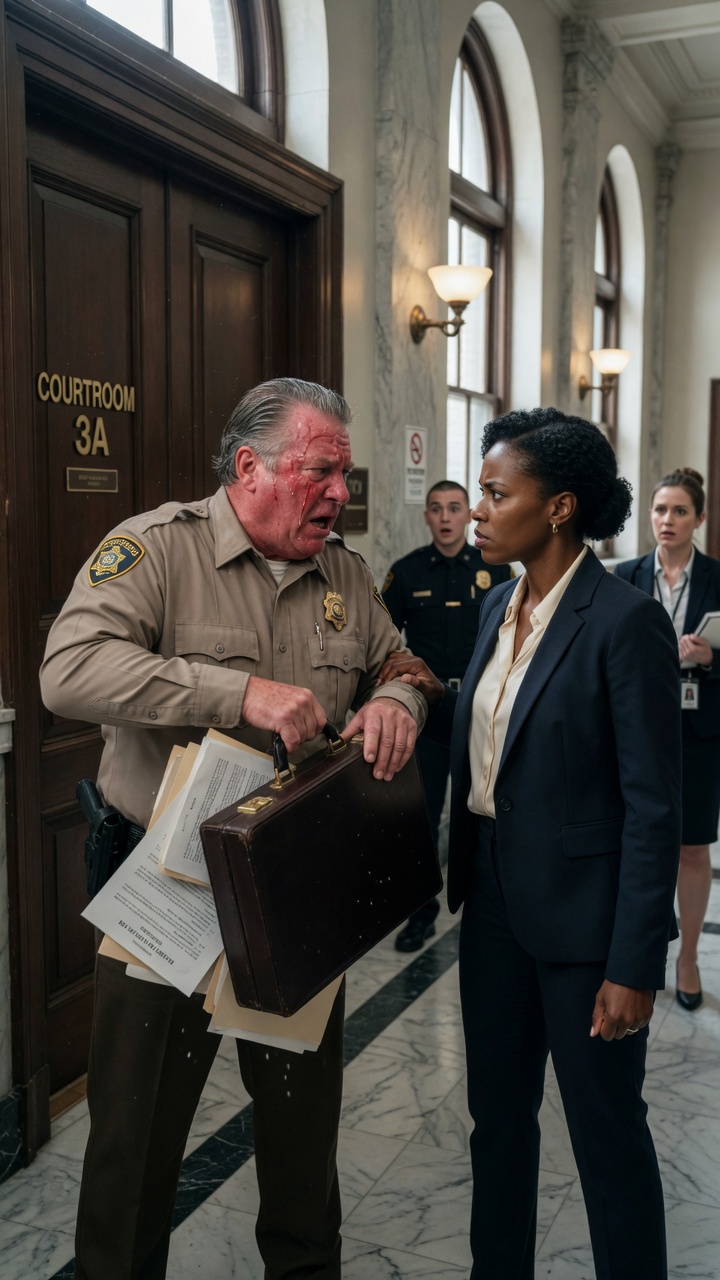
The first thing Curtis Vale noticed about the woman standing outside Courtroom 3A was that she did not look scared.
That irritated him more than anything else.
People usually looked scared outside Courtroom 3A.
They looked scared because it was the largest courtroom in Redwood County, the one reserved for murder trials, political scandals, police funerals, and the kind of proceedings where reporters crowded the hallway pretending not to smell blood. They looked scared because the old courthouse had a way of making people feel small. High ceilings. Marble floors. Bronze plaques. Dark wood doors heavy enough to sound final when they closed.
But the woman standing near the entrance did not look small.
She stood alone beneath the courtroom sign, one hand wrapped around the handle of a black leather briefcase, the other resting loosely at her side. She wore a navy suit, low heels, and a cream blouse buttoned neatly at the throat. Her hair was pinned back in a clean twist. No jewelry except a pair of small gold earrings. No makeup beyond what made her face look more composed than decorated.
Black woman. Late thirties, maybe forty.
Still.
Quiet.
Patient.
Curtis did not like patient people.
Patient people were often waiting for something.
He had been a bailiff in Redwood County for twenty-six years. Before that, a sheriff’s deputy. Before that, a man who learned early that buildings had weak points and people had weaker ones. He knew the difference between a grieving mother and a troublemaker. Between a nervous witness and someone rehearsing a performance. Between a lawyer who belonged in court and someone who had wandered too close to power.
This woman, he decided, was trouble.
She looked at the double doors of Courtroom 3A as if she had a right to them.
Curtis stepped in front of her before she could reach the handle.
“Courtroom’s closed.”
She looked at him.
Not up. Not down. Directly.
“Good morning.”
Her voice was low, even, almost gentle.
Curtis did not return the greeting.
“I said the courtroom’s closed.”
“I heard you.”
“Then you can wait downstairs with the others.”
A young deputy standing near the metal detector glanced over. A clerk carrying file boxes slowed. Two reporters near the drinking fountain turned their heads slightly.
Curtis felt the hallway becoming aware of him.
He straightened.
The woman did not move.
“I’m required to be inside before the proceeding begins,” she said.
Curtis gave a short laugh.
“Required by who?”
“The court.”
“The court talks through me at this door.”
“No,” she said calmly. “The court talks through orders.”
The hallway quieted.
Curtis’s face hardened.
People made mistakes with him sometimes. They saw the round belly, the gray hair, the heavy eyelids, and assumed he was just some courthouse fixture. A man who opened doors, called cases, and told people where to sit.
They forgot the badge.
They forgot the keys.
They forgot that his hand was the one on the door.
He stepped closer.
“Ma’am, this is a restricted murder trial. Family members, press, and spectators enter when I say they enter. Not before.”
“I’m aware of the restriction.”
“Are you?”
“Yes.”
“Then why are you standing here like you don’t understand English?”
The clerk’s eyes widened.
The young deputy looked down.
One reporter slowly lifted her phone but did not raise it all the way.
The woman’s expression remained unchanged.
That bothered Curtis more than if she had snapped.
“I understand you perfectly,” she said.
Curtis smiled.
It was not a kind smile.
“Then understand this. You don’t get to walk into a sealed courtroom because you dressed nice and practiced a few legal words.”
Her fingers tightened slightly around the briefcase.
Only slightly.
“I have clearance.”
“Everybody has something.”
“My name is on the witness list.”
Curtis looked her up and down.
“Witnesses check in downstairs.”
“I was instructed to report directly to Courtroom 3A.”
“By who?”
“The United States Attorney’s Office.”
The young deputy looked up quickly.
Curtis noticed.
So did the woman.
That annoyed him.
“The U.S. Attorney’s Office,” Curtis repeated, drawing out the words like they tasted ridiculous. “You people really do come in here with stories.”
The hallway went still.
For one second, something moved behind the woman’s eyes.
Not fear.
Not surprise.
Recognition.
As if she had been expecting him to show himself eventually and was almost disappointed he had done it so quickly.
“You people?” she repeated quietly.
Curtis leaned in.
“People who think this courthouse is a stage.”
A reporter took one step closer.
Curtis saw her and raised his voice just enough to control the moment.
“This trial has been delayed twice because people keep trying to turn it into a circus. I don’t care who you are, who you know, or what you think you deserve. You wait until I tell you to enter.”
The woman studied him.
“What is your name?”
Curtis pointed to the metal plate pinned above his breast pocket.
“Bailiff Vale. You can read, can’t you?”
The young deputy flinched.
The woman looked at the nameplate.
Curtis Vale.
Then she looked at his face again.
This time, her stillness changed.
It deepened.
For the first time, Curtis felt the smallest disturbance under his ribs.
He did not know why.
“You’re Curtis Vale,” she said.
“That’s what the badge says.”
“Were you assigned to courthouse security in 2004?”
The question struck him like a cold drop of water down his spine.
He recovered quickly.
“Lady, I’ve been assigned to this courthouse longer than you’ve probably been out of school.”
She nodded once.
Not impressed.
Recording.
That was what it felt like.
As if every word he said was being collected and placed somewhere.
Curtis’s voice lowered.
“You need to step back.”
“I need to enter.”
“No, you need to learn how things work here.”
The woman opened her briefcase.
Curtis’s hand moved to his belt.
“Don’t reach.”
She paused.
Slowly, she lifted her eyes to his.
“My credentials are inside.”
“I said don’t reach.”
“I am not armed.”
“I decide what concerns me.”
“No,” she said. “You decide what you can justify.”
The sentence was quiet.
But it landed hard.
The reporter’s phone rose another inch.
Curtis saw it.
His pride caught fire.
“Close the briefcase.”
The woman did not.
He stepped forward and slapped the lid down with his palm.
The sound cracked through the hallway.
Several people turned.
The woman looked down at his hand resting on her briefcase.
Then up at his face.
“Remove your hand.”
Curtis smiled.
“You always talk to officers like that?”
“You’re not an officer.”
His face changed.
“I am an officer of this court.”
“Then behave like one.”
The hallway went silent.
Curtis felt every eye on him now.
The clerk had stopped breathing. The young deputy looked trapped between fear and fascination. The reporters were no longer pretending not to watch.
Curtis could have stopped there.
Later, he would think about that moment.
There were always moments before disaster when a door remained open. Not wide. Not inviting. But open enough for a man to step back and survive.
Curtis did not step back.
Men like Curtis Vale survived so long by mistaking retreat for death.
He took the briefcase from her hand.
The woman’s grip tightened.
“Do not take that.”
“You don’t give me orders.”
He pulled harder.
She did not fight him. She released it.
That somehow made him angrier.
He held the briefcase up slightly, as if displaying evidence of her arrogance.
“You walk into my courthouse, refuse instructions, reach into a bag during a restricted murder proceeding, and then tell me how to do my job?”
The woman’s voice was still calm.
“That briefcase contains protected witness documents.”
Curtis laughed.
“Of course it does.”
He turned to the young deputy.
“Deputy Cruz, escort this woman downstairs.”
Deputy Cruz swallowed.
“Sir, maybe we should check with the clerk first.”
Curtis stared at him.
“What did you say?”
Cruz went pale.
“I just mean if she’s on the witness—”
“She’s not on anything until I verify it.”
The woman said, “Then verify it.”
Curtis turned back slowly.
“You think I need permission from you to run my door?”
“No.”
“Good.”
“I think you need permission from the law.”
That was when he reached for her arm.
Not roughly at first.
Just enough to move her.
Just enough to show her where power lived.
The instant his fingers closed around her sleeve, her body went still in a way that made the air change.
Not stiff.
Not afraid.
Still.
“Bailiff Vale,” she said, every word clear, “you are touching a protected federal witness outside a sealed proceeding.”
Curtis leaned close enough that only the first few rows of hallway could hear him.
“You’re a witness to what? Your own attitude?”
The woman looked at him.
And for one brief, terrible second, Curtis saw something in her eyes that made the back of his neck prickle.
Grief.
Old grief.
Not fresh.
Not fragile.
Forged.
She said, “My father’s murder.”
Curtis let go.
Not because he wanted to.
Because his hand forgot how to hold.
The phrase echoed in his head.
My father’s murder.
He looked at her face again.
Really looked.
The shape of her eyes.
The line of her mouth.
The quiet, cutting patience.
Memory stepped out of a locked room.
Thomas Ellison.
Public defender.
Black man.
Tall, lean, always carrying case files under one arm and trouble under the other.
Curtis had not thought the name in years.
That was not true.
He had not said the name in years.
There was a difference.
The woman watched recognition begin inside him.
“You know who I am now,” she said.
Curtis’s mouth went dry.
Before he could answer, the elevator at the end of the hall opened.
Three federal marshals stepped out first. Behind them came a woman in a gray suit with close-cropped silver hair and a face built for courtrooms. Assistant U.S. Attorney Miriam Kline.
Curtis knew her from television.
Everyone in Redwood County did.
She had spent the last eighteen months quietly dismantling the county’s old justice network one plea deal at a time. Former deputies. Retired clerks. One judge. Two prosecutors. All tied to evidence tampering, forged warrants, coerced testimony, and wrongful convictions dating back two decades.
The trial today was supposed to be the first murder proceeding.
The murder of Thomas Ellison.
Curtis suddenly understood why the hallway felt too bright.
Miriam Kline walked directly toward the woman.
“Mara,” she said, her voice tight. “Are you all right?”
The name struck Curtis like a hammer.
Mara Ellison.
Thomas’s daughter.
The little girl from the funeral.
She had been twelve then. Thin braids. White dress. No tears. Standing beside her mother while half the courthouse lied with flowers in their hands.
Curtis remembered avoiding her eyes.
Mara reached for her briefcase in Curtis’s hand.
He did not move.
Not fast enough.
One of the marshals stepped forward.
“Bailiff, hand it over.”
Curtis released it.
Mara took the briefcase and checked the latch.
Only then did she answer Miriam.
“I’m fine.”
Miriam looked at Curtis.
“What happened?”
No one spoke.
The reporter’s phone was fully raised now.
Deputy Cruz stared at the floor.
Curtis cleared his throat.
“There was confusion about access.”
Mara looked at him.
“No,” she said. “There was not.”
The words were calm.
That made them worse.
Miriam’s expression hardened.
“Bailiff Vale, Ms. Ellison is a protected witness in a federal murder prosecution. She was to be escorted directly into Courtroom 3A through this entrance.”
Curtis’s mouth opened.
“I wasn’t informed.”
Deputy Cruz looked up.
“Yes, sir, you were.”
Curtis turned slowly.
Cruz’s face was pale, but he did not back down.
“The morning memo said Ms. Mara Ellison had direct entry clearance. I saw it posted in chambers security.”
Curtis felt something fall away beneath him.
The hallway was silent now.
Miriam asked, “Is that true?”
Curtis said nothing.
Mara looked at Cruz.
For the first time, her expression softened slightly.
“Thank you.”
The young deputy nodded once, ashamed and relieved at the same time.
Miriam turned to the lead marshal.
“Remove Bailiff Vale from courtroom access pending review.”
Curtis jolted.
“What?”
The marshal stepped toward him.
“Sir, surrender your courtroom keys.”
Curtis almost laughed.
Not because it was funny.
Because reality had briefly become absurd.
His keys?
Those keys had hung from his belt for twenty-six years. Heavy brass and steel. Courtrooms, jury rooms, basement access, holding cells, evidence lockers, judge corridors. They were not just keys. They were proof that the building trusted him.
Or that the building had been forced to.
“This is my assigned courtroom,” Curtis said.
Miriam’s voice cut through him.
“Not today.”
He looked at Mara.
“You’re making a mistake.”
She held his gaze.
“No, Mr. Vale. That was twenty years ago.”
The marshal held out his hand.
Curtis hesitated.
Then slowly unclipped the key ring.
The sound of metal leaving his belt felt louder than the slap on Mara’s briefcase.
He handed the keys over.
A second marshal opened Courtroom 3A.
Mara walked inside without looking back.
Curtis stood in the hallway, empty at the waist, watched by clerks, deputies, reporters, and the same door he had guarded for half his life.
For the first time, the courthouse did not feel like his.
It felt like a witness.
Inside Courtroom 3A, Mara paused just past the threshold.
The room smelled exactly as she remembered.
Old wood. Paper. Floor polish. Dust warmed by sunlight.
She had only been inside once before.
The day after her father died, her mother brought her there before dawn. Mara remembered the courtroom empty and huge, remembered her mother standing at counsel table with one hand pressed over her mouth, remembered not understanding why a room could hurt someone.
Thomas Ellison had spent half his life in Courtroom 3A defending people Redwood County wanted to throw away quickly.
Poor men.
Black boys.
Addicted mothers.
Immigrant workers.
Teenagers who signed confessions they could not read.
He was not loved by the courthouse.
He was tolerated by the Constitution.
That was what he used to say.
They don’t have to like me, little moon. They just have to write down what they did.
Little moon.
That was what he called Mara because when she was small, she refused to sleep unless the curtains were open and she could see the sky.
Now she stood in his courtroom as a woman older than he had been when he died.
Miriam touched her arm gently.
“You still want to do this?”
Mara almost smiled.
“No.”
Miriam waited.
Mara looked toward the witness stand.
“But I’m here.”
“That’s not the same thing.”
“It’s the closest I have.”
Miriam nodded.
The federal judge had not entered yet. Counsel tables were arranged. Reporters filled the permitted rows. The jury box was empty because this hearing was pretrial, limited to admissibility of newly discovered evidence and witness statements. The actual murder trial would begin later.
But everyone knew today mattered more.
Today would decide whether the truth could walk into court after twenty years of being kept outside.
Mara sat behind the prosecution table.
Her briefcase rested on her lap.
Inside were three things.
A photograph of her father holding her on his shoulders at a county fair.
A sealed witness statement from a former deputy who claimed Curtis Vale helped move Thomas’s body.
And a small cassette tape Mara had received anonymously six months ago in a padded envelope with no return address.
The note inside had only six words.
Your father kept his own record.
Mara had listened to the tape once.
Then vomited in her kitchen sink.
Then called Miriam Kline.
That tape had started everything.
No.
That was not true.
Her father had started everything twenty years before, when he discovered that Redwood County deputies were planting weapons on defendants, prosecutors were hiding exculpatory evidence, and courthouse staff were altering access logs after hours.
Thomas Ellison had filed motions.
Then complaints.
Then letters to the state bar.
Then he died in what the county called a robbery gone wrong.
Shot twice behind the courthouse annex after a late filing.
His briefcase missing.
His car untouched.
His wallet still in his pocket.
Redwood County said wrong place, wrong time.
Mara’s mother said no.
For twenty years, that no lived in their house like another person.
At 9:02, the clerk stood.
“All rise.”
The room rose.
Judge Evelyn Hart entered from chambers. She was small, white-haired, and sharper than any blade in the building. A retired federal judge brought back by special appointment because every local judge had a conflict or a shadow.
Mara watched her take the bench.
Judge Hart looked over the courtroom.
Then at Mara.
Then at the empty space where the bailiff should have stood.
Her eyes narrowed.
“Where is Bailiff Vale?”
Miriam rose.
“Your Honor, there was an access incident involving Ms. Ellison outside the courtroom. Federal marshals removed Mr. Vale from door duty pending review.”
Judge Hart’s face did not change.
“What kind of incident?”
Miriam glanced at Mara.
Mara stood.
“My entry was denied, Your Honor. My briefcase was taken. Bailiff Vale touched my arm and ordered me removed.”
The room shifted.
Reporters began writing instantly.
Judge Hart’s gaze hardened.
“Is Mr. Vale named in any exhibit currently before this court?”
Miriam said, “Yes, Your Honor.”
“Then he should not have been at the door.”
“No, Your Honor.”
Judge Hart turned to the clerk.
“I want the security assignment order reviewed immediately. If Mr. Vale placed himself at that door despite conflict notice, I want to know who allowed it.”
“Yes, Your Honor.”
Mara sat.
Her hands were steady.
That surprised her.
Outside the courtroom, Curtis Vale was not supposed to be listening.
He knew that.
A marshal had escorted him to the personnel office, told him to remain there, and instructed him not to contact witnesses, court staff, or law enforcement personnel involved in the case.
Curtis waited six minutes.
Then left.
He took the back service hallway, the one behind the old law library. He no longer had his keys, but he still knew the building. Every weak hinge. Every stairwell camera that pointed slightly too high. Every maintenance door that did not latch unless pulled hard.
He reached the utility alcove behind Courtroom 3A.
There was a vent there.
Old buildings had old secrets.
Curtis pressed himself against the wall and listened.
Inside, Miriam Kline was speaking.
“The United States intends to show that Thomas Ellison was murdered not during a robbery, but as part of a conspiracy to prevent exposure of systematic evidence fabrication within Redwood County.”
Curtis closed his eyes.
He should leave.
Instead, he leaned closer.
“Among the individuals involved,” Miriam continued, “were then-Detective Harold Boone, former Assistant District Attorney Neil Carver, former evidence clerk Sandra Pike, and courthouse security deputy Curtis Vale.”
Curtis’s stomach tightened.
They said his name like it belonged with murder.
No.
Not murder.
He had not pulled the trigger.
That mattered.
It had to matter.
Inside, Miriam continued.
“Mr. Ellison had discovered that after-hours courtroom access was being used to alter exhibits in pending criminal cases. He had obtained partial logs showing unauthorized entries into Courtroom 3A, the evidence review room, and the sealed exhibit vault. Those logs disappeared after his death.”
Judge Hart asked, “And have they been recovered?”
“Yes, Your Honor. In part.”
Paper rustled.
Miriam said, “Exhibit 7 is a duplicate access log recovered from the personal files of retired clerk Margot Simmons, now deceased. It shows Curtis Vale entered Courtroom 3A at 11:18 p.m. on May 3, 2004, the night before State v. Lamont Harris. The official log shows no entry.”
Curtis gripped the vent.
Margot.
That old woman had smiled at him for years.
Brought pound cake every Christmas.
All that time, she had kept a duplicate?
Judge Hart asked, “Why is the Harris case relevant?”
“Because Thomas Ellison represented Lamont Harris. Two weeks before his death, Mr. Ellison filed a motion alleging the handgun introduced against Harris had been planted after arrest.”
The defense attorney objected.
Judge Hart let him speak for twelve seconds before cutting him off.
“Overruled for purposes of this hearing. Continue.”
Miriam’s voice sharpened.
“The missing access logs support Mr. Ellison’s claim. More importantly, they establish motive.”
Curtis swallowed.
Motive.
Such a clean word for panic.
He remembered Thomas that night in the courthouse parking area, standing under weak yellow lights with a folder pressed against his chest.
“You know what they’re doing,” Thomas had said.
Curtis had laughed at him.
“You always think you know something.”
“I know enough.”
“You know how to get yourself hurt.”
Thomas had looked at him then.
Not scared.
Disappointed.
Just like Mara outside the courtroom.
“You don’t have to keep helping them,” Thomas said.
Curtis hated him for that.
Because it assumed there was still a choice.
Inside the courtroom, Miriam called the first witness.
“Deputy Cruz.”
Curtis stiffened.
The young deputy from the hallway?
No.
He was nobody.
He knew nothing.
Cruz’s voice came faintly through the vent, nervous but clear.
“My name is Daniel Cruz. I’m a deputy assigned to courthouse security.”
Miriam asked, “Were you present this morning when Bailiff Curtis Vale interacted with Mara Ellison?”
“Yes, ma’am.”
“What did you observe?”
“He denied her entry, even though the witness memo had her listed for direct access.”
“Did Mr. Vale have access to that memo?”
“Yes.”
“How do you know?”
“It was distributed to all courthouse security personnel at 6:30 a.m. I saw him sign the acknowledgment sheet.”
Curtis’s pulse surged.
That little—
“Did Ms. Ellison behave aggressively?”
“No.”
“Did she identify herself?”
“She said she had clearance and was on the witness list.”
“Did Mr. Vale verify it?”
“No.”
“What did he do?”
“He mocked her. Took her briefcase. Ordered me to escort her downstairs.”
“Did he touch her?”
A pause.
“Yes.”
The courtroom murmured.
Judge Hart said, “The gallery will remain silent.”
Miriam asked, “Deputy Cruz, why didn’t you escort Ms. Ellison downstairs?”
Cruz’s voice shook.
“Because I knew she was telling the truth.”
Curtis backed away from the vent.
His chest was tight.
He told himself this did not matter.
A hallway incident.
A young deputy trying to impress federal prosecutors.
It would pass.
Then Miriam asked, “Deputy Cruz, did Bailiff Vale say anything after he learned Ms. Ellison’s identity?”
Cruz answered, “He told her she was making a mistake.”
Miriam paused.
“Did he seem surprised by her name?”
“Yes.”
“How?”
“He looked like he recognized it.”
Curtis turned away.
Recognition was not a crime.
Memory was not evidence.
Not yet.
Inside, the next witness was called.
Margot Simmons could not testify because she was dead.
So her deposition played on screen.
Curtis heard her old voice fill the courtroom, thin but steady.
“My name is Margot Elaine Simmons. I served as deputy clerk in Redwood County Superior Court from 1989 to 2011.”
Miriam’s recorded voice asked, “Ms. Simmons, why did you preserve duplicate access logs?”
“Because Thomas Ellison told me someone was changing them.”
“When did he tell you that?”
“May 2004. About three weeks before he died.”
“What exactly did he say?”
“He said, ‘Margot, if paper starts lying, people start dying.’”
The words hit Curtis in the throat.
He remembered Thomas saying things like that.
Too dramatic.
Too righteous.
Too dangerous.
Miriam’s deposition voice continued.
“Did Mr. Ellison identify anyone he believed was involved?”
“Yes.”
“Who?”
“Curtis Vale. Harold Boone. Neil Carver. Maybe others. Thomas said Vale was the door. Boone was the muscle. Carver was the protection.”
The door.
Curtis almost laughed.
Even Thomas had understood.
A door was power.
Inside, Judge Hart called a fifteen-minute recess.
Curtis moved quickly.
He had to get out of the alcove before marshals swept the hallway.
He turned toward the service stairwell.
And found Mara Ellison standing ten feet away.
Alone.
Briefcase in hand.
For one terrible second, neither spoke.
Curtis’s mind scrambled.
How long had she been there?
Had she seen him at the vent?
Mara looked at him with the same calm that had unsettled him at the courtroom door.
“You always listened from behind walls?” she asked.
Curtis forced his face into anger.
“You shouldn’t be back here.”
“Neither should you.”
“I work here.”
“Not today.”
He stepped closer.
She did not move.
The service hallway was narrow, lined with old filing cabinets and peeling paint. No reporters. No deputies. No audience.
Curtis lowered his voice.
“You think you know what happened to your father?”
Mara held his gaze.
“I know more than I did this morning.”
“You know what they told you.”
“You mean the truth?”
He scoffed.
“Truth changes depending on who survives to tell it.”
Mara’s eyes sharpened.
“That sounds like something guilty people say.”
His face twitched.
“You were a kid.”
“Yes.”
“You don’t know what your father was into.”
“My father was into records. Motions. Proof. Defending people your friends wanted buried.”
Curtis stepped closer.
“Your father was reckless.”
Mara’s grip tightened on her briefcase.
“You called him that at the funeral.”
Curtis stopped.
“What?”
“I remember you.”
No.
She could not.
She had been twelve.
Mara continued.
“You stood near the back with Deputy Boone. You said, ‘Ellison should’ve learned when to stop digging.’ My mother heard you too.”
Curtis’s mouth went dry.
“I don’t remember that.”
“Yes, you do.”
He looked away.
She stepped closer now.
For the first time, she advanced.
“You knew who I was before Miriam said my name.”
“No.”
“You knew.”
Curtis looked back at her, anger rising because fear had nowhere else to go.
“I knew your father. That doesn’t mean I killed him.”
Mara’s expression did not change.
“I didn’t say killed.”
The hallway went silent.
Curtis realized the mistake.
Too late.
Mara’s voice lowered.
“But thank you for telling me where your mind went.”
He pointed at her.
“You better be careful.”
“No,” she said. “That was what my father told you.”
The words landed like a slap.
Before Curtis could respond, footsteps sounded around the corner.
Two federal marshals appeared.
Mara did not look away from Curtis.
“He’s been listening through the service vent,” she said.
The marshals moved immediately.
Curtis backed up.
“I was looking for maintenance.”
One marshal took his arm.
Curtis jerked away.
“Don’t touch me.”
The second marshal blocked the stairwell.
Mara watched him.
Not with satisfaction.
That would have been easier to bear.
She watched him the way someone watches a door finally swing open.
The marshals escorted Curtis back into Courtroom 3A.
This time, not as staff.
Not as security.
As a subject.
Every head turned when he entered.
Judge Hart had not yet returned to the bench, but Miriam Kline stood near counsel table. She looked from Curtis to Mara to the marshals.
“What happened?”
Mara answered, “He was listening through the service vent during recess. Then he confronted me in the hallway.”
Miriam’s face hardened.
“Did he threaten you?”
Curtis snapped, “No.”
Mara looked at him.
“He told me to be careful.”
The reporters in the permitted gallery leaned forward like a single animal.
Miriam turned to the marshals.
“Seat him in the front row and keep him there.”
Curtis felt his stomach drop.
“I’m not under arrest.”
“Not yet,” Miriam said.
Judge Hart entered moments later.
The courtroom rose.
Curtis did not move at first.
A marshal’s hand pressed lightly on his shoulder.
He stood.
The humiliation burned through him.
Judge Hart took the bench and looked directly at him.
“Mr. Vale, you were instructed not to interfere with these proceedings.”
“I didn’t interfere, Your Honor.”
“You entered a restricted service area adjacent to this courtroom during a sealed evidentiary hearing.”
“I was looking for—”
“Do not insult this court with a lie that careless.”
Curtis’s mouth closed.
Judge Hart looked at Miriam.
“Proceed.”
Miriam stood.
“The United States calls Mara Ellison.”
The room seemed to tighten.
Mara rose.
For a moment, she felt twelve again.
Small shoes on courthouse marble.
Her mother’s hand gripping hers too tightly.
Adults saying words above her head.
Tragic.
Senseless.
Investigation ongoing.
No comment.
Now she walked to the witness stand under her own power.
She raised her right hand.
Swore to tell the truth.
Then sat facing the room that had once swallowed it.
Miriam approached gently.
“Please state your name.”
“Mara Christine Ellison.”
“Ms. Ellison, who was Thomas Ellison?”
“My father.”
“What did he do for a living?”
“He was a public defender in Redwood County.”
“Do you remember the night he died?”
Mara inhaled.
“Yes.”
Curtis looked down.
He did not want to hear this.
He had spent twenty years not hearing it.
Mara continued.
“I was twelve. We were supposed to have spaghetti because it was Thursday and my father always made spaghetti on Thursdays, even though he burned the garlic every time.”
A faint, painful smile moved through the room.
“My mother told me to set the table. I remember putting out three plates. Then two. Then three again because I thought if I left his plate there, he would come home.”
Her voice remained steady.
“He didn’t.”
Miriam gave her a moment.
“When did you learn he was dead?”
“After midnight. Sheriff’s deputies came to the house.”
“Was Curtis Vale among them?”
Mara looked at Curtis.
“Yes.”
Curtis kept his eyes down.
“What did he do?”
“He stood on our porch while Detective Boone told my mother my father had been killed behind the courthouse annex. Mr. Vale never spoke to me directly. But he watched us like he already knew how the night would end.”
Miriam asked, “Did the county tell your family the case was solved?”
“Yes. They said it was a robbery. They blamed a man named Andre Mills.”
“And was Andre Mills convicted?”
“Yes.”
“How old was he?”
“Nineteen.”
“How long did he serve?”
“Sixteen years before his conviction was vacated.”
“And what happened after his conviction was vacated?”
Mara opened her briefcase.
The courtroom watched.
She removed the cassette tape in its evidence sleeve.
“Three months later, this arrived at my home.”
Miriam stepped closer.
“Did you know who sent it?”
“No.”
“Did you listen to it?”
“Yes.”
“What did you do afterward?”
“I contacted the United States Attorney’s Office.”
Miriam turned to the judge.
“Your Honor, Exhibit 41 has been authenticated by forensic audio analysis. The government moves to play the recording.”
The defense objected immediately.
Judge Hart overruled him immediately.
Mara sat very still.
Curtis stopped breathing.
The tape began with static.
Then Thomas Ellison’s voice filled the courtroom.
Alive.
Close.
Urgent.
“This is Thomas Ellison. May 27, 2004. If this tape is found, I did not die by accident, robbery, or coincidence.”
Mara’s hands folded tightly in her lap.
She had listened to the tape once.
She had not heard it in a room full of strangers.
Her father continued.
“I am in the courthouse annex basement. Deputy Curtis Vale told me an evidence clerk was willing to turn over the original Harris and Bell logs if I came alone.”
Curtis’s face drained.
The whole courtroom turned toward him.
On the tape, there was the sound of footsteps.
Then Curtis’s younger voice.
“You recording?”
Thomas replied, “Always.”
A nervous laugh from Curtis.
“You lawyers.”
Thomas said, “Where’s the clerk?”
Curtis answered, “Inside.”
A door creaked.
The audio shifted.
A larger room.
Echoing.
Basement.
Then another voice.
Detective Harold Boone.
“You just couldn’t leave it alone, could you, Tom?”
Thomas’s voice sharpened.
“Where is the clerk?”
Boone laughed.
“There is no clerk.”
A pause.
Then Thomas said, “Curtis.”
Curtis on the tape said nothing.
Thomas repeated, “Curtis, what did you do?”
Curtis in the courtroom shut his eyes.
The tape continued.
Curtis’s younger voice came low.
“I told you to stop digging.”
Thomas answered, “No. You told me to let innocent boys go to prison.”
Boone snapped, “Those boys were animals.”
Thomas said, “They were clients.”
Another voice entered.
Assistant District Attorney Neil Carver.
Smooth.
Cold.
“Mr. Ellison, you’ve made a mess.”
Thomas breathed hard.
“Good.”
Carver said, “You still think this is a courtroom?”
Thomas answered, “Everything is a courtroom if someone tells the truth.”
The room was utterly silent.
Mara felt tears burn her eyes but refused to let them fall.
On the tape, movement.
A scuffle.
Thomas grunted.
Curtis’s voice, panicked.
“Harold, wait—”
Boone shouted, “Get his bag.”
Thomas yelled, “Mara, if you hear this—”
The sound of a strike cut him off.
Mara’s body went cold.
Her father groaned.
Carver said, “Find the tape.”
Curtis said, “He’s got a recorder somewhere.”
Boone said, “Then search him.”
More movement.
Breathing.
Then Thomas’s voice again, weaker.
“My daughter’s name is Mara Ellison.”
A sob escaped someone in the gallery.
Thomas continued, every word strained.
“She is twelve years old. She likes astronomy and hates peas. Her mother’s name is Denise. If you erase me, you do not erase them.”
Carver’s voice sharpened.
“Shut him up.”
Curtis said, “Neil—”
A gunshot thundered through the speakers.
Mara flinched despite herself.
The courtroom gasped.
On the tape, something heavy hit the floor.
Then silence except for breathing.
Curtis’s breathing.
Boone said, “Now you’re in it.”
Curtis whispered, “You shot him.”
Carver answered, “No, Curtis. We all did.”
The tape continued for six more seconds.
Footsteps.
A dragging sound.
Then Curtis’s voice, breaking.
“What about his daughter?”
Carver replied, “She grows up believing what we tell her.”
Static swallowed the room.
Miriam stopped the tape.
No one moved.
No one looked away.
For twenty years, Redwood County had called Thomas Ellison’s murder a street crime.
Now the courthouse had heard him name the room where he died.
He had not died behind the annex.
He had been moved there.
Mara stared at Curtis.
He was crying.
Silently.
Face gray.
Hands shaking.
Judge Hart’s voice came cold and controlled.
“Mr. Vale.”
Curtis looked up slowly.
“You will remain seated.”
He nodded, broken.
Miriam approached him.
“Your Honor, given the content of Exhibit 41 and Mr. Vale’s behavior this morning, the United States requests immediate custody pending formal indictment.”
Curtis stood suddenly.
“I didn’t shoot him.”
The courtroom erupted.
Judge Hart slammed her gavel.
“Sit down.”
Curtis pointed toward the prosecutor.
“I didn’t shoot Thomas. Boone did. Carver ordered it. I didn’t know they were going to kill him.”
Miriam’s eyes narrowed.
“But you brought him there.”
Curtis looked at Mara.
His mouth trembled.
“I thought they were going to scare him.”
Mara’s face remained still.
“You brought my father to a basement to be scared.”
“I was young.”
“You were older than I am now.”
The words hit him harder than the tape.
Curtis gripped the back of the bench.
“I had a family.”
“So did he.”
“I would’ve lost everything.”
“We did.”
The courtroom fell silent again.
Curtis broke then.
Not dramatically.
Not cleanly.
He sat down as if his bones had been removed.
“They told me he was going to ruin the courthouse,” he whispered. “They said cases would collapse. Guilty men would walk. Deputies would go to prison. They said he didn’t understand what it took to keep order.”
Mara stood.
Miriam moved as if to stop her, but Judge Hart lifted one hand.
Mara walked slowly from the witness stand toward the front row.
The marshals tensed.
Curtis did not move.
She stopped a few feet away.
“You want to know what my father understood?”
Curtis looked up at her.
“He understood that order built on lies is not order. It’s a hostage situation.”
Curtis cried harder.
“I’m sorry.”
Mara looked at him for a long time.
She had imagined this moment for years.
Not Curtis exactly.
Not this courtroom.
But the apology.
The guilty face.
The trembling voice.
She had imagined it would feel like a door opening inside her chest and light flooding through.
It did not.
It felt like standing in the ruins of a house someone burned down and listening to him say he regretted the match.
“I don’t need your apology,” she said.
His face collapsed.
She continued.
“I needed you to tell the truth when my mother was young enough to rebuild her life. I needed you to tell the truth when Andre Mills was nineteen and still had sixteen years ahead of him. I needed you to tell the truth when I was twelve and thought maybe if I remembered my father perfectly, he wouldn’t disappear.”
Her voice shook once.
Only once.
“You are twenty years late.”
Curtis bowed his head.
Judge Hart ordered him into custody.
This time, there was no confusion.
No hallway performance.
No badge.
No keys.
No door to guard.
Federal marshals cuffed Curtis Vale in the same courtroom where he had once dragged defendants to their feet.
Reporters watched.
Deputies watched.
Mara watched.
As they led him toward the doors, Curtis stopped near her.
A marshal tightened his grip.
Curtis did not resist.
He looked at Mara.
“He loved you,” he whispered. “That was the last thing he tried to say.”
Mara’s throat closed.
The marshal moved him forward.
The doors opened.
Curtis Vale left Courtroom 3A in handcuffs.
For the first time in twenty years, Mara did not feel the door close on her.
She felt it close behind him.
The case exploded after that.
There was no quieter word for it.
By evening, every local news station led with the tape. National outlets picked it up by midnight. Redwood County officials issued statements full of sorrow, concern, transparency, cooperation, and all the other words institutions used when caught standing over buried bones.
Neil Carver, the former assistant district attorney, was arrested at his lake house two states away.
Harold Boone had died five years earlier, but his pension records, bank deposits, and private storage unit became evidence.
Andre Mills, the man wrongfully convicted of Thomas Ellison’s murder, appeared on television outside his sister’s house and said only one sentence.
“I told them I didn’t kill that man, but Redwood County needed me guilty more than it needed me alive.”
Mara watched that clip three times.
Then called him.
She had spoken to Andre only once before, years earlier, after his release. She had been ashamed then. Not because she had accused him. She had been a child. But because some part of her had wanted anyone to be guilty so the story could stop hurting.
He answered on the fourth ring.
“This Mara?”
“Yes.”
A long pause.
“You all right?”
She almost laughed.
He had lost sixteen years and was asking if she was all right.
“No,” she said.
“Yeah,” he replied. “Me neither.”
She closed her eyes.
“I’m sorry.”
“You didn’t put me in there.”
“No. But my father’s name was used to do it.”
“Your father tried to save me before he even knew he needed saving.”
Mara covered her mouth.
Andre continued.
“I heard the tape.”
“I’m sorry.”
“Stop apologizing for dead men and criminals.”
She breathed out shakily.
“What do I do now?”
Andre was quiet for a moment.
Then he said, “You live so they don’t get to be the ending.”
The next week, Curtis Vale signed a cooperation agreement.
Cowardice, when cornered, often dressed itself as truth.
He gave names.
Dates.
Storage locations.
Judges who knew.
Prosecutors who altered.
Deputies who planted.
Clerks who were threatened.
Cases that needed review.
He admitted he had lured Thomas Ellison to the courthouse annex basement. He admitted he had taken the briefcase. He admitted he had helped move the body behind the annex. He admitted he had lied to investigators, to Thomas’s widow, to Mara, to the court, to himself.
In exchange, prosecutors did not promise mercy.
Only the possibility of being heard before sentencing.
Mara did not attend every proceeding.
Some days she could not.
Grief, she learned, was not one thing. It was weather. It changed shape without asking. Some mornings she woke furious enough to run five miles before sunrise. Some afternoons she sat in her car outside her office and could not remember how to make her hands open the door. Some nights she dreamed of spaghetti.
Her mother, Denise, came to court only once.
She wore a black dress, not because she was mourning but because she said some ghosts deserved formal recognition.
Mara met her on the courthouse steps.
Denise Ellison was sixty-four now, slim and elegant, with silver-threaded hair and eyes that had spent twenty years refusing to soften around lies.
She looked up at the courthouse.
“I hate this building.”
“I know.”
“Your father loved it.”
“I know.”
Denise shook her head.
“That man could love a place that hated him if he thought he could make it better.”
Mara smiled sadly.
“That sounds like him.”
Inside, Judge Hart allowed Denise to give a statement during the formal record correction hearing.
Denise walked to the podium with no paper.
She did not need one.
“My husband was not killed in a robbery,” she said. “He was not reckless. He was not paranoid. He was not confused. He was a lawyer who believed poor people deserved the same Constitution rich people quoted at fundraisers.”
The courtroom sat silent.
Mara sat behind her, hands clenched.
Denise continued.
“For twenty years, this county let my daughter grow up inside a lie. I had to raise her while fighting a ghost story written by the men who killed her father.”
Her voice did not break.
That was the part that made people cry.
Not weakness.
Control.
“I do not ask this court to give Thomas back to us. No court can do that. I ask this court to say his name correctly.”
Judge Hart’s face softened.
Denise looked toward the bench.
“His name was Thomas Ellison. He was murdered because he refused to let the law become a weapon in the hands of cowards.”
Mara wiped her eyes.
Behind them, Andre Mills bowed his head.
Judge Hart signed the corrected finding that afternoon.
Thomas Ellison’s official cause of death changed from homicide during robbery to homicide by conspiracy and obstruction related to public corruption.
A terrible phrase.
An honest one.
Redwood County began to unravel.
Twenty-seven cases reopened.
Nine convictions vacated within the first six months.
Three families learned sons they had buried as criminals had been framed.
Two former prosecutors surrendered law licenses.
A courthouse memorial honoring “distinguished service personnel” quietly removed three names in the middle of a Tuesday afternoon until reporters asked why it was being done so quietly.
Mara attended Curtis Vale’s sentencing eleven months after he blocked her at the door.
He looked older.
Not redeemed.
Just diminished.
His uniform was gone. His courthouse keys were gone. His old certainty was gone.
When he stood to address the court, his hands shook.
“I told myself I was protecting the courthouse,” he said. “Then I told myself I was protecting my job. Then I told myself it was too late to tell the truth. Every year made the lie heavier, and I let other people carry the weight of it.”
Mara listened.
Denise did not look at him.
Andre Mills sat beside them, jaw tight.
Curtis turned toward Mara.
“I knew who you were when you said your father’s murder. I knew because I never forgot his face. I never forgot yours either.”
Mara felt nothing move in her expression.
“I am sorry,” he said.
No one answered.
The judge sentenced Curtis Vale to thirty years.
Twenty for conspiracy and accessory after the fact.
Ten for obstruction, evidence tampering, and witness intimidation.
One year and change for every year Thomas Ellison had been dead.
Curtis cried when marshals led him away.
Mara did not.
Outside the courthouse, reporters called her name.
“Mara, do you forgive him?”
“Mara, what would your father say?”
“Mara, do you feel justice was served?”
She stopped at the bottom of the steps.
Denise touched her arm.
“You don’t have to.”
Mara looked at the cameras.
Then back at Courtroom 3A’s tall windows above.
“I don’t know if justice was served,” she said.
The reporters quieted.
“I know the truth was entered into the record. That is not everything. But it is not nothing.”
A microphone pushed closer.
“Do you forgive Curtis Vale?”
Mara thought of Curtis’s hand on her briefcase.
His fingers on her sleeve.
His voice saying you people.
His younger voice on the tape asking what about his daughter.
She thought of her father saying her name while dying.
“No,” she said.
The cameras clicked faster.
“But forgiveness is not a prerequisite for justice.”
She walked away.
One year later, Redwood County renamed Courtroom 3A.
The county commission fought about it, of course.
They always did when symbolism cost them nothing but pride.
Some said naming a courtroom after Thomas Ellison would “reopen wounds.”
Denise attended the meeting and said, “The wound was open. You were just standing on it.”
The motion passed unanimously after that.
The dedication took place on a clear September morning.
A bronze plaque was installed beside the courtroom doors.
THOMAS ELLISON COURTROOM
Public Defender, Husband, Father
He believed the law was only honorable when it protected the powerless.
Mara stood in the hallway staring at it.
For once, there were no reporters pressing close. Just family, a few lawyers, Andre Mills, Miriam Kline, Judge Hart, Deputy Cruz, and several people whose cases Thomas had touched before Mara was old enough to understand what he did all day.
Deputy Cruz stood near the door now as official court security.
He looked nervous in the way good people often did when trusted with something important.
Mara approached him.
He straightened.
“Ms. Ellison.”
She smiled faintly.
“Deputy Cruz.”
He glanced at the plaque.
“I think about that morning a lot.”
“So do I.”
“I should’ve spoken sooner.”
“Yes,” Mara said.
He accepted that.
No excuses.
No performance.
Then she added, “But you spoke.”
His eyes lifted.
“That matters.”
He nodded, swallowing hard.
Then he opened the courtroom door for her.
Not because she demanded it.
Not because federal marshals stood behind her.
Not because a memo said her name.
Because it was her father’s courtroom now, and nobody with a badge was going to make her ask twice.
Mara stepped inside.
The room had been polished for the ceremony. Sunlight fell across the benches. The judge’s bench shone dark and clean. Counsel tables stood ready. The witness stand waited.
Denise entered beside her.
For a while, mother and daughter stood in the aisle.
Finally, Denise whispered, “He would have hated all this attention.”
Mara laughed softly.
“He would have corrected the plaque grammar.”
“He absolutely would have.”
Their laughter faded into something warmer than silence.
Mara walked to the front of the room and placed one hand on the prosecution table, then the defense table.
Her father had stood at both in different ways.
Accused by the county.
Defending the accused.
Murdered by men who thought doors and logs and badges could outlive truth.
They had been wrong.
Mara opened her briefcase and removed the photograph she had carried since the first hearing.
Thomas Ellison at the county fair, holding her on his shoulders.
She placed it briefly on the defense table.
“Hi, Dad,” she whispered.
No answer came.
But for the first time in twenty years, she did not need one.
The courtroom door opened behind her.
People began entering for the dedication.
No one stopped them.
No one mocked them.
No one asked if they belonged.
Mara looked toward the plaque outside, visible through the open doors.
Then toward the witness stand where her father’s voice had returned from a tape and changed the county forever.
Some rooms remembered everything.
This one remembered the lie.
The shot.
The silence.
The daughter at the door.
The bailiff who thought he controlled entry.
And finally, the truth walking in anyway.
![[FULL STORY] My Girlfriend Said I Was Suffocating Her, So I Gave Her All The Space She Asked For](https://social.rabedo.com/storage/thumbnails/1777826992_689457073_994438143108388_5680284124682702040_n.jpg)
![[FULL STORY] My girlfriend called me the janitor in front of 50 strangers in the house I own. What she didn't](https://social.rabedo.com/storage/thumbnails/1777362822_1.png)

![[FULL STORY] My Stepmother Tried to Break Into My Late Mother’s Warehouse — But She Had No Idea I Was Ready for Her](https://social.rabedo.com/storage/thumbnails/1776667648_8acc6d2c-1c91-4edb-bb6d-5d2f9ea52a51.png)