
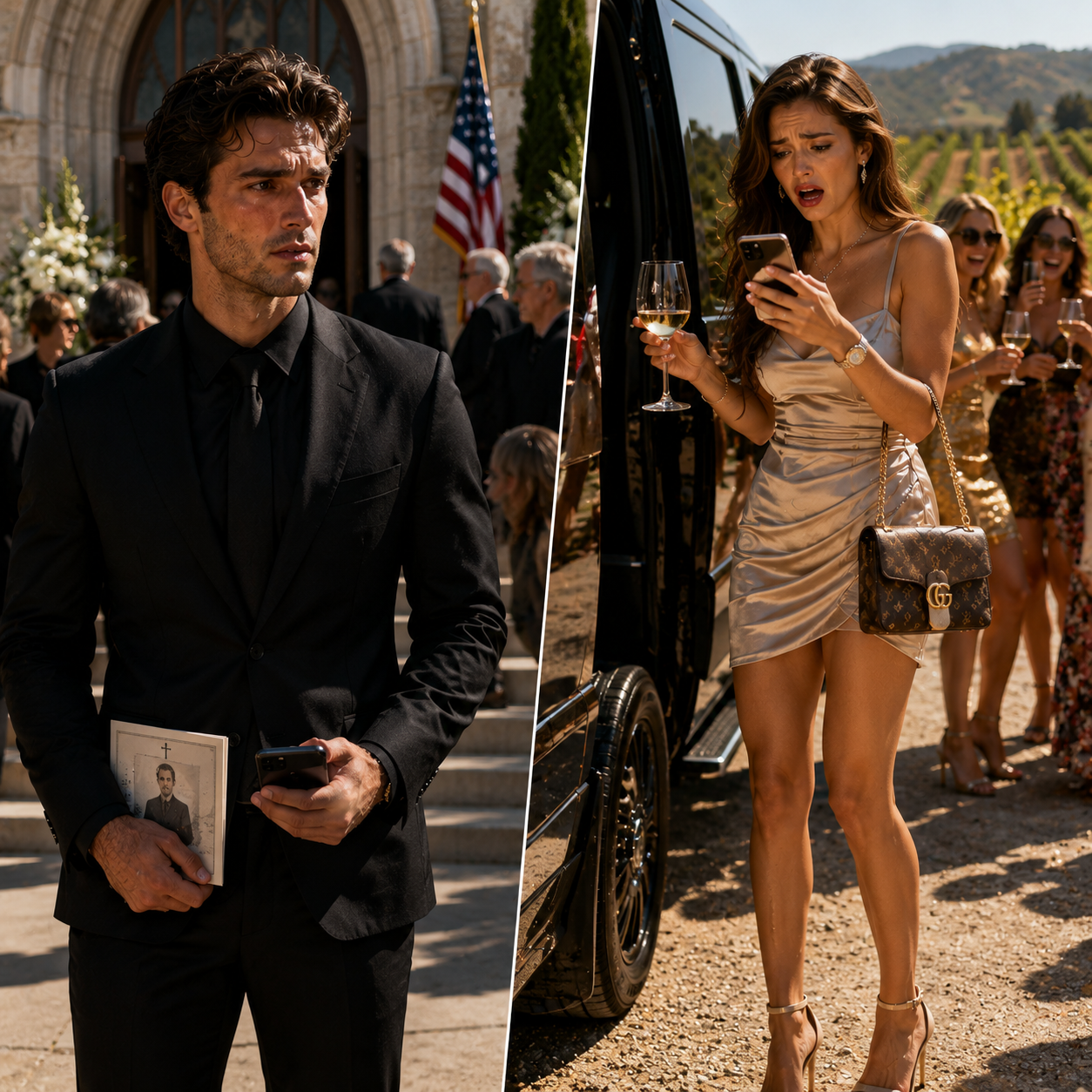
My father died on a Tuesday night.
For six weeks, cancer had moved through our lives like a storm with no mercy and no pause. One month he was still making jokes in the kitchen, still correcting my mother’s crossword answers from across the room, still asking me if I had checked the oil in my car like I was sixteen instead of twenty-eight. The next month, he was lying in a hospital bed with hands that looked too thin and eyes that kept apologizing even when he had done nothing wrong.
Pancreatic cancer does not negotiate. It does not give families time to prepare their hearts. It arrives quietly, spreads cruelly, and then leaves everyone standing in the wreckage wondering how a whole person can disappear from the world so fast.
I was holding his hand when he passed.
My mother was on the other side of the bed, whispering prayers through tears. I remember the monitor. I remember the smell of antiseptic. I remember the strange softness of the room after it happened, like the entire universe had lowered its voice out of respect.
At three in the morning, I walked into the hospital parking lot and called Natalie.
She had been my girlfriend for three years. We had lived together for a year and a half. I thought she was my person. Maybe not in a dramatic movie-love kind of way, but in the real way. The steady way. The person you call when the worst thing in your life has happened.
She answered groggily.
“Did he finally pass?”
Finally.
That was the word that stayed with me.
Not “I’m so sorry.” Not “Where are you?” Not “Do you need me?”
Finally.
As if my father’s death had been an overdue appointment.
I was too numb to react. Grief makes your mind move slowly. It turns obvious cruelty into background noise because your heart is already carrying something heavier. I told her I was going to stay at my mom’s house for a few days to help with arrangements.
“That’s probably for the best,” she said. “I have a lot going on at work, and I can’t really handle funeral stuff too.”
I looked across the parking lot at the dark sky and felt something inside me shift, but I did not have the energy to name it yet.
The funeral was set for Saturday.
My father had been a high school music teacher for twenty-three years. He believed every kid had a song inside them, even the ones who tried to hide behind sarcasm and hoodies. Former students still wrote to him years after graduation. Some credited him with keeping them alive during the hardest parts of their teenage years.
That Thursday, I was sitting at my mother’s kitchen table helping her write his obituary when Natalie called.
“So, about Saturday,” she began.
I already knew.
There is a tone people use when they are about to disappoint you but want you to comfort them for it.
“What about Saturday?” I asked.
“Well, Kayla’s birthday weekend is then. The wine tour. We’ve had it planned for months, and I already paid.”
For a second, I could not understand the sentence.
“My dad’s funeral is Saturday.”
“I know,” she said, already defensive. “And that’s awful, obviously. But Kayla’s thirtieth is a big deal. It’s not just a random hangout. We booked the whole thing way before this.”
“My father died, Natalie.”
“I know, Mike. But he was sick. It’s not like this came out of nowhere.”
Something in me went silent.
Not angry.
Silent.
That deep, cold kind of silence that comes when a person finally shows you exactly where you stand in their life.
“I understand,” I said.
Then I hung up.
My mother was watching me from across the table. She had heard enough from my side of the conversation.
“She’s not coming,” I said.
Mom nodded slowly, her face calm in that tired way grief makes people calm.
“Well,” she said, “that certainly clarifies things.”
Yes.
It did.
That evening, I turned my phone back on and saw Natalie’s messages waiting for me. She said I was overreacting. She said I was making her feel guilty. She said I could use the space anyway.
So I gave her space.
Permanent space.
I blocked her number. I blocked her on every social media account. I turned off location sharing, changed passwords, and disappeared from the relationship without a speech.
Some people will call that ghosting.
I call it survival.
The funeral came and went.
The church was full. Former students filled entire rows. The choir my father had directed sang for him, and I broke in a way I had been holding back for weeks. My mother squeezed my hand so hard it hurt. Relatives hugged me. Friends came. People told stories about my dad that made me laugh and cry in the same breath.
Natalie was not there.
And somehow, her absence said more than her presence ever could have.
After the funeral, I stayed with my mother for a week. We sorted through papers, donations, medical bills, sympathy cards, and the unbearable ordinary tasks that follow death. I also made a decision.
I was done with Natalie.
Not because she missed “one event,” as she later called it.
Because she missed the moment when love is supposed to stop being convenient and start being real.
When I finally returned to the house we shared, she was gone for the weekend. I packed quietly. Clothes. Electronics. Personal documents. My desk. A few pieces of furniture that had been mine before us.
I did not destroy anything. I did not take revenge. I did not leave a dramatic note.
I simply removed myself from a life where my grief had been treated like an inconvenience.
My friend Derek had a spare room, so I moved in with him. I emailed the landlord, explained the separation, and agreed to keep paying my share until the lease ended. Clean. Responsible. Final.
For eighteen days, Natalie did not look for me.
Not really.
She did not call my friends in panic. She did not show up at my mother’s house worried about my grief. She did not wonder if the man who had just buried his father was okay.
She assumed I was sulking.
On the nineteenth day, she appeared at Derek’s apartment.
Her eyes were red. Her phone was clutched in her hand like evidence.
“What the hell, Mike?” she snapped. “You moved out? You blocked me? You ghosted me during a hard time?”
I stared at her.
A hard time.
Her hard time.
In her version of the story, she was the injured party because I had stopped giving her access to me after she abandoned me on the worst day of my life.
“I didn’t ghost you,” I said calmly. “I broke up with you.”
Her mouth opened slightly.
“You can’t just decide that.”
“I can. I did.”
She started crying then, but I had already seen too much to trust tears without accountability.
“I was giving you space,” she said. “You were being distant.”
“My dad died.”
“I know, but life has to go on.”
There it was.
The whole truth of her in one sentence.
To Natalie, grief was something I was choosing to participate in for too long. Sadness was an inconvenience. Mourning was a mood. My father’s death was a disruption to her schedule.
“You were supposed to show up,” I told her. “That’s all. Just show up.”
“I missed one day.”
“The most important one.”
She wiped at her face, angry now.
“So three years means nothing?”
I shook my head.
“Three years meant a lot. That’s why it took me so long to believe what you were showing me.”
For a moment, she looked almost frightened.
Because stoic men do not always leave loudly.
Sometimes they leave after taking one final inventory of your character and realizing there is nothing left worth arguing for.
She tried to push past me into the apartment, but I stepped in front of the door.
“We need to talk properly,” she insisted.
“No,” I said. “We don’t.”
Her expression hardened.
“Don’t come crawling back when you realize what you threw away.”
I almost smiled.
Not because it was funny, but because it was so perfectly Natalie. Even at the end, she thought the loss was hers to define.
After she stormed away, Derek came out of his room and looked at me.
“Damn,” he said.
“Yeah,” I replied. “Want a beer?”
We sat on his balcony for a long time without saying much. The city moved below us. Cars passed. People laughed somewhere in another building. Life kept going in that offensive way it does after someone you love dies.
“You okay?” Derek asked eventually.
I thought about lying.
Then I didn’t.
“No,” I said. “My dad is dead, and the woman I thought I might marry turned out to be someone I didn’t know.”
He nodded and tapped his beer bottle against mine.
“To eventually,” he said.
“To eventually,” I answered.
The weeks after that were messy, but not in the way Natalie wanted them to be.
She sent messages through friends’ phones. She showed up at my mother’s house, which went badly for her because my mother had apparently been storing three years of polite opinions behind a locked door and Natalie had just handed her the key. She wrote me a letter saying she forgave me for overreacting and was ready to work through our difficult season together.
I did not respond.
There was nothing left to explain.
I found a small one-bedroom apartment closer to work. I adopted a three-legged pit mix named Buster, who had been at the shelter for over a year because people kept overlooking him. I think we recognized something in each other. Not broken. Just changed.
Therapy helped.
So did routine.
So did going to my mom’s house once a week for dinner and hearing her laugh again in small, careful bursts. She started taking watercolor classes because my dad had always wanted to try them and never did. The first painting she made was terrible, and we both laughed until we cried.
Grief still comes in waves.
Some days, I hear a song my dad loved and have to sit down. Some days, I reach for my phone to call him before remembering there is no number grief can dial. Some days, I feel almost normal, and then I feel guilty for feeling normal.
But I am healing.
Slowly.
Honestly.
As for Natalie, I heard through mutual friends that she started dating someone new. Apparently, he “communicates his feelings better than I did.” Maybe that is true. Maybe she found someone whose pain fits more conveniently into her social calendar.
I do not hate her.
That surprises people.
But hatred takes energy, and I would rather spend mine becoming someone my father would recognize.
Natalie was not a villain with horns and a master plan. She was simply selfish in the exact moment I needed love to be selfless. She showed me her priorities, and once I saw them clearly, I believed her.
That is the lesson I carry now.
Love is not proven by how someone acts when life is easy. Anyone can love you at brunch. Anyone can laugh with you during good seasons. Anyone can say the right things when nothing is required of them.
The truth appears in hospital rooms.
In funeral pews.
In the quiet after devastating phone calls.
In the moments when showing up costs something.
Natalie chose a wine tour.
I chose myself.
And somewhere, I hope my dad knows that the last lesson he taught me was not about death at all.
It was about dignity.
Because sometimes walking away quietly is not weakness.
Sometimes silence is the strongest answer you have left.
![[FULL STORY] At a family BBQ, her uncle asked her when she planned to get married and finally settle down.She](https://social-media.rabedo.com/thumbnails/1776761581_3.png)

![[FULL STORY] His Mother Ripped My Veil Off at the Altar—They Didn’t Know I Owned Everything](https://social-media.rabedo.com/thumbnails/1776745598_D66.jpeg)
![[FULL STORY] She Announced, “I’m Leaving You For The Millionaire Who’s Been Texting Me!” I Calmly Forwarded Her](https://social-media.rabedo.com/thumbnails/1776409307_659e8639-6a18-4b67-8b33-d1ea98827b38.png)