
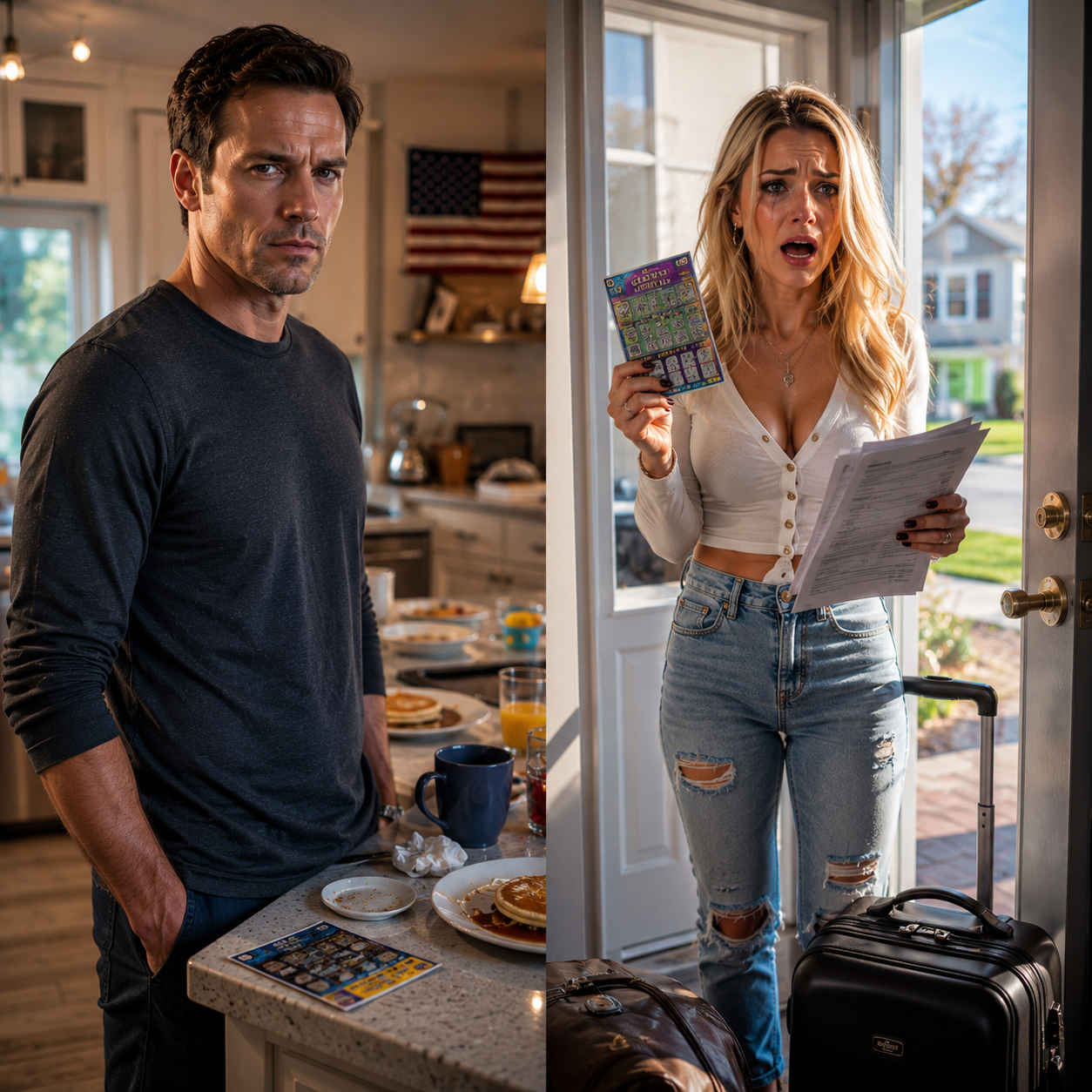
My wife thought she won the lottery.
For about thirty seconds, she believed she was finally rich, finally free, finally powerful enough to say out loud what she had apparently been thinking for months.
She stood in our kitchen on a Saturday morning, holding that ticket above her head like it was a passport out of the life we had built together, and screamed, “I’m rich. I’m finally leaving you and the kids.”
Our daughter Emma was ten.
Our son Tyler was eight.
They were standing right there.
I watched their faces change before Kelly even realized what she had done. Emma went pale first, her little hand reaching for her brother’s. Tyler’s eyes filled with tears almost immediately, confused and terrified because the woman who was supposed to be his safest place had just celebrated the idea of abandoning him.
Then I told Kelly to look at the ticket again.
She read the fine print.
Novelty item. Not a real lottery ticket.
The money was fake.
Her reaction was not.
When she realized what had happened, she tried to laugh.
“I was just joking,” she said.
That was when I walked to the safe, pulled out the envelope I had been keeping there for two weeks, and handed her the divorce papers.
“I wasn’t,” I said.
Her face turned ghost white.
My name is Daniel. I am thirty-eight years old, and until that morning, I had spent twelve years married to a woman I thought was just unhappy, stressed, maybe lost inside a midlife disappointment she did not know how to name.
Kelly is thirty-six. We met in college, married young, and built what I believed was a good, ordinary life. Two children. A house in a safe suburb. Decent jobs. School events. Grocery runs. Family movie nights. Mortgage payments. Birthday parties. The kind of life people dream about when they are young enough to think stability will automatically feel like happiness.
I work as an operations manager for a logistics company. I make around seventy-five thousand a year, not millionaire money, but enough for us to live comfortably. Kelly worked part-time at a dentist office, bringing in some extra income while still having flexibility for the kids.
We were not rich.
But we were not struggling.
That was never enough for her.
Over the last year, Kelly changed. At first, it looked like normal frustration. Bills annoyed her more than usual. Groceries were too expensive. The mortgage felt suffocating. Other people seemed luckier. Other couples our age were buying boats, going to resorts, upgrading kitchens, driving new SUVs.
Most of this came from social media.
She would sit on the couch scrolling Instagram and Facebook, showing me posts from women she barely knew.
“Look at them in Greece.”
“They just bought another car.”
“Must be nice to have a husband who can actually provide that kind of life.”
Sometimes she said it as a joke.
Sometimes she did not.
Then came the lottery tickets.
At first, it was one ticket here and there. Then Powerball. Mega Millions. Scratch-offs. Eight or ten tickets at a time, twice a week, always paired with the same little speech.
“Someone has to win. Why not us?”
But her version of winning was not family freedom.
It was escape.
At first, she talked about quitting her job, buying a huge house, taking vacations. Normal lottery fantasy stuff. But slowly, the dream got uglier.
She talked about moving to Florida alone.
She joked about sending the kids to boarding school so she could “finally breathe.”
She talked about hiring nannies because motherhood had “stolen her best years.”
Every time she said something like that, I tried to slow the conversation down.
“Kelly, they can hear you.”
She would roll her eyes.
“They know I’m joking.”
But kids know more than adults think.
Emma started asking if Mom was tired of us.
Tyler started getting quiet whenever Kelly complained about being trapped.
That was when I started seeing the truth I did not want to see.
My wife did not just want more money.
She wanted fewer responsibilities.
And in her mind, somehow, we had become the cage.
Things got worse after her sister Lisa visited.
Lisa had married a tech guy who sold his startup and became wildly wealthy. They lived in Arizona in a huge house with a pool, expensive furniture, and the kind of effortless lifestyle Kelly had been obsessing over.
During the visit, Kelly changed completely. She laughed too loudly at Lisa’s stories, asked too many questions about money, and spent the whole weekend comparing our life to theirs.
After Lisa left, Kelly became unbearable.
She looked at our house like it had failed her.
She looked at me like I had failed her.
Worst of all, she looked at our children like they were anchors dragging her away from the life she deserved.
Two weeks before everything happened, our neighbor Bob gave me a prank lottery ticket. It looked real, but when scratched, it showed a fake $50,000 win. The fine print clearly said it was a novelty item. Bob laughed and said his brother-in-law owned a joke shop.
I put it in my wallet and forgot about it.
I never planned to use it on Kelly.
Then Saturday morning came.
Kelly was at the kitchen table with coffee and her usual stack of lottery tickets. The kids were watching cartoons in the living room. I was making pancakes. She was already irritated, muttering under her breath every time a ticket lost.
That was when I remembered the fake ticket.
I do not know exactly why I placed it on the counter near her real ones. Maybe I wanted to snap her out of the obsession. Maybe I wanted one harmless joke. Maybe, deep down, I wanted to see what she would do if she believed the fantasy was real.
I set it down and went back to the stove.
A minute later, she scratched it.
Her entire body changed.
She gasped.
Then again.
“Oh my God,” she whispered. “Oh my God. Oh my God.”
I turned around like I did not know what was happening.
“What’s wrong?”
She shot up from the chair, ticket trembling in her hand.
“I won. I actually won.”
The kids came running in.
“How much?” Emma asked.
Kelly looked at her with annoyance.
That look alone hurt.
Not joy. Not excitement to share with her daughter. Annoyance that Emma had interrupted her moment.
“Fifty thousand dollars,” Kelly shouted. “Mommy’s rich now.”
Then she said it.
“I’m rich. I’m finally leaving you and the kids.”
The room froze.
Tyler started crying.
Emma grabbed his hand.
Kelly did not notice. She was already pacing the kitchen, laughing, talking about quitting her job, moving to Miami, buying a condo, living like a queen.
“No more bills. No more kids. No more boring husband. I’m free.”
Free.
That word echoed in my head.
I looked at my children, both crying now, both watching their mother celebrate the idea of disappearing from their lives.
That was the moment I knew there was no marriage left to save.
“Kelly,” I said calmly. “Look at the ticket again.”
She stopped, irritated, and looked down.
I watched her read the fine print.
Once.
Twice.
Her face shifted from joy to confusion to rage.
“This is fake,” she said.
“Yes.”
Her eyes snapped to mine.
“You knew?”
“Yes.”
She looked at the ticket, then at the kids, then back at me. I saw the panic arrive as she realized what she had revealed.
Then she started laughing.
Forced. Thin. Desperate.
“I was just joking. Obviously I wouldn’t leave you guys.”
She reached for Emma and Tyler.
Both backed away.
That broke something in me more than anything else.
Emma looked at her mother and said, “You said you were leaving us.”
Kelly’s mouth opened.
Nothing useful came out.
I walked to the hallway safe. She followed me with her voice, asking what I was doing. I entered the code and pulled out the envelope I had prepared two weeks earlier, after one too many lottery fantasies where my children sounded like burdens in their mother’s dream life.
I handed it to her.
“Divorce papers,” I said. “My lawyer will serve you officially within forty-eight hours.”
She stared at the documents.
“You can’t be serious.”
“Dead serious.”
“You’re divorcing me over a joke?”
“No,” I said. “I’m divorcing you because even fake money was enough to make you forget you were a mother.”
She tried to argue.
She said people say crazy things when they are excited. She said I had tricked her. She said I had set her up. She said no one should be judged by one emotional moment.
But it was not one moment.
It was a year of resentment.
A year of complaints.
A year of telling our children, in small ways, that they were obstacles instead of blessings.
The fake ticket did not create the truth.
It revealed it.
I told Kelly to pack a bag.
She cried then. Real tears, finally. She begged. She said we could fix it. She said I was breaking up the family.
I looked at Emma and Tyler, still standing together like two little survivors of a storm they did not understand.
“No,” I said. “You did that when you told them you wanted freedom from them.”
Kelly left that afternoon for her sister’s house.
The house changed immediately.
Not happy. Not easy. But calmer.
The absence of constant disappointment felt like air returning to a room.
That night, I sat with the kids on the couch. We talked in the simplest words I could find. I told them none of this was their fault. I told them both parents can love their children, but sometimes adults make harmful choices. I told them I would always be there, always choose them, always keep them safe.
Emma asked the question that shattered me.
“Did Mom ever really love us?”
I pulled her close.
“Yes,” I said, because I believe love can exist inside broken people. “But love is not enough if someone keeps hurting you.”
Tyler asked if she was coming home.
I told him not right now.
He looked relieved.
That told me more about the house we had been living in than any lawyer ever could.
By Monday, I had already scheduled counseling for both kids. My lawyer told me the custody case looked strong, especially because Kelly had made her declaration in front of the children and had already left the home. Kelly’s own mother called me and apologized. She said she loved her daughter but was ashamed of what she had said to the grandchildren.
Kelly kept texting.
At first apologizing.
Then blaming me.
Then saying I had manipulated her with the ticket.
Then begging to come home.
Then insisting she had rights.
I did not engage unless my lawyer told me to.
Bob, the neighbor who gave me the ticket, felt awful. He kept apologizing like he had destroyed my family. I told him the ticket did not destroy anything. It only turned on the light.
The fake lottery ticket is still on my kitchen counter.
I keep meaning to throw it away, but part of me cannot yet.
It is ugly evidence of the day my wife thought she had a way out and immediately announced what she wanted to escape from.
Me.
Our children.
Our ordinary life.
The life I thought we were lucky to have.
I have asked myself what would have happened if the ticket had been real. If Kelly had actually won fifty thousand dollars, would she have left?
The answer scares me because I think she would have.
Maybe not that day.
Maybe not cleanly.
But eventually.
The money would have become permission.
That is what fantasy does when someone feeds it long enough. It stops being imagination and becomes a plan waiting for funding.
The divorce will not be painless, but it will be clear.
I am asking for primary custody. Kelly can have visitation when the court determines what is healthy for the children. I am not trying to erase her from their lives, but I will not let her make them feel unwanted again.
Our kids deserve better.
They deserve a home where they are not treated like burdens.
They deserve pancakes on Saturday morning without wondering if their mother is dreaming about leaving them behind.
And me?
I deserve a marriage where I am not viewed as the boring obstacle between someone and a fantasy condo in Miami.
People keep asking if I am angry.
I am, sometimes.
But mostly I am disappointed.
Disappointed that twelve years of marriage could be exposed by one fake ticket. Disappointed that my children had to hear the truth in such a brutal way. Disappointed that Kelly could stand in the middle of a kitchen filled with the life we built and see only what she wanted to escape.
But I am also grateful.
Better now than later.
Better while the kids are young enough to heal.
Better before I wasted another decade trying to make someone appreciate a life she had already emotionally abandoned.
Tomorrow, I am taking Emma and Tyler out for ice cream.
Not to celebrate divorce.
Not to pretend everything is fine.
But to mark a new beginning.
A quieter one.
A safer one.
A life where nobody in this house is treated like a chain around someone else’s ankle.
Kelly wanted freedom.
Now she has it.
No husband to bore her.
No daily motherhood to resent.
No ordinary life to complain about.
She got exactly what she screamed she wanted when she thought she was rich.
The only difference is, she has to live it without the lottery money.
And this time, the ticket is real.
![[FULL STORY] The Woman Who Confused Love With a Paycheck](https://social-media.rabedo.com/thumbnails/1777067398_248f89d1-9bd2-43a5-8e09-b3cba6f3adcd.png)

![[FULL STORY] She Told Me to Step My Game Up — So I Removed Her From Everything I Paid For](https://social-media.rabedo.com/thumbnails/1776414041_671800449_978674831351386_3478751464949451631_n.jpg)

![[FULL STORY] She laughed with her friends, “He’s so obsessed with me. No matter how much I push him away, he…”](https://social-media.rabedo.com/thumbnails/1776759120_1.png)
![[FULL STORY] I Took Revenge on My Parking-Hog Neighbor… and Accidentally Built a Kingdom of Crows](https://social-media.rabedo.com/thumbnails/1777647894_c78204ff-29dd-44a2-a7ec-4801f03b4bc2.png)