

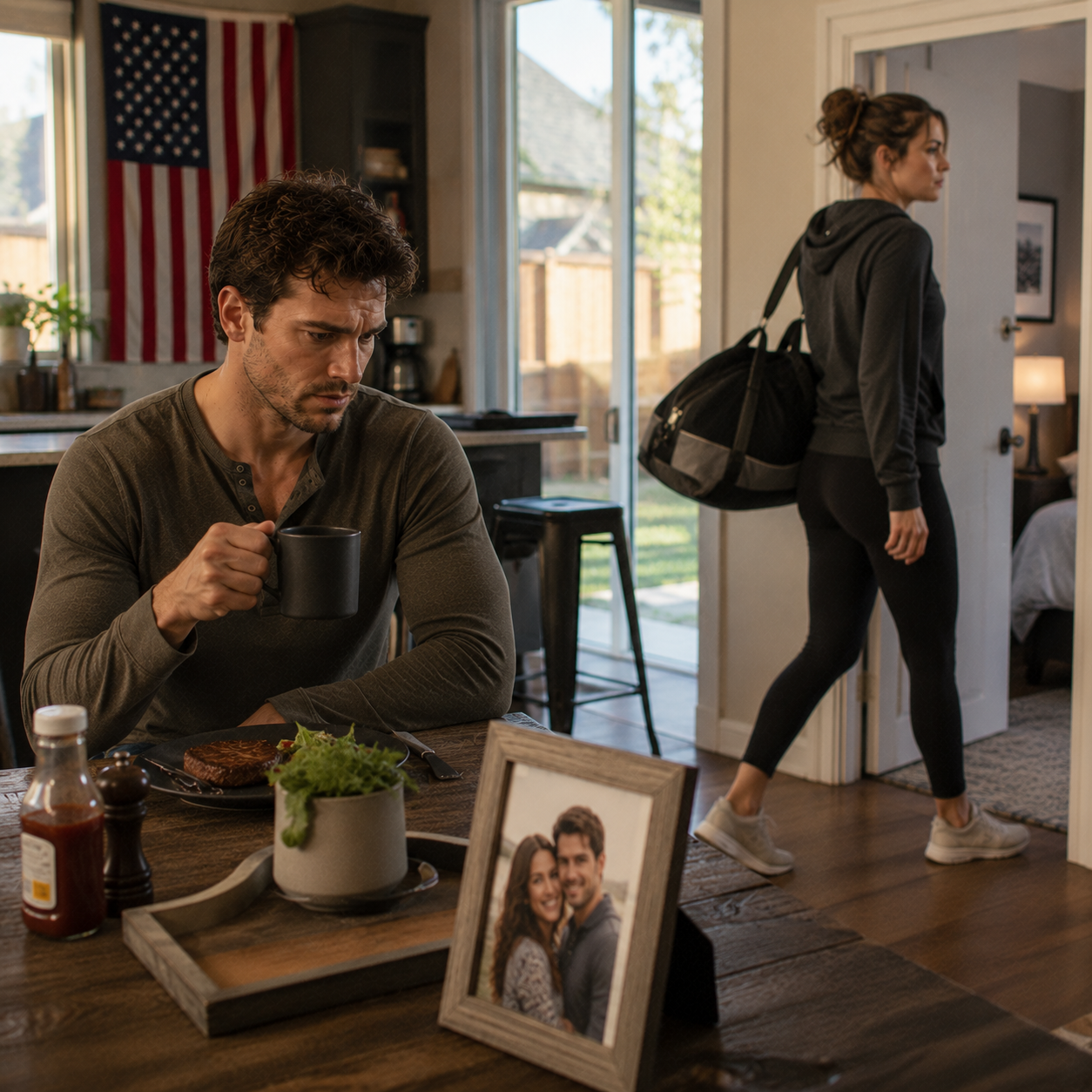
My fiancée said, “Your feelings are exhausting. I need someone stronger.”
I looked at her for a moment, waiting for some sign that she heard herself. Waiting for the instant regret. The apology. The small flicker of recognition that she had just said something cruel to the man she was supposed to marry.
Nothing came.
So I replied, “Then you need someone else.”
She laughed because she thought I was trying to win an argument.
I was not.
I stood up, walked upstairs, pulled two storage bins from the guest closet, and started packing her things.
By the next morning, the venue payment was canceled, the photographer and florist were paused, the registry was locked, and Kelsey was telling people I had abandoned her because I could not handle “one hard conversation.”
What she never understood was that the relationship did not end because I was too emotional.
It ended because I finally stopped apologizing for being human.
My name is Mason. I am thirty-three years old, and I work as an IT project manager for a hospital network in Columbus, Ohio. My life is not glamorous, but it is stable. I own my condo. I pay my bills early. I like clear plans, clean systems, quiet mornings, and people who say what they mean without turning every conversation into a power struggle.
Kelsey was thirty when this happened. She handled social media for a chain of boutique fitness studios, which meant she understood image better than most people understand themselves. She was sharp, polished, funny, and magnetic in the beginning. She had this way of making everything feel exciting, like life with her would always have motion and color.
For a long time, I thought she liked that I was steady.
Then steady became soft in her eyes.
And soft slowly turned into weak.
That is the part people misunderstand about relationships that rot from the inside. It rarely happens all at once. Nobody wakes up one morning and suddenly accepts contempt. It arrives slowly, disguised as honesty, then bluntness, then personality differences, then “you know how I am.”
At first, Kelsey’s comments were small enough to explain away.
If I talked about work stress, she said I was spiraling.
If I worried about my mother driving through snow, she said I carried too much emotion for a grown man.
When my younger sister and her husband lost a pregnancy last fall, I was wrecked for days. Kelsey hugged me once, then told me she needed me to stop bringing “heavy energy” into the apartment every night.
I should have left then.
Instead, I translated cruelty into practicality.
I told myself she was just less emotional than me. That she processed things differently. That maybe I did feel too deeply. That maybe my grief was inconvenient. That maybe loving someone meant making your pain smaller so it did not bother them.
That is the trap.
When someone keeps insulting the part of you that makes you human, eventually you start defending their insult for them.
We had been together a little over three years and engaged for eight months. She had moved into my condo ten months earlier. The mortgage was in my name. Most of the furniture was mine because I bought the place before I met her. But we were engaged, so I treated it like ours. I made space for her clothes, her ring light, her skincare products, her work props, her little notes on the fridge about content deadlines and gym launches.
I thought we were building a marriage.
Looking back, she was building a stage.
The final night came in March.
My father had a biopsy scheduled the next morning in Cincinnati. Nothing confirmed yet, just one of those medical words that makes the rest of your week go blurry. I was sitting in the living room, using hotel points to book a room because I planned to leave before sunrise and meet my parents at the hospital.
Kelsey was getting ready for a dinner with two influencers and her regional director. She came out wearing a green dress, putting in earrings, looking perfect.
She saw me sitting quietly and asked, “What’s your mood about?”
“My dad’s procedure is at seven tomorrow,” I said. “I’m trying not to think too hard about it.”
She rolled one earring into place and sighed.
“Mason, this is what I mean.”
I looked up.
“What do you mean?”
She crossed her arms and gave me that tired look she used whenever my emotions became inconvenient.
“Your feelings are exhausting. I need someone stronger.”
Not shouted.
Not during some screaming fight.
Cold.
Casual.
Like she had been carrying the sentence around and finally found the right moment to set it down between us.
I set my phone on the coffee table.
“Then you need someone else.”
She laughed.
Not because it was funny.
Because she did not believe me.
I walked upstairs and pulled out the storage bins.
She followed me halfway up the stairs.
“Are you seriously doing this right now?”
“Yes.”
“You’re proving my point by being emotional.”
“No,” I said. “I’m being decisive.”
That was when the scramble started.
“Mason, wait. You know I didn’t mean it like that. You always take everything to the worst possible place.”
I did not argue.
I folded her sweaters.
Then her jeans.
Then the skincare products that had slowly taken over both bathroom drawers.
I boxed the framed engagement photos from the hallway. I unplugged the ring light she kept in my office. I stacked the wedding binders she had left on the dining room bench.
She stood there watching me, trying different versions of herself to see which one would make me stop.
Anger.
Disbelief.
Tears.
Soft voice.
Sharp voice.
Blame.
By nine-thirty, she left for the dinner anyway.
Because image always came first.
On the way out, she said, “Don’t do anything stupid while I’m gone.”
I looked at the half-packed room.
“Too late,” I said. “I already listened long enough.”
After she left, I called the venue and canceled the April payment. We lost the twelve-hundred-dollar deposit. It hurt, but it still felt cheaper than divorce.
Then I emailed the photographer and florist. Paused the registry. Saved every vendor conversation. Moved wedding documents into a folder.
Finally, I texted Kelsey one line.
Your things will be packed by tomorrow evening. Coordinate pickup through your brother or your mom.
She replied instantly.
Are you insane?
I wrote back:
No. I’m done.
Then I blocked her.
The next morning, I drove to Cincinnati with my mother. My father’s procedure took most of the morning. The result was benign. Best possible outcome.
On the drive home, my mom asked why Kelsey had not checked in once.
I told her everything.
My mother went silent for almost a full minute.
Then she said, “Thank God she said it before the wedding.”
When I got back to Columbus, Kelsey’s brother Trevor was already in my driveway.
Trevor was one of the only people in her family I genuinely liked. Practical, quiet, direct. He looked uncomfortable standing there, hands in his jacket pockets.
“Kelsey says this was a fight,” he said. “She says you overreacted.”
I told him exactly what happened, word for word.
He stared at me for a second.
“She really said stronger?”
“Yes.”
He nodded once.
“I’ll help her get her stuff Saturday.”
That was the first time I knew someone in her world understood.
Saturday came.
Trevor brought Kelsey at noon. She got out of his truck wearing sunglasses and the engagement ring, which told me everything. She still thought this was about optics. She still thought the ring gave her leverage.
Her things were boxed in the garage. Labeled. Clean. Nothing damaged.
I was not trying to punish her.
I was trying to end this without giving her room to rewrite it.
Trevor loaded the first boxes while Kelsey stood there staring at me.
Finally, she said, “So you’re really throwing away three years because I asked you to grow up.”
“No,” I said. “I’m ending it because you hear vulnerability and call it weakness.”
She scoffed.
“You’re proving my point right now.”
Trevor stopped carrying the box.
“Kelsey,” he said. “Enough.”
That was the first crack in her confidence.
She switched to crying. She said she was overwhelmed. Work was brutal. She expected her fiancé to understand her communication style.
Communication style.
As if cruelty becomes professional when you use corporate language.
“You called my feelings exhausting the night before my dad’s biopsy,” I said. “There is no version of that I need to work through.”
She pulled off the ring and held it out dramatically, like I was supposed to collapse at the sight of it.
I took it, put it in my pocket, and thanked Trevor for helping.
She looked stunned by how easy it was.
After they left, her friend Marin texted me from an unknown number.
Kelsey’s in a really dark place. Can you please be compassionate?
I replied once.
She had compassion available to her. She chose contempt instead.
Then I blocked the number.
Two days later, one of her coworkers found me on LinkedIn and said Kelsey just wanted closure. I sent him a screenshot of her exact quote.
He never answered.
Then came the social media performance.
Beige-background quotes about men who fear emotional depth. A black-and-white selfie captioned, “Some people leave the minute life gets real.” Vague posts about healing from abandonment.
Three mutual friends asked if I had really left Kelsey during an emotional breakdown.
Interesting how quickly the story changed from I need someone stronger to he abandoned me in my darkest hour.
I stopped defending myself to most people.
Anyone who mattered got the screenshot.
Anyone who still pushed after that got silence.
A week later, Kelsey showed up outside my office parking garage. She was leaning against a concrete column in forty-degree weather, arms wrapped around herself like she had been waiting for a movie scene to begin.
I parked, stayed in the car, and cracked the window an inch.
She said she only wanted five minutes.
I said no.
She said she had been crying every day and could not eat.
I said I was sorry she was hurting, but the relationship was over.
That was when her expression changed.
The tears vanished.
Jaw tight.
Eyes sharp.
“You know what your problem is, Mason?” she said. “You want credit for having feelings. That doesn’t make you deep. It makes you exhausting.”
Same word.
Again.
That moment did more than confirm my decision.
It proved the apology had never existed.
I rolled up the window and drove around her.
That night, I installed a camera at my condo.
The next day, Kelsey’s mother called me. Her voice was calm but careful. She asked what happened.
I told her.
Then I forwarded the LinkedIn message, the parking garage timestamp, and the original screenshot.
She read everything while I stayed on the line.
Then she said quietly, “I raised her better than that.”
She told me not to answer Kelsey anymore and to save everything.
I took that advice.
Life kept moving, strangely enough.
That is the thing about personal collapse. Work still exists. Emails still arrive. Hospitals still need systems rolled out. Timelines still need managing. I got pulled into a major hospital rollout project and ended up leading it. Bigger team. Higher visibility. A problem I could solve by being clear, organized, and steady.
Funny how the qualities Kelsey mocked were suddenly the same qualities making me better at everything else.
I started sleeping through the night again.
I started running in the mornings.
The condo felt quieter. Not empty. Quieter.
Then Kelsey left a handwritten letter under my doormat.
Seven pages.
Mostly blame with softer edges.
She wrote that she had only been pushing me to become more resilient. That I had mistaken challenge for cruelty. That she still believed I was the love of her life and would fight for us.
I scanned it.
Saved it.
Added it to the folder.
About two and a half weeks later, things escalated from irritating to unstable.
By then, I had gone on two dates with Hannah, a woman I met through a volunteer board that runs school tech drives. She was thirty-one, an elementary school counselor, calm in a way that did not feel forced.
Dinner with her felt easy.
No performance.
No edge.
No emotional traps waiting under ordinary sentences.
I had not posted her anywhere, but Columbus is small when people want information badly enough.
The first sign Kelsey knew was flowers at my office.
Not romantic flowers.
Funeral-looking flowers.
White lilies and eucalyptus in a tall glass vase.
The card said:
Hope she enjoys the version of you I had to break open.
Reception brought them to my desk in front of two coworkers.
I photographed them, then carried the entire arrangement straight to the trash room.
An hour later, Kelsey emailed my work account.
Subject line: So, this is who you are.
Message:
I give you three years and some random woman gets the healed version. That’s disgusting.
I forwarded it to HR and to myself.
Then I replied once:
Do not contact me at work again.
Two mornings later, my assistant pinged me and said a woman in the lobby was claiming to be my fiancée and needed access because of a family emergency.
There was no family emergency.
I told security to remove her immediately.
One guard later told me she kept saying, “He can’t just shut me out because I’m emotional.”
That afternoon, Trevor called.
Apparently, Kelsey had told their aunt I was ignoring a medical crisis. Again, not true. Trevor said he was done covering for her and wanted me to know she had been driving past my condo most nights.
I checked the doorbell footage.
Two clips.
Her car rolling slowly past the curb at 11:43 p.m.
Again at 12:08 a.m.
I added them to the folder.
Then came the restaurant incident.
Hannah and I were at a small place in German Village on a Friday night. Halfway through dinner, Hannah glanced toward the bar and said, “I think someone’s filming us.”
I turned.
Kelsey stood half behind a pillar, phone raised, face tight.
I got up and walked over.
“Leave,” I said.
She smiled.
“So she’s the reward for all your brave feelings?”
“Kelsey, leave now.”
She stepped around me and walked straight to our table.
Hannah stood slowly, calmer than I felt.
Kelsey looked at her and said, “Be careful. He acts sensitive so women think he’s safe.”
Hannah said, “You need to go.”
Kelsey picked up Hannah’s wine glass and dumped it across the table.
Wine hit Hannah’s sleeve, my lap, the plates, the white tablecloth.
Then Kelsey started crying.
The manager came over. Then police.
I showed them the office email, the lobby report, the doorbell clips, the seven-page letter, the original quote. Hannah gave her statement. The restaurant had camera footage.
Kelsey received a criminal trespass warning.
The officer told me, “Keep every single thing. She’s escalating because access is gone.”
That Monday, I filed for a civil protection order.
One year requested.
No contact. Home and workplace included.
That same evening, I got a voicemail from a blocked number.
Kelsey’s voice was soft, almost whispering.
“You don’t get to make me the villain because I had emotions louder than yours.”
I listened to it twice.
Saved it too.
Court was just under a month later.
Kelsey arrived in a pale blue blouse, hair pulled back, makeup light. Clean. Careful. Harmless.
If you had not lived it, you might have believed it.
Her attorney used the predictable framing.
Painful breakup.
Emotional dysregulation.
Misread attempts at reconciliation.
My attorney let the evidence do the work.
The office email.
The flowers.
The handwritten letter.
The parking garage incident.
The fake lobby emergency.
The late-night drive-bys.
The restaurant footage.
The voicemail.
The judge listened to everything, then looked at Kelsey.
“If his emotional life was so burdensome to you,” she asked, “why have you spent six weeks forcing your way back into it?”
Nothing on Kelsey’s side improved after that.
She cried. Said she was under pressure. Said I cut her off too quickly. Said she only wanted to be heard.
The judge said, “Being heard does not authorize harassment.”
Order granted.
One year.
No calls. No texts. No emails. No third-party contact. Stay five hundred feet away from me, my condo, and my workplace.
After court, Kelsey tried one last look over her shoulder in the hallway, like I was supposed to see something tragic and soften.
I did not.
Three weeks later, Trevor told me Kelsey had lost her job.
Officially, it was restructuring.
Unofficially, she had missed too much work, dragged personal drama into the office, and posted vague things online that clients connected back to the company.
What surprised me was the message from her mother afterward.
Not pleading.
Not defending.
Just one sentence that stayed with me.
You were right to walk away the first time she mocked your feelings. I’m sorry you stayed long enough to see the rest.
She was right.
The real ending was not the night in my living room.
It was earlier.
That night was just when I finally stopped negotiating with it.
As for me, work got better. The hospital rollout finished on time, and I was bumped into a senior program role. I kept running and signed up for a half marathon in October.
Hannah and I are still seeing each other.
Slowly.
Normally.
After Kelsey, normal feels almost suspiciously peaceful.
The condo feels like mine again.
No ring light in the office corner.
No passive-aggressive notes about my tone on the fridge.
No rehearsed speeches about how I need to toughen up.
Just quiet coffee on Saturday mornings. Music while I cook. My actual life.
Here is what I learned.
People like Kelsey call empathy weakness because empathy is expensive to people who never plan to return it.
If they shame you out of your feelings, they do not have to respond to them.
If they label your pain dramatic, they get to stay comfortable while still asking you for care, patience, and stability.
That is not strength.
Real strength is being able to feel deeply without using those feelings as weapons.
Real strength is sitting with fear and grief and still choosing not to turn cruel.
Real strength is hearing someone you love say something humiliating and deciding, calmly, that access to you is over.
Kelsey said she needed someone stronger.
What she actually wanted was someone quieter.
Someone less inconvenient.
Someone who would keep loving her while accepting contempt as honesty.
She did not lose me because I was emotional.
She lost me because I finally understood that being human was never something I needed to apologize for.

![[FULL STORY] She Called It a “Girlfriend Bonus”… So I Ended the Relationship Like a Contract She Signed Herself](https://social-media.rabedo.com/thumbnails/1777142250_a75647bd-4a08-4ee8-9844-8050070acac1.png)

![[FULL STORY] She Bragged at Dinner That 8 Months Was Her Longest Time Without Cheating — So I Paid My Share and Walked Out](https://social-media.rabedo.com/thumbnails/1777129852_6219f742-ba75-437a-8d72-bcd164be9f1e.png)
![[FULL STORY] My Fiancée Posted Making Him Take A Polygraph Test Before The Wedding! If He Loves](https://social-media.rabedo.com/thumbnails/1777879331_21-.jpg)