
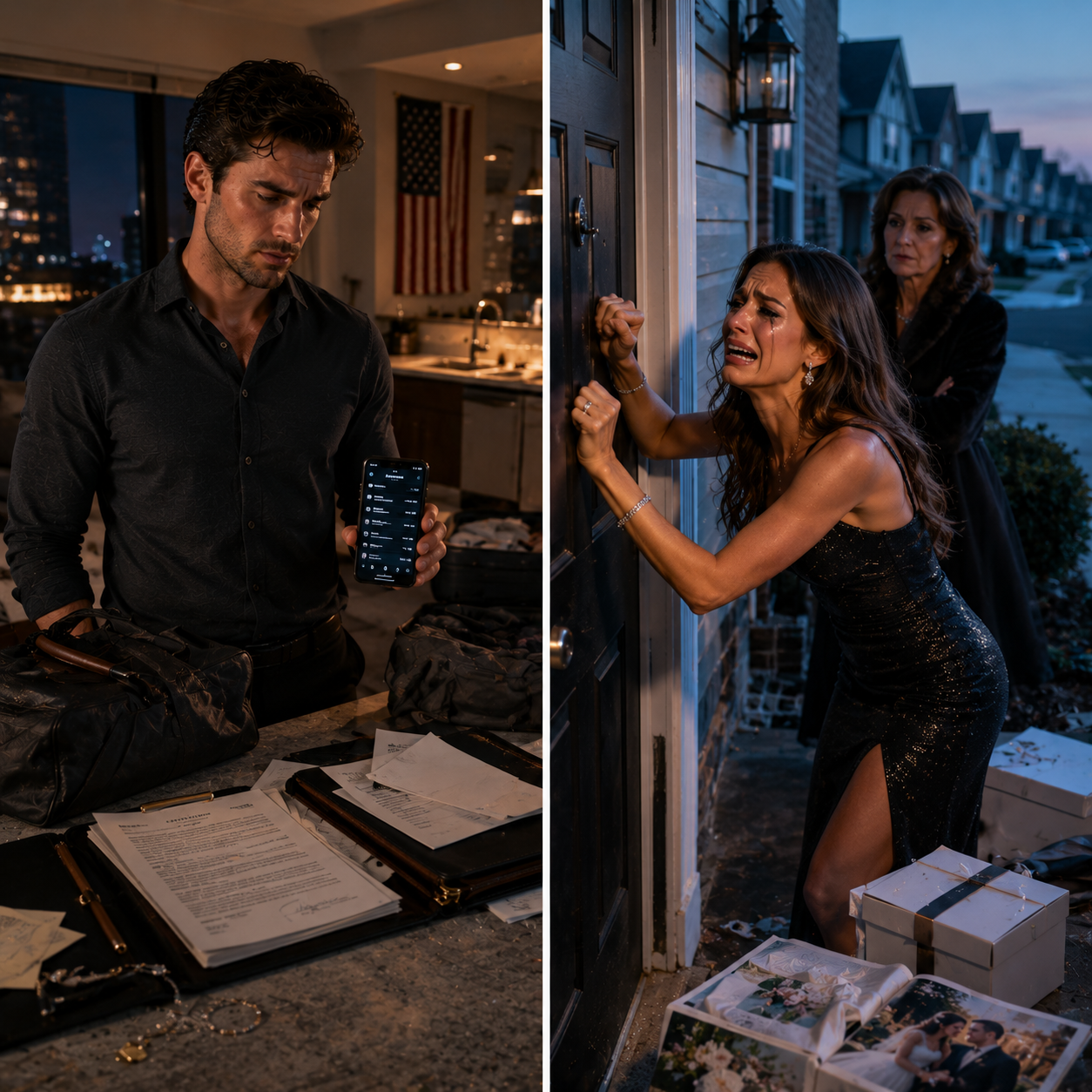
My fiancée said, “If one fight scares you, don’t come home.”
I looked at her standing there under the rooftop lights, arms crossed, face sharp with alcohol and confidence, waiting for me to fold like I always had before.
I said, “Okay. I won’t.”
Then I left.
No shouting. No speech. No dramatic exit designed to make people turn and stare. I just set my drink down, took out my keys, and walked away from the woman I was supposed to marry in October.
By midnight, I had cleared my side of the apartment, frozen every wedding payment tied to my cards, locked down the vendor accounts, and shut my phone off.
At 6:03 the next morning, Delaney was pounding on my sister’s front door crying that I had ruined her life.
What she really meant was that I had finally stopped letting her ruin mine.
My name is Mason. I’m thirty-two years old, and I work in logistics for a regional flooring company in Raleigh, North Carolina. My life has never been flashy. I make decent money, keep my apartment clean, pay my bills early, and like routines that make sense.
Before Delaney, that life was calm.
By the end of our engagement, it felt like a nightmare with invoices.
Delaney was twenty-nine, an event planner, magnetic in small doses, and exhausting in daily life. She could make a room love her in five minutes, then make the person closest to her pay for that performance for the next five hours.
We were together a little over three years and engaged for eight months. The wedding was already moving. Venue booked. Photographer booked. Caterer deposit paid. Save-the-dates mailed. Everyone knew. Everyone was excited. Everyone had an opinion.
And most of the largest bills had been paid by me.
Delaney kept saying her bonuses were coming. She said she would square everything later. She said we were a team, and I should stop making everything feel transactional.
I believed her longer than I should have.
But the money was not even the biggest issue.
The real problem was that every disagreement became public theater.
If I questioned the budget, I was cheap.
If I wanted one weekend without wedding talk, I was cold.
If I asked why she had approved something we had already agreed to pause, I was controlling.
There was always a script, and somehow I was always the villain.
The final scene happened at her friend Tori’s rooftop birthday party on a Thursday night.
Delaney had already had a couple of cocktails, and I recognized that too-bright mood immediately. The one where she smiled too widely, laughed too loudly, and said cruel things with just enough sparkle that people were not sure whether they were supposed to laugh.
Near the bar, she casually mentioned she had approved an upgraded floral package.
I asked if that was the one that added another twenty-seven hundred dollars.
Her eyes narrowed.
“Don’t start.”
“I’m not starting anything,” I said. “The card on file is mine, and we agreed not to add anything else this month.”
She laughed loudly enough that people nearby turned.
Then she said it.
“If one fight scares you, don’t come home.”
The words landed with a strange finality.
Not because they were the worst thing she had ever said.
Because they were the clearest.
Delaney did not say hard things to communicate. She said them to control the room. She wanted me embarrassed, off-balance, apologizing before I had even done anything wrong.
So I nodded once.
“Okay,” I said. “I won’t.”
Her expression shifted for half a second.
She had expected resistance.
She had expected me to chase the argument.
She had expected me to prove I cared by staying inside the humiliation.
Instead, I left.
Her texts started before I reached the elevator.
Mason, don’t be dramatic.
You better not leave me here.
We are not doing this tonight.
If you walk out over flowers, you’re proving my point.
I drove home in silence.
On the way, I called my sister Cameron. She is three years older than me, a middle school counselor, and one of the calmest people I know.
“I think the wedding is over,” I said.
She did not gasp. Did not ask for details. Did not lecture me.
She simply said, “Come here if you need to. No questions tonight.”
When I got to the apartment, I did not touch Delaney’s belongings. That mattered to me. I packed my essentials first. Laptop, work clothes, toiletries, passport, lease folder, wedding contracts, vendor receipts, financial documents.
Then I sat at the kitchen counter and started locking everything down.
I emailed the venue, caterer, florist, photographer, and honeymoon agent with the same message.
No new charges. No verbal changes. No approvals without written confirmation from me.
I locked my card.
Requested a replacement number.
Saved every contract to a cloud folder.
By then, Delaney had called seventeen times.
Her messages shifted from anger to mockery to threats to pleading.
So now you’re ghosting your fiancée.
Everyone here thinks you’re having some kind of episode.
You cannot cancel things without talking to me.
Pick up.
Pick up.
I turned the phone face down, grabbed two duffel bags and a file box, and drove to Cameron’s townhouse.
At 6:03 the next morning, Delaney was pounding on Cameron’s door.
Cameron looked through the peephole and sighed.
“Absolutely not.”
Delaney kept shouting that I was ruining everything, that people were asking questions, that I was insane for taking one sentence literally.
Cameron opened the door with the chain still on.
“He took you seriously,” she said. “That seems to be the real problem here.”
Then she shut the door.
The next four days proved I had made the right decision.
Delaney grabbed an imaginary microphone and started performing victimhood in every room available.
First came the apology phase.
Long paragraphs.
Voice notes.
One email with the subject line: Please just LET me explain.
According to Delaney, she was stressed, overwhelmed, and I should have known not to take her literally. She meant cool off. She meant stop being stubborn. She meant anything except the actual words she had said in front of people.
I replied once.
“You told me not to come home. I am respecting that. Do not show up at Cameron’s again.”
That should have ended it.
It didn’t.
Her best friend Kelsey texted me from an unknown number saying Delaney had cried for two days and I was being cruel. Her cousin Drew messaged me on Instagram saying real men did not abandon women during wedding season.
I blocked both.
The first real crack in Delaney’s version came from Janine, our venue coordinator. She emailed me privately asking whether Delaney was authorized to make payment changes using my account.
I called immediately.
Janine told me Delaney had already tried twice to restore my old card number and add a rush linen package. When Janine said she needed written approval from me, Delaney apparently snapped and said she was the bride and did not need permission from her own fiancé.
Janine said, “Something felt off, so I stopped everything.”
That woman probably saved me thousands.
I called every vendor again.
Two of them told me Delaney had contacted them crying, saying I was having a breakdown and sabotaging the wedding because I was afraid of commitment.
That became her new story.
Not that she humiliated me.
Not that she told me not to come home.
Not that she tried to keep spending my money after I left.
No.
I was unstable.
I was scared.
I was sabotaging love.
Sunday, I went back to the apartment with Cameron and my friend Nolan so I would not be alone. The lease was in my name only. Delaney had moved in ten months earlier and was never added. At the time, it felt unimportant because we were engaged.
In hindsight, it mattered a lot.
The apartment looked like a tornado had opinions.
Throw pillows on the floor. Kitchen drawers open. My office chair tipped over. Nothing major stolen, just chaos arranged to make a point.
Delaney still had her key.
Nolan looked around and said, “Change the locks today.”
I called the leasing office from the kitchen. By three that afternoon, maintenance had reprogrammed the smart lock and deactivated her building access.
That evening, Delaney texted.
You changed the code. Are you serious?
I replied:
The lease is in my name. Your belongings will be packed and available for pickup with a neutral witness present.
That was when she pivoted to false claims.
She said I had her grandmother’s pearl earrings, a designer bag, and cash she had hidden in a boot.
None of it was true.
Cameron was sitting on the floor wrapping Delaney’s ceramic decorations in bubble wrap when she said, “She doesn’t even know what she owns well enough to lie clearly.”
We packed everything carefully.
Clothes in garment bags. Makeup in bins. Shoes boxed. Decor wrapped. Every container labeled.
Not to be nice.
To be unassailable.
Pickup happened Monday at six in the apartment complex clubhouse lot. Delaney arrived in sunglasses like she was avoiding paparazzi, with Kelsey in one car and her mother Renee in another.
I expected yelling.
Instead, Renee stepped out, looked at the boxes, then looked at Delaney and said, “Mason packed all of this better than you ever would have.”
Delaney hissed, “Mom, not now.”
Renee ignored her and quietly asked if I had the ring.
I handed over the original box.
She nodded once.
Then Delaney started crying.
Loud.
Immediate.
Performative.
She said I was humiliating her. That people were asking if I dumped her. That I owed her five private minutes.
I said no.
She stepped closer and dropped her voice.
“Mason, don’t make me your nightmare over one bad night.”
That line told me everything.
Not remorse.
A threat dressed as a plea.
“I’m not making you anything,” I said. “I’m leaving.”
Nolan loaded the last box.
Renee told Delaney to get in the car.
I honestly thought that might be the end of it.
It was not even close.
About two and a half weeks later, Delaney stopped trying to fix things and started trying to punish me for not coming back.
First came the vague social media posts about surviving emotional abuse and being discarded by a controlling man. Then people I barely knew started viewing my LinkedIn, which told me her version had entered professional circles.
Then she emailed my office.
Not me.
My office.
The subject line was: Urgent personal matter regarding Mason Reed.
My boss Brent forwarded it to me with one sentence.
Handle this however you need.
Inside, Delaney claimed I had taken shared property, frozen money that belonged to both of us, and abandoned her while she was emotionally fragile. She asked my company to encourage me to respond because she was worried about my mental health.
I walked into Brent’s office with the lease, vendor contracts, screenshots, and a summary of the rooftop night.
He read for two minutes.
Then he said, “She’s not contacting this office again. Forward me anything else.”
Two days later, Delaney sent a Venmo request for six thousand two hundred forty dollars labeled reimbursement for wedding losses and emotional distress.
Emotional distress.
On Venmo.
I declined it and wrote one word.
No.
Then her brother Wyatt texted me saying a gentleman covers the damage he causes.
I blocked him too.
That same week, I got a late-night call from a woman claiming to be with Wake Memorial. She said Delaney had listed me as her emergency contact after a panic-related episode.
I asked for the department.
She hesitated.
I asked for Delaney’s date of birth.
She hung up.
Cameron was on speaker and immediately said, “That was not a hospital.”
The next morning, I filed a police information report.
Not because one fake call was enough on its own, but because the office email, vendor lies, fake emergency call, repeated third-party contact, and financial harassment had started forming a pattern.
A few days later, Delaney tried one more angle.
She contacted the travel agent and attempted to roll the honeymoon credit into her own name, claiming I had agreed she should still take the trip with her cousin because the cancellation was my fault.
The agent called me first.
I sent the contract and payment receipts within ten minutes.
Credit locked.
Name change denied.
Another screenshot went into the binder.
Then she started mailing things to my apartment.
Not gifts.
Props.
One envelope contained two save-the-dates ripped in half.
Another held a printed engagement photo with my face blacked out in marker.
No note.
Just theater.
I stopped opening them after the second one. I photographed the outside and dropped everything into a file box for my attorney.
The strangest part was how normal my actual life looked at the same time.
I still had trucks to schedule. Vendor delays to solve. A warehouse manager in Durham calling every morning about mislabeled pallets. Real problems. Useful problems. Problems with causes and solutions.
Every day at work made Delaney’s chaos feel more artificial.
That Saturday, I met Paige at Nolan’s backyard cookout.
She was a physical therapist, funny without trying, and refreshingly direct. We got coffee the next Tuesday. Easy conversation. No performance. No trapdoors.
Apparently, that reached Delaney faster than I expected.
The following Friday, she showed up outside the restaurant where Paige and I were having dinner. I still do not know who told her.
Delaney was wearing the blue dress from our engagement photos.
She walked right up to the patio railing and said, “So this is why you did all this.”
Paige looked at me once, calm and waiting.
I stood.
“Delaney, leave.”
She laughed that brittle laugh I knew too well.
“You replace me in three weeks and suddenly I’m the crazy one?”
“Leave now.”
Then she grabbed the water glass from our table and dumped it across Paige’s purse and lap.
The whole patio went silent.
Paige stood slower than I did, looked down at herself, then at Delaney.
“You need help,” she said.
Management called the police.
Delaney started crying before officers even arrived, saying she had been provoked and only wanted closure.
Security footage said otherwise.
The responding officer issued her a criminal trespass warning from the restaurant.
Afterward, Paige asked me one fair question in the car.
“Is this over, or is this the kind of thing that keeps growing if nobody stops it?”
I said, “I think it keeps growing.”
She nodded.
“Then stop treating it like a misunderstanding.”
That landed hard because she was right.
Some part of me had still believed that if I stayed calm enough, Delaney would eventually remember reality and step back into it.
She was not going to.
She had built an entire story where she was abandoned, betrayed, publicly humiliated, and morally entitled to do whatever came next.
Once I accepted that, filing for a protective order stopped feeling dramatic.
It felt overdue.
The following Monday, I met with an attorney. Her retainer was eighteen hundred fifty dollars. I handed over screenshots, the office email, the fake hospital call log, the Venmo request, witness statements, vendor notes, the restaurant report, and the police information report.
She looked through the binder and said, “You need a protective order.”
So I filed.
Court was three weeks later.
By then, Delaney had reinvented herself.
Conservative blouse. Soft voice. Hair pulled back. She looked like someone auditioning for the role of reasonable adult.
I came in with a binder.
Tabs. Dates. Printed screenshots. Emails. Police report. Vendor notes. Lease. Restaurant incident summary.
Everything.
Delaney’s lawyer tried the closure angle first. He said his client had been devastated by sudden abandonment and only made repeated contact because she was hurt, confused, and trying to resolve shared financial and emotional issues.
He actually used the phrase wedding trauma.
My attorney responded with the paper trail.
The fake hospital call.
The office email.
The Venmo request for emotional distress.
The restaurant trespass warning.
The vendor attempts.
And the screenshot from the rooftop night where Delaney texted, If you walk out over flowers, you’re proving my point, minutes after telling me not to come home.
The judge spent the longest time on that one.
Then he looked at Delaney.
“Ms. Harper, you told him not to come home.”
She cried and said she did not mean it literally.
The judge said, “That may be, but the court is not persuaded that your subsequent conduct was reasonable.”
He granted the protective order for one year.
No contact. No third-party contact. Stay three hundred feet away from my residence and workplace. Any real financial dispute could be handled through civil channels, not harassment campaigns, fake emergency calls, or workplace interference.
Delaney cried harder when she heard one year.
Renee was sitting in the back row. As she passed me on the way out, she said quietly, “I told her to stop.”
I believed her.
Financially, it could have been much worse.
Because I froze everything early, I recovered the honeymoon credit in full, got half the venue deposit back, and only lost about nineteen hundred dollars between booking fees and suit alterations.
Painful?
Yes.
Still cheaper than marrying into chaos.
Two months later, Brent promoted me to operations lead for our central region.
Paige and I kept things slow, which was the smartest choice possible. She stayed around. Stayed easy. Stayed honest. She also thinks the funniest detail in the whole disaster is that Delaney tried to bill me for emotional distress like it was a pizza order.
The quiet after everything was the strangest part.
No emergency texts.
No unknown numbers.
No friend-of-a-friend messages trying to shame me back into chaos.
Just my apartment.
My work.
My routines.
And the underrated luxury of peace.
Here is what I learned.
A nightmare does not always start with screaming.
Sometimes it starts with one person deciding their feelings matter more than facts, more than your dignity, and even more than the meaning of their own words.
Delaney wanted the power to throw me out without losing access to me.
She wanted consequences to be theatrical, not real.
She wanted to say the most damaging thing in the room and still have me come back apologizing.
I did not.
And that was the part she could not forgive.
If you tell someone to leave, do not be shocked when they believe you.
If you use humiliation as a test, do not act wounded when you fail it.
And if the only way your relationship works is by keeping the other person anxious, apologizing, and off-balance, then what you built is not love.
It is a hostage situation with better lighting.
![[FULL STORY] My Girlfriend Cheerfully Said, “I’m Grabbing Coffee With My Ex. Stay Home — We Need Space.” “Sure,”](https://social.rabedo.com/storage/thumbnails/1777367570_27.png)
![[FULL STORY] My Fiancée-To-Be Filmed Me Sleeping To Mock Me As A "Placeholder" On TikTok, So I Gifted Her Family The Truth For Thanksgiving.](https://social.rabedo.com/storage/thumbnails/1777343054_S5.png)

![[FULL STORY] My Girlfriend Said: “Stop Tracking My Location, It’s Controlling.” I Agreed. Then The Credit Card...](https://social.rabedo.com/storage/thumbnails/1776397217_4fc2025d-7674-4447-aa1d-bcdfca263ba6.png)