
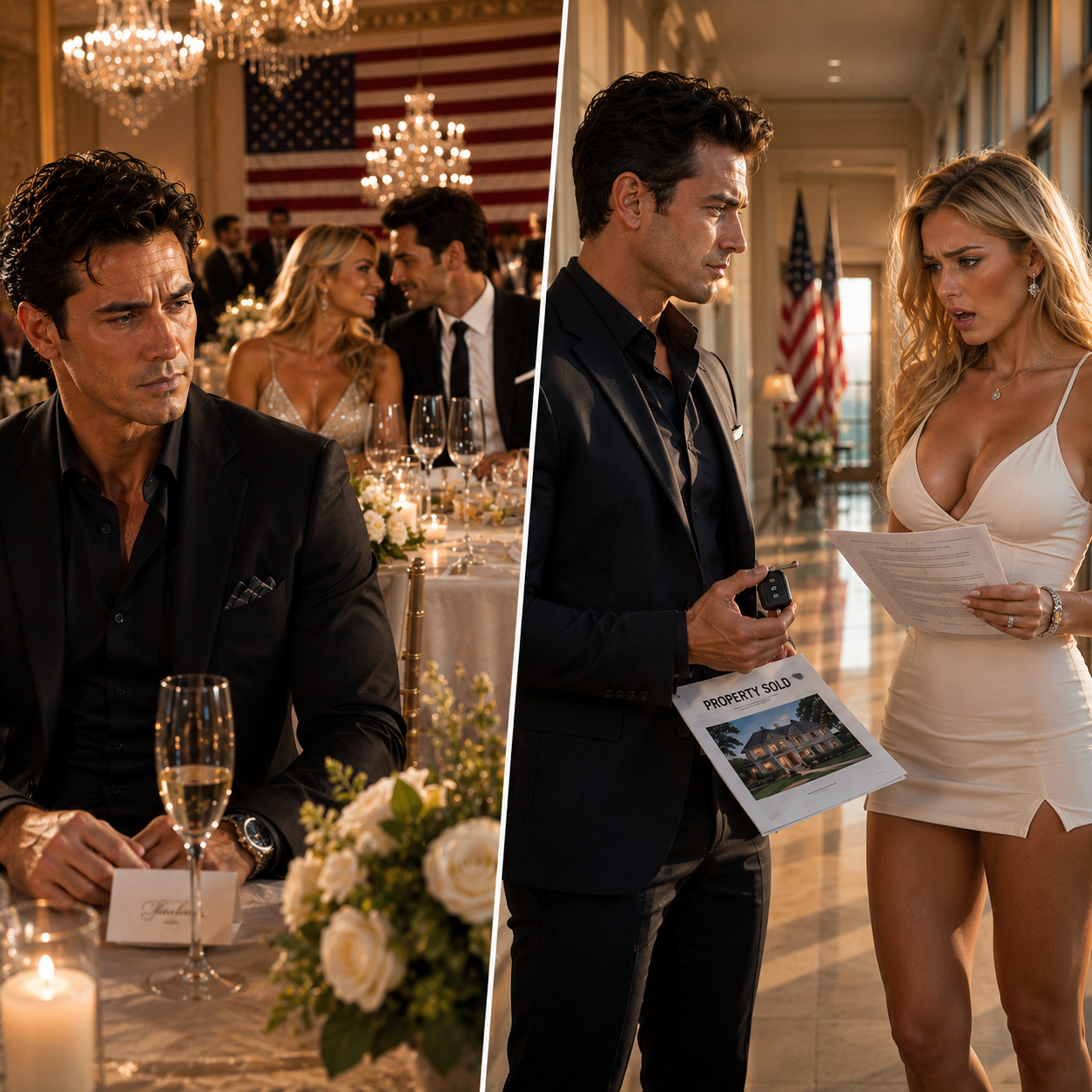
"Please don’t make this about you tonight, Evan. Appearances matter."
Those were the words my fiancée, Claire Whitmore, whispered into my ear while she adjusted my tie—not out of affection, but because it wasn't straight enough for her father’s liking. We were standing in the grand ballroom of the Ashford Club. The air smelled of expensive lilies, floor wax, and the kind of quiet arrogance that only comes with generations of inherited wealth.
I looked at Claire. She looked breathtaking in a white silk dress that cost more than my first two years of college tuition combined. But as I looked into her eyes, I didn’t see my future wife. I saw a stranger performing a role.
"I'm not making it about me, Claire," I said, my voice as steady as a concrete pour. "I'm asking why the groom is sitting next to the kitchen doors while another man is sitting in his chair."
She gave me that polished, public-facing smile. The one she practiced for charity galas. "The seating chart got complicated at the last minute. Bennett is helping my father with some business guests. It’s just logistics, Evan. Don't be small."
"Small," I repeated.
I looked across the room at Table One. The head table. There sat Graham and Elise Whitmore, looking like royalty. And there, sitting right next to Claire’s empty chair, was Bennett Harlow. He was laughing, leaning in close to Graham, whispering something that made the older man pat him on the shoulder. Bennett was wearing a navy suit that whispered "custom-tailored," and he held a crystal glass of scotch like he had been born with it in his hand.
I was the one who had proposed to Claire. I was the one who had spent fourteen months building a life with her. I was the one who had renovated a three-bedroom house with my own two hands so we would have a home.
But tonight, at our engagement party, I was sitting at Table Nine.
Table Nine was tucked behind a decorative pillar, right next to the double doors where the waiters came flying out with trays of hors d'oeuvres. My table-mates? The lead photographer, a woman named Sarah; the floral coordinator, Amber; and a band manager who was busy checking his watch.
I wasn't surprised. That was the saddest part.
You see, I like systems. I run operations for a construction supply company. I know when a foundation is cracked long before the walls start to lean. And the foundation of my relationship with Claire had been cracking for months.
I met Claire at a charity auction. I was there as a corporate sponsor, and she was the "golden girl" of the planning committee. She was smart, she was funny, and she seemed genuinely interested in the way I built things.
"You're so... grounded," she told me on our third date. At the time, I thought it was a compliment. I thought she valued my stability. Later, I realized "grounded" was just her family's code for "working class but useful."
The red flags started appearing when we discussed our future. Specifically, my house. I bought that house when I was twenty-eight. It was a fixer-upper in a neighborhood that was just about to explode. I spent every weekend for three years stripping wallpaper, refinishing oak floors, and tiling the kitchen. It was my greatest achievement.
When Claire moved in, she didn't see the sweat equity. She saw "potential."
"We should really open up this wall, Evan," she’d say. "And my mother says the blue shutters are a bit... quaint. We should go with charcoal."
Then came the "Deed Conversation."
It happened six months ago. We were having dinner with her parents at their Georgian mansion. Graham Whitmore, a man who views every conversation as a hostile takeover, leaned back and said, "Evan, we’ve been looking at Claire’s long-term security. It seems only right that once the vows are exchanged, her name is added to the title of the property. For the sake of the family legacy, of course."
I had looked at Claire. She didn't look shocked. She looked expectant.
"I think we should focus on the marriage first, Graham," I replied. "The house is already settled."
The air in the room had turned to ice. Claire didn't speak to me the whole way home. When we finally got inside, she turned on me. "Why do you have to be so transactional? My father is just trying to protect me. Don't you want me to feel like I belong?"
"You belong in my heart, Claire. Why do you need to belong on a legal document for a house I paid for before I met you?"
She cried. She used the "Trust" card. She used the "If you love me" card. And eventually, she started using the "Bennett" card.
Bennett Harlow was the son her parents always wanted. He was "family." He was wealthy. And according to Claire, he was a "gentleman who understood how to provide for a woman’s dignity."
I had been documenting everything. Every weird text, every demand from her mother, every time Claire "forgot" to tell me about a meeting with a wedding planner. I wasn’t being paranoid; I was being an operations manager. I was tracking the failure of the system.
And then, three weeks ago, I saw the message on her laptop. Bennett: Did he sign anything yet?
That was the moment I stopped trying to fix the railing and started planning the demolition.
Standing in that ballroom, watching Bennett laugh with Claire’s father, I felt a strange sense of peace. I walked away from Claire and headed toward Table Nine. I sat down next to Amber, the florist.
"I am so sorry," she whispered, looking at my place card. "I told the coordinator this had to be a mistake. The groom belongs at Table One."
I looked at the gold-lettered card: Evan Brooks - Table 9.
"No, Amber," I said quietly. "In this family, everything is exactly where they think it belongs."
I pulled out my phone. I had one notification. It was from my realtor, Denise.
Closing confirmed. Funds cleared into your private escrow. You are officially no longer the owner of 412 Oak Street. Congratulations, Evan.
I looked up at the head table. Claire was raising a glass of champagne, her diamond ring—the one I had paid for in cash—sparking under the chandelier. She looked over at me and gave me a curt, impatient nod, as if to say, Stay there. Be quiet. Don't ruin my night.
I smiled back. It was the most honest smile I’d given her in months.
She thought she was celebrating her engagement to a man she could control. She thought she was one step closer to owning a house she hadn't earned.
But as the band started to play a slow, romantic song, I realized that tonight wasn't a celebration of a beginning. It was the most expensive funeral I had ever attended. And the best part? The "deceased" didn't even know they were dead yet.
![[FULL STORY] My Fiancée Said I Wasn’t “Man Enough” at Our Wedding Rehearsal Dinner. I Took Off the Ring and Said, “Good Thing I Haven’t Signed the Checks Yet.”](https://social.rabedo.com/storage/thumbnails/1776934287_14.png)
![[FULL STORY] My Girlfriend Asked for an Open Relationship… Then Lost Everything When I Chose Her Best Friend](https://social.rabedo.com/storage/thumbnails/1776503346_668460178_975562764995926_6810130845607786474_n.jpg)
![[FULL STORY] My Fianceé Told Me If I Loved Her I Would Fight For Her, So I Let Her Go And Canceled Our $40,000 Wedding Overnight.](https://social.rabedo.com/storage/thumbnails/1777352007_B16.png)
![[FULL STORY] My manipulative ex-wife built her new life on a mountain of lies, so I gave the truth a microphone at her wedding](https://social.rabedo.com/storage/thumbnails/1777220806_R12.png)