
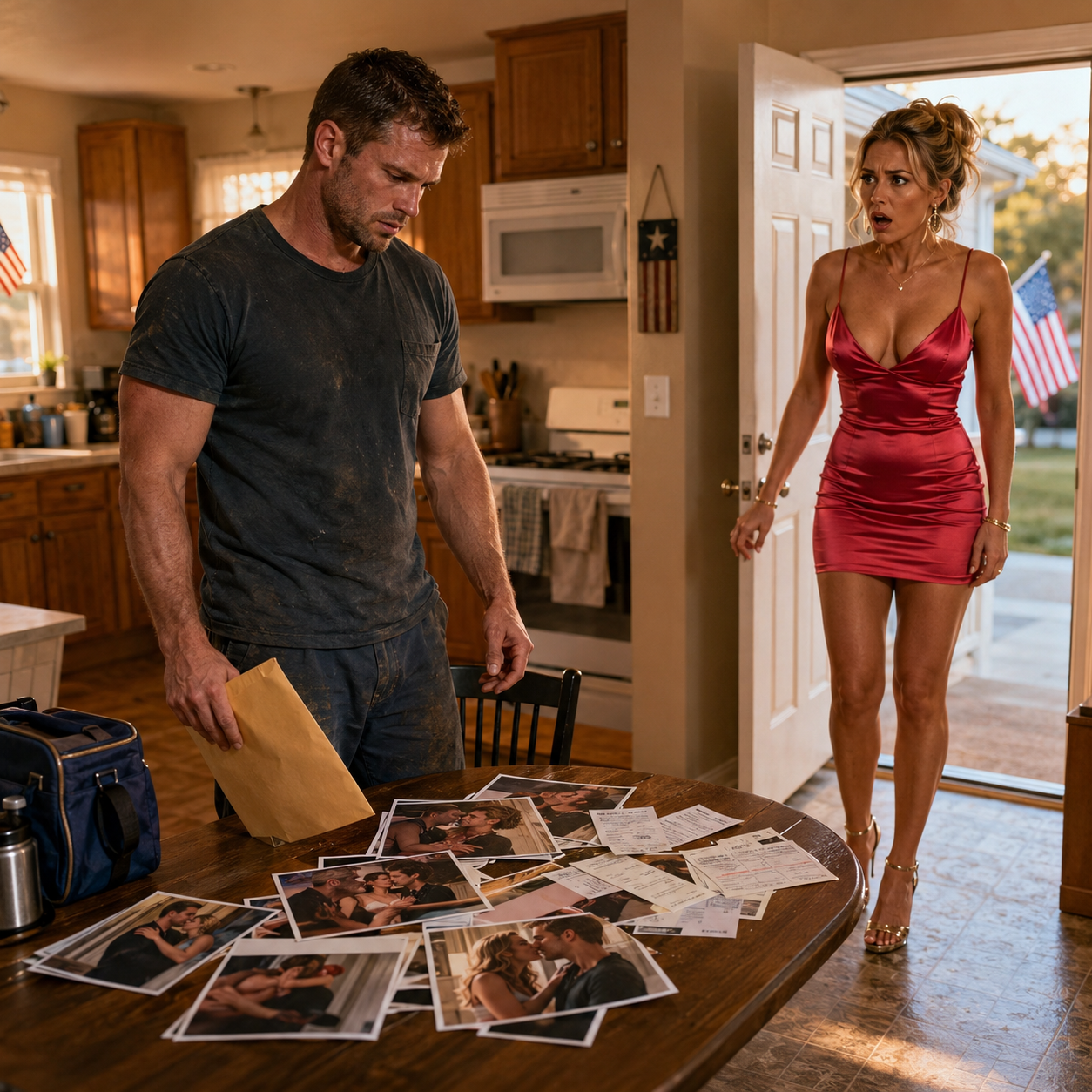
The Manila envelope sat on the kitchen counter like a coiled snake waiting to strike. I stared at it for what felt like hours, though the clock on the microwave insisted only 3 minutes had passed. My hands trembled as I reached for it again, pulling out the photographs that had already burned themselves into my memory.
Each image was a knife twist. My wife of 7 years wrapped in another man's arms at that downtown hotel I'd passed a thousand times. The private investigator had been thorough. Timestamps, locations, even credit card receipts from romantic dinners I'd never shared with her. "3 months," the report said. 3 months of lies while I worked double shifts at the manufacturing plant, believing we were building something together, believing in us.
I heard her car pull into the driveway, that familiar rumble of the sedan we'd bought together 2 years ago. The engine cut off. Car door slammed. Her heels clicked on the walkway, the expensive one she'd bought last month claiming they were on sale. Another lie, probably. Everything felt like a lie now. The front door opened.
"Honey, I'm home. Sorry I'm late. The meeting ran over." Her voice died when she saw me sitting at the kitchen table, the photographs spread out like playing cards in a game where I'd already lost. Her face went through a cascade of expressions, confusion, recognition, fear, and finally something that looked almost like relief.
"I can explain," she started, but I held up my hand. "Don't." My voice sounded foreign to my own ears, flat, dead, emotionless. "I don't want explanations. I don't want excuses. I just want to know one thing. Was any of it real?" She opened her mouth, closed it. Tears started streaming down her face, those same tears that used to move me, that used to make me want to fix whatever was wrong.
Now they just looked like salt water. "It was complicated," she whispered. "You were always working, and he was there, and I felt lonely." "Was any of it real?" I repeated each word like hammering nails into a coffin. "In the beginning, yes, but then I don't know. Things changed. You changed." I laughed, and it came out bitter and sharp.
"I changed? I was working myself to exhaustion trying to save money for the house you wanted, the life you wanted. I was building a future for us. A future I never asked for." Her tears turned to anger now. "You decided everything. You made all the plans. I just wanted you to be present, to see me, but you were always too tired, too busy, too focused on some dream that was yours, not ours.
" The accusation hung in the air between us. Part of me wanted to defend myself, to list all the sacrifices I'd made, all the reasons I'd worked so hard, but what was the point? She'd made her choice, and no amount of justification would change what she'd done. I stood up, my chair scraping against the linoleum we'd installed together one weekend, laughing and getting more glue on ourselves than on the floor.
That memory felt like it belonged to different people now. "I'm leaving," I said simply. "What? Where will you go? We need to talk about this. We need to figure out." "There's nothing to figure out. You get the house, the car, the furniture. I don't care. File whatever papers you want. I'll sign them." "You can't just leave everything.
What about your things? Your clothes, your books?" I walked to the hall closet and pulled out my old hiking backpack, the one from before we were married. Started filling it with clothes from the bedroom while she followed me, still talking, still trying to make sense of something that was already over.
"This is insane," she said. "You're going to throw away 7 years over a mistake." I zipped the backpack and shouldered it, feeling its weight settle familiar and right. I looked at her one last time, really looked at her. She seemed smaller somehow, diminished. "You threw it away," I said quietly. "I'm just accepting reality." I walked out the front door and didn't look back.
The motel room smelled like stale cigarettes and broken dreams. I sat on the edge of the sagging mattress, my backpack at my feet containing everything I now owned in the world. No house, no car, no wife, just 32 years old and starting over from absolute zero. No, from negative numbers, because the emptiness inside felt like debt I'd be paying off forever.
I spent that first night staring at the water-stained ceiling, running calculations in my head. I had about $3,000 in my personal checking account, money from a separate account she didn't know about, leftover from before the marriage. It was supposed to be emergency money. Well, this was an emergency. By morning, I'd made my decision.
No more working for someone else. No more building someone else's dream. If I was going to claw my way back from nothing, I was going to do it on my own terms. I'd spent 12 years in manufacturing, working every position from floor assembly to quality control to shift supervisor. I knew every inefficiency in the system, every bottleneck that slowed production.
I'd filled notebooks with ideas for improvements that management always dismissed. Those notebooks were in my backpack now, along with three changes of clothes and a photograph of my parents, both gone now, but their work ethic lived on in me. The first step was survival. I took a job at a warehouse, night shift loading trucks.
The work was brutal, but it came with a benefit. I could think while I worked. During breaks, I sketched designs on napkins. During the day, I slept a few hours, then spent the rest of my time in the public library researching patents, learning about business formation, studying supply chain logistics. 2 months later, I had a prototype.
It was simple, a modified fastening system that could reduce assembly time by 40% in certain manufacturing processes. I'd built it in the warehouse break room using spare parts and sheer determination. My supervisor caught me testing it one night. "What the hell is that?" Rick asked, squinting at my contraption. I explained it to him, showing how it worked. His eyes widened.
"Kid, you know what you got here? This could be worth something." "I know," I said. "I just need capital to develop it properly." Rick studied me for a long moment. "My brother-in-law owns a small manufacturing shop. Let me Let me make a call." That call changed everything. Within a week, I was in a cramped office pitching my invention to a skeptical business owner named Thomas.
He was old school, rough around the edges, but sharp as a tack. "Show me," he demanded. I demonstrated the fastening system on his equipment. His entire production line could benefit from it. I could see his mind working, calculating savings, efficiency gains, profit margins. "How much you want for it?" he asked. "I don't want to sell it," I said.
"I want to license it, and I want access to your workshop after hours to develop other ideas." He laughed. "You got balls, I'll give you that. What makes you think your other ideas are worth my time?" I pulled out my notebooks. "Because I've got 17 more designs, and I can prove every single one will save you money.
" We negotiated for 3 hours. Finally, we shook hands. He'd pay me a licensing fee per unit that used my design, plus give me access to his workshop and materials. In exchange, he got first right of refusal on anything I developed. It wasn't much, but it was a start. Over the next 18 months, I lived like a monk.
I moved from the motel to a tiny studio apartment that cost 400 a month. I ate ramen and rice. I worked the warehouse job at night, developed new designs during the day, and slept 4 hours if I was lucky. Every penny I made went into business formation, patent applications, and prototype development.
Thomas became something of a mentor. He taught me about business, about negotiating, about the importance of protecting intellectual property. He introduced me to his network, other manufacturers, potential clients, investors. "You remind me of myself 40 years ago," he told me one night over cheap coffee in his office.
"Hungry, angry, determined to prove something." "I'm not angry," I lied. He snorted. "Yes, you are. I don't know what happened to you, but you got that look. That's fine. Use it. Just don't let it eat you alive." By the end of year 2, I had six patents pending and licensing agreements with four companies. The money started flowing, not a flood, but a steady stream.
I hired a patent attorney, formed an LLC, started actually thinking beyond survival. Year 3 was the breakthrough. A major automotive manufacturer saw one of my designs at an industry trade show. They wanted to meet. The conference room on the 45th floor had floor-to-ceiling windows overlooking the city. 5 years ago, I'd been loading boxes in a warehouse.
Now I was sitting across from executives who controlled billion-dollar supply chains, and they wanted what I'd built. "Mr. Sterling," the VP of operations said, using the surname I'd legally changed to after the divorce, my mother's maiden name, a final cut of ties with my old life.
"Your variable tension assembly system is exactly what we need for our new electric vehicle line. We'd like to discuss an exclusive licensing agreement." I kept my face neutral, though my heart was hammering. This was it, the deal that would change everything. "I don't do exclusive agreements," I said calmly, "but I'm happy to discuss a preferred partner arrangement with volume-based pricing incentives.
" They didn't like that answer. We negotiated for 6 hours. They tried every pressure tactic, every intimidation play, but I'd learned from Thomas, and I'd done my homework. I knew exactly what my designs were worth, and I wasn't going to give that value away out of desperation or fear. Finally, we reached terms.
The contract they offered was more money than I'd ever imagined seeing in my lifetime. I didn't sign it. "I need to have my attorney review this," I said, gathering the documents. The VP looked annoyed. "This is a limited-time offer." "Then I guess we'll find out if that's true," I replied, standing and shaking hands.
My attorney called me 3 hours later, laughing. "They are bluffing. These terms are good, but you can get better. Let me make a counteroffer." The final deal was signed 2 weeks later. The licensing fees alone would generate steady income for years, but more importantly, having a major automotive company using my designs gave me credibility.
Other industries started calling. I moved Sterling Industrial Solutions from Thomas's workshop into a real office, hired three engineers who were smarter than me, brought on a business manager, started focusing not just on my own designs, but on acquiring patents from independent inventors who didn't know how to monetize their ideas.
We became a patent licensing powerhouse. I paid inventors fair prices for their work, then leveraged my growing network to get those designs into production. Everyone made money. The company grew exponentially. By year 7, we had 43 employees. By year 8, we'd acquired two small manufacturing companies to prototype our designs in-house.
By year 9, we were being courted by venture capital firms wanting to invest. I didn't need their money anymore, but I took their meetings anyway. Information was valuable. Networks were valuable. Understanding how the big players thought was valuable. The work consumed me completely. I poured everything into building something that couldn't be taken away, couldn't betray me, couldn't lie to me. Numbers didn't cheat.
Patents didn't break promises. Success was measurable, concrete, real. Thomas retired and sold me his company at a discount. "You earned this," he said. "Just promise me you'll remember where you came from." I promised, and I meant it. I hired from warehouses, gave opportunities to people who'd been overlooked, created apprenticeship programs for workers who wanted to learn new skills.
Sterling Industrial Solutions became known not just for innovation, but for taking care of its people. But my personal life remained empty. I dated occasionally, but never seriously. Colleagues invited me to dinners, parties, events. I went to the ones that were necessary for business and declined the rest. My apartment, though nicer now, was still spartan.
I owned four suits, a reliable car, and a growing investment portfolio. "You need to enjoy this," my business manager, Patricia, told me one day. She was 50-something, sharp as a razor, and the closest thing I had to a friend. "What's the point of all this success if you're just existing?" "I'm enjoying it," I said, reviewing acquisition paperwork.
"No, you're achieving it. That's different. When's the last time you did something just because it made you happy?" I couldn't answer that. She sighed. "There's a charity gala next month. Sterling Industries is being honored for our workforce development programs. You have to attend. They're giving you an award." "I hate those things.
" "I know. Go anyway. Smile. Shake hands. Show the world you're human. It's good for the company image." So I agreed, not knowing the decision would bring my past crashing back into my present with the force of a wrecking ball. The ballroom was excessive. Crystal chandeliers, marble floors, tables draped in white linen with centerpieces that probably cost more than my first month's rent at that studio apartment.
I wore a tailored tuxedo now instead of warehouse clothes, but I still felt out of place among old money and inherited wealth. Patricia worked the room like a pro, introducing me to potential clients and partners. I shook hands, made small talk, played the game. I'd gotten better at this over the years, learned to wear success like a comfortable jacket instead of an ill-fitting costume.
"And this is Senator Crawford," Patricia said, steering me toward a distinguished man with silver hair. "Senator, this is James Sterling, founder and CEO of Sterling Industrial Solutions." We shook hands. The senator launched into praise for our apprenticeship programs. I half-listened, nodding at appropriate moments, when I saw her.
She was across the room, wearing an emerald dress that probably cost a month's salary. Her hair was different, shorter, styled expensively. She'd aged, of course, but hadn't really She was with a man, mid-40s, soft around the middle, laughing too loud at someone's joke. My heart didn't skip. I didn't feel the old wound tear open.
Instead, there was just nothing. Distant recognition, like seeing a stranger who vaguely resembled someone you used to know. She hadn't seen me yet. I had time to leave, to avoid the confrontation entirely, but something kept me rooted. Curiosity, maybe. Or closure. Or just the simple fact that I'd spent 10 years rebuilding myself, and I wasn't going to run anymore.
"Excuse me, Senator," I said politely. "I need to speak with someone." I crossed the ballroom, Patricia beside me asking who we were approaching. The crowd seemed to part naturally. Success has a gravity that draws attention and creates space simultaneously. I stopped at their table. She was reaching for her wine glass when she looked up and saw me.
The glass slipped from her fingers, white wine spilling across the tablecloth. Her face went through that same cascade of expressions I'd seen 10 years ago. Confusion, recognition, shock. "Hello, Rebecca," I said calmly. Her companion stood up, hand extended. "I'm sorry. Do we know?" "No," I said, not taking my eyes off her.
"We don't know each other, but Rebecca and I were married once, a lifetime ago." She'd gone pale. "James, I I didn't know. I mean, I heard you'd done well, but I didn't realize that I'd be here." "I finished." "Yes. Well, life is full of surprises." Patricia, sensing the tension, excused herself tactfully. The man, Rebecca's date or husband or whatever he was, looked between us uncertainly.
"Richard," Rebecca said weakly, "this is this is my ex-husband." Richard's eyes widened with recognition. "You're the James Sterling from Sterling Industrial Solutions. We use your components in our medical devices. Your work is revolutionary." "Thank you," I said simply. An awkward silence fell.
Rebecca kept staring at me like I was a ghost, tears beginning to form in her eyes. The confident woman in the expensive dress was crumbling before my eyes, and I felt nothing. No satisfaction. No vindication. Just emptiness. "You look good," she finally managed. "Successful. Happy." "Two out of three isn't bad," I replied. "I She started, then stopped.
Tears were flowing freely now. "I'm so sorry. For everything. I was young and stupid and selfish, and I threw away "The past," I interrupted gently. "You threw away the past, which is exactly where it belongs." Rebecca stood abruptly, nearly knocking over her chair. "Can we talk? Please? Just for a minute." Richard looked uncomfortable, but nodded his permission. I almost declined.
What was there to say after 10 years? But something in her desperation made me agree. We walked to a quiet corner of the ballroom, near tall windows that looked out over the city lights. "I destroyed you," she said immediately, voice cracking. "I destroyed us. And you you became this." She gestured vaguely at everything.
"You became everything you were supposed to become, and I wasn't there for it." "No," I agreed. "You weren't." "Do you hate me?" The question came out small, broken. I considered it honestly. I did. For a long time, I hated you. I used that hate as fuel. Every exhausting night, every rejection, every setback, I survived it all by reminding myself that succeeding meant proving you wrong.
She flinched like I'd struck her, but somewhere along the way, I continued, the hate burned out. It consumed everything it needed to consume, and then there was just emptiness. And I had to figure out how to build something in that empty space. Something that wasn't about you, or us, or what we were supposed to be.
"I've thought about you every single day." She whispered. "I married Richard 2 years ago, and he's good to me, but I think about you. About what I did. About who you were and who I destroyed." You didn't destroy me, Rebecca. You destroyed us. There's a difference. I'm still here. She was fully crying now, mascara running down her cheeks.
I saw the article about your company in the business section last year. I saw your picture, and I couldn't breathe. I realized what I'd given up. What I'd thrown away. And for what? A 3-month affair with a man I didn't even love. I was so stupid. So incredibly stupid. "Stop." I said firmly. "This isn't about you being stupid or making mistakes.
This is about choices and consequences. You made a choice. That choice had consequences. I made different choices. Those had consequences, too." "What consequences? You're successful, wealthy, respected." "I'm alone." I said quietly. "I built an empire on the ashes of everything I lost, and it's hollow.
I have employees who depend on me, contracts worth millions, patents that will outlive me. But I go home to an empty apartment every night and realize I've forgotten how to let anyone in. I forgotten how to trust. How to be vulnerable. How to be anything other than focused and driven and successful." The honesty surprised me.
I hadn't admitted that to anyone. Barely admitted it to myself. Rebecca wiped her eyes. "So we're both broken, then. Just in different ways." "Maybe." I said. "Or maybe we're both exactly where we need to be." "Could we?" She started hesitantly. "Could we try again? Start over? I know it's crazy, but seeing you here, knowing what we had.
" "No." The word came out gentle, but final. "You were my last baggage, Rebecca. When I walked out of that house with just a backpack, I left behind everything that weighed me down. The hurt, the betrayal, the dreams we'd built together. I've spent 10 years building new dreams. Better dreams. Stronger ones." "Dreams without room for anyone else?" She asked, and there was real pain in the question. I paused, considering.
"Maybe that was true once, but lately, I've been wondering if it's time to change that. To figure out who I am when I'm not just achieving. When I'm not just proving something. Patricia, my business manager, she asked me when's the last time I did something just because it made me happy. I couldn't answer." "What does make you happy?" Rebecca asked. I thought about it.
Really thought about it. I don't know anymore. I lost that somewhere along the way. But I'm starting to think I need to find out. Rebecca nodded slowly, understanding finally dawning. "You're letting me go. Really letting me go." "Yes." I said. "And I think I'm letting myself go, too.
Letting go of the person I was when we were together. The person I became after we fell apart. All of it." "What comes next, then?" "I have no idea." I admitted. "And for the first time in years, that uncertainty didn't terrify me. Maybe that's the point. I've been so focused on building something that can't be taken away that I forgot to build a life worth living.
" We stood in silence for a moment, watching the city lights blur through the windows. The gala continued behind us. Music, laughter, conversations that would lead to deals and partnerships and futures being shaped. "Thank you." Rebecca said finally. "For what?" "For not being cruel. For being honest. For showing me that even though I broke something precious, you didn't let it break you. Not permanently.
" "We broke each other." I corrected. "But we're both still here. Still breathing. Still trying to figure it out. That has to count for something." She smiled, sad but genuine. "Take care of yourself, James. Really take care. Not just the business and the success, but you. The person underneath all of it." "You, too, Rebecca. Be happy.
Really happy. Not guilty. Not regretful. Just happy." She squeezed my hand once, then walked back to her table where Richard waited, concern written across his face. I watched her explain. Watched him put his arm around her protectively. She'd found something stable, if not passionate. She'd found safe harbor after the storm she'd created. That was something.
Patricia appeared at my elbow. "You okay?" "Yeah." I said, and meant it. "I think I actually am." "Who was she?" "Someone I used to know. Someone who taught me hard lessons I needed to learn." Patricia studied my face. "The gala is winding down. You want to skip the networking dinner afterward?" I almost said yes.
Almost retreated to my safe, empty apartment and my comfortable isolation. But something had shifted in that conversation with Rebecca. Some weight I'd been carrying for 10 years had finally been set down. "No." I said. "Let's go to dinner. And tomorrow, I want you to look into those charity proposals that keep coming across my desk.
The ones about workforce housing and education programs. I think it's time Sterling Industrial Solutions started giving back in more meaningful ways." Patricia's eyebrows rose. "You're going to start delegating? Actually enjoying the fruits of your labor?" "I'm going to start living." I corrected. "There's a difference between existing and living.
I've been existing for a decade. Building, achieving, proving. It's time to figure out what living looks like." We headed toward the dinner, and for the first time since that night I'd walked out with just a backpack, I felt light. Not happy. Not yet. But lighter. Like I'd been carrying a weight I'd forgotten was there until I finally set it down.
The ballroom doors closed behind us, and somewhere in that glittering crowd, Rebecca and her life continued on their own trajectory. Our paths had crossed one final time, and now they diverged completely. No more regret. No more what-ifs. No more defining myself by what I'd lost. Just possibility. Uncertain. Terrifying.
Beautiful possibility. The next morning, I stood in my office looking out over the city. Patricia came in with coffee and a knowing smile. "You're different." She observed. "I'm trying to be." I admitted. "10 years is So what now? What does James Sterling do when he's not busy conquering the business world?" I laughed. A real laugh.
Not the practiced one I used in meetings. "I have absolutely no idea. But I think that's okay. I think maybe that's perfect." And for the first time in a decade, I meant it.
![[FULL STORY] His Mother Ripped My Veil Off at the Altar—They Didn’t Know I Owned Everything](https://social.rabedo.com/storage/thumbnails/1776745598_D66.jpeg)
![[FULL STORY] She Lashed Out at Me in Front of Her Friends: 'You Can’t Please Me or Support Me ' I Grinned](https://social.rabedo.com/storage/thumbnails/1777305155_S6.png)

![[FULL STORY] My Fiancée Declared: "I'm Calling Off the Wedding I've Fallen for the Wedding Planner " I](https://social.rabedo.com/storage/thumbnails/1776737315_8.png)
![[FULL STORY] My girlfriend spent six hours grabbing coffee with her ex while I quietly refunded her engagement ring and moved out.](https://social.rabedo.com/storage/thumbnails/1777367751_28.png)