
My name is Sarah, and for the last five years of my mother’s life, I was the child who stayed.
Not the favorite child. Not the golden child. Not the one everyone praised at family dinners.
The available child.
There is a difference.
My older brother Dylan was thirty-eight and lived in Tampa. He liked calling himself practical, which mostly meant he had a long list of reasons why he could not help unless helping was convenient. My younger sister Marissa was thirty-one and lived in Austin. She called herself emotionally overwhelmed whenever responsibility came with a cost.
And then there was me.
Thirty-four years old, living in Raleigh, working remotely as a project coordinator for a healthcare software company, and slowly becoming less of a daughter and more of a full-time caregiver.
My mother, Linda, got sick when I was twenty-nine. At first, it was little things. Missed appointments. Pain in her hands. Groceries forgotten in the car. Then came the diagnosis, the surgeries, the medication schedules, the walkers, the specialist visits, the emergency rooms, the insurance calls, and the nights when I slept in a chair beside her bed because she was scared to be alone.
Dylan visited twice a year.
Marissa visited when she needed photos for Instagram.
I moved into Mom’s old house in Durham, the house my father had bought before he died. I gave up my apartment. I turned down a promotion because it required travel. I worked at the kitchen table with a medication chart taped to the fridge and a baby monitor beside my laptop even though my mother was not a baby. She was my mother, and she deserved not to be afraid.
I paid for things too.
Not everything. Mom had savings, and Medicare helped where it helped. But I paid for groceries, gas, repairs, medical supplies, a new water heater, and the part-time caregiver we needed twice a week when I could not be in two places at once.
Dylan always said he would send money.
He sent two hundred dollars once.
Marissa said she was supporting emotionally.
That meant heart emojis.
When Mom died, I was holding her hand.
Dylan was on a golf weekend.
Marissa said flights were too expensive, then posted brunch photos the next morning.
I did not say anything. I planned the funeral. I chose the flowers. I called relatives. I found the black dress. I wrote the obituary. I paid the funeral home deposit with my credit card because Dylan said, “We’ll settle everything later.”
That phrase became a theme.
We’ll settle everything later.
After the funeral, we met at Mom’s house. The casseroles were still on the counter. Sympathy cards were stacked beside her favorite mug. The whole house smelled like lilies, old wood, and grief.
I wanted one quiet evening.
Dylan wanted numbers.
He stood in the living room with his wife Kelsey and said, “So, when are we listing the house?”
I looked at him.
“Listing?”
“Yeah,” he said, like I was being slow. “Mom’s house. Market is still decent. We sell it, split it three ways, and everyone moves on.”
Marissa nodded like this had already been decided.
I said, “Mom left the house to me.”
The room went silent.
Not confused silent.
Angry silent.
Dylan laughed first.
“No, she didn’t.”
I walked to the kitchen drawer, took out the folder Mom had kept beside her insurance papers, and placed it on the table.
Will. Deed transfer. Care agreement. Receipts. Notes from her attorney.
Mom had updated everything eighteen months before she died. She left small cash gifts to Dylan and Marissa. The house went to me. Not because she loved them less, but because, in her own words, I had given up five years of my life to keep her in it.
Dylan read the first page and his face changed.
Marissa started crying before anyone accused her of anything.
Kelsey said, “This feels manipulative.”
I said, “It feels signed and notarized.”
Dylan slammed the folder shut.
“You owe us the house because blood comes first.”
I looked at him for a long second.
“Then act like family.”
Nobody spoke.
I did not yell. I did not cry. I did not defend five years of caregiving to people who had watched from safe distances and then arrived with empty boxes after the funeral.
I picked up the folder and said, “You have until Sunday to collect anything Mom personally left you. After that, call before coming over.”
Dylan laughed again.
“You’re really going to steal from your own siblings?”
“I’m going to follow Mom’s legal documents.”
Marissa whispered, “Mom would be ashamed.”
That almost got me.
Almost.
Then I remembered Mom squeezing my hand three weeks before she died and saying, “Don’t let them guilt you out of the only thing I can leave you.”
So I didn’t.
The flying monkeys arrived before Dylan even left North Carolina.
First, Aunt Carol called.
“Sweetheart, grief makes people behave badly. Maybe you should sell the house and keep a little extra for yourself.”
I asked, “Did Dylan tell you I lived with Mom for five years?”
She paused.
“He said everyone helped in their own way.”
“Ask him what Mom’s pharmacy was called,” I said.
Silence.
“Ask Marissa what dosage of blood thinner Mom took after surgery.”
More silence.
Aunt Carol finally said, “I didn’t know it was that unequal.”
“That’s because they didn’t want you to know.”
She never brought it up again.
Then came Dylan’s texts.
You’re being emotional.
This is not what Dad would have wanted.
You’re destroying the family.
Kelsey and I have kids. You don’t even need a whole house.
That last one told the truth.
They did not think I deserved the house because I did not have children. Apparently, caring for our dying mother did not count as family responsibility. Only having kids did.
Marissa posted a vague story online.
Some people show their true colors when money is involved.
I did not respond.
I was too busy meeting with Mom’s attorney, Brian.
Brian had handled the documents himself. He was calm in the way attorneys are calm when they know the other side has no case.
“The will is clean,” he told me. “The deed transfer is clean. The care agreement is clean. Your siblings can contest it if they want, but they will spend more than they gain.”
I asked, “Can they come into the house?”
He said, “Change the locks.”
So I did.
One hundred eighty-six dollars.
Worth every penny.
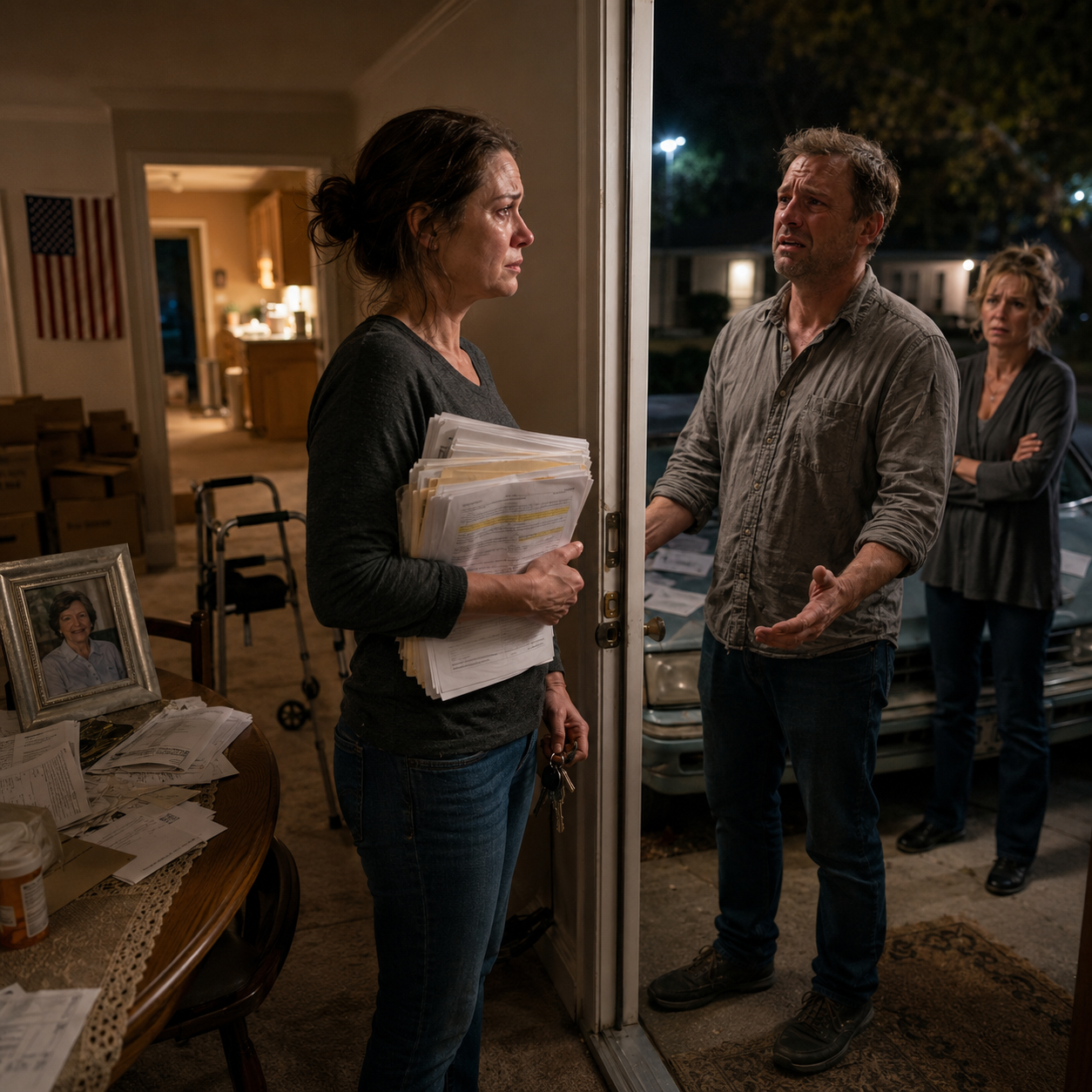
On Saturday, Dylan showed up without calling. My Ring camera caught him, Kelsey, and Marissa walking up the porch steps with empty boxes.
I answered through the camera.
“You need to schedule a time.”
Dylan looked directly into the lens.
“Open the door, Sarah.”
“No.”
Marissa held up a key.
“We still have Mom’s key.”
“It doesn’t work.”
She tried it anyway.
It did not work.
Beautiful little sound.
Metal failing.
Dylan kicked the bottom of the door. Not hard enough to break it. Hard enough to make a point.
I said, “Dylan, I’m recording. Leave or I’m calling the police.”
He stepped back fast.
Kelsey snapped, “You’d call cops on family?”
I answered, “Then act like family.”
Same sentence.
Same result.
They left.
Two hours later, Dylan texted that I had stolen Mom’s jewelry box.
I sent him a photo of the jewelry box sitting unopened on the dining table with a note beside it.
Available for inventory with attorney present.
No reply.
Truth is inconvenient when someone is trying to build a victim story.
That night, I slept in Mom’s room for the first time since she died. Not because I wanted to, but because I was too tired to climb the stairs.
I looked at her empty chair near the window and finally cried.
Not because of the house.
Because even after death, I was still protecting her peace from people who only wanted her things.
By week three, the family group chat had turned into a courtroom where everyone was both judge and gossip.
Cousins I had not heard from in years suddenly had opinions.
You should think about the kids.
Your mom loved all of you equally.
A house is too much for one person.
Forgiveness matters.
I answered once.
“Mom’s attorney has the documents. Any questions can go through him.”
Then I left the chat.
Marissa showed up at my workplace next.
I work hybrid two days a week at an office in Cary. Reception called me at 11:15.
“There’s a Marissa here. She says it’s a family emergency.”
My stomach dropped because, despite everything, the words family emergency still worked on me.
I came downstairs.
Marissa was standing in the lobby wearing sunglasses indoors and holding a folder like she was a lawyer in a movie.
“We need to talk,” she said.
“Not here.”
“Then stop ignoring us.”
“I gave you Brian’s number.”
Her face tightened.
“This is not about lawyers. This is about Mom.”
“Mom made her decision.”
Then she started crying loudly.
Not quiet grief.
Lobby crying.
People turned.
“You took everything,” she said. “You took Mom from us when she was alive, and now you’re taking what she left.”
That was the line.
You took Mom from us.
For five years, I had begged them to visit more. Begged them to call. Begged them to come for appointments, surgeries, recovery, holidays, bad weekends.
Now I had taken her from them by being the only one there.
I said, “Marissa, leave my workplace.”
She said, “Or what?”
I looked at the receptionist.
“Please call building security.”
Security walked her out.
I emailed HR before she reached the parking lot. Clear summary. No emotion. Just facts.
Then I called Brian.
He said, “We’re sending a cease and desist.”
Four hundred fifty dollars.
Another bill caused by people who claimed I was greedy.
The letter went to Dylan and Marissa. No harassment, no workplace visits, no entering the property, all communication through attorneys.
Dylan responded by filing a police report claiming I had stolen family property.
Two officers came to the house the next evening. I invited them in, gave them coffee, and showed them the folder.
Will. Deed. Receipts. Funeral invoice. Caregiver payments. Attorney letter. Ring camera footage. Texts about the jewelry box.
One officer looked at the paperwork and said, “This looks civil, not criminal.”
I said, “That’s what my attorney said.”
The other officer asked if I wanted a report documenting their visit.
“Yes,” I said. “Documentation is boring. Boring wins.”
A week later, Dylan tried a fake crisis.
He texted from a new number.
Kelsey is in the ER because of the stress you caused. Hope the house is worth it.
Old Sarah would have panicked.
New Sarah called the hospital mainline.
No Kelsey registered.
I texted back, “I called the hospital. They have no record of her. Do not contact me again.”
He replied, “You’re sick.”
I sent it to Brian.
That became page twelve in the folder.
Around that time, something changed in me.
I realized I did not want the house.
Not like that.
I loved Mom. I loved what the house had been when Dad was alive. Christmas lights hung crooked. Mom dancing in the kitchen. The hallway smelling like cinnamon.
But after five years of illness and three weeks of war, the house felt less like inheritance and more like a battlefield.
So I made a decision.
Not emotional.
Strategic.
I got the house appraised.
Four hundred twelve thousand dollars.
Mom still had medical debt, final expenses, and a home equity line she used during the worst part of treatment.
After everything, there would still be enough for me to restart my life.
I listed the house privately through a realtor named Nora, who had worked with Brian before.
Within eleven days, we had a cash offer.
Four hundred twenty-eight thousand dollars.
Thirty-day close.
I accepted.
Dylan found out through a neighbor and exploded.
“You’re selling our house.”
I replied, “My house.”
“We’ll sue.”
“Talk to Brian.”
“You’ll regret choosing money over family.”
I stared at that text for a long time.
Then I typed, “I chose Mom for five years. You chose convenience. Don’t confuse the two.”
Then I blocked the number.
Three months later, the house sold.
I paid Mom’s remaining medical bills. I paid the funeral balance. I paid off the caregiver invoices I had carried on a credit card. I donated Mom’s medical equipment to a local nonprofit.
I kept her recipe box, her wedding photo, her blue scarf, and the mug she used every morning.
Not expensive things.
Important things.
After taxes, fees, debts, and everything else, I walked away with enough to buy a small townhouse in Raleigh and rebuild my savings.
I did not give Dylan or Marissa cash.
Not because I wanted revenge.
Because Mom had already given them what she chose to give them, and I was done editing her decisions to make selfish people comfortable.
Dylan did file something with a probate attorney.
It went nowhere.
Brian sent one response with the signed documents and a summary of their lack of caregiving involvement.
Dylan’s attorney quietly disappeared after that.
Marissa sent one final email.
“I hope the money keeps you warm when you realize you have no family.”
I did not answer.
Two weeks later, Aunt Carol invited me to Sunday dinner.
I almost said no.
Then she added, “Dylan and Marissa won’t be there. I want to apologize properly.”
So I went.
She made pot roast, Mom’s favorite.
After dinner, she handed me a small envelope. Inside were three photos of Mom before she got sick. Young, laughing, standing in front of the Durham house with paint on her jeans.
Aunt Carol said, “Your mom told me once she didn’t know how she would survive without you. I should have remembered that before I listened to your brother.”
That apology mattered.
Not because it fixed everything.
Because it was honest.
A month later, Dylan showed up at my new townhouse.
No warning.
No Kelsey.
No confidence.
Just Dylan standing on my porch at 8:30 p.m. looking tired.
I answered through the doorbell camera.
“What do you need?”
He looked embarrassed.
“Can we talk?”
“About what?”
He rubbed his face.
“Rent went up. Kelsey and I are behind. I thought maybe since you sold the house, you could loan us something. Just until we get stable.”
There it was.
Blood comes first again.
But only when his bills were due.
I said, “No.”
His face hardened.
“Seriously? After everything?”
“Especially after everything.”
“Mom would want us to help each other.”
“Mom wanted help for five years. You didn’t show up.”
He looked away.
For one second, I thought he might finally say sorry.
He didn’t.
He only said, “You’ve changed.”
“I know.”
Then I ended the camera feed.
He stayed on the porch for another minute, then left.
I thought I would feel guilty.
I didn’t.
I felt sad.
There is a difference.
Guilt says you did something wrong.
Sadness says you finally accepted what was always true.
My family did not break because I kept the house.
My family broke because Mom’s illness revealed who was family and who was only related.
That lesson cost me five years, thousands of dollars, and more lonely nights than I can count.
But it also gave me freedom.
I live alone now. My townhouse is smaller than Mom’s house, but it is quiet in a way I needed.
No pill bottles on the counter.
No medical alarms beside the bed.
No relatives arriving with boxes and entitlement.
On Sundays, I make Mom’s chicken soup from the recipe card she wrote in blue ink. I still call it too salty, just like she did.
Sometimes I miss the old version of Dylan and Marissa.
Or maybe I miss the version I kept hoping they would become.
That is the hardest thing about family. You do not just grieve what happened. You grieve what should have happened.
They should have visited.
They should have helped.
They should have held Mom’s hand.
They should have thanked me.
They should have been ashamed before they were angry.
But should is a house nobody gets to live in.
I live in reality now.
And reality is this:
Family is not proven by last names, childhood photos, or who cries loudest after the funeral.
Family is proven in hospital rooms, grocery runs, unpaid bills, hard conversations, and showing up when there is nothing to gain.
Blood may explain where you came from.
Behavior decides who gets to stay.
Dylan said blood comes first.
I finally learned peace comes before blood when blood only knows how to take.
![[FULL STORY] My girlfriend invited her "platonic" best friend on our $8,000 anniversary trip to Paris, so I gave her ticket to my female friend and left her stranded at the airport.](https://social.rabedo.com/storage/thumbnails/1777361759_C2.png)
![[FULL STORY] She Said She Was “Too Evolved” for Monogamy — So I Asked Her Father for Permission to Date Her Sister](https://social.rabedo.com/storage/thumbnails/1777132614_20ab7fe5-27d7-48f6-99b2-c55be5d8bada.png)
![[FULL STORY] “At The Reunion, Tell Everyone We’re Just Friends—My Ex Will Be There.”](https://social.rabedo.com/storage/thumbnails/1776660070_6b0fc02e-d41f-4bcf-8749-8296492afd16.png)
![[FULL STORY] My Fiancée Secretly Invited My Abusive Parents To Our Wedding As A Surprise. I Didn’t Show Up To...](https://social.rabedo.com/storage/thumbnails/1777186974_C14.png)

![[FULL STORY] My Fiancée Said: "If You Loved Me, You'd Fight For Me." I Replied: "I Love You Enough To Let You Go.](https://social.rabedo.com/storage/thumbnails/1777351921_B15.png)