Fresh flowers rested near the windows. Private nurses moved carefully across polished floors. A television played silently in the corner while financial news scrolled beneath muted voices. The room belonged to someone important.
And the man lying in the hospital bed made sure everyone knew it.
Charles Whitmore was seventy-two years old, rich enough to have buildings named after him, and powerful enough that doctors straightened their posture before speaking to him. Even sick, he carried authority like a weapon. His silver hair was perfectly trimmed. His hospital robe looked tailored. On the table beside him sat legal documents, luxury watches, and a phone that never stopped vibrating with calls from lawyers and board members.
Around his left leg sat a thick white cast stretching from thigh to ankle.
According to Charles, the injury was devastating.
According to Charles, he might never walk properly again.
According to Charles, the accident had left him fragile, helpless, dependent.
And everyone believed him.
Almost everyone.
Then—
CRACK.
The sound exploded through the room like a gunshot.
Doctors flinched instinctively.
A nurse screamed.
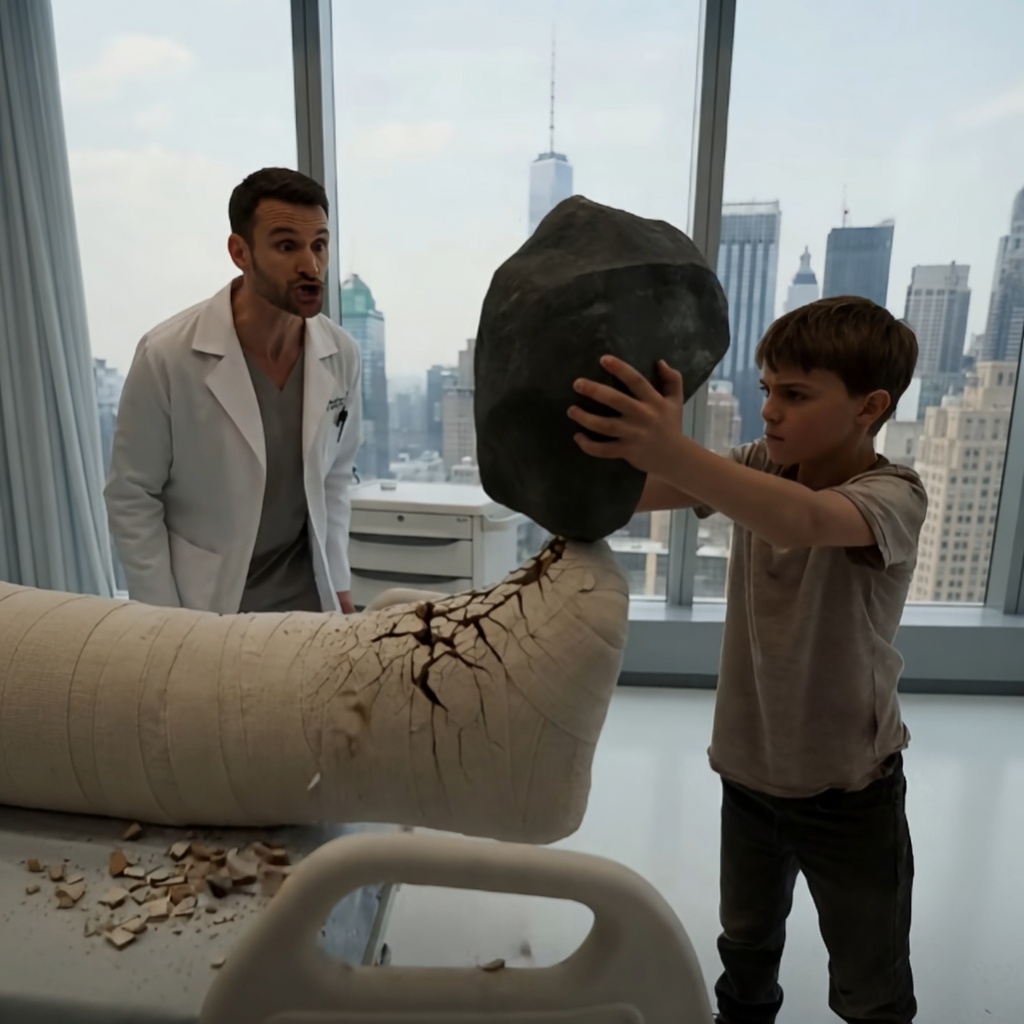
White plaster burst across the polished floor as the lower half of Charles Whitmore’s cast shattered apart.
And standing beside the bed was a ten-year-old boy holding a heavy dark stone in both hands.
Thin.
Still.
Silent.
Fragments of cast rolled across the floor beneath him.
Charles grabbed the bedrails instantly, panic flashing across his face so fast it almost looked animal.
“What did you do?!” he shouted.
The boy didn’t move.
Didn’t blink.
“It wasn’t healing.”
His voice was calm.
Too calm.
The room fell into a sharp, unnatural silence.
A female doctor stared at the broken cast in disbelief. “Security—”
But before anyone could move, the boy lifted the stone again.
Steady.
Controlled.
Charles went pale.
“STOP!”
The fear in his voice changed everything.
Because rich men like Charles Whitmore were used to anger.
Not fear.
The second strike landed harder.
CRACK.
A large section of plaster split away and crashed against the floor with a hollow final sound.
The doctors froze.
The camera of the moment seemed to drop lower.
Closer.
To the exposed foot beneath the broken cast.
Toes.
Clean.
Normal.
No swelling.
No bruising.
No damage.
The female doctor’s hand flew to her mouth.
The boy pointed directly at the foot.
“Move them.”
Nothing happened at first.
The silence grew heavier.
Thicker.
Like the room itself was holding its breath.
Then—
A twitch.
Small.
Unmistakable.
A nurse gasped sharply.
Charles’s face began collapsing inward, sweat forming instantly across his forehead.
The boy stepped closer, eyes locked onto him.
“So why were you pretending?”
The question did not sound like a question.
Behind them, one of the male doctors crouched beside the broken cast fragments. Something inside the inner lining had caught his attention.
He reached carefully into the damaged plaster.
Then slowly pulled out a sealed plastic packet.
Folded papers inside.
His voice dropped to a whisper.
“…what is this?”
Charles Whitmore looked like a man watching his entire life collapse in real time.
And at the center of it all stood the boy.
A child named Noah Bennett.
The boy Charles Whitmore had spent two years trying to erase.
Two years earlier, Noah’s mother, Evelyn Bennett, worked as Charles Whitmore’s live-in physical therapist.
Evelyn had not come from money.
She grew up in a small Pennsylvania town, the daughter of a mechanic and a waitress. She paid her way through college by working double shifts, earned her medical certifications honestly, and became known for one dangerous quality:
Integrity.
She refused bribes.
Refused shortcuts.
Refused silence.
That was how she met Charles Whitmore.
After a minor surgery, Charles hired Evelyn privately for rehabilitation therapy inside his Manhattan penthouse. The pay was life-changing. Enough to move Noah into a better school district. Enough to finally stop counting grocery money every week.
At first, Evelyn believed she had been lucky.
Then she started noticing things.
Charles never wanted certain doctors involved.
Certain medications were hidden.
Visitors arrived late at night carrying sealed folders.
And most importantly—
Charles seemed healthier than anyone admitted publicly.
Much healthier.
The “injury” that supposedly left him partially disabled never made sense to Evelyn medically. His muscles showed none of the deterioration expected from long-term immobility. His reflexes remained too strong. His balance reactions were wrong for someone truly damaged.
At first, she ignored the doubts.
Until the night she saw him walking.
Perfectly.
Alone in his office at nearly midnight.
No limp.
No cane.
Nothing.
Evelyn confronted him the next morning.
Charles smiled calmly and denied everything.
Three days later, Evelyn was fired.
Two weeks later, anonymous complaints appeared accusing her of malpractice.
Then came the lawsuit.
Charles Whitmore claimed Evelyn had worsened his injury through negligence.
The case destroyed her career almost overnight.
Hospitals stopped calling.
Clients disappeared.
Lawyers demanded settlements she could never afford.
People believed Charles because wealthy men in expensive hospital rooms always sound more trustworthy than exhausted single mothers.
Evelyn tried to fight.
Until the stress began destroying her health.
Until Noah started hearing her cry at night behind the bathroom door.
Until they lost their apartment.
That was when Noah stopped being only a child.
Children notice more than adults think.
Noah remembered every detail from those months. The unpaid bills. The moving boxes. The way his mother pretended cereal counted as dinner. The way she sat staring at legal papers long after midnight with hollow eyes.
And he remembered something else too.
The day she whispered one sentence while half-asleep on the couch.
“He’s lying.”
That sentence stayed inside Noah like a splinter.
For almost a year, Evelyn tried rebuilding their lives quietly. She took smaller jobs. Temporary care work. Overnight shifts nobody else wanted.
But Charles Whitmore kept pushing.
More legal threats.
More pressure.
Because Evelyn knew something dangerous:
His injury was fake.
And if the truth came out, the consequences would reach far beyond embarrassment.
Because Charles Whitmore was not pretending to be disabled for sympathy.
He was pretending because the cast protected his fortune.
Three years earlier, Charles’s older brother Edward died unexpectedly, leaving behind a complicated inheritance agreement. According to Edward’s will, the controlling shares of Whitmore Industries would transfer fully to Charles only if Charles remained medically incapable of active executive management.
The moment Charles recovered physically, the shares would instead pass to Edward’s daughter.
A woman named Claire Whitmore.
Charles’s niece.
The one person standing between him and total control of a multi-billion-dollar empire.
So Charles stayed injured.
Publicly.
Carefully.
Profitably.
And Evelyn discovered it.
That was why he destroyed her.
Noah learned the full truth accidentally.
One rainy night, he overheard Evelyn arguing with her lawyer over the phone.
“They buried the medical records,” she cried. “The real scans vanished after his private transfer.”
Noah listened silently from the hallway.
Then came the sentence that changed everything.
“There’s no proof left.”
But Noah didn’t believe that.
Because children still believe truth should matter.
And unlike adults, they sometimes act on that belief.
Three weeks later, Noah sneaked into Halston Medical Tower carrying a dark landscaping stone hidden inside his backpack.
Not because he wanted revenge.
Because he wanted proof.
The hospital staff barely noticed him. Rich hospitals are full of children visiting wealthy relatives. Noah wore a hoodie, kept his head down, and moved quietly through elevators until he reached the private floor.
He expected fear.
Instead, he felt strangely calm.
Because somewhere inside himself, Noah already knew the truth.
And now the entire room knew it too.
The doctor holding the plastic packet slowly opened it.
Charles Whitmore’s breathing became uneven.
“Don’t,” he whispered.
The doctor unfolded the papers carefully.
His face changed instantly.
“What is it?” the female doctor asked.
The man looked up slowly.
“It’s a payment agreement.”
Charles shut his eyes.
The doctor continued reading in disbelief.
“Monthly compensation issued to maintain documented immobility status until inheritance transfer finalized…”
The room went silent.
A nurse stepped backward.
Another doctor stared openly at Charles now, not like a patient, but like a criminal.
Noah stood motionless beside the broken cast.
“You lied,” he said quietly.
Charles opened his eyes again.
And for the first time in decades, there was no power left in them.
Only fear.
The hospital administrators arrived within minutes.
Then security.
Then lawyers.
Then police.
The story spread through the building like fire.
By evening, reporters gathered outside the tower.
The mighty Charles Whitmore—the fragile billionaire everyone pitied—had been exposed by a ten-year-old boy carrying a stone.
But the truth inside that room went deeper than fraud.
Because while the doctors argued and administrators panicked, Noah stood near the wall looking smaller and more tired by the minute.
The adrenaline was fading.
Now he just looked like a child.
One nurse finally crouched beside him gently.
“Why did you do this?”
Noah stared at the broken cast pieces scattered across the floor.
“Because my mom stopped smiling.”
The nurse’s eyes filled instantly.
Noah continued quietly, “She used to sing while cooking.”
The woman swallowed hard.
“But after him…” Noah glanced toward Charles. “…she got quiet.”
That hurt more than the fraud itself.
Because suddenly everyone in the room understood this was never only about money.
It was about what powerful people destroy while protecting themselves.
Evelyn arrived at the hospital forty minutes later after frantic calls from security and administrators.
The moment she entered the room and saw Noah standing beside the shattered cast, all color drained from her face.
“Noah…”
Her voice broke completely.
Noah looked terrified for the first time all day.
“I’m sorry,” he whispered immediately. “I know you said not to go near him again but—”
Evelyn crossed the room instantly and pulled him into her arms so tightly he almost lost balance.
“You could’ve gotten hurt.”
“But I proved it.”
The room stayed silent around them.
Evelyn held his face in both hands, tears already falling.
“You’re a child,” she whispered.
Noah’s voice cracked. “I know.”
That answer destroyed her.
Because he sounded older than ten.
Charles watched them from the hospital bed while lawyers surrounded him.
For years he had controlled every room he entered.
Now nobody looked at him the same way.
Not even the doctors.
Especially not the doctors.
The female physician stepped toward Evelyn carefully.
“Ms. Bennett…” Her voice carried shame now. “We owe you an apology.”
Evelyn looked exhausted.
Not triumphant.
Not vindicated.
Just tired.
“My son should never have had to do this.”
Nobody argued.
Because she was right.
The investigation exploded nationwide.
Medical fraud.
Corporate manipulation.
Bribed specialists.
Falsified mobility reports.
Hidden payments.
Charles Whitmore’s empire began collapsing piece by piece.
Executives turned on each other immediately. Lawyers blamed consultants. Consultants blamed private physicians. News networks replayed the footage constantly:
CRACK.
The cast breaking apart.
The exposed foot.
The twitching toes.
The little boy calmly saying:
“Move them.”
People called Noah brave.
A hero.
A genius.
Noah hated all of it.
At school, students stared at him differently now. Teachers became overly gentle. Reporters waited outside the apartment building.
Evelyn tried protecting him, but fame is another kind of violence when it lands on children.
One night, weeks after the scandal broke, Noah asked quietly over dinner:
“Did I do something bad?”
Evelyn looked up sharply.
“Why would you ask that?”
“Because everyone keeps saying I ruined his life.”
Evelyn set her fork down carefully.
Then she moved beside him and touched his hair gently.
“Noah.”
He kept staring at the table.
“You exposed the truth. What ruined his life was what he chose to do.”
Noah nodded slightly.
But children carry guilt easily when adults place heavy things in their hands.
The lawsuit against Evelyn disappeared completely. Her medical license was restored after investigations confirmed every accusation against her had been fabricated.
Hospitals started calling again.
Better offers than before.
But something inside Evelyn had changed.
One evening, months later, she sat on the apartment balcony watching Noah draw quietly beside her.
“What are you making?” she asked.
“A cast.”
She smiled weakly. “That’s unfortunate.”
“No.” He held up the drawing. “See?”
The cast in the picture was cracked open.
And from inside it, flowers were growing.
Evelyn stared at it for a long moment.
Then suddenly started crying.
Noah panicked immediately. “Mom?”
But Evelyn shook her head and laughed softly through the tears.
“It’s okay.”
“What’s wrong?”
She looked at the drawing again.
Then at her son.
“You remind me that broken things don’t always stay broken.”
Noah thought about that carefully.
Then he pointed to the flowers.
“They only grew after the cast broke.”
Evelyn pulled him into her arms.
And for the first time in years—
really held him without fear crushing her from the inside.
Meanwhile Charles Whitmore awaited trial under house arrest.
The empire he nearly destroyed his family to control no longer belonged to him. Claire Whitmore reclaimed leadership of the company and publicly apologized to Evelyn for what her uncle had done.
But the most painful punishment for Charles was not prison.
It was irrelevance.
Because power had always protected him.
Until one small boy with a stone proved truth could still hit harder.
Years later, people would still tell the story.
The perfect hospital room.
The billionaire patient.
The cast.
The stone.
The sound of plaster shattering like a gunshot.
But the part people remembered most was not the fraud.
It was the boy.
Thin.
Still.
Terrified underneath the courage.
Standing beside the bed saying calmly:
“It wasn’t healing.”
And maybe he was never talking only about the leg.
Maybe he was talking about his mother.
About himself.
About every wound powerful people force others to carry in silence.
Because some lies become casts.
They harden around pain.
Protect corruption.
Keep people trapped.
And sometimes the only way truth survives—
is when someone brave enough finally breaks them open.
![[FULL STORY] My Wife Said We Were Just Roommates Now. So I Treated Her Like One—No Touch, No Plans, No Priority..](https://social-media.rabedo.com/thumbnails/1776397514_136b008a-bd84-4d97-81bc-9357125b1305.png)

![[FULL STORY] Pregnant Woman Claims My Husband at Baby Shower — The Truth That Shattered the Rumors](https://social-media.rabedo.com/thumbnails/1776417455_670278619_1913204749632691_3514394731525350555_n.jpg)