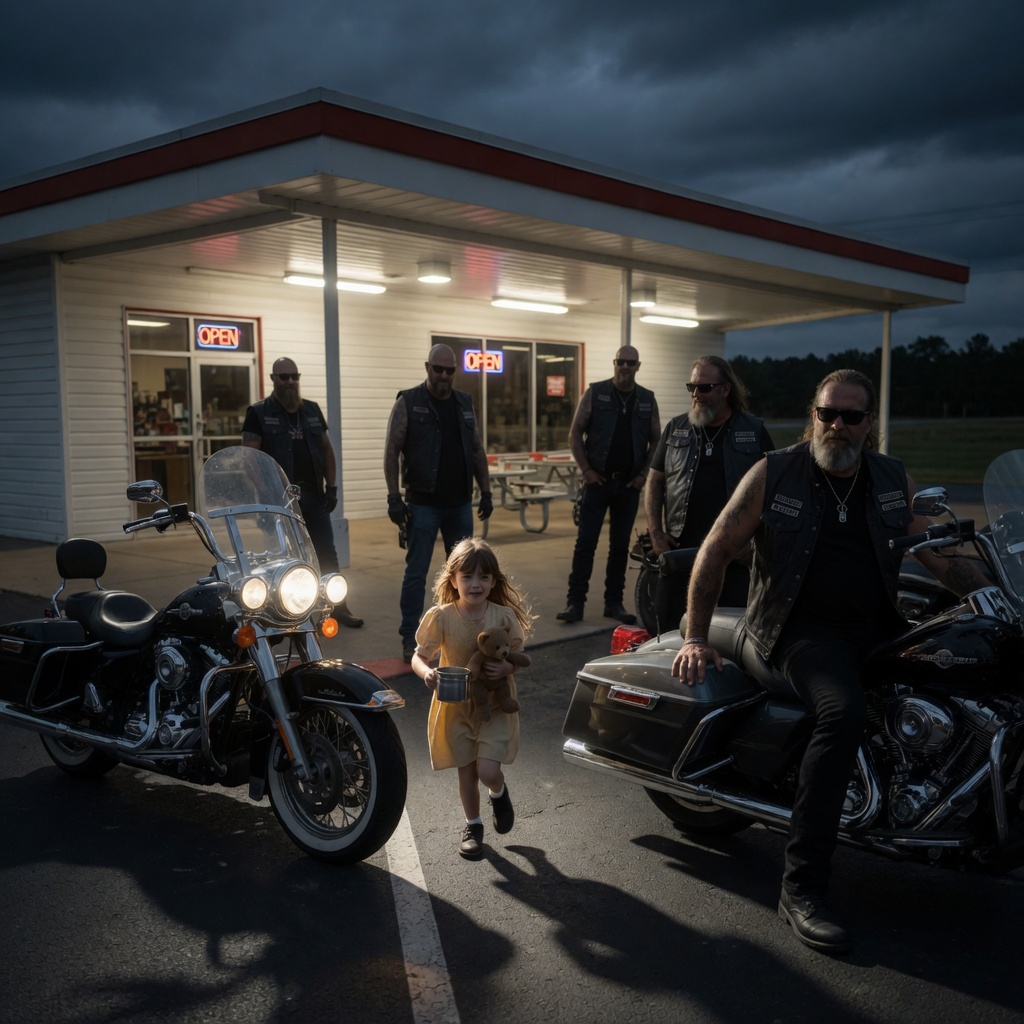
At the center of it all sat a man everyone called Tank.
He was huge, broad across the shoulders, with a gray-streaked beard, a black leather vest, and a wolf tattoo wrapped around his right arm. Men lowered their voices when he spoke. Strangers avoided his eyes. Even his own crew waited before laughing too loudly near him. Tank had earned his name in prison, on highways, in fights, and in stories people repeated only when he was not around.
Then a metal cup crashed onto the pavement.
The laughter died.
A little girl in a dirty yellow dress came running into the parking lot, crying so hard she could barely breathe. She clutched a tiny worn teddy bear tightly against her chest. Her hair was tangled. Her knees were scraped. Dust covered her bare ankles.
She stopped in the middle of the motorcycles and screamed, “Which one of you is Tank?!”
Every head turned.
For one second, no one moved.
Then Tank slowly stood up beside the largest motorcycle in the lot. Dust shifted beneath his boots. The sunlight hit the wolf tattoo on his arm.
His voice came low and rough. “Who wants to know?”
The little girl walked toward him with shaking legs. Every biker watched. The waitress inside the diner froze by the window, coffee pot still in her hand.
The girl lifted the teddy bear with both trembling hands.
“My mama said… give this to the man with the wolf tattoo.”
Tank’s face changed instantly.
Not much.
But enough for every man there to notice.
The grin disappeared from one biker’s face. Another slowly removed his sunglasses. A third looked away like he already knew this was about to hurt.
Tank stared at the bear.
It was small, brown, old, with one stitched eye and a torn pocket on the front. The kind of toy a child kept because it had survived too many moves, too many nights, too much fear.
His voice dropped. “Where did you get that bear?”
The little girl swallowed hard and held it higher.
“She said… you left before I was born.”
The entire parking lot fell dead silent.
Even the motorcycles seemed far away now.
Tank took the teddy bear carefully into his massive hands, like it might break apart. His fingers found something hidden inside the torn pocket.
A folded photograph.
Slowly, he opened it.
A younger version of him stared back.
No gray in his beard. No hardness in his eyes. One arm wrapped around a pregnant woman with dark hair, standing outside a cheap motel, both of them smiling like they still believed the world could forgive them.
Tank stopped breathing.
“No…” he whispered.
The little girl looked up at him, tears still streaming down her face.
“She said you’d pretend not to know me.”
That broke him.
Not loudly. Not dramatically. Something in his face simply collapsed. The feared biker leader, the man who had made grown men step aside without speaking, stood frozen in the sun with tears filling his eyes for the first time in years.
“What’s your name?” he asked.
The girl clutched her own hands together. “Molly.”
Tank closed his eyes.
Molly.
He remembered the woman in the picture whispering that name years ago, one night when they were lying on the roof of his old truck, staring at stars over a gas station parking lot.
“If it’s a girl,” she had said, “I want to call her Molly.”
Tank had laughed then. “What if it’s a boy?”
“Then I’ll still call him Molly until he complains.”
Her name had been Rosa.
Rosa Bell.
She was not supposed to become a wound. She was supposed to be a few wild months, a soft place in a hard life, a woman who knew how to make him laugh before he remembered he had no right to happiness.
But Rosa had become more than that.
And then she disappeared.
Tank looked at the child again.
Molly’s eyes were Rosa’s.
Her chin was his.
That realization hit him like a fist to the ribs.
“Where’s your mother?” he asked.
Molly’s mouth trembled. “She’s sick.”
Tank’s grip tightened around the photograph. “Where?”
The child pointed toward the road with one shaking finger. “At the motel. Room six. She said if she fell asleep and didn’t wake up, I had to find you.”
Tank moved before anyone else could speak.
“Keys,” he barked.
A biker named Rusty tossed them without question.
Tank lifted Molly carefully onto the back of his bike, but she stiffened the moment his hands touched her.
He stopped immediately.
“I won’t hurt you,” he said, voice rough but softer now.
She stared at him. “People say that.”
Tank swallowed. “Yeah. They do.”
He stepped back and pointed to the diner. “You want to ride in a car instead?”
Molly looked at the motorcycles, then at the men around them, then back at him. “Mama said motorcycles are loud but faster.”
A broken laugh escaped one of the bikers, but it died quickly when Tank looked over.
He removed his leather jacket and wrapped it around the girl’s shoulders before helping her onto the bike.
“Hold on,” he said.
“To you?”
“If you want to stay on.”
Molly hesitated, then wrapped her tiny arms around his waist.
Tank looked down at her hands against his vest.
For years, no one had held onto him like they believed he might save them.
Then the engine roared.
The motel was twelve minutes away, but it felt like twelve years.
Tank remembered Rosa in pieces as the road blurred beneath him. Her bare feet on his dashboard. Her laugh when he burned breakfast. The way she touched his wolf tattoo and said, “You act like a monster because you’re scared someone will notice you’re not.”
He remembered the last fight too.
He had been mixed up in a dangerous run. Debts. Weapons. Men who smiled without blinking. Rosa had begged him to leave the club life before the baby came. He told her he did not know how to be anything else. She cried. He got angry because fear always turned into anger in him.
Two days later, she was gone.
He found a note.
Don’t look for me. You’ll only bring danger.
He believed she had chosen to leave him.
Maybe part of him had wanted to believe that. It was easier to be abandoned than to admit he had made himself unsafe.
Now the child behind him was proof that the past had not ended.
It had been waiting.
Room six sat at the far end of the motel, behind a broken vending machine and a row of weeds growing through cracked concrete. Tank barely parked before Molly jumped down and ran to the door.
“Mama!”
No answer.
Tank’s blood turned cold.
Molly pushed the door open.
The room smelled of medicine, stale air, and fear.
A woman lay on the bed beneath a thin blanket, skin pale, lips dry, dark hair spread across the pillow. Rosa was older now. Thinner. Life had carved itself into her face. But Tank knew her instantly.
“Rosa,” he whispered.
Her eyes fluttered open.
For a moment, she looked confused.
Then she saw him.
A faint, exhausted smile touched her mouth. “Told you he’d come,” she whispered to Molly.
Tank crossed the room and dropped to his knees beside the bed. “What happened?”
Rosa tried to speak, but coughing tore through her. Tank turned toward Rusty, who had followed in the truck with two others.
“Call an ambulance.”
Rosa gripped Tank’s wrist weakly. “No hospitals.”
“Yes hospitals,” he said. “You don’t get to vanish again and die in a motel room.”
Her eyes filled. “Still bossy.”
“Still stupid,” he said, but his voice broke.
Molly climbed onto the bed and curled against her mother’s side. Rosa touched her hair gently.
Tank watched that small hand, weak and shaking, and guilt opened inside him like a knife.
“You should’ve told me,” he whispered.
Rosa looked at him with tired sadness. “I tried.”
Tank froze.
“What?”
She swallowed hard. “I sent letters. To the club. To the old garage. I called once.”
His face changed.
Behind him, Rusty stopped moving.
Tank slowly turned. “Who answered?”
Rosa looked past him toward the doorway.
One of the bikers had not come inside.
A man called Dutch stood outside near the truck, smoking too fast, not looking toward the room.
Tank understood.
His face went dead cold.
“Dutch.”
The man looked up.
Tank stepped outside slowly. Every biker in the lot felt the shift before they knew why.
“You got letters from Rosa?”
Dutch’s jaw tightened. “Tank—”
“Answer.”
Dutch flicked the cigarette away. “You were a mess back then.”
Tank took one step closer.
Dutch lifted both hands. “She was pregnant. You were dealing with Moreno’s crew. You think bringing a woman and baby into that would’ve helped?”
Tank’s voice dropped. “You hid my child from me.”
“I protected the club.”
Tank hit him once.
Only once.
Dutch dropped hard against the truck, blood spilling from his mouth. Rusty and another biker grabbed Tank before he could do more.
Molly screamed from inside.
That stopped him faster than any man could have.
Tank turned back toward the motel room, breathing hard, and saw Molly standing in the doorway, terrified.
Not of Dutch.
Of him.
The sight destroyed him.
He stepped back immediately, raising both hands.
“I’m sorry,” he said.
Molly cried harder. “You got scary.”
Tank swallowed the rage until it burned going down.
“I know.”
He knelt in the dust before her. The men around him stared, stunned. Tank never knelt. Not to police. Not to enemies. Not to anyone.
But he knelt for this child.
“I’m sorry,” he repeated. “I won’t be scary at you.”
Molly hugged the teddy bear tighter. “Mama said you were angry because you were sad.”
Tank shut his eyes.
Rosa had known him too well.
The ambulance arrived minutes later.
Rosa tried to refuse again, but Molly started crying, and that ended the argument. Tank rode in the ambulance with them, his knees cramped beside the stretcher, one huge hand holding Rosa’s, the other resting near Molly’s shoulder without touching unless she allowed it.
At the hospital, doctors used words that made Tank feel like the floor was breaking beneath him.
Pneumonia.
Untreated infection.
Exhaustion.
Malnutrition.
Stress.
Rosa had been working cleaning shifts while raising Molly alone. She had gotten sick weeks ago and kept going because rent did not wait for fever to pass. She had been afraid to use Tank’s name. Afraid Dutch or old enemies might find them. Afraid Tank might reject Molly. Afraid, most of all, that the child would end up alone.
So she gave Molly the teddy bear.
The photograph.
The instructions.
Find the man with the wolf tattoo.
Tank sat outside the hospital room with his elbows on his knees and both hands over his face.
Rusty stood nearby.
After a long silence, Rusty said, “I didn’t know.”
Tank did not look up. “You should have.”
Rusty accepted that. “Yeah.”
Molly sat in a chair beside Tank, wrapped in his leather jacket, the teddy bear in her lap. She had stopped crying, but she watched everything. Children who grow up around instability learn to watch before trusting.
Tank looked at her.
“How old are you?”
“Six.”
Six years.
Six birthdays.
Six years of Rosa carrying everything alone.
His daughter had learned to walk, talk, count, cry, and survive without him.
His throat tightened.
“I didn’t know about you,” he said.
Molly studied his face. “Mama said maybe.”
“Maybe?”
“She said maybe you didn’t know. Maybe you knew and stayed away. She said either way, I should be brave.”
Tank looked toward Rosa’s hospital door. “Your mama deserved better than maybe.”
Molly nodded. “She said that too.”
Despite the pain, Tank almost smiled.
When he was allowed into Rosa’s room later that night, she was awake, oxygen tubing beneath her nose, exhaustion pressed into every line of her face.
Molly had fallen asleep in the chair outside, guarded by Rusty like she was made of gold.
Tank stood beside the bed.
For once, he had no idea what to say.
Rosa spoke first. “Don’t look at me like I’m dying.”
“You nearly did.”
“But I didn’t.”
He nodded once. “Good.”
Silence settled between them.
Then he whispered, “I would’ve come.”
Rosa’s eyes filled. “I wanted to believe that.”
“I swear to you.”
“I know.” She looked away. “That’s the worst part. I think I always knew.”
Tank sat slowly. “Then why didn’t you find me?”
“Because loving you felt like standing near fire. And when Molly came, I couldn’t risk the burn.”
He absorbed that without defending himself.
Because it was true.
The old Tank, the man she left, had been dangerous even when he was loving. He solved fear with fists. He called violence loyalty. He treated softness like weakness because no one had taught him what else to do with it.
“You were right to run,” he said.
Rosa looked at him sharply.
He continued, voice rough, “But you shouldn’t have had to run alone.”
Tears slipped down her cheeks.
Tank reached into his vest and pulled out the old photograph. He placed it on the bed between them.
“I looked happy there,” he said.
“You were.”
“I don’t remember being that happy.”
Rosa touched the edge of the photo. “You were scared of it.”
He nodded.
“Still are?”
He looked toward the door where Molly slept outside.
“Terrified.”
Rosa smiled weakly. “Good. Maybe that means you’ll be careful.”
Tank gave a broken laugh.
The next days changed everything.
Dutch was thrown out of the club. Not dramatically, not with a parking lot execution like old stories might suggest. Tank did something harder. He gathered the crew and told the truth.
Dutch had hidden letters from a pregnant woman.
Dutch had kept a child fatherless.
Dutch had decided the club mattered more than a family.
Then Tank looked at every man there and said, “If this patch means we protect ourselves by sacrificing women and children, burn mine first.”
No one spoke.
Then Rusty removed Dutch’s vest himself.
The club was never the same after that.
Rosa recovered slowly. Molly visited every day, always with Tank, never out of his sight unless Rosa asked for privacy. Tank learned things awkwardly. How to braid hair badly. How to cut pancakes into small squares. How to lower his voice when Molly flinched. How to ask before lifting her. How to sit still when he wanted to fix everything with force.
Molly did not call him Dad.
Not at first.
She called him Tank because that was what everyone else called him.
The first time she said it, he laughed.
Rosa did not.
“She deserves a father, not a nickname,” she said.
Tank looked down. “I know.”
But fatherhood did not arrive because blood said so. It arrived in small repetitions.
He showed up every morning.
He brought clean clothes.
He paid the hospital bills without making Rosa feel bought.
He found them an apartment but put the lease in Rosa’s name.
He took Molly to school and stood awkwardly outside the classroom while parents stared at the enormous biker holding a pink lunchbox.
He learned that Molly liked strawberries, hated thunder, counted motorcycles by color, and slept best when the teddy bear was tucked under her chin.
One evening, weeks after Rosa came home from the hospital, Molly found Tank sitting on the apartment steps, staring at his wolf tattoo.
She sat beside him.
“Does the wolf bite people?”
Tank looked at his arm. “Sometimes.”
“Is it bad?”
He thought about lying, then decided she deserved better.
“It used to be.”
Molly touched the edge of the tattoo with one careful finger. “Mama said wolves take care of their pack.”
Tank’s throat tightened. “Your mama says a lot of things.”
“She’s usually right.”
“Yeah,” he said softly. “She is.”
Molly leaned against his arm.
Only for a second.
But it was the first time she came close without fear.
Tank did not move.
He barely breathed.
Months passed.
The roadside diner became different too. The waitress who had watched everything from the window began keeping a cup of juice ready for Molly whenever Tank came by. The bikers stopped swearing when she was nearby, or tried to. Rusty built a small wooden box for her teddy bear “so he could ride safe.” Tank pretended not to cry when Molly placed the bear inside it before her first motorcycle ride around the parking lot.
Rosa watched from the diner steps that day, arms crossed, face serious.
“Slow,” she warned.
Tank nodded. “Walking speed.”
“I mean it.”
“I know.”
Molly wore a helmet too big for her, grinning like the sun had chosen her personally.
When the bike moved, slow and gentle across the lot, every biker cheered.
Tank looked down at Molly’s tiny hands on the handlebars in front of him.
For the first time in his life, the roar of a motorcycle did not feel like escape.
It felt like home.
Rosa and Tank did not magically become what they had been. Too much had happened. Too many years. Too much fear. Love survived, but survival changes love. It became quieter. More careful. Built from apology, boundaries, and proof.
One night, Rosa asked him, “Are you here because you love me, or because Molly is yours?”
Tank answered honestly. “Both. But even if you never take me back, I’m still her father if she lets me be.”
Rosa nodded.
That was the right answer.
A year after Molly ran into the parking lot, Tank returned to the diner with her and Rosa. The sun was lower this time, softer. The motorcycles still lined the gravel. Men still laughed. Chrome still caught the light.
But when Molly jumped from the truck holding her teddy bear, the entire crew turned toward her like she was royalty.
Rusty called out, “Princess coming through!”
Molly rolled her eyes. “I’m not a princess. I’m a wolf.”
The men howled so loudly Rosa covered her ears.
Tank laughed.
Real laughter.
The kind Rosa had not heard from him since the photograph.
Inside the diner, they sat in the back booth. Molly placed the teddy bear in the center of the table. Its torn pocket had been repaired, but Tank had asked Rosa to leave one small stitch visible.
Some things should not be hidden completely.
Molly pushed the bear toward him. “You keep it today.”
Tank frowned. “Why?”
“Because you found us.”
He looked at Rosa.
Rosa smiled faintly. “Technically, she found you.”
Molly shrugged. “Same thing.”
Tank picked up the bear carefully.
Inside the pocket, the photograph was still there.
Younger Tank.
Pregnant Rosa.
A life interrupted.
He looked at it for a long time.
Then he looked at the two people across from him.
Not lost anymore.
Not safe forever — nobody is.
But together.
Years later, people would tell the story of the little girl in the dirty yellow dress who ran into a biker parking lot and demanded to know which one was Tank. They would talk about the huge biker leader, the wolf tattoo, the teddy bear, the hidden photograph, and the moment a terrifying man broke down in front of his entire crew.
Some would say the girl found her father.
Some would say the father was forced to face his past.
Both were true.
But Molly remembered something simpler.
She remembered being scared.
She remembered holding the bear so tightly her fingers hurt.
She remembered motorcycles roaring around her like monsters.
And then she remembered the largest monster kneeling in the dust and promising not to be scary at her.
That was when Tank began to change.
Not when he saw the photograph.
Not when he learned he had a daughter.
But when he saw fear in her eyes and chose to become someone she did not have to fear.
The wolf tattoo stayed on his arm.
The past stayed too.
But from that day on, Tank understood something Rosa had tried to teach him years earlier.
Strength was not the ability to make people afraid.
Strength was becoming safe for the people who had every reason to run.
And every time Molly asked about the teddy bear, Tank told her the truth.
“That bear was brave before I was.”
Molly liked that answer.
Rosa did too.
And in the diner parking lot, beneath sunlight and chrome and the rumble of motorcycles, a little girl’s scream became the beginning of a family that had almost been lost forever.
![[FULL STORY] My Girlfriend Bragged To Her Friends That I Was The Ugliest Guy She’d Ever Dated, So I Replaced Her Presence With Absolute Silence and Total Success.](https://social-media.rabedo.com/thumbnails/1777359008_B26.png)

![[FULL STORY] I Caught My Husband With My Sister On Our Anniversary, So I Opened The Vault That Destroyed Them Both](https://social-media.rabedo.com/thumbnails/1777821275_688000732_943620588515327_1790886156462189678_n.jpg)