The sliding glass doors of Terminal 4 at John F. Kennedy International Airport opened and closed in a constant rhythm, swallowing travelers from the gray morning outside and releasing them into the rush of departures.
It was barely seven, but the airport was already alive. Rolling suitcases rattled across polished floors. Business travelers moved with coffee in one hand and phones pressed to their ears. Families argued softly over passports, toddlers cried from exhaustion, and announcements echoed overhead in that calm, mechanical voice airports always used, as if delays, departures, and goodbyes were all ordinary things.
Daniel Harper walked through it all without slowing down.
Everything about him was controlled. His navy suit was tailored perfectly. His shoes were polished black. His leather briefcase swung lightly at his side, expensive enough to catch the eyes of people who noticed such things. He adjusted one cufflink as he passed a duty-free shop, glanced once at the departure screen, then at his watch.
Ten minutes to boarding.
Perfect.
Daniel liked perfect.
He liked schedules, contracts, numbers, clean decisions. He liked first-class seats, private drivers, meetings that ended on time, and people who understood that emotion had no place in business. At thirty-eight, he had built Harper Strategic Holdings into one of the most aggressive investment firms in New York. He was respected, feared, and rarely surprised.
He was flying to London that morning to close a deal worth more than some people earned in a lifetime. The flight was only the beginning of a week planned down to the hour: landing, hotel, private dinner, board meeting, negotiation, press statement, return flight. He had slept four hours and still looked sharper than most men after eight.
Control.
That was what Daniel trusted.
He had no idea it was about to disappear.
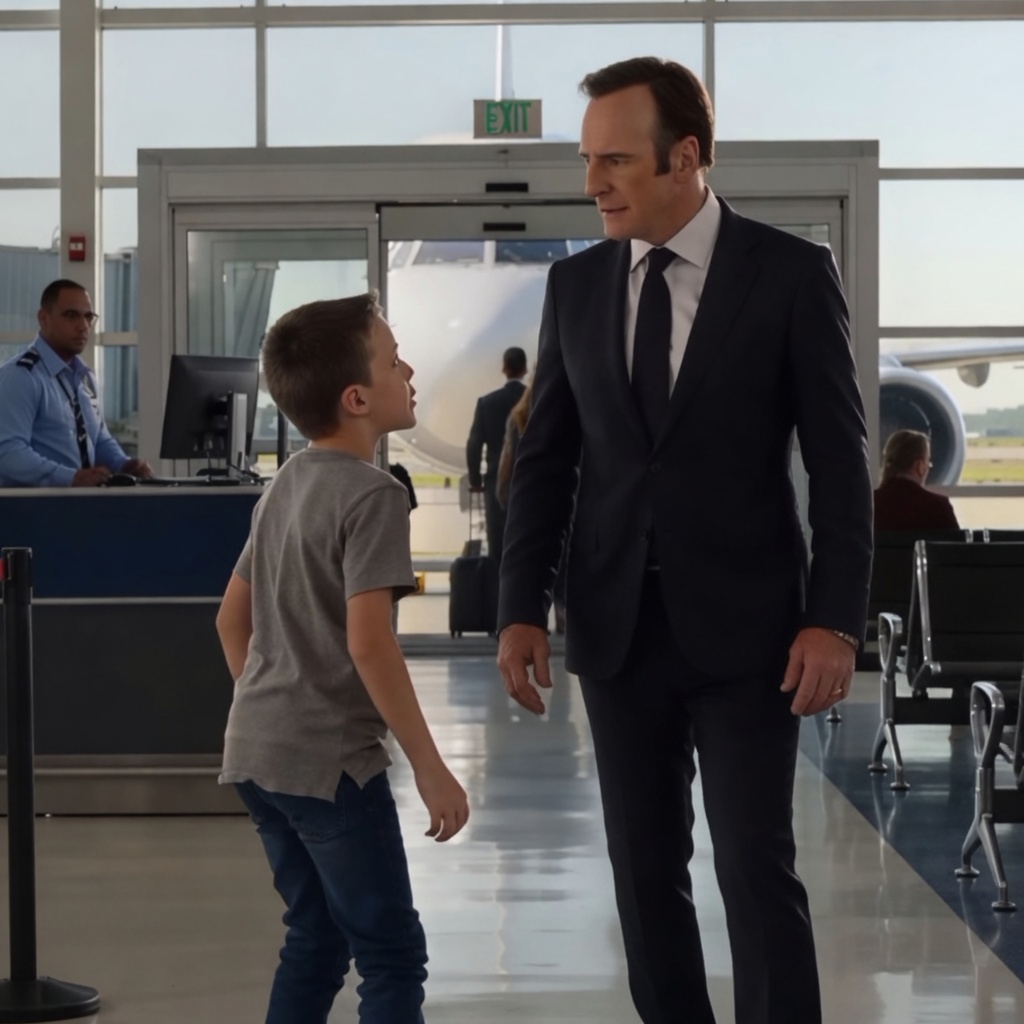
He was halfway to Gate B27 when a small figure broke through the crowd.
A boy.
No more than nine years old. Thin. Breathless. Wearing clothes that looked wrong beneath the bright airport lights. His oversized shirt hung from his shoulders. His jeans were faded at the knees. His sneakers were frayed and dirty, one lace trailing behind him as he ran. He dodged between travelers with desperate speed, knocking against luggage, slipping past a woman with a stroller, ignoring the angry voices behind him.
Daniel saw him only a second before the boy stopped directly in front of him.
“Please!” the boy shouted, chest heaving. “Please don’t board this plane!”
Daniel stopped instinctively.
The words made no sense.
Not here.
Not from a child.
For a split second, everything around them blurred — the announcements, the rolling suitcases, the crowd moving around them like water around a stone.
Daniel’s eyes narrowed. “What?”
Before the boy could answer, two airport ground staff rushed in from behind.
“Hey! Stop him!” one of them barked.
They grabbed the boy by both arms. He twisted hard, panic flooding his face.
“Let me go! Please, you don’t understand!”
“Sir, we’re sorry,” one staff member said quickly to Daniel, already pulling the boy backward. “He shouldn’t be here.”
The boy fought harder. “No! Please! He has to listen!”
Daniel should have walked away.
That was the logical thing. Strange child. Security issue. Airport staff handling it. His flight boarding in minutes. A deal waiting in London.
But then he saw the boy’s eyes.
There was something in them that stopped him cold.
Not mischief.
Not confusion.
Fear.
Real fear.
The kind that did not belong on a child’s face unless something terrible had already happened or was about to.
“Stop,” Daniel said.
The staff kept moving.
Daniel’s voice sharpened. “STOP.”
This time it cut through the noise like a blade.
Passengers turned. A woman lowered her phone. Even the staff froze, startled less by the volume than by the authority in his tone. Daniel Harper was used to being obeyed, and in that moment, everyone felt it.
“Let him speak,” Daniel said.
The staff hesitated. “Sir, we really need to—”
“I said let him speak.”
Slowly, reluctantly, they loosened their grip.
The boy stumbled forward, nearly falling. Daniel crouched slightly, lowering himself closer to the child’s level. It was not something he usually did. Daniel did not kneel for anyone. But something about the boy made standing over him feel wrong.
“What is it?” Daniel asked. “What did you see?”
The boy swallowed hard. His voice dropped to a shaky whisper.
“I saw someone put something in your bag.”
Daniel’s expression changed.
His hand tightened around the briefcase.
“What did you say?”
The boy pointed at the leather case. “Not that one. The suitcase. The black one with the silver tag. The one they took at check-in.”
Daniel stared at him.
“My checked luggage?”
The boy nodded quickly. “A man opened it near the service hallway. He had a badge, but it wasn’t real. He put something inside.”
One of the staff members exhaled sharply. “This is ridiculous. Sir, he’s been running through restricted areas. We don’t even know how he got past—”
Daniel lifted one hand without looking at him.
The man stopped.
Daniel’s gaze stayed on the boy. “How do you know it was mine?”
The boy reached into his pocket and pulled out something small.
A silver luggage tag.
Daniel froze.
It was his.
His initials were engraved on it: D.H.
The boy held it out with trembling fingers. “It fell off when he opened the suitcase. I picked it up. I tried to tell someone, but nobody listened. Then I saw you on the screen at check-in. First class. London. Gate B27.”
Daniel slowly took the tag.
For the first time that morning, control slipped from his face.
The ground staff exchanged uncertain looks.
Daniel stood. “Call security.”
One of them blinked. “Sir?”
“Real security. TSA. Port Authority. Whoever handles baggage tampering. Now.”
The second staff member’s confidence collapsed. He reached for his radio.
The boy took one step closer to Daniel and whispered, “You can’t get on that plane.”
Daniel looked down at him. “What’s your name?”
The boy hesitated.
That hesitation said too much.
“Eli,” he said finally.
“Eli what?”
The boy looked away.
Daniel softened his voice slightly. “Eli, if what you’re saying is true, you may have just saved a plane full of people.”
Eli’s face tightened strangely, not with pride, but pain.
“I only came because of her.”
Daniel frowned. “Because of who?”
Before Eli could answer, an airport security officer arrived with two TSA agents and a Port Authority policeman. The atmosphere shifted immediately. The crowd was pushed back. Questions began. Daniel showed the luggage tag. Eli repeated his story, his voice shaking but consistent. The agents did not look convinced at first. A poor child in a terminal claiming a bag had been tampered with was exactly the kind of story adults wanted to dismiss quickly.
But Daniel Harper did not dismiss it.
And because he refused to move, they could not easily dismiss him either.
Within minutes, the boarding announcement for Daniel’s flight sounded overhead.
“Final boarding call for Flight 216 to London Heathrow…”
Daniel did not move.
One TSA agent spoke into his radio, then looked at Daniel. “Mr. Harper, we’ve located your checked luggage. It’s already loaded.”
“Unload it.”
“Sir, that will delay—”
“Unload it.”
The agent studied him. “You understand this may be nothing.”
Daniel looked down at Eli, whose face had gone pale.
“No,” Daniel said. “I don’t think it is.”
The next twenty minutes unfolded with terrible slowness.
Daniel was escorted with Eli and the officers to a private security area near the gate. The staff tried to separate the boy, but he panicked instantly.
“No! Please! Don’t let them take me!”
Daniel’s eyes narrowed. “He stays where I can see him.”
“Mr. Harper—”
“He stays.”
Eli clung to the strap of his own small backpack, the only thing he seemed to own. Daniel noticed bruising near the boy’s wrist. Old. Fading. His mind filed it away, though he did not yet know why.
The checked luggage was removed from the plane.
Specialists were called.
The gate was closed.
Passengers complained loudly at first. Some cursed the airline. Some demanded upgrades. A man in a gray suit shouted that he would miss a connection. But then uniformed officers moved around the gate area with clipped seriousness, and the complaints began to fade.
Something was wrong.
Daniel stood behind a glass partition, watching through the reflection as officers examined his black suitcase.
He knew every item inside. Three shirts. Two suits. A pair of shoes. A leather folder. Toiletries. Nothing unusual.
Then one of the technicians stopped.
Everyone in the room seemed to hold their breath.
A hidden compartment had been cut into the lining.
Inside was a sealed package.
Daniel’s chest tightened.
The technician looked up and spoke to the officer beside him. Daniel could not hear the words through the glass, but he saw the officer’s face change.
That was enough.
Eli whispered, “I told you.”
Daniel turned toward him.
The boy was not triumphant. He looked sick.
“What was in it?” Daniel asked one of the agents when he returned.
The agent hesitated. “We’re still identifying it.”
Daniel’s eyes hardened. “Don’t insult me.”
The Port Authority officer answered instead. “It appears to be a device. Not fully assembled, but enough to trigger an emergency response.”
The words struck the room like a physical blow.
Daniel felt the blood drain from his face.
His plane.
His suitcase.
His name.
A device hidden in his luggage.
If the boy had not stopped him…
He looked at Eli.
The child had wrapped both arms around himself and was staring at the floor.
Daniel crouched again. “Eli, how did you see the man?”
Eli’s eyes flicked toward the door. “I was hiding.”
“From whom?”
Silence.
Daniel waited.
Eli swallowed. “My uncle.”
That was when the story began to unravel.
Not all at once.
Children do not hand over trauma neatly. They reveal it in pieces, especially when every adult in their life has taught them that truth can be punished.
Eli had been living in and around the airport for nearly three days.
His mother worked night cleaning shifts in Terminal 4. She had brought him sometimes when she could not find anyone safe to watch him. Two weeks ago, she disappeared. Eli said she had been scared before she vanished. She kept telling him not to trust “men with fake badges.” She had seen something while cleaning near the baggage service corridor. Something she was not supposed to see.
Then Eli’s uncle came to the apartment.
Not a real uncle, Eli admitted eventually. His mother’s boyfriend’s brother. A man named Victor. He told Eli his mother had left and that Eli had to come with him. Eli ran.
Since then, he had been hiding wherever he could: bathrooms, service corners, behind vending machines, once inside a cleaning closet until morning. He stole food when hunger became unbearable. He watched people because watching kept him alive.
That morning, he saw the man in the service hallway open Daniel’s suitcase.
He saw the fake badge.
He saw the package.
He saw the silver tag fall.
And somehow, in a crowd of thousands, one forgotten child understood danger better than every adult rushing past him.
Daniel listened without interrupting.
The more Eli spoke, the colder Daniel became.
Because this was no random airport incident.
Someone had chosen his luggage.
Someone had placed a device in his suitcase.
Someone had expected Daniel Harper to board Flight 216 and take the blame if anything happened.
Or die with everyone else.
“Why me?” Daniel asked quietly, more to himself than anyone.
The answer came two hours later.
By then the flight had been fully grounded, passengers evacuated, and federal agents had entered the investigation. Daniel was moved into a private office. Eli sat in the corner with a bottle of water and a sandwich Daniel had demanded someone bring him. The boy ate slowly at first, then faster, then stopped suddenly, ashamed.
Daniel noticed.
“There’s more if you want it.”
Eli looked up suspiciously.
Daniel said, “You don’t have to earn food here.”
Eli stared at him for a long second, then looked back at the sandwich.
A federal agent named Marquez entered the room carrying a folder. Her face was controlled, but her eyes were sharp.
“Mr. Harper,” she said, “we need to ask you about Thomas Bellamy.”
Daniel’s expression tightened.
Bellamy.
A former partner.
A man Daniel had destroyed professionally six months earlier after uncovering fraud inside a shipping acquisition deal. Bellamy lost everything: position, reputation, license, investors. He had threatened Daniel once outside a courthouse.
“You think Bellamy did this?”
“We believe someone connected to him may be involved,” Agent Marquez said. “The device was hidden in your luggage. If it had been discovered in London, you would have been detained internationally. If it had activated…” She stopped.
Daniel understood.
Either way, he was the target.
Then Eli spoke from the corner.
“The man with the badge said Bellamy.”
Everyone turned.
Eli froze.
Daniel stepped carefully between him and the adults’ sudden attention. “What did you hear?”
Eli gripped the sandwich wrapper. “He was talking on the phone. He said, ‘Bellamy wants Harper on the plane before anyone notices.’”
Agent Marquez’s expression changed.
“Are you sure?”
Eli nodded. “I remember because Harper was on your suitcase tag too.”
Daniel stared at him.
This boy had not only saved his life. He had heard the name of the man behind it.
Marquez asked gently, “Eli, would you recognize the man if you saw him?”
Eli nodded again, but fear flooded his face. “If I tell, will they find me?”
Daniel answered before anyone else could.
“No.”
Eli looked at him.
Daniel’s voice remained steady. “Not while I’m here.”
It should have been an impossible promise from a stranger.
But Eli seemed to need it badly enough to believe it for one more minute.
They showed him security images.
Airport workers.
Contractors.
Baggage handlers.
Delivery staff.
Eli rejected them one by one.
Then he stopped.
His finger hovered over one image.
“That’s him.”
The man wore a maintenance uniform. His badge appeared real in the photo.
Agent Marquez leaned closer. “His name is Peter Walsh. Contracted baggage systems technician.”
Eli shook his head. “No. His badge said Walsh. But he wasn’t Walsh.”
Marquez looked up sharply.
Within twenty minutes, they discovered the real Peter Walsh had called in sick that morning.
The man in the footage was using stolen credentials.
By early afternoon, the airport was locked into a full federal investigation. Daniel’s London deal collapsed instantly, but he no longer cared. His phone vibrated with calls from executives, lawyers, journalists, airline officials. He ignored almost all of them.
Eli sat beside him now instead of across the room.
Still cautious.
Still ready to bolt.
But closer.
Daniel watched him drink milk from a carton with both hands wrapped around it. The boy’s hunger was not just physical. It was in the way he watched doors. In the way he flinched when footsteps approached too quickly. In the way he kept checking whether Daniel was still there.
“Eli,” Daniel said quietly, “what was your mother’s name?”
The boy’s face tightened.
“Anna.”
Daniel paused.
Something about the name touched memory.
“Anna what?”
“Anna Morales.”
Daniel went still.
He knew that name.
Not well.
But enough.
Anna Morales had worked on the cleaning crew at Harper Strategic’s midtown office years earlier. Quiet woman. Dark hair. Kind eyes. She once found Daniel’s lost presentation drive after a late-night board meeting and returned it before a major investor pitch. He remembered offering her money. She refused. Said she was just doing her job.
He remembered her because she had looked tired and proud.
And because she had a little boy’s photo taped inside her cleaning cart.
“Your mother worked in my building,” Daniel said slowly.
Eli looked at him in surprise. “You knew her?”
“Not enough,” Daniel admitted.
That answer seemed to confuse him.
Most adults pretended to know more than they did.
Daniel leaned forward. “Did she ever mention me?”
Eli nodded. “She said you were scary but fair.”
Despite everything, Daniel almost smiled.
Then Eli added, “She said if anything ever happened, I should find someone who didn’t smile too much.”
Daniel’s smile vanished.
“What did she see at the airport?”
Eli looked down. “She found a bag.”
“What kind of bag?”
“Black. Heavy. In the service room. She said men were using passenger luggage to move things. She took pictures. Then she got scared.”
Daniel’s mind moved quickly.
His company had recently invested in airport logistics software. Bellamy had connections in shipping, contractors, and cargo routing. If people were using airport baggage systems to move illegal materials, Anna may have stumbled into something far bigger than one attempt on Daniel.
“Do you know where the pictures are?”
Eli nodded slowly.
The room sharpened.
“Where?”
The boy touched his backpack.
Agent Marquez stepped forward, but Daniel lifted a hand slightly. “Let him.”
Eli opened the bag and pulled out a cracked old phone wrapped in a sock.
“My mom gave it to me before she disappeared,” he whispered. “She said don’t turn it on unless I found help.”
Marquez took the phone carefully, as if it were a bomb itself.
In a way, it was.
By evening, the phone revealed everything.
Photos of suspicious cargo transfers.
Fake badge IDs.
Messages Anna had recorded after realizing she was being watched.
One video showed a man Daniel recognized instantly.
Thomas Bellamy.
Standing in a restricted corridor, speaking to the fake technician.
Daniel watched the video in silence.
His face revealed nothing.
But inside him something cold settled permanently.
Bellamy had not only tried to destroy him.
He had dragged a cleaning woman and her child into danger.
Agent Marquez lowered the phone. “Mr. Harper, this is now part of a major investigation. We will need to place Eli into protective custody.”
Eli went rigid instantly.
“No.”
Daniel looked at him.
Eli backed into the wall. “No. I’m not going with strangers.”
Marquez softened. “Eli, we need to keep you safe.”
“No!”
His voice cracked.
The boy who had run through an airport to stop a plane now looked suddenly very small.
Daniel turned to Marquez. “What are the options?”
“Normally child protective services would—”
“No.”
The word came out before Daniel considered it.
Everyone looked at him.
Daniel himself was almost surprised.
He had no children. No warm family home. No experience comforting frightened boys. His apartment was glass, steel, and silence. His life had no room for bedtime stories, school runs, or nightmares.
But Eli had stopped him from boarding a plane.
Eli had risked everything because no one else listened.
Daniel would not let him disappear into another system of strangers.
“I’ll take responsibility,” Daniel said.
Marquez studied him carefully. “That is not a simple process.”
“I didn’t ask if it was simple.”
“You are a witness and potential target.”
“Then he’s already safer with someone who has security than he is anywhere else.”
Eli stared at him.
Daniel looked back. “Only if you want that.”
The boy’s lips parted.
Daniel’s voice softened. “You don’t have to decide forever. Just tonight.”
Eli’s eyes filled, though he fought the tears hard.
“Will you look for my mom?”
Daniel felt the question pierce straight through him.
“Yes.”
“You promise?”
Daniel had made thousands of promises in contracts, negotiations, boardrooms.
None had ever mattered like this.
“I promise.”
Eli nodded once.
That night, Daniel Harper did not fly to London.
He did not close the deal.
He did not sleep in a five-star hotel or sit across from investors beneath chandeliers.
Instead, he sat in a secure hotel suite near the airport while a frightened boy slept on the sofa with a blanket pulled to his chin and one hand wrapped around the cracked phone that had belonged to his mother.
Daniel sat awake in the chair across from him.
His briefcase lay unopened.
His shoes were still polished.
His suit was still perfect.
But nothing else was.
At three in the morning, Eli woke gasping.
Daniel was on his feet instantly.
“It’s okay.”
Eli sat up, disoriented. “Where am I?”
“Hotel. Safe room.”
“Where’s my mom?”
Daniel swallowed. “We’re looking.”
Eli stared at him for a long moment.
Then whispered, “She might be dead.”
Daniel did not lie.
“She might be.”
Eli’s face crumpled.
Daniel crossed the room slowly and sat on the edge of the sofa, leaving space between them.
“My parents died when I was twelve,” Daniel said.
Eli looked up, surprised.
“I didn’t like when adults told me everything would be okay,” Daniel continued. “Because it wasn’t okay. It was terrible. So I won’t say that to you.”
Eli wiped his face with his sleeve.
Daniel’s voice lowered. “But I will say this. You are not alone tonight.”
The boy looked away.
For a while, neither spoke.
Then Eli leaned slightly against Daniel’s side.
Barely.
Almost accidentally.
Daniel stayed completely still.
Like a man afraid to break something fragile.
The next morning, Bellamy was arrested trying to leave the country on a private charter.
The fake technician was captured two hours later.
But Anna Morales remained missing.
For three days, Daniel lived between conference calls with federal agents, private investigators, and airport security. His company panicked. Board members demanded his attention. The London deal disintegrated. Journalists camped outside his building once word leaked that a terror plot had been interrupted at JFK.
Daniel ignored almost all of it.
He became obsessed with finding Anna.
Not because of guilt alone.
Because every time Eli asked, “Any news?” Daniel saw the same desperate hope in the boy’s eyes, and every time he had to say no, something inside him broke further.
On the fourth day, they found her.
Alive.
Barely.
A warehouse in Queens.
Locked storage room.
Dehydrated. Injured. Weak.
But alive.
When Agent Marquez called, Daniel was standing near the hotel window while Eli sat at the table coloring on hotel stationery. Daniel listened without speaking. Then his eyes closed.
Eli saw his face and stood.
“What?”
Daniel turned.
For once, he did not hide emotion quickly enough.
“They found her.”
The crayon dropped from Eli’s hand.
“She’s alive.”
Eli ran into him so hard Daniel nearly stumbled.
The boy sobbed into his suit jacket, all the fear of the past week finally breaking open at once.
Daniel held him.
Awkwardly at first.
Then tightly.
At the hospital, Anna Morales looked smaller than Daniel remembered. Her face was bruised. Her lips were cracked. One wrist was bandaged. But when Eli ran into the room, she came alive.
“Mamá!”
Anna tried to sit up too fast and cried out from pain.
Eli climbed carefully onto the bed, sobbing into her chest.
Daniel stood near the doorway, suddenly aware he did not belong in this reunion.
Anna looked over Eli’s shoulder at him.
Recognition moved across her face.
“Mr. Harper?”
Daniel nodded.
Her eyes filled. “He found you.”
“No,” Daniel said quietly. “He saved me.”
Anna held Eli tighter.
Weeks passed before the full truth became public.
Bellamy had funded a revenge plot using a criminal network inside airport logistics. The device in Daniel’s luggage was meant either to destroy him physically or frame him internationally. Anna discovered evidence while cleaning near restricted service offices. She recorded what she could, gave the phone to Eli, and was abducted before she could reach authorities.
Eli survived because he listened.
Daniel survived because Eli refused to be ignored.
The case became national news, but Daniel protected Eli and Anna from the worst of it. No interviews. No photographs. No exploitation. He paid for Anna’s medical care without allowing anyone to call it charity. He arranged safe housing. He hired lawyers to help her. He set up a fund for airport contract workers who reported security violations.
His board called it excessive.
Daniel called it late.
Months later, Daniel returned to Terminal 4 for the first time.
Not to fly.
To meet Eli and Anna for breakfast before their relocation to a safer apartment.
The airport still moved in its same rhythm. Doors opening and closing. Suitcases rolling. Announcements echoing. People rushing toward departures as if nothing terrible could happen if they walked fast enough.
Eli stood beside his mother near the café, healthier now, clean clothes, new sneakers, but the same watchful eyes.
Daniel approached with two hot chocolates and one black coffee.
Eli grinned. “You’re late.”
Daniel checked his watch. “I am exactly on time.”
“No. Mom says if people like you say exactly, they’re late emotionally.”
Anna laughed softly.
Daniel looked at her. “I don’t know what that means.”
“It means you brought hot chocolate, so you’re forgiven.”
They sat near the window overlooking the tarmac.
For a while, they talked about ordinary things. School. Apartment furniture. Whether Eli could get a dog. Whether Daniel’s suits were all the same color. Whether airport pancakes counted as real pancakes.
Then Eli grew quiet.
Daniel noticed. “What is it?”
Eli looked toward the gates.
“That day… if you didn’t stop…”
Daniel followed his gaze.
Gate B27 was visible in the distance.
He understood.
“If I didn’t stop,” Daniel said, “you would have found someone else.”
Eli shook his head. “Nobody listened.”
Daniel’s throat tightened.
“I did.”
“Yeah,” Eli said. “But you looked like you didn’t want to.”
Daniel almost smiled. “That sounds accurate.”
Eli looked at him seriously. “Why did you?”
Daniel thought about the crowd, the staff dragging the boy away, the fear in his eyes.
Then he answered honestly.
“Because you weren’t acting like a child trying to cause trouble. You were acting like a child who knew adults were about to make a mistake.”
Eli nodded slowly.
Daniel added, “And because sometimes control is just another word for not listening.”
Anna looked at him then.
She saw the change before he fully did.
Daniel Harper, who once built his life around schedules and certainty, had been saved by interruption. By chaos. By a child who did not belong in his perfect morning.
Before leaving, Eli handed him something.
The silver luggage tag.
Daniel stared at it.
“I thought security kept this.”
Eli smiled. “They gave it to my mom. She said it was yours.”
Daniel closed his fingers around the tag.
The engraved initials caught the light.
D.H.
A piece of metal that had fallen at the exact right moment.
A clue small enough to be ignored.
A miracle shaped like lost luggage.
“Thank you,” Daniel said.
Eli looked embarrassed. “You already said that.”
“I’ll probably keep saying it.”
“That’s weird.”
“I’m told I’m improving emotionally.”
Anna laughed again.
Eli hugged him before leaving.
Not long.
Not dramatically.
But fully.
Daniel stood still for a moment afterward, one hand resting lightly on the boy’s back, realizing something strange and unfamiliar had opened in his life.
Not obligation.
Not debt.
Connection.
Years later, people would tell the story of the boy who ran through JFK Airport and stopped a billionaire from boarding a plane. Some would focus on the device hidden in the suitcase. Some would talk about the revenge plot, the corrupt airport contractor, the dramatic arrest of Thomas Bellamy. Some would call Eli a hero, Daniel lucky, the whole thing fate.
Daniel remembered it differently.
He remembered a thin boy in worn-out sneakers shouting through a crowd.
Please don’t board this plane.
He remembered almost letting security drag him away.
He remembered the fear in the boy’s eyes.
And he remembered the exact moment he chose to listen.
That was the moment that saved him.
Not the money.
Not the security.
Not the private lawyers or corporate influence.
Listening.
A simple human act he had nearly forgotten how to do.
In Daniel’s office, years later, the silver luggage tag sat framed on the wall beside no awards, no certificates, no deal trophies. Just the tag, scratched slightly at one corner, engraved with his initials.
Below it was a small plaque.
A sentence Daniel wrote himself.
When a frightened child speaks, stop moving.
Because once, in the rush of Terminal 4, a child the world almost ignored saw what everyone else missed.
And because Daniel Harper stopped long enough to listen, a plane never took off with a lie hidden in its belly.
A mother was found.
A child was saved.
And a man who thought control was everything learned that sometimes life begins the moment control falls apart.