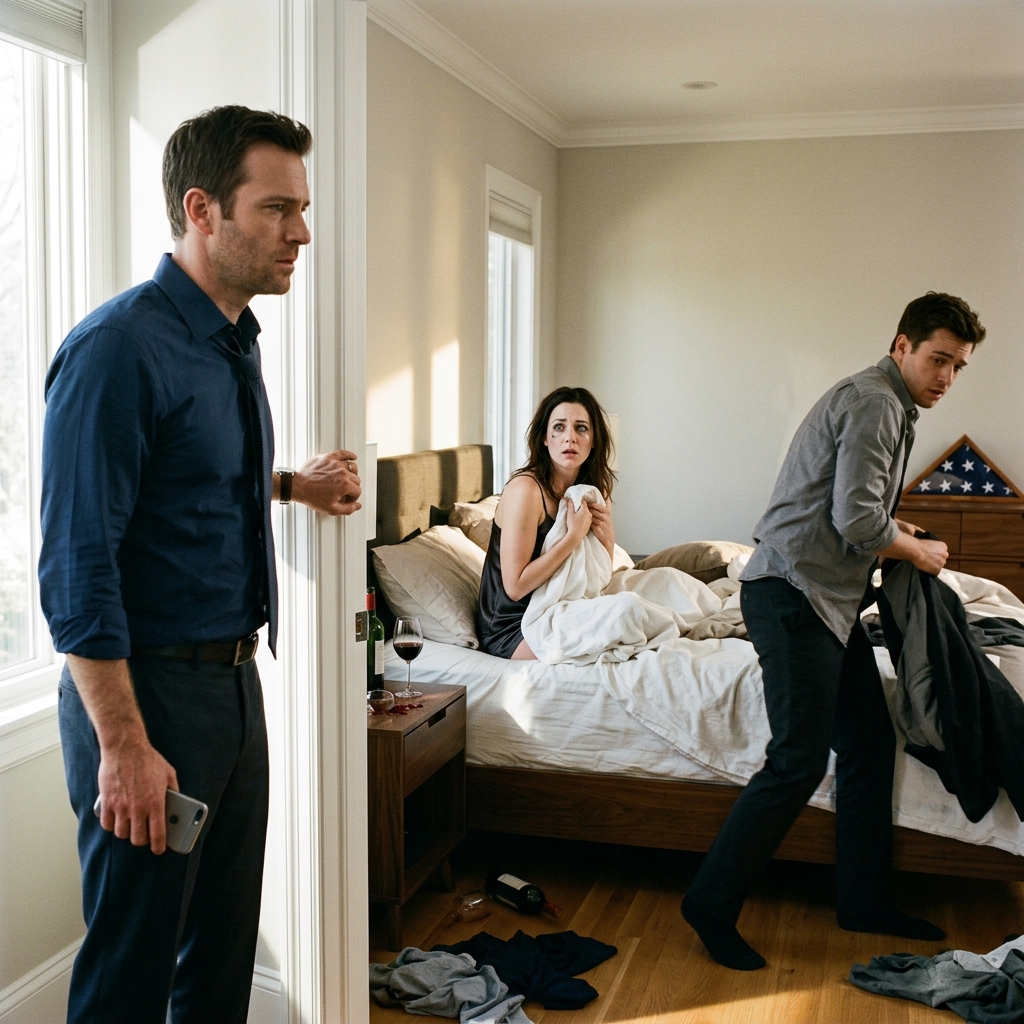

I still remember the exact sentence that changed everything. It wasn’t shouted. It wasn’t part of a blowout fight. In fact, it was said with the kind of casual indifference you’d use to describe the weather or the price of milk.
Vanessa was scrolling through her phone on our Italian leather couch—a couch I paid for, by the way. I was standing in the kitchen, pouring two glasses of a vintage red she liked. The lighting was warm, the apartment looked like a magazine spread, and for a split second, I felt that familiar sense of "comfort."
Then, without looking up, she said it.
“You’ll never leave me, Ethan. You like comfort too much.”
I froze, the bottle still tilted over the glass. I didn't say anything. I just waited.
Then she laughed—that soft, melodic laugh that used to make me feel chosen, but now sounded like a lock clicking into place. “Honestly,” she added, “you’d be lost without me. You’re like a plant, Ethan. You just need a stable corner and someone to water you occasionally.”
She looked up then, flashing me a brilliant, predatory smile. “And I’m the only one who knows your schedule, right?”
I handed her the wine. I even managed a small, tight smile. But inside? Inside, something went pitch black.
My name is Ethan Cole. I’m thirty-eight years old, a financial systems analyst. I deal in patterns, risks, and structures. For twelve years, I thought I was building a fortress with Vanessa. It turns out, I was just building my own cage, and she was the one holding the keys, mocking me through the bars.
We met in Chicago in our mid-twenties. Vanessa was magnetic. She was the woman who walked into a room and the air molecules seemed to rearrange themselves to suit her. I was the "quiet one." The "stable one." People told me I was lucky to have her. Vanessa told me I was lucky to have her. Eventually, I started believing it.
But over the last four years, the "balance" she used to talk about shifted. It wasn't love anymore; it was management. I wasn't her partner; I was her project. Or worse—her furniture.
“Ethan’s the human version of beige,” she told a group of our friends at a dinner party last month. Everyone laughed. I stood there holding a tray of hors d'oeuvres like a glorified waiter in my own home.
“He’s reliable, though,” she continued, swirling her drink. “You can put him anywhere and he just… stays. He doesn’t have the stomach for a reboot. Do you, babe?”
I remember looking at our friend Trevor. He looked uncomfortable, but he chuckled anyway. Because when Vanessa laughs, you laugh. That’s the rule.
I looked at her and said, “I guess I just value what we’ve built, Vanessa.”
“See?” she chirped, turning back to the group. “No teeth. Just gums. He’s adorable.”
That night, after everyone left, I sat in the dark living room while she slept. I realized that my patience hadn’t been a virtue. It had been permission. By not speaking up, I had told her that her disrespect was acceptable. I had trained her to treat me like a doormat.
And then, a week later, I found the iPad.
I wasn't looking for anything. The "Trusting Ethan" was still alive then. But she’d left it on the counter while she went for a run. A notification popped up. Then another.
Ryan Mercer: “Can’t stop thinking about that hotel balcony in Miami. You’re a dangerous woman, V.”
Vanessa: “You’re the one who booked the room with the view, Ryan. 😉 Ethan thinks I was at a branding seminar. He didn’t even ask for the itinerary.”
Ryan: “Does he ever suspect?”
Vanessa: “Please. Ethan notices spreadsheets, not people. I could bring you home and tell him you’re the plumber and he’d probably make you a sandwich.”
I felt a physical wave of nausea hit me. Ryan Mercer. Her boss. A man I had shaken hands with. A man who had sat at my table and complimented my choice of bourbon.
I scrolled. I didn’t want to, but it was like watching a train wreck in slow motion. It went back six months. The jokes about my "beigeness," the mocking of my quiet nature, the detailed descriptions of their trysts. It wasn’t just an affair; it was a conspiracy of humiliation.
I put the iPad back exactly where it was. I walked into the bathroom, splashed cold water on my face, and looked at myself in the mirror.
Vanessa thought I was weak because I was quiet. She thought because I avoided conflict, I was incapable of causing it. She had confused my silence for surrender.
But as a systems analyst, I know one thing: when a system is terminally corrupted, you don’t try to patch it. You build a new one in the background. And when the new one is ready… you pull the plug on the old one.
The next morning, I made her coffee just the way she liked it—two sugars, a splash of almond milk.
“You’re awfully quiet this morning,” she said, peering at me over her phone.
“Just thinking about the future,” I said, my voice as steady as a heartbeat.
“The future is boring,” she yawned. “Let’s focus on the gala next week. I need you to wear the charcoal suit. The navy makes you look… well, even more invisible than usual.”
“The charcoal suit. Got it,” I said.
I kissed her forehead. She didn’t even look up from her screen. She was already texting him. I could tell by the way her thumb moved.
I walked out the door and didn't go to my office. I went to a building three blocks away. A law firm. I had an appointment with a woman named Rebecca Lin, a specialist in "complex domestic dissolutions."
I walked into her office, sat down, and placed a folder on her desk.
“My name is Ethan Cole,” I said. “I’m here to plan an exit. I want it to be clean, I want it to be legal, and I want her to see it coming only when it’s too late to stop it.”
Rebecca looked at me, then at the folder. “And what’s your timeline, Mr. Cole?”
I looked out the window at the Chicago skyline. “She thinks I’d rather die than start over. I want to prove her wrong. But first, I need to see just how deep this rabbit hole goes.”
I didn't know it yet, but the iPad was just the surface. What I was about to discover about our "shared" finances and Vanessa's "business trips" would make the affair look like a minor disagreement.
Vanessa thought I was the furniture. She was about to find out what happens when the house itself decides to move. But before I could leave, I needed one more piece of evidence—something that would ensure she could never rewrite this story. And I knew exactly where to find it.
![[FULL STORY] The Day My Unfaithful Fiancée Demolished My Pride And Joy In A Fit Of Rage Only To Realize I Recorded Everything](https://social-media.rabedo.com/thumbnails/1777883617_S1.jpg)
![[FULL STORY] When I saw my girlfriend checking into a couples resort with my business partner, my heart skipped](https://social-media.rabedo.com/thumbnails/1777000533_c14.png)