

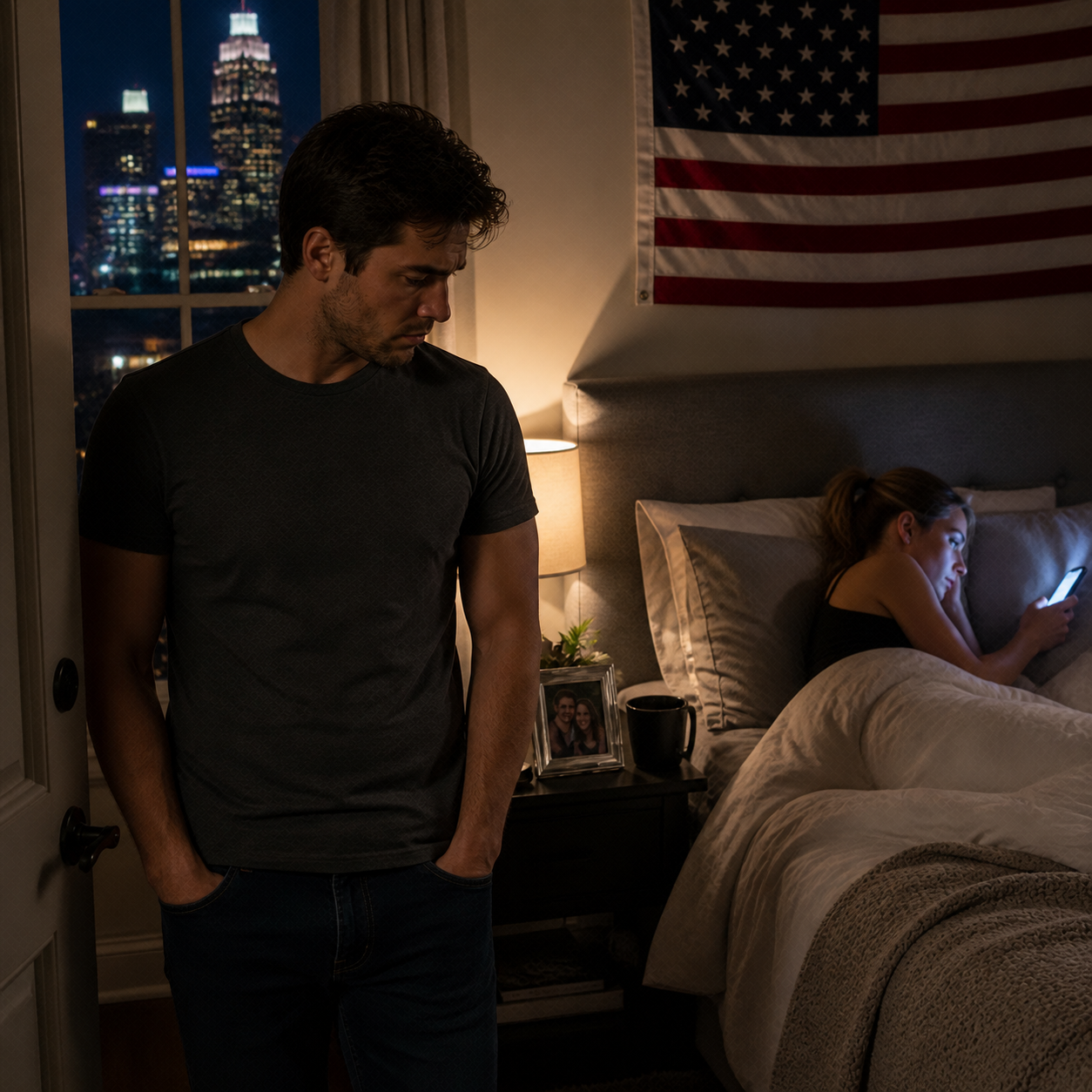
The first thing my wife said after admitting to a year-long affair was not "I’m sorry."
It wasn't "I made a mistake," or "I was lonely," or any of the usual clichés people use when they realize they’ve just detonated their entire lives. Rebecca stood in our kitchen, leaning against the white marble island I had spent six long weekends installing myself. She didn't look guilty. She looked bored. She looked at me with a calmness that hurt more than the actual betrayal.
Then she said the words that ended my marriage before I even realized it.
"You’ll never leave me, Ethan. You don’t have the spine for it."
She didn't scream it. She said it like she was reciting a weather report. In her mind, I wasn't a husband. I wasn't a partner. I was a permanent fixture, like the dishwasher or the custom cabinetry. I was something she could treat like garbage and still expect to be there, functioning, when she got home.
My name is Ethan Cole. I’m forty-two years old, and for thirteen years, I thought I was building a legacy with a woman I loved. I own a mid-sized logistics company in Columbus, Ohio. It’s a "boring" business—trucking routes, fuel costs, warehouse management—but it’s a business built on real things. Real people, real contracts, real deadlines.
Rebecca, on the other hand, lived in a world of "branding" and "perception." She worked in high-end marketing, surrounded by men who wore sneakers with suits and used words like "synergy" and "disruption." To her, my work was background noise. I was the guy who provided the house, the country club membership, and the stability so she could go out and play the high-powered executive.
Our marriage didn't die in a single explosion. It rotted from the inside out. It started after the second miscarriage. A wall went up between us. I tried to reach over it, but Rebecca just kept adding bricks. We stopped talking. We started "co-existing." We had a beautiful house that felt like a museum—everything was perfectly placed, but nobody was allowed to live in it.
The affair wasn't even a shock. That’s the saddest part. I had noticed the changes months ago. The late-night "strategy sessions." The new password on her phone. The way she would flinch if I touched her shoulder. But suspicion is a ghost. You can’t fight a ghost. You need proof.
The proof came from a guy named Gavin, an accountant at Rebecca’s firm. He sent me an anonymous email titled "You deserve to know." Attached were photos. High-resolution, undeniable photos. Rebecca at a downtown hotel. Rebecca kissing a guy named Marcus, one of those "disruptor" executives she admired. Rebecca holding his hand at a restaurant three hours away on a weekend she told me she was at a corporate retreat.
I sat in my home office until 2:00 AM staring at those images. I didn't cry. I didn't punch a wall. I just felt a deep, hollow coldness settle into my bones.
The next evening, I confronted her. I didn't yell. I just placed my phone on the kitchen counter with the photos pulled up. She scrolled through them with a blank expression. When she reached the last one, she didn't apologize. She didn't even try to lie. She just looked up at me, folded her arms, and delivered that line about my "spine."
"Ethan," she said, her voice dripping with a condescending kind of pity, "People like us don't just 'divorce.' Think about the house. Think about our social circle. You’re comfortable here. You’ve never liked conflict. You’ll be mad for a week, and then we’ll go to dinner at the club, and you’ll pretend this never happened. Because that’s what you do. You’re a peace-keeper."
I looked at her. Really looked at her. I saw the expensive lotion on her skin, the designer watch I’d bought her for our anniversary, and the sheer arrogance in her eyes. She thought she owned me.
"Maybe you’re right," I said quietly.
She looked surprised for a second, then gave a smug little nod. "I’m glad we’re being adults about this. I’m going to go take a bath. We can talk about 'rules' tomorrow."
She walked away, her heels clicking on the hardwood floor I’d polished just the week before. She thought the conversation was over. She thought the power dynamic was settled.
But as I stood there in the silence of my "museum" house, I realized Rebecca had made one fatal mistake. She mistook my patience for weakness. She thought because I was quiet, I was powerless. She forgot that in my business, if a truck is off-route, you don't scream at the driver—bellowing doesn't move freight. You look at the map, you identify the problem, and you quietly reroute the entire fleet.
I didn't go to bed that night. I sat at that marble island and started making a list. Not a list of grievances, but a list of assets.
I’ve survived things Rebecca couldn't imagine. I grew up in a house where the sound of a closing door could mean a beating or a blessing. I learned to read the room, to stay silent, and to wait for the right moment to move. Rebecca thought she had studied me? No. I had spent thirteen years studying her. I knew her patterns, her fears, and most importantly, I knew where she was vulnerable.
She wanted a war of perception? Fine. I would give her a ghost story.
I was going to leave. I was going to strip her of every luxury she used as a weapon against me. But I wasn't going to do it with a suitcase in the middle of the night. I was going to do it with the same cold, logistical precision that I used to manage a multi-million dollar shipping firm.
The next morning, I made coffee for both of us. I kissed her on the cheek before she left for work. I told her I needed time to "process," and she smiled that predatory smile of hers, thinking she had successfully managed me.
"Take all the time you need, honey," she said.
I waited until her car pulled out of the driveway. Then, I picked up the phone and called Valerie Mercer. Valerie was the most expensive divorce attorney in the state, known for being a "shark in a Chanel suit."
When she answered, I didn't sound like a heartbroken husband. I sounded like a CEO.
"Valerie," I said, "I need to dismantle a thirteen-year contract. And I need to do it without the other party knowing the ink is already dry."
Valerie listened to the story for twenty minutes. When I finished, there was a long pause on the other end of the line.
"Ethan," she said, "This is going to be expensive, and it’s going to be cold. Are you sure you’re ready for the fallout?"
"She told me I don't have a spine, Valerie," I replied, watching a cardinal land on the bird feeder outside. "I’m about to show her I’m made of nothing but bone."
But I had no idea that while I was planning my exit, Rebecca was already planning something far more sinister that would force me to accelerate my timeline—or lose everything I had built.


![[FULL STORY] He Called My Daughter “Not Gifted”… My Grandfather Ended It in One Sentence](https://social-media.rabedo.com/thumbnails/1777707107_687999908_993338103218392_4846595946212261346_n.jpg)
![[FULL STORY] My Fiancée Slept With My Father The Night Before Our Wedding — So I Exposed Them In Front Of All ...](https://social-media.rabedo.com/thumbnails/1776410732_d36467a0-dd19-48e2-a4ac-54e70d8efc6d.png)
![[FULL STORY] Five Years of My Life for a Diamond Status Symbol? Here is the Invoice for Your Entitlement.](https://social-media.rabedo.com/thumbnails/1777885135_V1.jpg)