
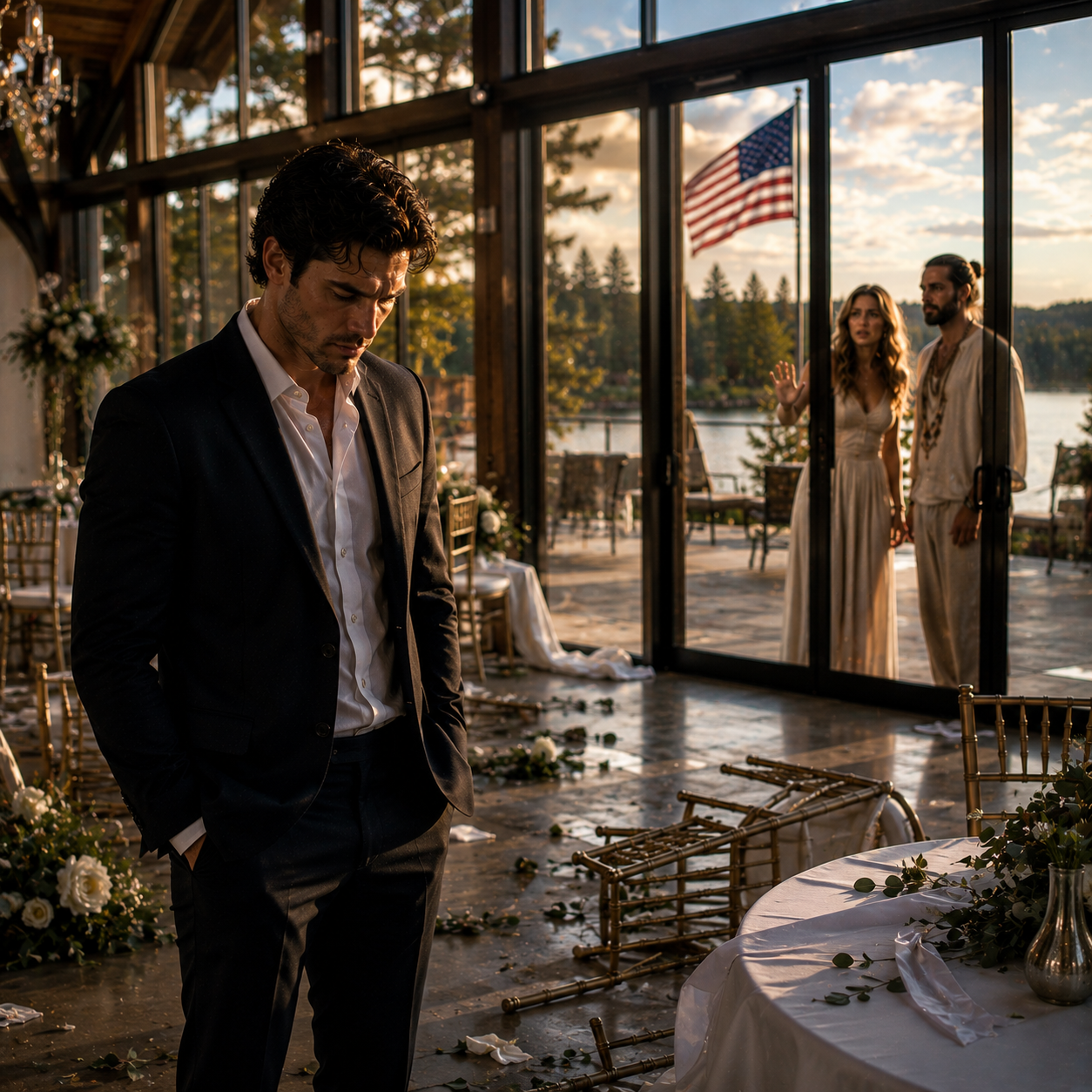
The night my fiancée left with her spiritual mentor, I was marinating salmon for the next day’s dinner service.
That detail always makes people pause when I tell the story because they expect emotional collapse to arrive dramatically. They imagine shouting, crying, slammed doors, maybe some cinematic moment where everything explodes at once.
Real life usually sounds quieter than that.
Sometimes the end of your future arrives while garlic burns lightly in a stainless steel pan and someone you love calmly explains why disappearing with another man is actually a form of emotional growth.
My name is Ethan. I was thirty-five when this happened, and I worked as executive chef at a restaurant outside Portland. Kitchens become your entire nervous system after enough years. Timing. Structure. Discipline. Pressure. Everything has a sequence, and if one station collapses, the entire service feels it.
I used to think relationships worked the same way.
If you showed up consistently enough, communicated clearly enough, sacrificed enough, eventually stability became safety.
Then I met Vanessa.
And for a long time, I thought I had finally found someone building toward the same future.
We had been together almost four years. Engaged for nine months. Living together for nearly two. The wedding was scheduled six weeks away.
Most of our recent conversations revolved around seating charts, floral budgets, and whether her cousin should really be allowed a plus-one after breaking up with the previous fiancé two months earlier.
Normal wedding stress.
At least that’s what I thought.
Looking back now, the warning signs had already started months earlier.
Vanessa had always been vulnerable to reinvention. Every new interest became an identity. Yoga. Minimalism. Breathwork. Astrology. Trauma release therapy. She never explored things casually. She submerged herself completely until the new worldview replaced the old one.
Then she met Julian.
Julian was forty-something, soft-spoken, permanently wrapped in scarves no matter the weather, and somehow managed to sound condescending while pretending to be enlightened. He called himself a spiritual alignment coach.
Translation: emotionally manipulative man with expensive bracelets.
Vanessa started attending his sessions twice a week.
At first, I ignored it.
Restaurant culture teaches you not to judge coping mechanisms too quickly. Everyone survives stress differently.
But slowly, Julian stopped being a hobby and started becoming an authority inside our relationship.
Suddenly every disagreement carried psychological meaning.
If I questioned something, I was “emotionally reactive.”
If I asked for practical plans, I was “trapped in masculine control patterns.”
If I wanted direct communication, I was “resisting energetic truth.”
Eventually, she quoted Julian the way religious people quote scripture.
“Julian says most relationships are based on attachment, not alignment.”
“Julian believes emotional discomfort is necessary for awakening.”
“Julian thinks marriage should only happen after ego separation.”
That last one should have warned me.
Instead, I laughed and kept slicing vegetables.
The conversation that ended everything happened on a Tuesday night.
I was sitting at our kitchen island reviewing supplier invoices while Vanessa paced slowly around the apartment like she had rehearsed the speech already.
Finally she stopped and said, “I think I need space before the wedding.”
I looked up.
“What kind of space?”
At first, I assumed she meant a weekend away.
Maybe staying with her sister.
Maybe stress relief before the final month of planning.
Instead, she took a breath and said, “Julian thinks couples sometimes need temporary separation to discover whether the relationship is truly aligned.”
That sentence hit me strangely.
Not emotionally at first.
Logically.
Because there is something surreal about hearing another man psychologically narrate your relationship through your fiancée.
Then she added the part that changed everything.
“I’m going away with him for a week.”
I stared at her.
“With Julian?”
“Yes.”
“Alone?”
“It’s not like that.”
That phrase.
It’s never just that phrase.
“It’s a spiritual retreat,” she continued quickly. “You’re framing it wrong already.”
I remember setting my pen down very carefully because suddenly I understood something important.
She expected me to negotiate.
To panic.
To chase.
To prove my emotional depth by fighting for the relationship.
Instead, I asked one simple question.
“Do you hear yourself right now?”
Her expression hardened instantly.
“This is exactly why I need space.”
“No,” I said calmly. “You need consequences.”
That irritated her immediately.
“You’re reducing something meaningful into insecurity.”
“And you’re leaving your fiancé for a week with another man six weeks before our wedding.”
“He’s not another man. He’s a guide.”
That sentence nearly made me laugh.
Not because it was funny.
Because people become terrifying once they start replacing common sense with self-importance disguised as enlightenment.
Then she said the sentence that ended the relationship emotionally for me.
“Please don’t contact me while I’m gone. Outside pressure could interfere with the process.”
The process.
Like our relationship was now some spiritual experiment requiring isolation from reality.
I looked at her quietly for several seconds.
Then I nodded once.
“Okay.”
She seemed relieved by my calmness.
That was her mistake.
She mistook calmness for acceptance.
It wasn’t.
It was clarity arriving faster than either of us expected.
That night she packed slowly while explaining how important this experience was for her growth. She kept using words like alignment, emotional truth, and transformational space.
Meanwhile, I kept thinking one thing repeatedly.
If someone truly values a relationship, they do not disappear with another person to test it.
Eventually she left.
And the second the apartment door closed behind her, something inside me became incredibly still.
Not broken.
Certain.
The next morning, I woke up at five, drove to the restaurant, ran breakfast prep, and functioned normally.
That surprised me.
I expected devastation.
Instead, I felt emotionally detached in the cleanest possible way.
Like some hidden tension had finally become visible enough to stop pretending around.
Around noon, Vanessa texted me.
She said she arrived safely and that the retreat already felt transformative.
Then she added:
“Julian thinks this separation will reveal whether our connection is authentic or habitual.”
I stared at the message for maybe ten seconds.
Then I locked my phone and went back to work.
By day three, I stopped emotionally processing and started making decisions.
I called the venue first.
Then the florist.
Then the photographer.
Then the rental company Vanessa spent two months arguing with because she wanted imported candle holders nobody would remember anyway.
Every cancellation felt strangely administrative.
No drama.
Just logistics.
“This booking is no longer needed.”
“Yes, I understand the deposit is non-refundable.”
“No, we will not be rescheduling.”
One woman from the venue sounded sympathetic when she asked whether I wanted to postpone instead.
I answered honestly.
“There won’t be a wedding.”
Then came the harder calls.
Family.
My parents handled it quietly. My father simply said, “You probably avoided a divorce.”
My mother asked whether Vanessa expected to come back and continue planning like nothing happened.
At the time, I hadn’t realized how accurate that question would become.
Vanessa’s parents were more complicated.
Especially because they genuinely liked me.
When I explained the situation to her father, silence stretched so long I thought the call disconnected.
Finally he asked quietly, “She left with another man?”
“Yes.”
“For a week?”
“Yes.”
Another long silence.
Then he sighed heavily and said, “I’ll speak to her when she returns.”
By Sunday evening, the apartment already felt different.
Lighter.
Not happier yet.
Just emotionally cleaner.
That was when the final realization arrived.
Vanessa still thought she was coming home to a wedding.
She just had no idea the wedding no longer existed.
She returned Monday evening.
I knew immediately because her key scraped awkwardly against the lock the way it always did when she carried too many bags.
I was cooking pasta when she walked inside smiling faintly like someone returning from a wellness retreat instead of detonating her engagement.
The first thing she said was, “The apartment feels energetically lighter.”
I nearly laughed.
Not because she looked ridiculous.
Because she genuinely believed the problem in our relationship was blocked emotional energy instead of basic disrespect.
She spent the next several minutes explaining the retreat.
Meditation.
Healing exercises.
Long conversations.
Emotional breakthroughs.
Apparently Julian helped her understand fears around intimacy and identity.
Then she smiled softly and said, “I think we’re finally ready to move forward with the wedding.”
That was the moment I interrupted.
“The wedding is canceled.”
She blinked once.
Then laughed lightly.
“No seriously.”
“I’m serious.”
The smile disappeared instantly.
“What?”
“I canceled everything.”
Her expression shifted rapidly from confusion to irritation.
“You canceled our wedding without discussing it with me?”
That question genuinely stunned me.
“You left for a week with another man.”
“It wasn’t like that.”
“Then what was it like?”
“It was emotional work.”
I nodded slowly.
“And canceling the wedding was mine.”
That made her angry immediately.
“You’re reacting from ego.”
“No,” I said quietly. “I’m reacting from reality.”
Then came the psychological language again.
According to Vanessa, my reaction proved I was threatened by her growth. Julian apparently warned her that emotionally rigid partners often resist transformation.
I remember thinking how incredible it was that a man who never met me somehow became the authority on my personality.
Finally, I asked one question.
“Did you genuinely believe disappearing for a week with another man six weeks before our wedding would not affect whether I wanted to marry you?”
She rolled her eyes immediately.
“If you trusted me, it wouldn’t.”
That sentence ended any remaining uncertainty inside me.
Because trust is not unconditional tolerance for disrespect.
And people who confuse those two things eventually destroy every relationship they touch.
Then she asked if we could simply rebook everything.
Like the entire situation was a scheduling inconvenience instead of emotional betrayal.
That was the moment the conversation stopped sounding absurd and started sounding sad.
Because she truly did not understand what she destroyed.
Not the wedding.
Trust.
Respect.
Safety.
Things much harder to rebuild than deposits.
The argument escalated quickly after that.
She accused me of punishing her for self-improvement.
Said most men would feel lucky to have a partner willing to confront emotional truth before marriage.
I finally stopped debating and said something simple instead.
“You need to leave.”
Silence.
Then immediate outrage.
“You can’t kick me out.”
“The lease is in my name.”
“You’re overreacting.”
“No,” I said calmly. “I’m finished.”
I brought her suitcase into the hallway and set it beside the door.
That changed the emotional temperature instantly.
Suddenly this was no longer abstract spiritual language.
Now it was consequences.
Real ones.
For the first time since returning, Vanessa looked uncertain.
She packed angrily while continuing to explain why I misunderstood everything.
Apparently Julian believed resistance often appears before major breakthroughs.
At one point she actually said, “Eventually you’ll realize he was trying to help both of us.”
That sentence removed any remaining guilt I still carried.
Because anyone capable of saying that after disappearing with another man was not emotionally grounded enough to marry.
Eventually she dragged her bags to the door and stopped.
“Is this really how you want this to end?”
I looked at her quietly.
“It ended when you decided another man’s guidance mattered more than respecting the relationship you already had.”
She shook her head sadly.
“You’re afraid of growth.”
“No,” I said. “I’m afraid of marrying someone who thinks disrespect is enlightenment.”
Then I opened the door.
She left.
And for the first time in months, I slept peacefully.
The next two months changed my life more than the relationship ever had.
Work became easier because my mind stopped carrying constant emotional confusion.
I spent more time with friends.
Started running again.
Reconnected with parts of myself that slowly disappeared during the relationship.
Then six weeks later, Vanessa texted me.
Apparently things with Julian ended.
Shocking.
She said she had been reflecting deeply and wanted to talk.
We met at a small café near the restaurant.
The difference in her energy was immediate.
Gone was the superiority.
Gone was the certainty.
Now she looked exhausted.
She apologized quickly. Said she became too dependent on outside guidance. Admitted leaving the way she did was unfair.
Then she asked whether we could rebuild slowly.
I listened quietly.
Then asked one question.
“Are you still working with Julian?”
She hesitated before answering.
“No.”
Of course not.
The fantasy had collapsed already.
Then she said she missed our stability.
Our routines.
The life we built together.
That part mattered.
Because suddenly enlightenment became much less appealing once reality arrived.
Finally she asked whether she could come back to the apartment sometime so we could continue talking privately.
Like the relationship had simply paused.
I looked at her carefully for several seconds before answering.
“No.”
Her face fell immediately.
“Are you sure?”
“Yes.”
“People survive worse things than this.”
“Maybe,” I said. “But I don’t want to.”
Silence settled between us.
Then I explained the truth she still partially avoided.
“The issue was never just the retreat. It was the certainty. You left convinced I was the problem for not accepting it.”
She looked down immediately.
“And now?” she asked softly.
“Now I think you confused emotional performance with wisdom.”
That hurt her.
I could see it instantly.
But honesty matters more than comfort once relationships reach this point.
She tried one final time.
“I’m different now.”
I nodded slowly.
“I am too.”
We sat quietly after that.
Then eventually she whispered, “I really thought you’d wait for me.”
That sentence stayed with me afterward.
Because it revealed everything.
She never believed I would leave.
Never believed consequences would actually arrive.
She thought stability meant permanence.
That I would simply absorb whatever confusion she brought back home.
Instead, I chose myself.
And honestly?
It saved me.
Looking back now, canceling the wedding was not impulsive.
It was the first truly clear decision I made in months.
People kept asking afterward whether I regretted not trying harder.
But relationships cannot survive when one person disappears emotionally while expecting unconditional understanding in return.
Love requires respect.
Not spiritual jargon.
Not emotional manipulation disguised as growth.
Not another man explaining your relationship back to you through your fiancée.
Just respect.
Vanessa spent months chasing emotional enlightenment.
I found something simpler.
Peace.
And unlike everything Julian promised her, peace actually lasted.

![[FULL STORY] The Wedding Day Betrayal: How My Fiancee and Best Friend’s Scheme For My Software Empire Backfired Spectacularly](https://social-media.rabedo.com/thumbnails/1777888226_B5.jpg)
![[FULL STORY] My Wife Got Pregnant by My Younger Brother — Then My Family Told Me to Be the Hero](https://social-media.rabedo.com/thumbnails/1777886168_f9acef1b-f424-4028-9745-66f1196d3a87.jpg)

![[FULL STORY] My Fiancée Said Her Family Didn’t Think I Was Good Enough. I Thanked Them for Saving Me From Five Years of the Wrong Marriage.](https://social-media.rabedo.com/thumbnails/1776936317_17.png)