
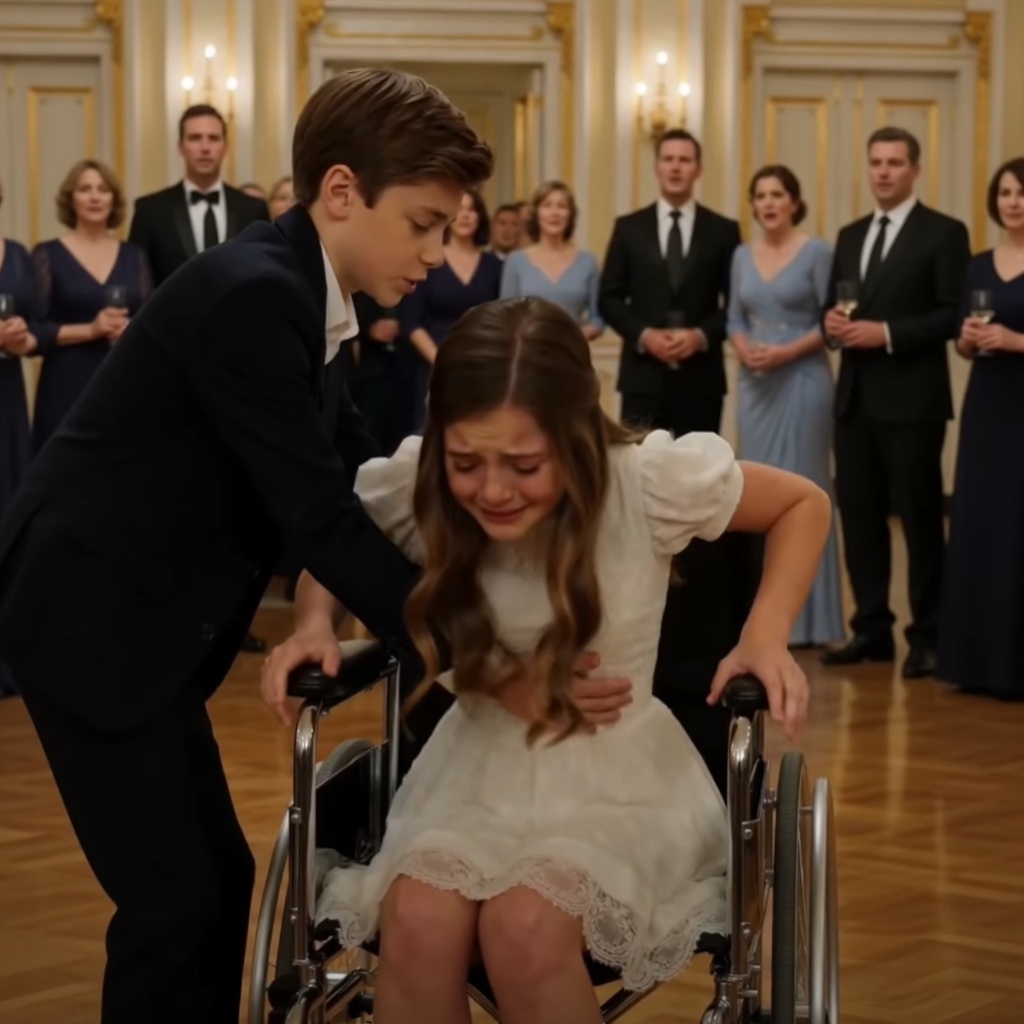
She was only nine years old, but in that moment she felt much smaller. Her white dress trembled with every shaky breath. Her hands were cold. Her knees were hidden beneath layers of soft fabric, but she could feel them shaking before she had even tried to move. Around her, adults whispered behind their hands. Men in dark suits leaned forward. Women in silk gowns watched with shining eyes. Some held phones low, pretending not to record. Others stood stiffly, unsure whether they were about to witness a miracle or a heartbreak.
Lily wished they would all disappear.
She wished the chandeliers would go dark. She wished the music would start again so nobody could hear how fast she was breathing. She wished her mother were still alive to kneel beside her and say, “You don’t have to prove anything to anyone.” But her mother was gone, and the hall was full of people who had come to see whether the famous little girl in the wheelchair could stand.
That was not how the evening was supposed to feel.
The charity gala had been planned for months. Lily’s father, Thomas Carter, had built the event around the children’s rehabilitation center that had treated Lily after the accident. He wanted to raise money for new equipment, new therapy rooms, and scholarships for families who could not afford long-term care. He told everyone the night was about hope. The invitations said hope. The speeches said hope. The banners near the stage said hope.
But hope felt different when it was placed on a child’s shoulders in front of two hundred guests.
For weeks, Lily had practiced standing in private. First between parallel bars, then with braces, then with a therapist holding her hips, then with a small boy standing in front of her and refusing to let her give up. Some days, she had managed three seconds. Other days, she had cried before trying. Once, she had pushed herself up halfway, felt pain shoot through both legs, and screamed so hard that her father ran into the therapy room white-faced and trembling. After that, Lily begged him not to watch anymore.
Her father loved her. She knew that. But his love had become heavy since the accident. He looked at her with too much fear. Too much guilt. Too much hunger for good news. Every tiny improvement made his eyes fill with tears, and every bad day made him disappear into his office, where she could hear him speaking sharply into the phone. Lily did not want to disappoint him. That was the problem. She did not want to disappoint anyone.
Especially tonight.
Because tonight, without asking her clearly enough, the adults had turned her private battle into the emotional center of the gala.
“Just a small moment,” her father had said earlier, smoothing her hair with shaking fingers. “Only if you feel ready, sweetheart. It will inspire people.”
Lily had nodded because he looked so proud. Because the doctors smiled. Because the photographer was already standing near the stage. Because everyone seemed to need her courage more than she had any to spare.
Now she sat in the middle of the hall, and every eye was on her.
In front of her stood Noah.
He was ten, almost eleven, though he liked to say “almost eleven” as if the extra months made him wise. He wore a navy suit that was slightly too big at the shoulders, and his hair had been combed neatly at the beginning of the evening but was already falling over his forehead. He was not rich like most of the children at the gala. He lived with his grandmother three bus rides away, and he came to the rehabilitation center because his little brother had needed therapy after a long illness. Noah had met Lily there on a rainy Tuesday when she refused to try the walking bars and he had sat on the floor beside her wheelchair eating crackers as if nothing were wrong.
“You can ignore me,” he had said that day. “I’m good at being ignored.”
Lily had almost smiled despite herself.
After that, he kept showing up. Sometimes with homework. Sometimes with juice boxes. Sometimes with silly stories. He never spoke to her like she was breakable. He never clapped when she did tiny things, which Lily secretly appreciated because adults always clapped too loudly. Noah simply stayed. When she was angry, he let her be angry. When she cried, he gave her tissues and looked away so she would not feel watched. When she fell, he said, “That looked awful. Want to try again after snacks?”
And somehow, because he did not make her courage feel like a performance, Lily began to trust him.
Now Noah held both her hands.
His grip was gentle, steady, warm.
“You can do it,” he whispered.
Lily’s eyes flickered past him to the crowd. All those faces. All that pressure. Her father stood near the front, hands clasped so tightly his knuckles were white. Beside him was Dr. Meredith Shaw, the rehabilitation director, smiling with nervous pride. Near the stage, a reporter lifted a camera. Lily saw the lens and felt her throat close.
“They’re all looking at me,” she said, her voice breaking.
Tears filled her eyes instantly. Her lips trembled. She looked so small in the chair, so scared of failing in front of everyone, and for the first time Noah’s face changed. Not with fear. With anger. Not at her, never at her, but at the room.
Because he saw what the adults did not.
They were waiting for a miracle from a child who had not been asked if she wanted to be one.
Noah stepped closer and tightened his hands around hers. “Then don’t look at them,” he said softly. “Look at me.”
Lily tried.
Her breathing stuttered. One tear slipped down her cheek.
“I’m scared,” she whispered.
“I know,” he said. “But I’m here.”
That made something change.
Not much.
Just enough.
She looked into his eyes instead of the crowd. He didn’t look afraid for her. He looked sure. Calm. Like he could hold all her fear until she didn’t need it anymore. Her fingers tightened around his. He gave her the smallest nod.
“Try.”
The whole room seemed to stop breathing.
Lily swallowed hard and leaned forward in the chair. Her legs shook before she even moved. One of the guests covered her mouth. Another took a step closer. Her father whispered her name, almost like a prayer.
Noah slid one arm carefully around her waist, still holding one of her hands. “Slowly,” he whispered. “I’ve got you.”
She pushed.
Her body trembled.
The wheelchair creaked behind her.
For one terrible second, it looked like she would fall.
A ripple of panic passed through the crowd, but Noah did not move away. He held her steady with surprising strength for a boy his size. His jaw tightened. His shoes shifted slightly on the polished floor, but his eyes stayed locked on hers.
“Again,” he whispered.
Lily cried out softly through clenched teeth and pushed harder. Her knees quivered beneath the white dress. Pain shot upward, bright and sharp, but she did not collapse. Her shoulders rose. Her spine straightened. Noah’s arm stayed firm around her waist.
And suddenly, she was lifting.
Gasps rippled through the room.
For a moment, Lily did not understand what had happened. The world looked different. Higher. The faces were not towering above her anymore. The chandelier light seemed closer. Her wheelchair was behind her. Her feet were beneath her.
She was standing.
Not perfectly. Not alone. Not without pain. But standing.
Tears flooded her eyes as she clung to Noah, shaking all over, almost fully upright for the first time in front of anyone outside the therapy room. She stared at him in pure disbelief.
“I can…” she whispered.
Noah smiled then, small and bright. “Yeah,” he said. “You can.”
The hall erupted.
Applause burst from every side, loud enough to make Lily flinch. People cried openly. Her father covered his mouth with both hands. Dr. Shaw pressed a napkin to her eyes. Cameras flashed. Someone shouted, “Beautiful!” Another person began clapping above their head.
But Lily was no longer looking at them.
She was still looking at Noah.
Because he was the only one who seemed to understand that this was not a show. It was not a perfect miracle wrapped in music and applause. It was pain. It was terror. It was trust. It was a little girl standing because one boy had made the room smaller for her, shrinking two hundred watching faces into one pair of steady eyes.
Then her legs buckled.
The applause turned into a gasp.
Noah caught her before she fell.
“I’ve got you,” he said quickly, lowering her back into the wheelchair with care. “I’ve got you. You did it.”
Lily’s whole body shook. Her breath came fast and broken. She wanted to smile, but she was crying too hard. Noah crouched in front of her and wiped one tear from her cheek with his sleeve.
“You did it,” he repeated.
Her father rushed forward then. He dropped to his knees beside the chair and wrapped his arms around her, careful but desperate. “Lily,” he choked. “My brave girl. My brave, brave girl.”
At first, Lily leaned into him. She loved him. She had missed the feeling of his arms around her without sadness between them. But then she heard the applause still rolling across the hall, the murmurs, the cameras, the phones, and something inside her tightened again.
Her father pulled back, tears shining. “You were incredible.”
Lily nodded, but she could not speak.
Noah saw her face.
“She needs a break,” he said.
Thomas looked at him, startled. “Of course. Yes. Of course.”
But Dr. Shaw was already stepping closer, smiling through tears. “Just one photograph, Lily? With your father and Noah? It would mean so much for the center.”
Lily’s shoulders rose toward her ears.
Noah stood. “She needs a break.”
The doctor blinked, surprised by the firmness in his voice. “Noah, sweetheart, I know you’re protective, but—”
“She’s tired,” he said.
The room quieted slightly.
Thomas looked from Noah to his daughter and finally saw what the boy had seen first. Lily was pale. Her hands were clenched in her lap. Her breathing had not settled. She was not basking in joy. She was trying not to fall apart.
His pride collapsed into guilt.
“No photographs,” Thomas said.
Dr. Shaw hesitated. “Mr. Carter, the donors—”
“No,” he said, sharper this time. “My daughter is not a campaign poster.”
Lily looked at him.
For the first time that night, her father’s voice protected her instead of presenting her.
Thomas turned to the guests and forced himself to smile politely. “Thank you all. Please give Lily some space.”
Noah took hold of the wheelchair handles without waiting for permission. Thomas moved to help, and together they guided her out of the center of the hall and toward a side room near the garden doors. The applause faded behind them. The warm light softened. The air grew quieter.
Only when the door closed did Lily finally sob.
Thomas knelt before her, panic returning. “Are you hurt?”
She shook her head, crying too hard to answer.
“Was it your legs? Your back? Tell me what hurts.”
Noah stood beside her chair. “It wasn’t just pain.”
Thomas looked up at him.
Noah swallowed but did not back down. “She was scared. Everybody was staring. You made it too big.”
The words landed hard.
Thomas opened his mouth, then closed it.
Lily cried harder, because someone had said it. Someone had spoken the thing she did not know how to explain.
Thomas turned back to his daughter. “Lily?”
She wiped her face with both hands. “I didn’t want everyone watching.”
His face changed.
“I thought…” He stopped. “I thought you wanted to show them.”
“I wanted to show you,” she whispered.
The sentence broke him.
Not loudly. Thomas Carter was a man who had spent years controlling rooms, companies, meetings, negotiations. But there are words that go past every defense. His daughter had not wanted a stage. She had wanted her father’s belief. She had wanted him to see her, not display her.
He bowed his head. “I’m sorry.”
Lily looked at him through tears.
“I’m so sorry,” he said again. “I let my hope become pressure.”
Noah shifted awkwardly, suddenly unsure whether he should leave. Lily reached for his hand before he could step away. He stayed.
Thomas noticed.
And for the first time, he truly saw the boy who had held his daughter upright when the whole room was waiting for her to become a symbol.
“Noah,” he said quietly. “Thank you.”
Noah shrugged, uncomfortable. “She did the hard part.”
“Yes,” Thomas said. “She did.”
For a few minutes, nobody spoke. Lily’s breathing slowly settled. Noah found a box of tissues on a side table and handed her one. Thomas sat on the floor in his expensive suit, no longer caring about appearances. Beyond the door, the gala continued. Music resumed. Guests returned to their conversations. The world moved on, as it always does after demanding courage from someone else.
Inside the small room, Lily finally whispered, “Was everyone disappointed when I sat back down?”
Thomas looked horrified. “No. Sweetheart, no.”
She looked at Noah.
He made a face. “If they were, they’re dumb.”
A tiny laugh escaped her.
Thomas laughed too, but his eyes filled again.
Lily looked down at her legs beneath the white dress. “I thought if I stood, everything would feel different.”
Noah tilted his head. “Did it?”
She thought about it. “For a second.”
“That counts.”
“But then I was still scared.”
“That counts too.”
Thomas listened, humbled by the simplicity of it. Adults loved clean endings. Child stands. Crowd cheers. Hope wins. But children knew the truth better. Standing once did not erase fear. Applause did not erase pain. A miracle could be real and still not fix everything.
Later that night, after the gala ended and the guests left with damp eyes and generous checks, Thomas carried Lily’s shoes upstairs because her feet were swollen from the braces. Noah and his grandmother waited near the entrance for their taxi. Lily insisted on saying goodbye.
Thomas wheeled her over himself.
Noah’s grandmother, Mrs. Alvarez, was a small woman with kind eyes and a coat missing one button. She looked nervous in the grand hall, as if afraid someone might ask why she was there. Thomas recognized that look. He had spent the night surrounded by wealthy donors who assumed generosity belonged to people with money. But the bravest person in the room had been a boy whose grandmother counted bus fares.
Lily held Noah’s hand. “Will you come to therapy Tuesday?”
“Obviously,” he said. “You still owe me a race.”
“I’m in a wheelchair.”
“So? I’ll run slow.”
She smiled.
Thomas turned to Mrs. Alvarez. “May I arrange a car for you both?”
She shook her head quickly. “No, no. We can manage.”
“I know you can,” he said gently. “But I would like to.”
She studied him, perhaps deciding whether this was charity or respect. Then she nodded once. “Thank you.”
Noah looked suspicious. “Is it one of those cars where the seats feel like clouds?”
Thomas smiled faintly. “Something like that.”
“Okay,” Noah said. “But only because my grandma’s knees hurt.”
Mrs. Alvarez swatted his arm lightly. “Boy.”
Lily laughed again.
That laugh stayed with Thomas all night.
After Lily fell asleep, he sat alone in his study and watched the gala footage. Not the polished version the event team had already prepared. The raw recording. He watched his daughter sitting in the wheelchair, pale and terrified. He watched Noah step closer, watched him say something the microphone barely caught. Don’t look at them. Look at me. He watched Lily rise. He watched the crowd erupt. Then he watched her face after the applause — the fear returning, the exhaustion, the way Noah noticed before anyone else.
Thomas closed the laptop.
He thought about his wife, Grace.
Grace would have known. She would have sensed Lily’s fear before the first guest entered the hall. She would have knelt beside their daughter, asked one quiet question, and stopped the whole event if Lily’s answer trembled. Grace had understood love without turning it into expectation.
Thomas had loved his daughter fiercely after the accident, but fear had made his love clumsy. He had wanted proof that she would be okay. He had wanted one beautiful moment to fight back against the night he almost lost her. He had wanted to show the world that Lily was not broken.
But Lily had never asked the world to decide that.
The accident had happened eleven months earlier on a rainy evening. Thomas had been late leaving work. Grace was driving Lily home from piano lessons. A truck ran a red light. The impact killed Grace instantly and left Lily trapped in the back seat, conscious, screaming for her mother until firefighters cut her free.
Thomas arrived at the hospital still in his suit, still holding his phone, still expecting someone to tell him it was bad but survivable. Instead, a doctor took him into a small room and said his wife was gone. Another doctor told him Lily’s spine had been injured. There would be surgeries. Uncertainty. Long rehabilitation. No promises.
From that night on, Thomas divided his life into two missions: mourn Grace later, fix Lily now.
He poured money into treatment. Hired specialists. Built ramps. Donated to the center. Read medical papers at three in the morning. Asked doctors for percentages until they stopped giving them. He loved Lily through action because action was the only language that did not collapse into grief.
But somewhere along the way, he had forgotten that Lily did not need to be fixed before she could be loved.
The next morning, Lily woke late. Thomas was waiting in the kitchen, making pancakes badly. One was burned. One was half raw. One looked like a map of a country nobody had discovered yet.
Lily stared at the plate.
“Dad?”
“Yes?”
“Did the pancakes survive a war?”
He looked down. “Possibly.”
She smiled, and his heart loosened.
After breakfast, he sat across from her. “I need to ask you something, and you can answer honestly.”
She looked wary. “Am I in trouble?”
“No. I am.”
That confused her.
He took a breath. “Last night, did I make you feel like you had to stand?”
Lily looked at her plate.
Thomas waited. He did not rescue her from the silence.
Finally, she whispered, “A little.”
He nodded, though the answer hurt. “Thank you for telling me.”
“I wanted you to be happy.”
The words nearly crushed him.
“Lily,” he said, voice thick, “you do not have to stand for me to be happy.”
Her eyes lifted.
“You do not have to walk for me to love you. You do not have to inspire people. You do not have to be brave on command. If you never stand again, you are still my whole heart.”
Her lips trembled.
“Really?”
Thomas moved around the table and knelt beside her chair.
“Really.”
She began to cry, and he pulled her carefully into his arms. This time, he did not say, “You’re brave.” He did not say, “You’ll walk one day.” He did not say anything that turned her pain into a future goal.
He simply held her.
That afternoon, Thomas called Dr. Shaw and changed the rehabilitation plan. No public demonstrations. No donor events centered around Lily. No cameras without her consent. Therapy would be therapy again, not proof. Dr. Shaw apologized, and Thomas accepted it, though he also made sure she understood the boundary was permanent.
Then he called Mrs. Alvarez.
“I’d like to support Noah’s family,” he said. “But I don’t want to insult you or make it uncomfortable.”
There was a long pause on the line.
Mrs. Alvarez answered carefully. “What kind of support?”
“Transportation to the center. Meals if needed. School expenses. Anything that makes it easier for Noah to keep being a child.”
Mrs. Alvarez was silent for so long that Thomas thought the call had dropped.
Then she said, “Noah does not like feeling bought.”
“I’m not buying anything.”
“He helped your daughter because he loves her like a friend.”
“I know.”
Another pause.
Then Mrs. Alvarez sighed. “The bus is hard in winter.”
“Then we start with transportation.”
“And only that for now.”
“Only that.”
When Lily returned to therapy on Tuesday, Noah was already there, sitting on the mat with two juice boxes and a packet of crackers.
“You’re late,” he said.
“I am not.”
“I’ve been waiting forever.”
“It’s been four minutes.”
“Forever is different in kid time.”
Lily rolled her eyes, but she was smiling.
Her therapist, Mara, adjusted the parallel bars. “No standing today unless you want to. We can work on balance from the chair.”
Lily glanced at her father, who sat in the corner with a book he was not reading. He looked up and smiled, not with pressure, not with expectation, just presence.
She looked at Noah.
“What do you think?” she asked.
Noah shrugged. “I think crackers first.”
Mara laughed. “That is not a medical recommendation.”
“It should be.”
Lily laughed too.
And just like that, the therapy room became less frightening.
Over the next months, Lily improved slowly. Not in the dramatic way people loved to imagine. There were no daily miracles. There were tears, bad mornings, muscle spasms, frustration, braces that pinched, exercises that felt pointless, and days when Lily refused to try because she was tired of her body being everyone’s project. But there were also small victories. Sitting straighter. Transferring from chair to mat with less help. Standing for five seconds. Then seven. Then twelve. Taking one assisted step between the bars while Noah shouted, “That was definitely at least a step and not just fancy falling.”
Lily laughed so hard she almost lost balance.
Thomas learned too. He learned to ask, “Do you want help?” before helping. He learned not to count seconds out loud unless Lily asked him to. He learned that hope could be quiet. He learned that sitting beside her on bad days mattered as much as cheering on good ones.
Noah remained Noah. He brought terrible jokes. He challenged Lily to wheelchair races in the hallway. He named her leg braces “the metal dragons.” He once taped a small paper crown to the back of her chair that said QUEEN OF NOT GIVING UP, and Lily pretended to hate it but kept it for two weeks.
One rainy afternoon, Lily had a terrible session. Her legs would not cooperate. Pain made her sharp and embarrassed. She snapped at Mara. Then at her father. Then at Noah.
“Stop looking at me!” she shouted.
The room went silent.
Noah blinked.
Lily’s face crumpled immediately. “I’m sorry.”
Noah sat on the therapy mat. “Okay.”
“I didn’t mean it.”
“I know.”
“I hate this.”
“Yeah.”
“I hate that everyone waits to see if I can do things.”
Noah picked at a loose thread on his sleeve. “Then let’s make them wait somewhere else.”
“What?”
He stood, grabbed a stack of cones from the corner, and began placing them around the room.
Mara watched with amused confusion. “Noah?”
“We’re making an obstacle course,” he said. “For me.”
Lily sniffed. “For you?”
“Yep. You get to judge me.”
He attempted the most ridiculous obstacle course in history. He hopped over cones, crawled under a therapy band, spun around three times, and dramatically collapsed on a mat. Lily tried not to laugh. Failed. Then laughed until her anger dissolved.
Noah lifted his head from the mat. “See? Judging people is fun when they deserve it.”
Lily wiped her eyes. “You’re weird.”
“Correct.”
Thomas stood in the doorway, watching. He understood then that Noah was not helping Lily because he believed she would walk. He was helping her because he believed she was still Lily whether she walked or not.
That was the difference.
By spring, Lily could stand with support more consistently. The center wanted to feature her progress in a newsletter, and this time they asked properly. Lily said no at first. Then maybe. Then only if Noah could draw the picture instead of using a photo. The newsletter went out with a crayon drawing of two stick figures, one in a wheelchair, one with wild hair, both wearing capes. Under it, Lily wrote one sentence:
“Being brave is easier when someone lets you be scared.”
The sentence spread farther than anyone expected. Parents printed it. Therapists quoted it. Donors loved it. But Thomas loved it for a different reason. It sounded like Lily. Not a symbol. Not a miracle child. His daughter.
One year after the gala, the rehabilitation center held another fundraiser. Smaller this time. No grand public demonstrations. No surprise speeches about Lily. Thomas had insisted. Lily attended in a blue dress and silver shoes, seated proudly in her wheelchair, with Noah beside her wearing a suit that still did not fit properly.
The grand hall looked the same as before. Chandeliers. Polished floor. Elegant guests. Soft music. But Lily felt different. Not fearless. Fearless was not a real thing, she had decided. But she felt steadier.
Halfway through the evening, the musicians began playing a slow song. Couples moved to the floor. Lily watched them with an expression Thomas could not read.
Noah noticed first. “You want to dance?”
Lily gave him a look. “Noah.”
“What?”
“I’m in a wheelchair.”
“So?”
“That’s not how dancing works.”
“Maybe you’ve only seen boring dancing.”
She narrowed her eyes. “What are you planning?”
“Something majestic.”
“That means stupid.”
“Sometimes.”
Before she could protest, Noah stepped in front of her chair and offered both hands, exactly as he had done a year earlier. For a second, Lily was back in that moment — the circle of faces, the fear, the pressure. Her chest tightened.
Noah saw it immediately.
“Hey,” he said softly. “No audience. Just me.”
She looked around. People were dancing, talking, laughing. No one was waiting for her to prove anything.
She looked back at him.
“Just you?”
“Unfortunately, yes.”
She smiled.
Lily placed her hands in his. Noah moved backward slowly, guiding the chair in gentle circles across the edge of the dance floor. He spun her once, badly. She laughed. He bowed. She told him he looked like a broken umbrella. He said that was his artistic style.
Then Thomas came forward.
“May I cut in?” he asked.
Noah looked suspicious. “Can you dance?”
“No.”
“Then yes.”
Lily laughed as Noah stepped aside. Thomas took the wheelchair handles gently.
“Ready?” he asked.
She nodded.
He guided her into a slow circle beneath the chandeliers. Not standing. Not performing. Not proving. Dancing. Simply dancing. Lily looked up at him, and for a moment Thomas saw Grace in her eyes so clearly that his breath caught.
“Dad?”
“I’m okay,” he said.
“You’re crying.”
“A little.”
“Because I’m dancing?”
He smiled through tears. “Because you’re happy.”
She thought about that. Then she smiled too.
“I am.”
Across the room, Noah stood with his grandmother. Mrs. Alvarez wiped her eyes with a napkin. Noah pretended not to be emotional, then ruined the act by blowing his nose loudly.
Later that evening, Thomas stepped onto the small stage to thank the guests. He spoke about the center, the therapists, the families, the need for funding. Then he paused and looked toward Lily, who watched him carefully.
“A year ago,” he said, “I made a mistake in this room. I believed hope needed an audience. My daughter taught me it does not. Hope can be private. Hope can be slow. Hope can look like standing for three seconds, or crying through a hard day, or laughing with a friend when nothing goes as planned. Tonight, we are not here to watch children become symbols for us. We are here to make sure they have what they need to become themselves.”
The applause that followed was gentle, not demanding.
Lily looked at Noah.
“Your dad is less dumb now,” he whispered.
She elbowed him lightly. “Don’t be rude.”
“I said less.”
She laughed.
At the end of the night, when most guests had left, Lily asked to go to the center of the floor. Thomas wheeled her there. Noah followed, hands in his pockets.
“This exact spot?” Lily asked.
Thomas looked down. “I think so.”
She stared at the polished floor. “This is where I stood.”
“Yes.”
She was quiet for a long moment.
“Back then, I thought if I couldn’t stand, everyone would be sad.”
Thomas knelt beside her. “I’m sorry I made you feel that way.”
“You did. But you stopped.”
He nodded. “I’m trying.”
“I know.”
Noah crouched in front of her. “For the record, I would’ve booed everyone if they were sad.”
Lily smiled. “You would not.”
“I absolutely would.”
Thomas chuckled.
Lily looked between them. Then she held out her hands.
Noah understood first. His eyes widened slightly. “Are you sure?”
She nodded.
Thomas asked softly, “Do you want to stand?”
Lily looked around the empty hall. No crowd. No cameras. No waiting circle. Only her father, her best friend, and the soft glow of chandeliers above them.
“Yes,” she said. “But just for me.”
Noah took one hand. Thomas took the other.
Slowly, Lily leaned forward.
Her legs trembled. They always did at first. Pain flickered through her, familiar but not victorious. Thomas held steady on one side. Noah held steady on the other.
“Slowly,” Noah whispered, smiling. “We’ve got you.”
Lily pushed.
Her knees shook.
Her shoulders rose.
She stood.
Only for a few seconds.
But this time, no one gasped. No one clapped. No one shouted. The hall did not erupt. The world did not demand anything from her.
Thomas cried silently.
Noah grinned like an idiot.
Lily looked straight ahead, breathing hard, and smiled.
“I can,” she whispered.
Then she sat back down before her body gave out. Noah immediately handed her a juice box from his jacket pocket.
“Emergency victory juice,” he said.
She laughed so loudly it echoed through the hall.
Years later, people would still talk about the night a little girl stood up from her wheelchair in the middle of a grand charity gala while a young boy held her hands and told her not to look at the crowd. Some told it like a miracle. Some told it like a love story, though Lily and Noah were children then and would have rolled their eyes at the idea. Some told it as the moment that inspired hundreds of donations and changed the future of the rehabilitation center.
But Lily remembered it differently.
She remembered fear first.
Then Noah’s hands.
She remembered the crowd disappearing when he told her to look at him.
She remembered the terrible second when her legs almost failed.
She remembered standing.
But more than that, she remembered being allowed to sit back down.
That was the part that saved her.
Not the applause.
Not the headlines.
Not the idea that she had overcome everything in one shining moment.
She had not overcome everything. Life was not that simple. Her body still hurt sometimes. She still used her wheelchair. She still had good days and bad days. She still missed her mother with an ache that changed shape but never fully left. But she learned that courage did not mean becoming what other people needed to see. Courage meant telling the truth about fear and trying anyway, in her own time, for her own reasons.
And Noah remained the boy who understood that before any adult did.
Whenever Lily faced something frightening after that — a surgery, a new school, a difficult therapy goal, a room full of strangers — she would hear his voice in her memory.
Don’t look at them.
Look at me.
As she grew older, the words changed meaning. They no longer meant she needed Noah every time. They meant: find the steady thing. Find the face that loves you without asking you to perform. Find the truth beneath the noise. Look there. Breathe there. Begin there.
Thomas kept learning too. He never stopped grieving Grace, but he stopped trying to turn Lily’s recovery into a replacement for loss. He became quieter, more patient, less afraid of bad days. He funded the rehabilitation center for years, but he made one rule for every event: no child’s pain would ever be used as entertainment. Every family who came through the doors learned that progress belonged first to the person living it.
And in the grand hall, beneath the chandeliers, there was a small brass plaque near the side entrance. Most guests passed it without noticing. But those who stopped to read it found a simple sentence engraved there:
Hope does not need an audience. It needs a hand to hold.
Lily chose the words herself.
Because once, in that glowing hall, she had been a frightened little girl in a white dress, surrounded by people waiting to see if she could rise. Her legs had shaken. Her breath had broken. Her fear had felt bigger than the room.
Then a boy had stepped closer, held both her hands, and made the world small enough to survive.
“You can do it,” he had whispered.
And when she said she was scared, he had not told her not to be.
He had simply said, “I know. But I’m here.”
That was the beginning.
Not of walking.
Not of a miracle.
But of believing that she did not have to face the eyes of the world alone.
![[FULL STORY] My Fiancée Took A Guy’s Number At A Bar And Said I Didn’t Own Her. She Came Home To An Empty Place..](https://social-media.rabedo.com/thumbnails/1777187307_R15.png)

![[FULL STORY] After My Father-in-Law Died, My Wife Became CEO — Fired Me 5 Days Later. She Never Knew I Owned 62%](https://social-media.rabedo.com/thumbnails/1776410046_8ae48144-f8f5-4983-a8a4-0eb1f7601b8f.png)
![[FULL STORY] Ex Girlfriend’s Manipulation, Social Media Meltdown, and Final Karma Ending](https://social-media.rabedo.com/thumbnails/1776416990_670468327_1913216606298172_4462595154709772581_n.jpg)