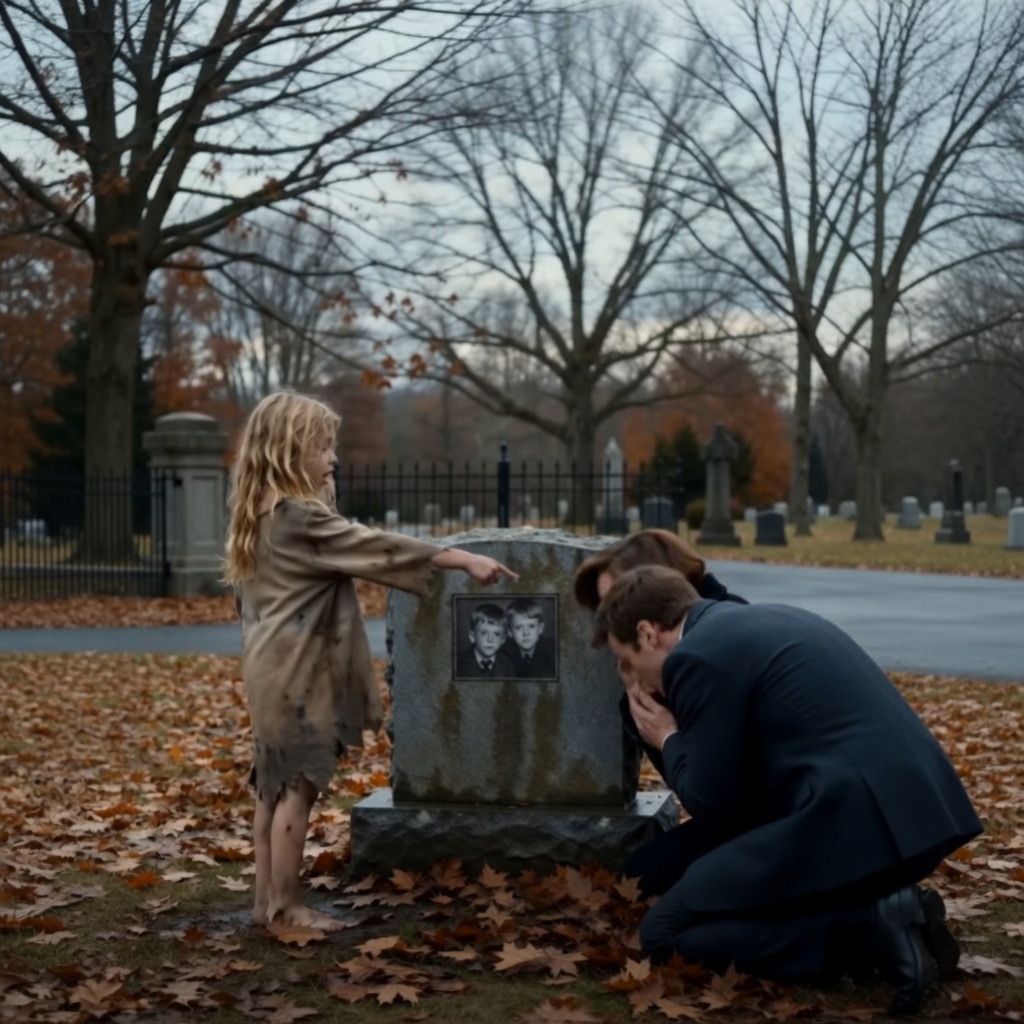
The mother, Claire Whitmore, covered her face with both hands. Six months had passed, but time had not softened anything. It had only taught her how to breathe while broken. The father, Daniel, stared at the headstone like he had spent half a year trying not to scream at it. Their sons’ names were carved beneath the photo: Noah and Caleb Whitmore. Beloved sons. Taken too soon.
Claire hated those words. Taken too soon. They sounded gentle, almost poetic, as if death had reached for her boys politely. There had been nothing gentle about the night St. Agnes Home burned. There had been smoke. Sirens. Screaming. Flames climbing through old windows. Then officials with tired eyes telling them there was nothing left to see. Closed caskets. No bodies shown. Only clothing fragments, a melted shoe buckle, and one small bracelet they said belonged to Caleb.
That was how they had buried their children — with proof too damaged to question and grief too heavy to fight.
Daniel had not cried at the funeral. People mistook that for strength. Claire knew better. Her husband’s grief had gone somewhere deeper than tears. It had hollowed him out. He stopped sleeping in their bedroom because Noah and Caleb’s rooms were across the hall. He stopped eating breakfast because Caleb used to steal toast from his plate. He stopped fixing the old blue bicycle in the garage because Noah had been waiting to ride it when spring came.
Spring had come.
The bike still leaned against the wall, unfinished.
Claire lowered her hands and touched the cold stone. “I’m sorry,” she whispered, though she did not know who she was apologizing to anymore. Her sons. God. Herself. The world for continuing when they had not.
Daniel’s hand tightened around a bunch of wilted white flowers. “We should have kept them home that weekend.”
Claire closed her eyes. “Don’t.”
“They didn’t want to go.”
“They loved St. Agnes.”
“Noah had a fever.”
“A small one.”
“I should have said no.”
Claire turned to him, exhausted. “Daniel, please.”
But he kept staring at the photograph. “I keep hearing Caleb asking if we’d be there Sunday.”
Claire broke then, a small sound leaving her throat before she could stop it. Sunday. They had promised to pick the boys up Sunday afternoon after the charity weekend program ended. St. Agnes Home was not just an orphanage; it also hosted weekend programs for children whose parents volunteered with the foundation. Claire and Daniel had supported it for years. They trusted the place. They trusted the director, Sister Margaret. They trusted the old brick building with its chapel, dormitories, kitchen, and blue-painted playroom where Noah and Caleb once made paper crowns.
Then the fire came before Sunday.
A rustle moved through the wet leaves.
Daniel looked up first.
A barefoot little girl stood on the other side of the grave.
She was small, maybe seven years old. Her smock was torn at one shoulder, her blonde hair tangled, her face pale from cold. Her feet were dirty and red against the wet ground. She looked too small, too strange, too still for a place like that. Not crying. Not lost. Just watching them with eyes that seemed to know more than childhood should allow.
Claire froze.
Before either parent could ask who she was, the girl lifted one finger and pointed straight at the photograph on the headstone.
“They’re not gone.”
The words cut through the silence like something alive had broken out of it.
Claire looked up fully, grief turning into confusion so sharp it almost became pain. Daniel rose halfway from his knees. “What did you say?”
The girl did not step back. She kept pointing at the photo, looking from the boys’ faces to the parents with a calm certainty no child should have carried.
“They stay with me.”
That was worse, because it did not sound like comfort.
It sounded like knowledge.
Claire crawled one step closer through the wet leaves, staring at the child as fear slowly entered her grief. “Who?”
The little girl pointed to one boy in the photograph, then the other. “Both of them.”
Daniel stood too quickly. Leaves crushed under his shoes. Claire grabbed the gravestone to steady herself, her hands shaking so badly she could barely breathe.
The wind moved harder through the trees.
Daniel’s voice came low, rough, barely controlled. “Where?”
For the first time, the girl lowered her hand. She paused, then glanced past them toward the road beyond the cemetery gate and answered with impossible innocence.
“At the orphanage.”
Claire went white.
Not pale.
White.
Because their sons had been buried after the fire at St. Agnes Home six months earlier. Closed caskets. Smoke damage. No bodies shown. They had been told there was nothing left to identify except clothing and one bracelet.
Daniel stepped forward. “Take us there.”
The girl slowly turned toward the cemetery gate. Claire stumbled to her feet, one hand pressed to her mouth. Daniel reached for the child, desperate now, almost afraid she might disappear before giving them the truth.
But just before his hand touched her shoulder, he saw something tied around her wrist.
A faded blue friendship string.
Daniel stopped breathing.
Claire saw it too.
Her knees nearly gave out.
Noah had made those strings the summer before the fire. Blue for himself. Green for Caleb. Yellow for Claire. Red for Daniel. He had called them “family ropes” because bracelets sounded too fancy. Caleb had worn his until the thread frayed. Noah had tied one around his own wrist and one around the stuffed bear he carried everywhere.
But this blue one had a tiny silver bead tied near the knot.
Daniel remembered adding it himself after Noah begged him to make the bracelet “look like treasure.”
The officials had told them it was lost.
Now it was tied around the wrist of a barefoot girl in a cemetery.
Claire whispered, “Where did you get that?”
The girl looked down at her wrist as if she had forgotten it was there. “Noah gave it to me.”
Claire made a sound that did not become a word.
Daniel’s hands shook. “When?”
The girl looked toward the gate again. “After the fire.”
The world seemed to tilt.
Daniel took one step back, then forward again, as if his body could not decide whether to collapse or run. “What is your name?”
“Lena.”
“Lena,” Claire repeated, tasting the name through terror. “Lena, are Noah and Caleb alive?”
The child looked at the photograph again, then back at Claire.
“Yes.”
Claire covered her mouth with both hands. Her eyes flooded. Daniel turned toward the cemetery road as if he could already see the boys standing there. But hope is dangerous when it returns too suddenly. It came at them like a blade. What if this child was confused? What if she had seen other boys? What if grief was making them believe the impossible because the truth had been unbearable?
Daniel crouched in front of Lena, forcing his voice to stay calm. “Lena, listen to me. The boys in that picture. You know them?”
She nodded.
“The older one is Noah.”
“He tells stories.”
Daniel’s face crumpled.
“And the younger one?”
“Caleb. He cries at night but says he doesn’t.”
Claire sobbed once. Caleb had always done that. Even as a toddler, he would wipe his face angrily and say, “I’m not crying, my eyes are leaking.”
Daniel looked at Claire.
For the first time in six months, something like life entered his eyes.
“Take us there,” he said again.
Lena nodded and began walking.
She was barefoot, stepping through wet leaves and gravel without complaint. Claire quickly took off her own scarf and wrapped it around the child’s shoulders. Daniel wanted to carry her, but every time he moved too close, Lena stiffened. So he stayed beside her, hands open, careful, terrified.
Their car waited near the gate.
The drive to St. Agnes took twenty-three minutes.
Claire knew because she had counted that drive a thousand times before the fire. Twenty-three minutes from home to the orphanage. Twenty-three minutes from Sunday pickup to two boys bursting through the front doors with drawings, scraped knees, and stories about Sister Margaret’s terrible oatmeal.
Now the road felt longer.
Lena sat in the back seat with Claire. She held the blue bracelet with her other hand, twisting it gently. Daniel drove too fast at first, then forced himself to slow down because his hands were shaking.
Claire spoke softly. “Lena, why were you at the cemetery?”
The girl looked out the window. “Noah said if I got out, find the stone with their faces.”
Daniel nearly swerved.
Claire gripped the seat. “Noah told you that?”
Lena nodded.
“When?”
“This morning.”
Claire closed her eyes.
This morning.
Not in memory.
Not in dreams.
This morning.
Daniel’s voice came from the front, tight with restraint. “Why didn’t they come with you?”
Lena’s face changed.
The first real fear entered it.
“Because the doors were locked.”
No one spoke after that.
St. Agnes Home stood beyond a rusted iron gate at the end of a narrow road. The main building was blackened in places from the fire, though scaffolding covered one side as if repairs had begun. Half the windows were boarded. The chapel roof sagged slightly. A faded sign near the entrance still read: St. Agnes Children’s Home and Family Mission.
Claire had not come back since the investigation closed.
Seeing it again made her stomach turn.
Lena pointed toward the rear of the property. “Not there.”
Daniel drove past the main entrance and stopped near an old service road nearly hidden by overgrown shrubs. A chain blocked the path, but it was loose. Lena got out before Daniel could open the door.
“This way.”
They followed her through the trees, around the back of the property, to a low stone building Claire barely remembered. The old laundry house. It had been marked unsafe years earlier. During the investigation, officials said the fire had not reached that part of the grounds.
But now Daniel saw fresh tire tracks in the mud.
His face hardened.
Claire whispered, “Daniel…”
He put one finger to his lips.
From somewhere inside the building came a sound.
A child coughing.
Claire’s body moved before thought.
Daniel caught her arm. “Wait.”
“My sons are in there.”
“I know.”
“Let go.”
“Claire, wait.”
His voice broke on her name. Not because he wanted to stop her, but because running blind into whatever this was could cost them the boys all over again.
He pulled out his phone and called the police.
Then he called a second number: Marcus Reed, an old friend and private investigator who had once questioned the fire report when Daniel no longer had strength to. Marcus answered on the second ring.
“I need you at St. Agnes,” Daniel said. “Now. Back laundry house. And bring whoever you trust.”
Then he hung up.
Lena tugged Claire’s sleeve. “There’s a loose board.”
They circled the building. Behind a stack of broken crates, a narrow board had been pried away from the wall. Lena knelt and pointed.
“I came out here.”
Claire dropped to her knees in the mud. “Noah? Caleb?”
For one terrible second, there was no answer.
Then a small voice from inside whispered, “Lena?”
Claire stopped breathing.
Daniel went still beside her.
“Noah?” Claire said.
A rustle.
A cough.
Then, from the dark gap behind the board, a boy’s face appeared.
Dirty. Thin. Eyes too large.
But alive.
Noah.
Claire screamed his name.
Not loudly enough to scare him, but with such raw relief that Daniel grabbed the wall to keep from falling. Noah blinked into the gray light, confused, scared, disbelieving.
“Mom?”
Claire reached through the gap, but it was too narrow. Her hands scraped the wood. “Baby. Oh God. Noah. I’m here. I’m here.”
Noah’s face crumpled. “I told Caleb you’d come.”
Daniel’s voice broke. “Where is he?”
Noah looked back into the darkness. “He’s sick.”
That was all it took.
Daniel tore at the board with his bare hands.
Splinters cut his palms. Nails resisted. Claire helped, sobbing, pulling, ripping at rotten wood until the gap widened. Daniel kicked the lower plank loose. The board snapped, and stale air rushed out — cold, damp, sour with mold and fear.
Inside, in the shadow of the old laundry room, were children.
Not just Noah and Caleb.
Seven children huddled among blankets and crates.
Caleb lay curled on a thin mattress, face flushed with fever, hair damp against his forehead. When he saw Claire, his eyes opened slowly, and for a moment he looked as if he thought she was part of a dream.
“Mommy?”
Claire crawled through the gap and reached him.
She pulled him into her arms carefully, shaking so hard she could barely hold him. He was too light. His bones pressed through his shirt. His skin burned with fever.
Daniel pulled Noah through the opening and held him against his chest. The boy clung to him with a strength born of terror. Daniel’s face twisted as he buried it in Noah’s dirty hair.
“You’re alive,” he whispered. “You’re alive. You’re alive.”
Noah cried then, not like a child crying over a scraped knee, but like someone whose bravery had finally reached the end of itself. “We waited. I told him you’d come. I told him.”
Daniel held him tighter. “You were right.”
Sirens sounded in the distance.
Claire looked around the room, horror rising through her joy. The other children watched from the shadows, some younger than Lena, some older. Their clothes were worn. Their faces were pale. One little boy had a bandaged arm. A girl with dark braids sat beside the door, silent and hollow-eyed.
“What is this?” Claire whispered.
Noah pulled back enough to look at his father. “They said we couldn’t go home.”
“Who?”
Noah swallowed.
“Sister Margaret.”
Claire’s blood turned cold.
The police arrived within minutes, followed by paramedics, then Marcus. The old laundry house erupted into controlled chaos. Children were lifted out, wrapped in blankets, checked for injuries. Caleb was taken straight to an ambulance with Claire beside him. Daniel refused to let go of Noah until the paramedic gently insisted on examining him.
Lena stood near the edge of the road, half-hidden behind Claire’s scarf.
Daniel saw her watching, uncertain now, as if she had completed her task and did not know whether she was allowed to stay.
He walked to her and knelt despite the mud.
“You saved them,” he said.
Lena looked down. “Noah said find you.”
“And you did.”
She twisted the bracelet. “Can I keep it?”
Daniel’s throat tightened. “Yes. Noah gave it to you.”
Her eyes filled.
“No one ever gave me something before.”
Daniel looked toward the ambulance where Claire held Caleb’s hand and Noah sat with a blanket around his shoulders.
“You’re coming with us,” Daniel said.
Lena shook her head quickly. “I don’t have parents.”
“Then you need people even more.”
She stared at him, confused by kindness spoken like fact.
Before Daniel could say more, a police officer approached. “Mr. Whitmore?”
Daniel stood.
“We found records inside. Names. Placement documents. Some look altered.”
Marcus stepped beside Daniel, face grim. “I told you the fire report smelled wrong.”
Daniel’s jaw tightened. “Where is Margaret?”
The officer glanced toward the main building. “We’re looking.”
They found Sister Margaret in her office twenty minutes later.
She was not in a habit, despite the title everyone used. She was the director, not a nun, though she had allowed donors to assume otherwise for years. She was dressed in a gray wool suit, packing files into a leather bag when officers entered. Her face showed surprise, then irritation, then something colder when she saw Daniel standing behind them.
“Mr. Whitmore,” she said. “This is a misunderstanding.”
Daniel almost laughed.
Misunderstanding.
His sons had been declared dead and hidden in a locked laundry building for six months.
Caleb was burning with fever in an ambulance.
Noah weighed less than he had the year before.
And she called it misunderstanding.
He stepped forward, but Marcus caught his arm.
The officer said, “Margaret Vale, you need to come with us.”
She straightened. “On what charge?”
“Child endangerment, unlawful confinement, falsification of records, fraud, and pending further investigation regarding the St. Agnes fire.”
For the first time, fear crossed her face.
Daniel noticed.
“The fire,” he said.
Margaret looked at him.
“You told us they died.”
Her lips thinned. “The night was chaos. Identification was difficult.”
“You buried empty caskets.”
“I did what was necessary.”
That phrase would haunt him later.
Necessary.
Not accidental.
Not mistaken.
Necessary.
Police pulled files from her office. Marcus photographed everything he could before evidence techs took over. Donation records. Insurance correspondence. Foster placement ledgers. Medical logs. False death confirmations. A list of children marked deceased after the fire, several of whom had been found in the laundry house alive.
The scheme began to emerge in pieces.
St. Agnes had been failing financially. Donations had slowed. Inspections were coming. Margaret had used the fire to erase records, claim insurance, cover neglect, and hide children whose paperwork was valuable in other ways — children tied to donor families, inheritance disputes, undocumented placements, or illegal private adoption channels. Noah and Caleb had not been supposed to survive the confusion, but a caretaker named Ruth had pulled them from the smoke and hidden them temporarily in the laundry house before Margaret found them. Ruth disappeared two days later.
No one knew where she was.
The boys had been told their parents were dead.
The parents had been told their boys were dead.
And grief did the rest.
It silenced questions.
It made closed caskets acceptable.
It made impossible pain look final.
At the hospital, Claire sat beside Caleb’s bed while doctors treated pneumonia, dehydration, and malnutrition. Daniel sat beside Noah, who refused to sleep unless he could see both parents. Every few minutes, Noah asked where Caleb was. Every few minutes, Daniel answered.
“He’s here. Mom’s with him. He’s safe.”
Lena sat in a chair near the wall, wrapped in a blanket, eating crackers as if someone might take them away. Claire kept looking at her with tears in her eyes.
Finally, when Caleb was stable, Claire went to the girl and knelt.
“You found us.”
Lena looked embarrassed. “Noah said you cried at the stone every week.”
Claire’s face crumpled.
“He saw us?”
Lena nodded. “Sometimes they took him near the fence to scare him. They said if he tried to run, you wouldn’t believe him because you already buried him.”
Claire covered her mouth.
Lena continued, not understanding how each word cut. “He said you still came anyway.”
Daniel looked at Noah.
His son’s face turned away.
“Noah,” Daniel said softly.
The boy’s shoulders shook. “I saw you once. I tried to yell. They covered my mouth.”
Daniel closed his eyes.
Rage came then, huge and black, but he forced it down because his son needed his arms, not his fury.
“You’re here now,” he said.
Noah whispered, “I thought you forgot us.”
Claire crossed the room so fast the chair nearly tipped. She pulled Noah into her arms, careful of the IV line.
“Never,” she said. “Never. Never for one second.”
Noah cried into her shoulder. Caleb woke at the sound and began crying too. Daniel gathered them both as best he could, and for the first time in six months, the Whitmore family was not whole exactly, but alive in the same room.
That was enough for the night.
The investigation expanded quickly. The fire at St. Agnes became national news. Reporters gathered outside the hospital. Police reopened the case. Families who had buried children demanded answers. Some children were found alive in illegal placements across the state. Others were still missing. Ruth, the caretaker who had saved several children, was found hiding two towns away, terrified that Margaret’s people would kill her. She testified that the fire had started in a locked storage room where old records were kept. She had smelled accelerant.
Margaret denied everything.
Then evidence broke her.
A maintenance worker admitted he had been paid to disable alarms in the older wing. A forged coroner’s report surfaced. Financial records showed insurance claims filed before families were notified. Emails revealed private adoption inquiries tied to children reported dead.
Daniel read none of the articles in full.
Claire could not bear them.
They focused on the boys.
On feeding them.
Holding them.
Learning the new shapes of their fear.
Noah could not sleep with the door closed. Caleb hoarded bread under his pillow. Both boys panicked at the smell of smoke. Lena spoke very little unless Noah was beside her. She had no reliable records. No one knew exactly how long she had been at St. Agnes or where she came from. The faded blue string around her wrist became her anchor. She touched it whenever adults asked questions.
One evening, Daniel found Noah sitting beside Lena in the hospital playroom.
“I told you they’d come,” Noah said.
Lena nodded.
“You can stay with us,” he added.
Lena looked startled. “You can’t say that.”
“Why?”
“Because I’m not yours.”
Noah frowned. “You saved us.”
“That doesn’t make me yours.”
Caleb, sitting nearby with a blanket around his shoulders, said weakly, “It kind of does.”
Daniel stood in the doorway, unable to speak.
Later, he told Claire.
She cried quietly, then said, “We can’t let her go back into the system without knowing she’s safe.”
“We have two traumatized sons.”
“I know.”
“We may not be enough.”
Claire looked toward the boys’ room, where Lena slept in a chair because she refused to be separated from them.
“Then we become more.”
It was not simple. Nothing about healing was. There were social workers, emergency placements, legal petitions, background checks. Daniel and Claire did not rush the word adoption. Lena did not trust permanent words. But she came home with them under a kinship-style foster arrangement while officials searched for her origins.
The first night in the Whitmore house, Noah and Caleb stood at the foot of the stairs, staring.
Everything was the same.
Everything was different.
Their coats still hung near the door. Their drawings were still on the fridge. The blue bicycle still waited in the garage.
Caleb touched the banister. “Is this real?”
Claire knelt. “Yes.”
Noah looked toward his room. “Did you change it?”
Daniel shook his head. “No.”
Noah’s eyes filled. “You thought we were coming back?”
Daniel could not answer.
Claire did. “Some part of us did.”
Lena stood behind them, uncertain.
Daniel turned to her. “Your room is next to theirs. Only if you want it. Door can stay open.”
She nodded once.
At bedtime, all three children ended up in the hallway, refusing separate rooms. So Daniel dragged mattresses onto the floor, and Claire brought blankets. They slept there too, backs against the wall, listening to the children breathe.
Around midnight, Caleb woke screaming.
Smoke.
Door locked.
Can’t breathe.
Claire held him while Daniel turned on every light. Noah woke too and began shaking. Lena crawled under a blanket and covered her ears. It took an hour for the house to settle again.
Healing, they learned, was not one rescue.
It was a thousand nights after.
Winter passed slowly.
Therapy began. Medical appointments. Legal interviews. School meetings. Police updates. The boys had to learn that food would not disappear, doors would open, adults could be questioned, and not every smell of burning meant death. Lena had to learn that kindness did not always come with a trap.
One day, Daniel found her standing in the kitchen, staring at the pantry.
“You can take something,” he said.
She shook her head.
“You don’t need permission.”
She looked at him. “At St. Agnes, taking food meant stealing.”
“This is not St. Agnes.”
“What is it?”
He paused.
“Home,” he said.
She looked down at the blue bracelet. “For me too?”
Daniel’s throat tightened. “For you too.”
She took one granola bar.
Then another.
Then looked scared.
Daniel took a basket from the counter and filled it with snacks. “This can go in your room.”
Her eyes widened. “All of it?”
“All of it.”
“What if I eat it?”
“I’ll refill it.”
She stared at him as if he had just explained magic.
By spring, the boys began laughing again.
Not like before. Not careless. But real.
Noah fixed the blue bike with Daniel. Caleb planted flowers with Claire because he wanted “something alive near the house.” Lena sat nearby, drawing the cemetery over and over until one day she drew the house instead.
The trial began in autumn.
Margaret entered court in a dark suit, face composed, hands folded like a woman wrongfully accused by chaos. Claire watched her from across the room and felt nothing but cold. Daniel held her hand. Noah and Caleb did not attend. Lena testified by recorded interview, holding the blue bracelet as she described the locked rooms, the hidden children, and Noah telling her to find the stone with their faces.
Ruth testified too, voice shaking, explaining how she pulled children from smoke and hid them when she realized Margaret was altering the survivor list. She had meant to come forward sooner, but Margaret threatened her family. Ruth wept when she saw Claire.
“I tried to save them,” she said.
Claire took her hands. “You did.”
Margaret was convicted on charges tied to fraud, child endangerment, unlawful confinement, falsified death records, conspiracy, and arson-related evidence tampering. Other investigations continued for years. Not every missing child came home. That truth remained a shadow over every victory.
But Noah and Caleb were alive.
Lena was safe.
And the empty grave no longer held their names as a lie.
One year after Lena appeared at the cemetery, the Whitmores returned to the graveyard.
This time, the headstone had been changed.
No longer a memorial for dead sons. The photograph remained, but beneath it a new engraving had been added:
Noah and Caleb Whitmore
Lost to a lie. Returned by courage.
Beside their names was a smaller line:
For every child still waiting to be found.
Claire stood before it with Daniel on one side and the children on the other. Noah held Caleb’s hand. Lena wore shoes now, warm boots with purple laces, but the blue friendship string remained tied around her wrist. It was more faded than ever.
Daniel looked at it. “We should make you a new one.”
Lena shook her head. “Not yet.”
Noah smiled. “It’s magic.”
Caleb nodded solemnly. “It found Mom and Dad.”
Claire knelt and opened her arms. All three children came into them.
Leaves moved around them. The same cemetery. The same gray sky. But grief no longer owned the place completely. Something else stood there now.
Not closure.
Not exactly.
Truth.
That afternoon, they went to St. Agnes again.
The old building had been shut down. The front sign removed. The laundry house was gone, demolished after investigators finished. In its place, families of the victims and survivors had planted a garden. Each child’s name was written on a small stone. Some stones had dates. Some had question marks. Some had flowers.
Lena placed one hand on the garden fence.
“This is where I came out,” she said.
Daniel stood behind her. “You were very brave.”
She looked back. “I was scared.”
Claire touched her hair gently. “Bravery usually is.”
Noah tied a new string bracelet to the fence. Blue, green, yellow, and red woven together.
“For everyone,” he said.
Years later, people would tell the story of the barefoot girl who appeared in a graveyard and told two grieving parents their sons were not dead. Some would call it a miracle. Some would call it scandal. Some would focus on the fire, the fake burials, the corrupt orphanage director, the investigation that exposed a network of fraud and stolen children.
But Claire always remembered the leaves.
Wet brown leaves.
A small dirty foot stepping through them.
A finger pointing at a photograph.
“They’re not gone.”
At the time, the words had sounded impossible.
Cruel, almost.
But they had broken open the numb silence grief had built around her. They had forced air back into a world she thought had ended.
Daniel remembered the bracelet.
The faded blue string on Lena’s wrist. The tiny silver bead. Proof so small he almost missed it. Proof that his son had survived long enough to give away something precious, not because he had plenty, but because he believed one day it might guide someone home.
Noah remembered watching through a fence while his parents cried at a stone with his face on it.
Caleb remembered Lena holding his hand in the dark.
And Lena remembered the promise Noah made her before she ran.
“If you get out, find them. They don’t stop loving. Even when they think we’re gone.”
She had believed him.
That belief carried her barefoot through cold roads, into a cemetery, across wet leaves, and straight to the two people grief had nearly destroyed.
The graveyard was quiet that day too.
But it was not numb anymore.
Because beneath the gray sky, among stones and leaves and names carved into memory, three children stood alive where two had once been mourned.
And a mother who had spent months apologizing to a headstone finally held her sons again.
Not in dreams.
Not in photographs.
Not in prayers whispered into wet earth.
In her arms.
![[FULL STORY] She Cheated, Slapped Me, and Called Me a Stalker — So I Exposed the Truth and Watched Her Life Collapse](https://social-media.rabedo.com/thumbnails/1777019541_a233209a-78e9-457b-bd4e-6d006e249962.png)