
I’ve spent ten years building a fortress of stability for a woman who thought I was just the janitor. My name is Mark, I’m 34, a business analyst by trade, and for a long time, I thought I was a partner. I thought I was a husband. But life has a funny way of stripping away your delusions with a single sentence.
It happened on a random Tuesday. Nothing special about it. I’d just finished a 10-hour shift, picked up the kids from soccer, made a quick pasta carbonara because it’s the only thing they’ll eat without a fight, and spent two hours helping my son, Leo, understand long division. My wife, Elena, was in her "studio"—the spare bedroom we converted for her "content creation"—doing God knows what. Probably filming a reel about "energy alignment" while I was downstairs alignment-testing the dishwasher.
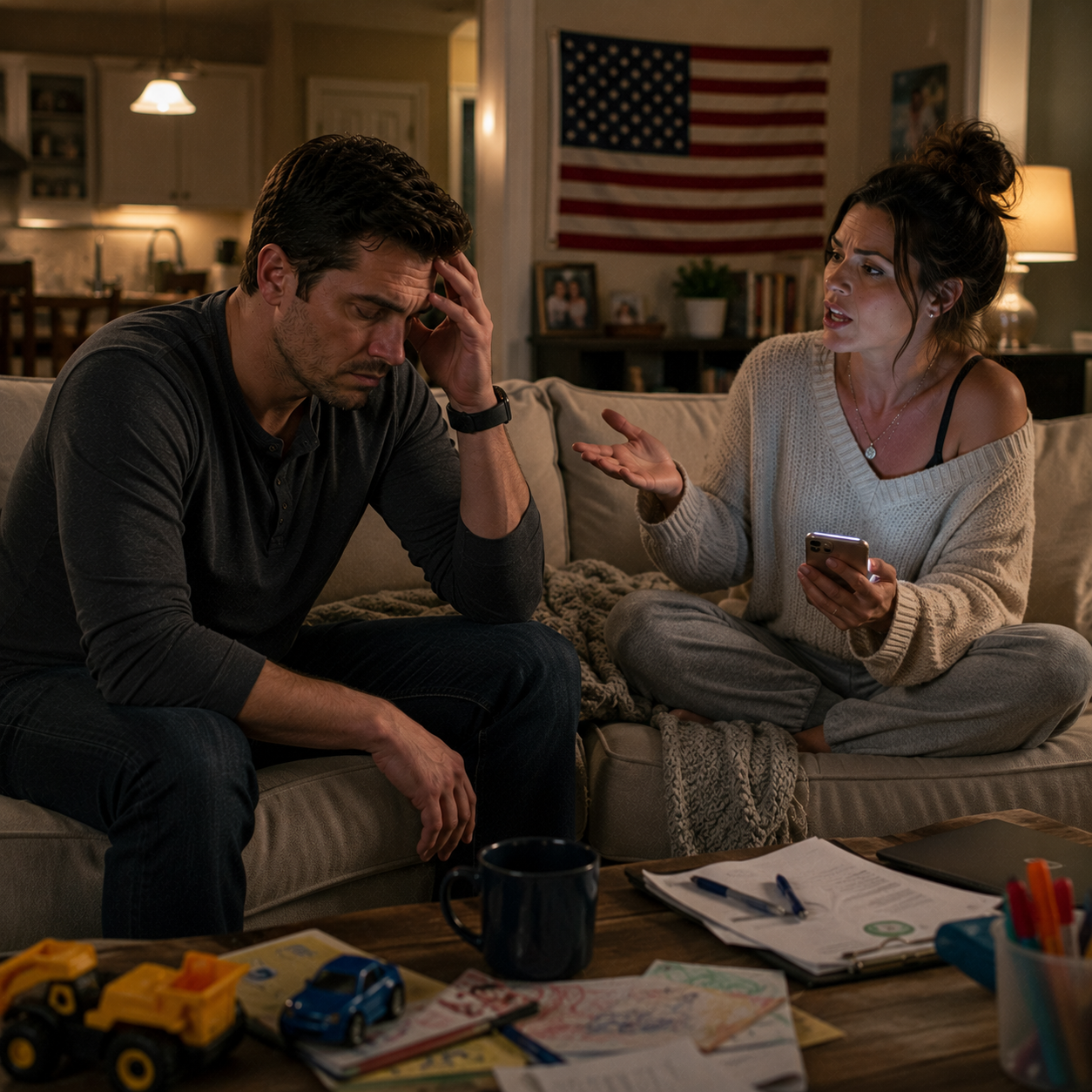
When the kids were finally in bed, I walked into the living room. I was exhausted, the kind of bone-deep tired that makes your eyes sting. I saw Elena on the couch, her face illuminated by the cold blue light of her iPhone. I sat down, hoping for a moment of connection. Just a "Hey, how was your day?" or "Thanks for handling the kids."
"Hey," I said, leaning back. "Thinking about that long weekend we talked about for next month. Maybe we could look at some cabins?"
She didn't even blink. Her thumb just kept flicking upward, scrolling through a sea of strangers' lives.
"Elena?"
She sighed, a heavy, theatrical sound that suggested my presence was an interruption to her spiritual growth. She put the phone down, but she didn't look at me with love. She looked at me with clinical detachment.
"Mark," she said, her voice flat. "I think we need to be honest about where we are. You’re not really my match. Not intellectually, not spiritually. At this point, you’re nothing more than a co-parent. You’re not my real partner."
The air didn't just leave the room; it felt like the walls were closing in. I felt a cold prickle at the back of my neck. A co-parent. Not a lover. Not a best friend. Not the man she’d stood at an altar with ten years ago. Just a utility. A piece of household infrastructure, like the water heater—necessary, but boring and easily ignored until it stops working.
"A co-parent?" I repeated, my voice sounding distant even to me.
"Don't get defensive," she said, waving a hand dismissively. "You’re stable, you’re a good provider, and the kids love you. But you don’t stimulate me. I’ve grown so much through my journey with the blog and my community, and you... you’ve stayed the same. You talk about spreadsheets and mortgage rates. I need depth. I need fire. You’re just... the person I raise children with."
I sat there, frozen. Behind my eyes, a montage of the last decade played in fast-forward. I saw myself working 60-hour weeks so she could quit her marketing job to "find her voice." I saw myself changing diapers at 3:00 AM while she slept because she had a "vulnerability workshop" the next day. I saw every parent-teacher conference I attended alone because she was busy networking with other "empowered" influencers.
I looked at her, and for the first time, I didn't see the vibrant girl I met in college. I saw a stranger who had hollowed out our marriage to make room for her ego.
"I see," I said. My voice was surprisingly steady. I didn't yell. I didn't cry. My analytical brain, the one she found so "boring," had already shifted into high gear. If I was just a co-parent, then the contract of our marriage was effectively void. I had been playing the role of the devoted husband in a play that had been cancelled years ago.
"Is that all you have to say? 'I see'?" Elena looked almost disappointed. She wanted a scene. She wanted me to beg for her to see my "depth." She wanted the drama of a husband trying to prove his worth.
"What else is there to say, Elena? You’ve made your assessment clear." I stood up. My legs felt heavy, but my mind was sharpening. "I'm going to bed."
I went upstairs, but I didn't go to our room. I went to the guest room. I lay there staring at the ceiling as the clock ticked past midnight. 1:00 AM. 2:00 AM. At 3:17 AM, a switch flipped. The grief I felt—the sharp, stabbing pain of rejection—suddenly crystallized into a cold, hard diamond of resolve.
I realized she was right about one thing. I wasn't her partner. But it wasn't because I wasn't enough. It was because she was a black hole. No matter how much I poured in—money, time, emotional support, labor—it was never enough to fill the void of her narcissism. She didn't want a partner; she wanted a patron.
I realized that for years, I had been an enabler of my own misery. I had been the "boring" one because I was too busy handling the reality she refused to acknowledge. And if she wanted a co-parent? Fine. I would give her exactly that. No more "How was your day?" No more flowers on Fridays. No more carrying her emotional baggage.
As the sun began to peek through the blinds, I felt a strange sense of liberation. The marriage was dead. The funeral was over. Now, it was time to handle the estate.
I walked downstairs at 6:30 AM, my heart beating with a new, rhythmic purpose. Elena was in the kitchen, looking slightly ruffled, probably expecting me to come out of the guest room with red eyes and an apology.
I walked right past her. I didn't look at her. I didn't say good morning. I started making pancakes for Leo and Mia.
"Mark?" she asked, her voice tinged with confusion. "Did you hear me? I asked if you wanted coffee."
I flipped a pancake, the sizzle filling the silence. I turned my head just enough to acknowledge her presence without making eye contact.
"I’m good," I said, my tone as neutral as a weather report. "Kids, breakfast is ready. Leo, don't forget your gym bag. Mia, we need to leave five minutes early for your rehearsal."
I moved through the morning like a machine. I was polite to the children, efficient in my movements, and completely, utterly invisible to Elena. I could feel her eyes burning into my back. She was waiting for the "talk." She was waiting for the emotional fallout she could use for her next blog post about "Navigating Difficult Conversations in the Modern Marriage."
But I gave her nothing.
I dropped the kids off, and instead of heading straight to my office, I pulled over into a quiet parking lot. I opened my phone and searched for the name a colleague had mentioned months ago during a casual lunch about "precautionary measures."
Patricia Vane. Family Law.
I hit the call button. When the receptionist answered, I didn't hesitate.
"I'd like to schedule an initial consultation," I said. "As soon as possible."
The game had changed. Elena thought she had demoted me to a roommate who pays the bills. She didn't realize that by stripping me of the title of "Husband," she had also stripped herself of the protection that came with it.
But as I drove to work, a thought hit me that chilled my blood. If I was going to do this, I had to be perfect. I had to be the "boring, stable" man she despised, but with a hidden edge she wouldn't see coming. Because I knew Elena. She wouldn't go quietly once she realized her safety net was being cut.
And as I walked into my office, I saw a notification on my phone. Elena had just posted a new photo on Instagram. It was a picture of a single candle with the caption: "Sometimes, speakng your truth is the loneliest path, but the only one worth walking. #Empowerment #NewChapters #Truth."
I smiled to myself. She had no idea how right she was about the "New Chapters" part. But I knew something she didn't—and what I discovered later that afternoon would turn this "co-parenting" arrangement into a full-blown war...
![[FULL STORY] I Hid in the Closet to Surprise My Husband—What I Heard Changed Everything](https://social-media.rabedo.com/thumbnails/1776746898_D67.jpeg)




![[ FULL STORY ] She Called Me “Just a Roommate”… So I Started Living Like One](https://social-media.rabedo.com/thumbnails/1777567294_fd8f9300-cac6-4894-a862-4213f17f3bd4.png)