
For one second, no one moved.
The luxury showroom had been quiet only moments earlier, the kind of quiet money likes to create for itself. Soft classical music floated through hidden speakers. Crystal chandeliers poured warm light over silverware, porcelain tea sets, hand-painted vases, and plates so expensive that most people would be afraid to breathe near them. Wealthy shoppers moved slowly from one display to another, speaking in low voices, their leather handbags tucked neatly under their arms, their coats smelling of perfume, cashmere, and cold air from outside.
Then a small boy in a torn school uniform ruined the silence.
He stood beside the broken display, frozen in terror. He could not have been more than eight years old. His shirt was too thin for the weather, one sleeve ripped near the elbow. His blue school tie was loose and stained, and his shoes were scuffed so badly the black leather had turned gray at the toes. A faded backpack hung from one shoulder, patched in two places with thread that did not match.
His name was Lucas.
He had not meant to touch anything.
He had not even meant to come inside the showroom.
He had only been trying to cut through the warm building because the rain outside had become too heavy, and his mother’s medicine could not get wet. The pharmacy was three blocks away. The bus fare was too expensive. He had counted the coins twice that morning, then a third time, hoping the number would change. It had not. So he walked.
Now everyone was staring at him.
A woman near the silverware counter raised her phone.
Another shopper whispered, “Where is his mother?”
A man in a dark coat stepped back as if poverty were contagious.
Lucas’s mouth opened, but no sound came out. His eyes dropped to the broken plates. The pieces looked like ice around his shoes. He clutched the strap of his backpack with both hands, his small fingers white from fear.
Then the manager came.
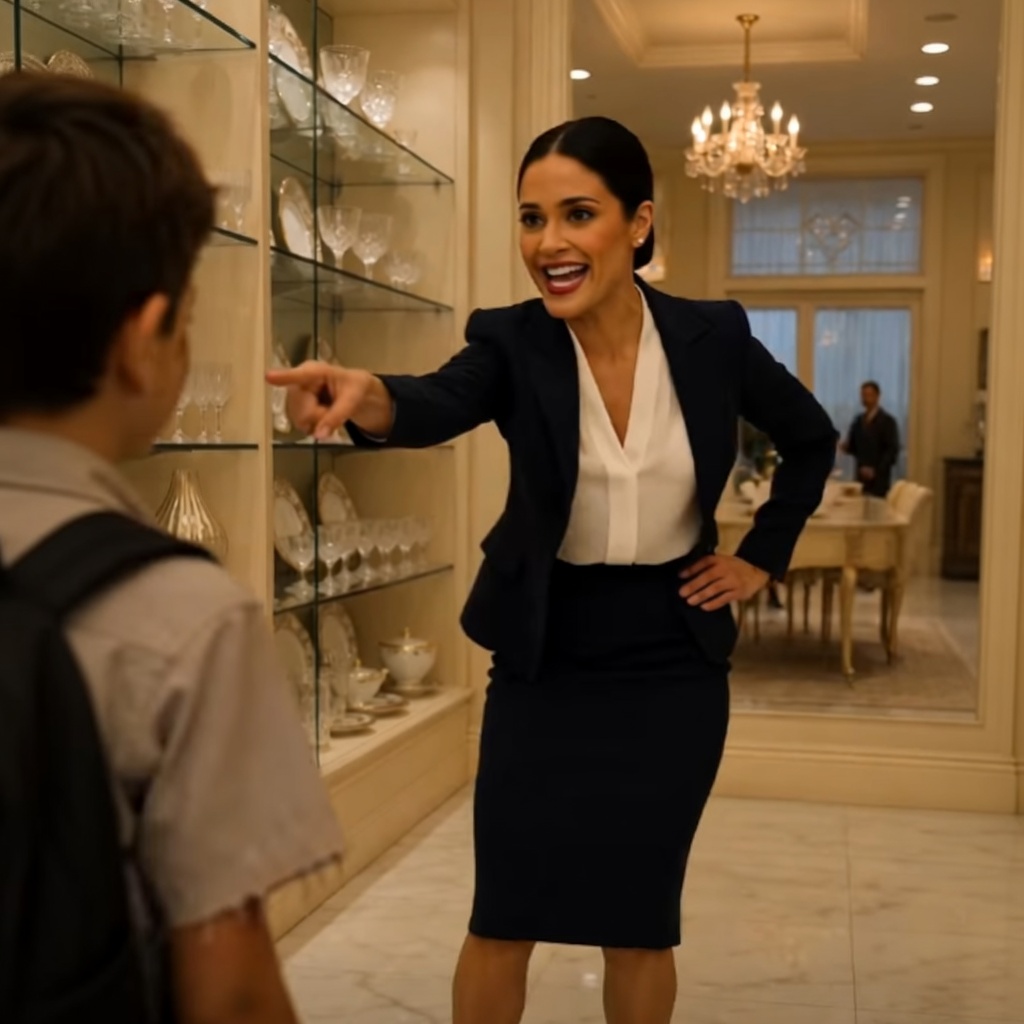
Her heels struck the marble floor fast and hard.
Her name was Margaret Vale, though most staff called her Mrs. Vale. She was tall, elegant, and severe, with hair pulled into a perfect knot and a black blazer cut sharply at the shoulders. She had managed Harrington Crystal House for twelve years, and everyone in the showroom knew she could smile at customers while destroying an employee with a glance.
Now she was not smiling.
“What have you done?” she demanded.
Lucas flinched.
“I’m sorry,” he whispered.
Margaret looked at the shattered plates, then at the boy’s torn clothes, then at the shoppers who had already lifted their phones. Her face tightened with embarrassment before it hardened into anger.
“Do you have any idea how much those cost?”
Lucas shook his head quickly. “I didn’t mean to. I was just—”
“You were just what?” Margaret snapped. “Wandering around where you don’t belong?”
The words hit him harder than shouting.
Lucas had heard versions of that sentence before. In grocery stores, when guards followed him down aisles. At school, when classmates laughed at his secondhand shoes. At apartment offices, when landlords looked at his mother’s tired face and said the rent had gone up again. He knew what it meant to be seen as a problem before he even spoke.
“I’m sorry,” he said again, tears gathering in his eyes. “I can help clean it.”
A few shoppers laughed under their breath.
Margaret’s face twisted. “Clean it? You think this is about cleaning? This display was imported. Each plate was hand-cut crystal. Do you understand that? Of course you don’t.”
Lucas swallowed hard. “I can pay…”
This time the laughter was louder.
The manager stepped closer. “You can pay?”
Lucas nodded desperately, though his whole body shook. “Not today. But I can. I can bring money every week. I can work. I can sweep. I can carry boxes. I can—”
“You are a child,” Margaret said coldly. “And you are trespassing.”
“I wasn’t stealing.”
“I didn’t ask.”
His eyes widened. “But I wasn’t.”
Margaret glanced at the phones recording her, then lifted her chin. Her voice became louder, more official, meant for the audience as much as for the boy. “You walked into a private showroom, damaged thousands of dollars’ worth of merchandise, and now you expect us to believe you simply made a mistake?”
Lucas’s lips trembled. “It was a mistake.”
“Children like you are always full of mistakes.”
The room quieted.
Even some of the shoppers seemed uncomfortable now, but nobody stepped forward. Phones stayed raised. The broken crystal glittered between the boy and the woman like a line drawn on the floor.
Lucas hugged his backpack to his chest.
“I only came to bring medicine for my mother,” he whispered.
Margaret stared at him. “What?”
“My mother,” he said, his voice breaking. “She’s sick. The pharmacy gave me the medicine, but the rain was bad, so I came in for a minute. I didn’t touch the plates on purpose. My backpack brushed the table. I’m sorry.”
Margaret held out her hand. “Open the bag.”
Lucas hesitated.
The backpack held everything that mattered that day: the medicine bottle wrapped in a plastic bag, the folded prescription, and the coins left over after the pharmacist took almost all he had. His mother had told him to keep the prescription safe, because they might need it again. She had also told him not to speak to strangers about her condition, because pride was one of the last things she still owned.
“Open it,” Margaret repeated.
Slowly, Lucas unzipped the backpack.
Everyone leaned in.
Inside was no stolen silverware. No hidden crystal. No wallet taken from a customer. Just a small bottle of pills inside a pharmacy bag, a folded prescription, and a handful of coins wrapped in a napkin.
A murmur passed through the showroom.
Lucas reached into the bag and pulled out the coins first, as if offering proof of his honesty. “This is all I have left,” he said. “But I can bring more. Please don’t call the police. My mom needs me home.”
Margaret looked down at the coins. Something in her face flickered — not pity, exactly, but irritation at being denied the villain she had expected. She snatched the prescription from the bag instead.
“Let me see that.”
Lucas reached for it. “Please, don’t tear it. My mother needs—”
Margaret unfolded the paper sharply.
Then she froze.
The showroom manager, who moments earlier had been full of anger and authority, went completely still.
Her eyes were fixed on one name printed near the top of the prescription.
Anna.
Anna Vale.
The paper trembled in her hand.
Lucas noticed.
So did the old man standing across the aisle.
He had been browsing near the antique glass cabinet, leaning on a dark wooden cane. He was very old, with silver hair combed neatly back and a wool coat that looked expensive but worn by time. At first, he had watched the commotion with the confused sadness of someone who had seen too much public cruelty in his life. But when Margaret unfolded the prescription and the name caught the light, the old man leaned forward.
His face changed.
His cane slipped from his hand.
It hit the marble floor with a hollow crack.
“Anna’s son?” he gasped.
The room went silent.
Margaret turned slowly toward him. Her lips parted, but no words came.
The old man stared at Lucas as if the child had stepped out of a dream that had haunted him for years.
“What did you say?” Lucas whispered.
The old man took one unsteady step toward him, then another. A younger sales assistant rushed to pick up his cane, but he barely noticed. His eyes stayed on the boy’s face. On the curve of his eyebrows. On the shape of his mouth. On the frightened dark eyes that looked too much like someone he had spent years mourning.
“What is your mother’s name?” the old man asked.
Lucas gripped his backpack tighter. “Anna.”
The old man’s breath shook. “Anna what?”
Lucas looked uncertainly at Margaret, then back at the old man. “Anna Vale.”
A sound went through the crowd.
Margaret whispered, “No.”
The old man raised a trembling hand to his mouth.
For several seconds, he could not speak.
Then he reached into the inside pocket of his coat and pulled out an old leather wallet. His hands shook so badly it took him three tries to open it. From behind a faded identification card, he pulled out a photograph.
The photo was old, its corners softened and bent. In it, a young woman stood in front of the same store, though the sign above the entrance was older, painted in gold letters instead of modern brass. She had bright eyes, dark hair falling over her shoulders, and a smile full of life. Beside her stood the same old man, much younger then, proud and smiling. His arm rested around her shoulders.
He turned the photograph toward Lucas.
“Is this your mother?”
Lucas stared at it.
For a moment, he forgot the broken plates. Forgot the phones. Forgot the manager. His eyes widened slowly.
“That’s Mom,” he said. “But… younger.”
The old man closed his eyes.
A tear slipped down his cheek.
“She’s my daughter,” he said, voice breaking.
The words seemed to hollow out the room.
Lucas looked at him as though he had been struck.
Margaret’s face went pale. “Mr. Vale…”
The old man turned on her. “Don’t.”
The single word carried years of buried pain.
Lucas stared at him. “You’re… you’re my grandfather?”
The old man looked at the boy, and the pain in his face softened into something unbearably tender. “I think I am.”
Lucas’s lips trembled. “Mom said you were gone.”
The old man swallowed. “I was told your mother was gone.”
Margaret took a step back.
Nobody missed it.
The old man turned slowly toward her.
“You told me Anna died,” he said.
Margaret’s voice came out thin. “She did.”
Lucas looked up through tears.
“No, she didn’t.”
Margaret’s head snapped toward him.
The boy’s voice shook, but he did not look away. “She said you told everyone that.”
A heavy silence fell.
The old man looked at Lucas, then at Margaret, then at the prescription in her hand.
“What does that mean?” he asked.
Lucas hugged the backpack to his chest as if it were armor. “Mom said she had to leave because nobody would believe her. She said Aunt Margaret told everyone she ran away first, then later said she died. She said she tried to come back once, but no one let her in.”
The old man’s face drained of color.
Margaret whispered, “He’s lying.”
Lucas shook his head hard. “I’m not.”
Margaret’s eyes flashed. “You’re repeating whatever your mother told you.”
“She doesn’t lie.”
“You don’t know what happened.”
Lucas’s small face tightened with sudden anger. “I know she can’t walk right when it rains. I know her back hurts so bad sometimes she cries into a pillow so I won’t hear. I know she keeps medicine in a box and cuts pills in half when we don’t have enough money. I know she has nightmares about stairs.”
The old man gripped the edge of a display table.
“Stairs?” he whispered.
Margaret looked away.
Lucas reached for the prescription in Margaret’s hand, but she did not give it back.
“My mother said she got sick after you pushed her down the stairs.”
The words did not explode.
They dropped.
Heavy. Final. Unavoidable.
The showroom went dead silent.
Even the phones seemed to lower.
Margaret’s face hardened instantly. “That is a filthy lie.”
But the old man was no longer looking at her like a confused grieving father.
He was looking at her like a man whose heart had just recognized the truth before his mind could bear it.
“Margaret,” he said slowly. “What did you do?”
She straightened. “I did nothing. Anna was unstable. You remember how she was.”
“No,” he said. “I remember how you said she was.”
Margaret’s mouth opened, then closed.
The old man turned toward Lucas. “Where is she?”
Lucas hesitated.
All his life, his mother had warned him about this family. Not because she hated them, but because fear lived in her bones. She had told him there were people who could smile while taking everything from you. She had told him if anyone from the Vale family found them, he must come home first, tell her first, and never trust promises made in expensive rooms.
But now the old man’s eyes were wet. His hands shook. He looked not like a dangerous man, but like someone who had been grieving a daughter who still breathed somewhere in the city.
“She’s at home,” Lucas said quietly. “She couldn’t come. Her pain was bad today.”
The old man bent slightly, as if the words had struck him in the chest.
“Take me to her.”
Margaret stepped forward quickly. “Father, absolutely not. This is absurd. We don’t know who this child is. He could be part of some scam.”
The old man turned on her. “Do not call me Father right now.”
Margaret went still.
He pointed at the prescription. “Give that back to him.”
She hesitated.
His voice sharpened. “Now.”
For the first time since the plates shattered, Margaret obeyed.
Lucas took the prescription and held it against his chest.
The old man looked at the broken plates around the boy’s feet, then at the frightened way Lucas stood in the middle of the glittering mess, as if expecting punishment for existing.
“Are you hurt?” he asked.
Lucas shook his head.
“Did any glass cut you?”
“I don’t think so.”
The old man looked toward the nearest employee. “Clear a path. Carefully. Bring him a chair.”
Margaret snapped, “Those plates are worth—”
“Enough,” the old man said.
The word struck the room like a slammed door.
He turned to the employees. “No one touches this child. No one calls security. No one calls the police. And no one speaks to him as if he is less than anyone else in this room.”
A young assistant hurried forward with a chair. Lucas sat only after the old man nodded gently. He kept his backpack on his lap and his feet tucked under him, careful not to touch anything.
The old man knelt in front of him with difficulty. His knees cracked, and a sales assistant moved to help, but he waved her away.
“What is your name?” he asked.
“Lucas.”
“Lucas,” the old man repeated, as if learning a sacred word. “How old are you?”
“Eight.”
The old man closed his eyes briefly.
Eight years.
Eight years of a grandson growing up somewhere without him. Eight years of birthdays missed, first steps missed, fevers missed, school mornings missed. And before that, years of his daughter suffering somewhere beyond his reach while he believed she was dead.
“What did your mother tell you about me?” he asked.
Lucas looked down. “Not much.”
“Why?”
“Because it made her cry.”
The old man’s face crumpled.
Margaret turned away, but not before several shoppers saw fear flash across her face.
The old man slowly stood. “We are going to your mother.”
Margaret moved in front of him. “You are not thinking clearly.”
He looked at her, and for the first time in years, she seemed small before him. “No, Margaret. I am thinking clearly for the first time in a very long time.”
Her voice dropped. “You don’t understand what she did.”
“What did she do?”
Margaret’s eyes darted toward the watching crowd. “This is not the place.”
“Then perhaps you should have considered that before you accused a hungry child of trespassing in front of half the city.”
Her face tightened.
The old man turned to the sales assistant. “Call my driver.”
Lucas immediately stood. “I can walk.”
The old man looked at him. “In this rain?”
“I walked here.”
Something in the old man’s expression broke again.
“Not anymore,” he said softly.
Lucas did not understand what that meant. Not yet.
Outside, rain had turned the street silver. The old man’s black car was waiting at the curb, the kind with tinted windows and a driver who stepped out with an umbrella before being asked. Lucas had never sat in a car like that. His shoes left wet marks on the floor mat, and he tried to tuck them beneath the seat so he would not dirty anything.
The old man noticed.
“You don’t have to make yourself smaller,” he said.
Lucas looked up.
The old man’s voice trembled. “Not with me.”
Lucas said nothing. But his grip on the backpack loosened a little.
The drive took twenty minutes. The showroom disappeared behind them, along with Margaret’s pale face and the broken crystal shining on the floor. They passed clean avenues, then older streets, then buildings with laundry in the windows and cracked steps out front. The old man watched through the glass as the city changed. With every block, the guilt inside him grew heavier.
This was where Anna had been living?
His Anna?
The girl who once ran barefoot through the showroom after closing, laughing while he pretended to chase her with a feather duster. The teenager who knew every piece of crystal by name and could charm customers twice her age. The daughter who had wanted to turn the family store into something warmer, more welcoming, less obsessed with rich clients and more connected to ordinary people. The daughter he had argued with because he thought she was naive. The daughter who disappeared after a fight Margaret had explained too smoothly.
He had believed Margaret because grief made him weak.
Because she was the one who stayed.
Because she handled the funeral arrangements, the legal papers, the staff, the business. Because she cried in all the right places and said Anna had been troubled, Anna had been angry, Anna had left with a man nobody approved of, Anna had fallen into bad company, Anna had died somewhere far away before anyone could help.
And he, broken by loss, had accepted the story because the alternative was too terrible.
What if he had failed his own child?
The car stopped outside a narrow apartment building with peeling paint around the doorway. Lucas unbuckled quickly.
“Wait,” the old man said. “Let me come with you.”
Lucas hesitated. “She might be scared.”
“I know.”
“You can’t shout.”
“I won’t.”
“You can’t let that woman come here.”
The old man’s jaw tightened. “Margaret will not come near your mother.”
Lucas studied him for a long moment, then nodded.
They climbed the stairs slowly because the elevator was broken. On the third floor, Lucas stopped at a chipped green door and knocked in a pattern: two quick taps, one slow, then two quick again.
A woman’s voice came from inside, weak but alert.
“Lucas?”
“It’s me, Mom.”
Locks turned. The door opened.
Anna stood there.
For a moment, time stopped.
She was older than the girl in the photograph. Of course she was. Her hair was tied back loosely, her face pale with illness, her body thinner than it should have been. One hand gripped the doorframe for support. Pain had carved lines near her mouth. But her eyes were the same.
The old man made a sound that was almost a sob.
Anna saw him.
Her face went white.
“No,” she whispered.
Lucas rushed forward. “Mom, I’m sorry. I broke something. I didn’t mean to. He was there, and he said—”
Anna pulled him behind her with surprising strength, her frightened eyes locked on the old man.
“Stay back.”
The old man lifted both hands. “Anna.”
Her mouth trembled. “Don’t.”
“I thought you were dead.”
She laughed once, broken and bitter. “That’s what she wanted.”
The words pierced him.
“I didn’t know.”
“You didn’t want to know.”
He flinched.
Lucas looked between them, terrified.
Anna held the door as if she might slam it shut, but her body shook too badly. “Why are you here?”
The old man’s eyes filled. “Because your son walked into the showroom with your prescription. Because Margaret read your name. Because for the first time in years, the lie cracked open.”
Anna closed her eyes at Margaret’s name.
“She was there?”
“Yes.”
Anna’s grip tightened on the doorframe. “Did she touch him?”
“No.”
“She yelled at him?”
The old man hesitated.
Anna opened her eyes, and pain sharpened into fury. “Did she yell at my child?”
“He broke some plates by accident.”
Lucas began crying again. “I’m sorry, Mom. I was trying to keep the medicine dry. The bag hit the table. I didn’t mean—”
Anna turned immediately and cupped his face. “Lucas, breathe. Are you hurt?”
“No.”
“Did they call the police?”
“No.”
“Did anyone hit you?”
“No.”
Her shoulders loosened only slightly.
The old man watched the exchange with unbearable shame. His daughter’s first questions were not about money, property, or reputation. They were survival questions. Questions learned by a woman who had been cornered too many times.
Anna finally looked back at him. “You should leave.”
“Please,” he said. “Let me speak.”
“There’s nothing to say.”
“There is everything to say.”
She shook her head. “You believed her.”
“I did.”
“You let her bury me while I was still breathing.”
His face crumpled. “Yes.”
The simple admission stopped her.
He did not defend himself. Did not say he had been grieving. Did not say Margaret fooled everyone. Did not say Anna should have tried harder to contact him. He simply stood in the hallway of her poor apartment building and accepted the weight of what he had done.
“I failed you,” he said.
Anna’s eyes filled despite herself. “Do you know what she did?”
His voice broke. “Tell me.”
Anna looked away.
For years, she had imagined this moment. Sometimes she screamed at him in her mind. Sometimes she begged him to believe her. Sometimes she told him everything. Sometimes she shut the door. But now that he was here, old and shaking and devastated, the truth felt too large to fit through the doorway.
Lucas held her hand.
That gave her strength.
Anna stepped back. “Come in.”
The apartment was small. Clean, but worn down by necessity. A blanket covered a cracked window. Medicine bottles sat on a small table. A sewing machine stood near the wall, surrounded by folded fabric. On the stove, a pot of soup simmered quietly. There was only one bedroom. Lucas’s schoolbooks were stacked neatly beside a mattress in the corner.
The old man looked around and had to grip his cane.
Anna saw his face. “Don’t pity me.”
“I’m not.”
“Yes, you are.”
He looked at her. “I am grieving what I should have prevented.”
She turned away, but the anger in her face softened for half a second.
They sat at the small table. Lucas stayed close to his mother. The old man placed the old photograph between them.
Anna stared at it.
Her fingers hovered above the image but did not touch.
“I used to love that store,” she said quietly.
“I know.”
“No. You don’t.” Her voice hardened. “You loved what it represented. The name. The clients. The tradition. I loved the people who worked there. I loved Mrs. Bell who polished the shelves and hid candy in the register. I loved the delivery boys who sang off-key. I loved customers who saved for months to buy one wedding plate and cried when we wrapped it for them.”
The old man listened.
“Margaret hated that,” Anna said. “She said I made the business look cheap. She said I smiled too much at people who couldn’t afford anything. She said I was ruining the family image.”
He closed his eyes.
Anna continued, “After Mom died, Margaret changed. Or maybe she stopped pretending. She wanted the store. She wanted control. You were tired. You were grieving. You let her handle everything.”
“I know.”
“She told you I was reckless. Emotional. Unstable. Every disagreement became proof. Every time I defended myself, she said I was hysterical.”
The old man whispered, “I remember.”
“One night I found papers in her office. Transfer documents. She was trying to move parts of the company before you even knew. I confronted her at the top of the back stairs.”
Lucas looked up. He knew this part, but he had never heard his mother tell it in so much detail.
Anna’s voice lowered. “She smiled at me. That’s what I remember most. She didn’t even look angry. She said, ‘No one will believe you over me.’ I tried to go past her. She grabbed my arm. I pulled away. Then she pushed.”
The old man covered his mouth.
“I fell down the stairs,” Anna said. “I remember the sound more than the pain. My back hitting wood. My head striking the wall. Then nothing. When I woke up, I was in a clinic outside the city. Not the hospital we used. Some private place. Margaret was there. She told me you had signed papers to have me committed if I came back causing trouble. She said I had attacked her. She said you believed I was dangerous.”
“I never signed anything,” he said hoarsely.
Anna’s eyes burned. “I didn’t know that.”
He bowed his head.
“She gave me cash,” Anna said. “Told me to disappear. Said if I came near you, she would make sure I lost everything. I was hurt. I couldn’t walk properly. I was scared. And then I found out I was pregnant.”
The old man looked at Lucas.
Lucas lowered his eyes.
Anna placed a protective hand on his shoulder. “His father left before he was born. He didn’t want a sick woman and a baby. So I stayed hidden. I sewed clothes. Took small jobs. Paid cash when I could. I tried once to go back to the store after Lucas was born.”
The old man looked up sharply.
Anna nodded. “Margaret met me at the back entrance. She had security remove me. She said you had mourned enough and I had no right to destroy you again. She told me if I loved you, I should stay dead.”
The old man began to cry silently.
Anna’s anger trembled, but did not disappear. “So I did.”
For a long time, nobody spoke.
Rain tapped against the covered window. Somewhere downstairs, a dog barked. Lucas leaned into his mother’s side, exhausted from fear.
The old man finally said, “I don’t deserve forgiveness.”
Anna looked at him.
“I won’t ask for it today,” he said. “Maybe not ever. But I am asking for the chance to tell the truth now. To protect you now. To know my grandson now, if you allow it.”
Anna’s face tightened.
Trust did not return just because someone cried. Blood did not erase abandonment. A father could be fooled, yes, but a daughter still lived with the consequences. There were years in her body. Years in her medicine. Years in Lucas’s too-small shoes.
“What happens when Margaret denies it?” Anna asked.
The old man’s face changed.
“She will.”
“I know.”
“She has money. Lawyers. People who owe her favors.”
The old man sat straighter. “So do I.”
Anna laughed bitterly. “That didn’t help me then.”
“No,” he said. “Because I used my power to sleep inside a lie. This time I will use it to tear the lie apart.”
Lucas looked at him. “Will Mom go to jail?”
Anna pulled him closer. “No, baby.”
The old man’s voice softened. “No. Your mother did nothing wrong.”
Lucas’s lips trembled. “Then why did everybody say she died?”
“Because adults can be cowards,” the old man said, the words costing him. “And because one person lied very well.”
That evening, the old man called his private doctor first. Then his lawyer. Then a retired investigator who had worked for the family years ago. He did not leave Anna’s apartment until a doctor arrived and checked her properly. He did not ask her to move that night. He did not demand she come home. He only made sure she had medicine, food, and a lock that worked.
Before he left, Lucas walked him to the door.
“Are you really my grandpa?” he asked.
The old man knelt slowly, despite the pain in his knees.
“Yes,” he said. “If you’ll have me.”
Lucas studied him with the seriousness only children who have known hardship carry. “You made my mom sad.”
The old man’s eyes filled. “I know.”
“You have to fix it.”
“I will try for the rest of my life.”
Lucas thought about that, then nodded once. “Okay.”
The old man almost broke again.
By morning, everything began to change.
The showroom footage was pulled. Not just from the front floor, where Lucas broke the plates, but from the office hallway, where Margaret had held the prescription and gone pale. The old man ordered archived security records from years earlier. Most had been deleted, but not all. An old server backup revealed a file from the night Anna disappeared. It showed Margaret arguing with Anna near the back stairwell. The angle did not capture the full push, but it showed enough: Margaret grabbing Anna’s arm, Anna pulling away, Margaret stepping forward sharply, Anna vanishing backward down the stairs.
The investigator found the private clinic. A nurse who had worked there years ago remembered Anna. She remembered Margaret paying in cash. She remembered being told not to log the patient under the family name. She had kept a copy of a discharge note because something felt wrong. The lawyer found the transfer documents Anna had discovered, unsigned but prepared. The old man found, in Margaret’s old files, letters Anna had sent and never received.
Letters addressed to him.
Father, please let me explain.
Father, I am alive.
Father, I had a son.
Father, if you hate me, at least tell me yourself.
The old man read them alone in his study and wept until his chest hurt.
Margaret denied everything at first. She said Anna had always been unstable. She said Lucas was being used. She said the footage was misunderstood. She said the clinic records were incomplete. She said grief had made their father vulnerable.
But lies that survive in darkness often weaken quickly under light.
Staff members began to speak. Mrs. Bell, now retired, admitted Margaret had ordered everyone not to discuss Anna. A former security guard confessed he had removed Anna from the back entrance years earlier under Margaret’s instruction. An accountant revealed suspicious transfers that gave Margaret temporary control over family assets after Anna vanished.
The story spread.
Not because the family wanted publicity, but because people in the showroom had recorded Lucas. The video of the little boy crying over broken plates had gone online before anyone understood the larger truth. Then came the second video: the old man dropping his cane, asking, “Anna’s son?” The internet did what it always does — it tore the moment apart, searched names, found records, demanded answers.
For once, the attention helped.
Margaret’s carefully polished reputation began to crack.
Three days after the showroom incident, Anna returned to Harrington Crystal House.
She did not want to.
Her body hurt. Her hands shook. Standing before that building felt like standing before a ghost. But Lucas held one hand, and her father stood on the other side, not touching her, not forcing comfort, simply present.
The staff had gathered quietly inside. Some cried when they saw her. Mrs. Bell, older and bent now, pushed through the group and took Anna’s face in both hands.
“My girl,” she whispered. “My poor girl.”
Anna broke then, just a little.
Not because everything was healed.
Because someone remembered her without needing proof.
Margaret stood near the central staircase, pale but composed, her lawyer beside her. Even cornered, she tried to look superior.
Anna stopped at the foot of the stairs.
For years, she had dreamed of them. In nightmares, they stretched forever. In memory, they were shorter, ordinary, almost harmless. That made them worse. So much suffering had begun in such an ordinary place.
Her father looked at her. “You don’t have to do this.”
Anna’s fingers tightened around Lucas’s hand.
“Yes,” she said. “I do.”
Margaret lifted her chin. “This performance is unnecessary.”
Anna looked at her sister.
For a moment, she saw the girl Margaret had once been: older, ambitious, always praised for being disciplined, always resentful when Anna was loved for being warm. She wondered when envy had become hatred. When competition had become violence. When a sister had decided another sister’s life was worth destroying for a store.
“You told my son I was dead,” Anna said.
Margaret’s eyes flicked toward the watching staff.
Anna stepped closer. “You told our father I died. You told me he hated me. You took my letters. You stole years from us.”
Margaret’s jaw tightened. “You always were dramatic.”
Lucas moved behind his mother slightly.
Anna saw it.
And all her fear burned away.
“You can call me whatever you want,” she said. “But you don’t get to scare my child.”
For the first time, Margaret had no answer.
The lawyer spoke instead. “My client denies—”
The old man raised a hand. “Your client can deny it in court.”
Margaret turned toward him. “You would really do this to your own daughter?”
He looked at Anna, then back at Margaret. “I already did it to one daughter by believing the wrong one.”
Margaret’s expression cracked.
Police arrived shortly after. Not with flashing drama, but with quiet procedure. Questions. Statements. Documents. Evidence. Margaret was escorted from the showroom through the same front doors where she had once ruled with cold authority. Phones recorded again, but this time Lucas did not look afraid.
Anna watched silently.
She did not smile.
Justice did not feel like victory yet. It felt like opening an infected wound so it could finally be cleaned.
In the weeks that followed, her father did what he should have done years earlier. He listened. He paid for medical specialists, but did not act as if money could buy forgiveness. He moved Anna and Lucas into a safe home, but put the deed in Anna’s name. He restored her place in the family business, but told the board plainly that the decision belonged to her, not him. He set up a trust for Lucas, then sat with the boy and explained every page in simple words because Lucas had learned early not to trust gifts he did not understand.
Anna did not forgive him quickly.
Some mornings she could sit with him and drink tea. Other days she could barely look at him. Sometimes old anger rose so sharply she had to leave the room. Her father accepted it. He never said, “How long will you punish me?” He never said, “I was fooled too.” He never asked her to make his guilt easier to carry.
He simply showed up.
At doctor appointments. At Lucas’s school meetings. At the courthouse. At dinner, when invited. At the edge of Anna’s new garden, holding a packet of seeds because he remembered she had once loved white lilies.
One afternoon, months after the showroom incident, Anna brought Lucas back to Harrington Crystal House after closing time.
The showroom was empty. The displays had been rearranged. The row of crystal plates Lucas had broken had been replaced, though her father refused to let anyone charge the boy a cent. In fact, he had placed one small repaired fragment in a velvet box in his office.
When Anna asked why, he said, “Because that was the sound that brought you home.”
Lucas walked carefully beside his mother, hands behind his back, afraid to touch anything.
Anna noticed and smiled sadly. “You can breathe, sweetheart.”
“I don’t want to break anything.”
Her father, standing nearby, said gently, “Some things need to break.”
Lucas frowned. “Plates?”
The old man looked at Anna. “Lies.”
Anna looked away, but a small smile touched her mouth.
They stopped in front of the old staircase.
For a while, Anna said nothing.
Then Lucas asked, “Are you scared?”
She thought about lying, but she had promised herself never to teach him that courage meant pretending.
“Yes,” she said. “A little.”
He took her hand. “I’m here.”
Anna’s eyes filled.
Her father stood back, giving them space, but Anna turned and held out her other hand to him.
He stared at it.
Then, slowly, he took it.
Together, the three of them climbed the stairs.
One step.
Then another.
Anna’s body remembered pain. Her back tightened. Her breath caught halfway up. But Lucas held her right hand, and her father held her left, and for the first time in years, the staircase did not belong only to the night she fell.
At the top, Anna stopped.
She looked down over the showroom: the lights, the glass, the polished counters, the place where she had grown up, the place that had rejected her, the place her son had accidentally entered carrying medicine and truth.
“I used to think this store took everything from me,” she said quietly.
Her father’s hand trembled.
Anna continued, “But it didn’t. Margaret did. Fear did. Silence did.”
Lucas leaned against her side.
She looked at him and touched his hair. “And then you walked in here and broke the right thing.”
He looked confused. “The plates?”
Anna smiled through tears. “The lie.”
A year later, Harrington Crystal House changed its name.
Not completely. The old family name remained above the door, but beneath it, a new line was added in smaller gold letters:
Anna Vale Collection.
The first collection she designed was not for wealthy collectors. It was a simple line of glass dishes, beautiful but affordable, each piece engraved with a tiny mark on the bottom: a staircase crossed by a line of light. When the press asked what it meant, Anna said only, “It means no one should be pushed into darkness and left there.”
Lucas grew taller. His uniform was no longer torn. He still carried a backpack, but now it held books, pencils, snacks, and sometimes little sketches of plates he wanted his mother to design. He visited the showroom after school and helped Mrs. Bell arrange flowers near the front desk. Employees greeted him by name. No one followed him as if he did not belong.
The broken plates became family legend, but never as a joke at Lucas’s expense. His grandfather would sometimes say, “The most expensive mistake that ever saved us.” Lucas would roll his eyes, but secretly he liked it.
Margaret’s trial took time. There were delays, denials, legal maneuvers, and days when Anna felt dragged back into the past. But she testified. Her voice shook at first, then steadied. She told the court about the stairs, the clinic, the threats, the stolen letters, the years of pain. Lucas sat outside with Mrs. Bell during the hardest parts. Her father sat behind her every day, not as a man trying to control the story, but as a witness to the truth he had once failed to see.
When the verdict came, Anna did not cry.
She simply exhaled.
A chapter closed.
Not the pain. Not the scars. Not the years lost.
But the lie.
That evening, she and Lucas went home. Her father joined them for dinner. Nothing grand. Soup, bread, and roasted chicken. Lucas talked too much about school. Her father listened to every word as if each small detail were a gift.
After dinner, Anna stood by the window, looking out at the city lights.
Her father came beside her, careful to leave space.
“I missed your whole life,” he said.
Anna did not answer immediately.
Then she said, “Not all of it.”
He looked at her.
She nodded toward Lucas, who was sitting at the table drawing a crooked crystal plate with superhero wings.
“There’s still some left.”
The old man covered his mouth, overcome.
Anna did not say she forgave him.
Not yet.
But she let him stay for tea.
And for that night, it was enough.
Years from then, people would tell the story in different ways. Some would begin with the crystal plates. Some with the angry manager. Some with the old man dropping his cane. Some with the little boy holding out a prescription and exposing a secret that had poisoned a family for years.
But Anna always remembered it differently.
She remembered her son coming home that day, soaked from rain, eyes red from crying, clutching medicine in one hand and an old man’s business card in the other. She remembered thinking danger had found them. She remembered opening the door and seeing her father standing in the hallway, older, broken, alive with regret.
She remembered wanting to slam the door.
She remembered letting him in.
That, to her, was where the story truly began again.
Not with wealth.
Not with revenge.
Not with a perfect apology.
But with a child who loved his mother enough to walk through rain for her medicine. A mistake that shattered crystal but exposed a lie. An old man who finally listened. A woman who survived being erased. And a family that had to break before it could become true.
The showroom still sold crystal dishes under golden lights. Wealthy shoppers still came and went, speaking softly, touching polished glass with careful fingers. But every employee knew the rule Anna placed in the handbook herself:
No child is to be treated as invisible.
No poor customer is to be treated as suspicious.
No broken object is worth more than a human being.
And near the central display, in a small glass case, sat one repaired shard from the plates Lucas had broken. Beside it was a small engraved plaque.
Some things break to reveal the truth.
Whenever Lucas passed it, he smiled.
Because once, he had stood in that showroom terrified that one mistake would destroy his life.
Instead, it gave his mother hers back.
![[FULL STORY] My Girlfriend Chose Lunch With Her Male Best Friend Over Picking Me Up From the ER](https://social-media.rabedo.com/thumbnails/1777372317_60fa97b2-efb8-456b-a430-4b85f6d9f67b.png)

![[FULL STORY] My Fiancée's Dad Declared: "Agree to This Agreement for Her Education Debt, or the Marriage Is](https://social-media.rabedo.com/thumbnails/1776919022_8.png)

![[FULL STORY] Parents Try to Exclude Me From Dinner Party — Then $2.3M Grant Exposes the Truth in Front of Everyone](https://social-media.rabedo.com/thumbnails/1776418309_669594745_1909932203293279_8984749016305399201_n.jpg)