
At first, nobody understood what they were hearing. A delivery man unloading boxes outside the corner store paused with one hand still gripping the truck door. Two teenagers sitting on the steps of the laundromat looked up from their phones. An old man pushing a cart full of cans stopped in the middle of the sidewalk and turned his head. Even the pigeons near the curb scattered as the first black tire eased into view.
Then the cars appeared.
Three Rolls-Royces.
One white. One black. Another white.
They moved slowly, almost silently, their polished bodies reflecting the gray afternoon sky and the tired buildings around them. They looked wrong on that street. Too clean. Too calm. Too rich. They did not belong beside rusted fire escapes, faded awnings, chipped storefront signs, overflowing trash bins, and the warm smell of rice, beans, onions, and slow-cooked chicken drifting through the cold air.
But they stopped there.
Right in front of Shiomara Reyes’s food cart.
Shiomara froze with the ladle still in her hand. Steam rose from the large pot in front of her and touched her face, warm and familiar. She had been stirring beans, just as she did every afternoon before the dinner rush. Her hands knew the rhythm without thought: stir, taste, adjust the salt, lower the flame, smile at the next customer. That cart had been her whole world for nearly twenty years. A small metal box on wheels, dented in two places, patched more times than she could count, but alive with the smell of home.
Now three cars that cost more than every building on that block seemed to be waiting for her.
For a moment, Shiomara wondered if it was a mistake. Maybe a wedding party had taken a wrong turn. Maybe a music video was being filmed. Maybe some rich person’s driver had pulled over to check directions. Things like that sometimes happened near the city, though never quite like this.
Then the engines went silent.
The street seemed to go silent with them.
One by one, the doors opened. Three people stepped out. Two men and one woman. They were dressed with the quiet confidence of people who no longer needed to prove they belonged anywhere. One man wore a deep blue suit beneath a long dark coat. The other wore a brown cashmere coat and polished shoes that had never known broken pavement. The woman wore a cream-colored coat, her hair pulled back neatly, silver strands catching the afternoon light. They looked powerful, but not flashy. Rich, but not careless. Still, focused, almost reverent.
They did not look at the crowd. They did not look at the street. They looked only at Shiomara. And at the cart.
Something in Shiomara’s chest tightened.
She had served all kinds of people on that corner. Construction workers with dust on their boots. Nurses coming off double shifts. Mothers with tired eyes and hungry children. Students counting coins. Men who had nowhere to go. Women who smiled even when life had bruised them. She knew faces. She remembered regulars. She remembered who liked extra hot sauce, who could not eat pork, who always asked for more rice because they were saving half for later.
But these three faces… she did not know them.
Or maybe she did.
Maybe some part of her heart knew before her mind did.
The woman stepped forward first. She was graceful, but her steps were not steady. Her eyes were already wet. She pressed one hand against her chest as if something inside her had cracked open and she was trying to hold herself together.
Shiomara swallowed. “Good afternoon,” she said softly. “Can I help you?”
The woman looked at her for a long moment. Not like a customer. Not like a stranger. She looked at Shiomara as if she had spent years carrying her face through memory, afraid that if she forgot even one detail, she might lose her forever.
Then the woman whispered, “You fed us.”
Shiomara blinked.
The man in the blue suit stepped closer. His face was controlled, but his jaw trembled. “We were the kids under the bridge.”
The ladle slipped from Shiomara’s hand and struck the side of the pot with a dull metallic sound.
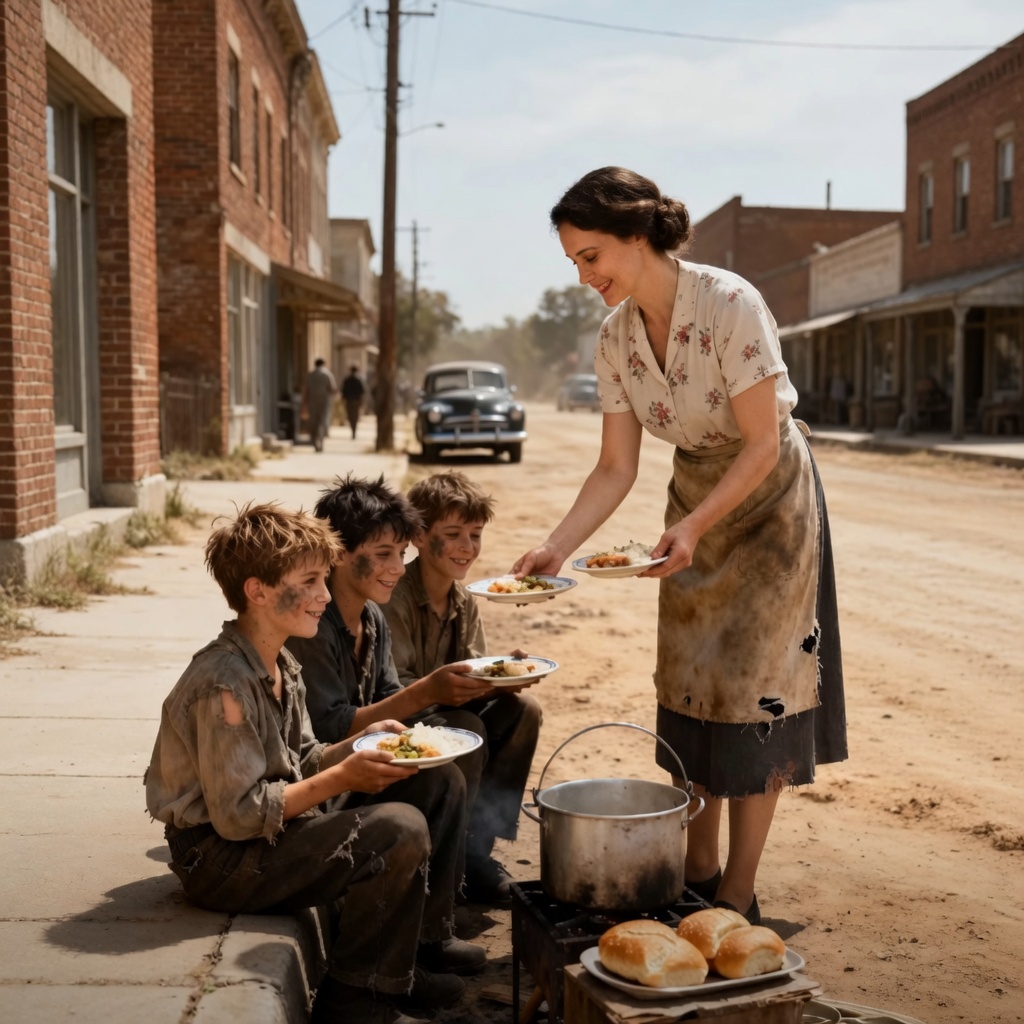
For one second, the present vanished. The street disappeared. The Rolls-Royces disappeared. The crowd disappeared. And all at once, she remembered rain. Cold rain. A winter so bitter it made people walk faster just to escape it. The overpass two blocks away, where the wind came through like knives. Three small children huddled together beneath it. Two boys and one girl. Thin faces. Big eyes. Wet clothes. Hands tucked under their arms to keep warm.
Triplets.
She had never known their names then.
They had never asked for food directly. That was what she remembered most. They were too proud, or too scared, or too used to being ignored. They would stand near the streetlight across from her cart, pretending not to stare. The smallest girl would keep her eyes on the ground. One boy would hold her hand. The other would watch everything, protective and silent, like a tiny old man trapped inside a child’s body.
The first night, Shiomara had seen them after closing. She had been packing leftover rice into containers, trying to decide whether to save it for the next day or take it home. Business had been bad that week. Rent was due. The permit fee was overdue. Her shoes had holes in the soles, and her own stomach was empty. But when she looked up and saw those three children watching from the corner, every calculation inside her stopped.
She remembered calling out, “You kids hungry?”
They had not answered.
So she filled three plates anyway. Rice. Beans. Chicken that night, because there had been enough. She carried the plates over herself and held them out. “Eat first,” she told them. “The world can wait.”
The girl had started crying before she took the plate.
The boy in the middle had whispered, “We don’t have money.”
And Shiomara had said, “Good. Then you won’t waste it.”
That was how it started.
For weeks, they came near closing time. Not every night, but often enough that Shiomara began saving food without admitting it to herself. She would scrape the best pieces of chicken aside. Add extra beans to the pot. Make more rice than she could afford. When business was good, she gave them full plates. When business was bad, she gave them soup and bread. Once, when she had almost nothing left, she gave them her own dinner and told them she had already eaten.
She had not known where they slept at first. Then one night she followed from a distance and saw them crawl beneath the bridge with a piece of cardboard and one torn blanket between them. She went home that night and cried in the shower so her neighbors would not hear.
After that, she brought them socks. Then gloves. Then an old coat that had belonged to her late husband. She never asked too many questions. Children living on the street often carried fear like a second skin. Push too hard, and they vanished. So she simply fed them. She smiled when they came. She scolded them for not wearing hats. She told them silly stories while they ate. She made them feel, for ten minutes each night, like the world had not completely abandoned them.
Then one evening, they stopped coming.
Shiomara searched the bridge. She asked the bodega owner. She asked the church pantry. She asked a woman who sometimes worked with shelters. Nobody knew. Someone said a city outreach team had taken three children away. Someone else said relatives had come. Someone said nothing good ever happened to kids under bridges, and Shiomara had nearly slapped him.
For months afterward, she left three plates aside at closing time.
Just in case.
But they never came back.
And life, cruel and busy, forced her to keep moving.
Now they were standing in front of her. Grown. Alive. Impossible.
The man in the brown coat smiled through tears. “You used to tell us, ‘Eat first. The world can wait.’”
Shiomara covered her mouth with one trembling hand.
“No,” she whispered. Not because she did not believe them. Because she did. Because suddenly their expensive coats and polished shoes meant nothing. She saw the children beneath them. Cold hands around paper plates. Thin shoulders under donated sweaters. Eyes lowered over hot food as if they were afraid someone might take it away.
The woman stepped closer, tears spilling freely now. “You saved us.”
Shiomara shook her head slowly. “No, baby. I only gave you food.”
The man in the blue suit inhaled sharply, as if the words hurt him. “No,” he said. “You gave us one place in the world where we weren’t invisible.”
The crowd around the cart had grown larger, but no one spoke. A few people held phones, but even they seemed too moved to lift them high. The old man with the can cart took off his cap. The delivery driver stood frozen beside his open truck. A young mother pulled her child closer, both of them watching in silence.
Shiomara leaned one hand against the cart to steady herself.
“What happened to you?” she asked. “Where did you go?”
The three looked at one another.
The man in blue answered first. “A shelter worker found us two nights after the last time we saw you. We were sick. All three of us. My sister had a fever. Mateo could barely stand.”
The man in brown nodded. “They separated us for three days at the hospital. We thought we’d never see each other again.”
The woman wiped her face. “But we fought. We screamed until they put us back together.”
A small laugh passed through them, full of old pain.
The man in blue continued, “Eventually, we were placed with a foster family upstate. Good people. Strict. Not rich. But good. They kept us together. That was everything.”
Shiomara’s eyes filled. “Thank God.”
The woman looked at her. “We wanted to come back. We asked about you. But we didn’t know your full name. We only remembered the cart. The corner. Your voice.”
The man in brown smiled faintly. “And the chicken.”
Shiomara let out a broken little laugh through her tears.
The man in blue reached into his coat and pulled out a thick sealed envelope. He placed it gently on the metal counter of the cart. Steam curled around it, rising from the food below, wrapping the envelope as if the past and present had met in the same breath.
“We looked for you for years,” he said. “When we got older, when we had money, when we had people who could help us search, we looked again. We found old permit records, business licenses, city vendor lists. Your cart had moved twice. Your name was spelled wrong in one file. But we found you.”
Shiomara stared at the envelope.
The woman’s voice trembled. “We promised each other that if we ever made it, we would come back.”
The man in brown nodded. “Not to say thank you and leave. Not with flowers. Not with a plaque. Something real.”
Shiomara did not move.
Her whole life had trained her to expect bills inside envelopes. Eviction notices. Permit warnings. Medical forms. Debt. Bad news folded neatly in paper.
But the way they looked at her now made her afraid for a different reason.
Afraid of kindness too large to understand.
With shaking fingers, she picked up the envelope and opened it.
Inside was a photograph. Old. Faded.
Her breath caught.
Three small children sat on the curb, holding paper plates in both hands. Their clothes were too thin. Their faces were too serious. But they were eating. Behind them stood Shiomara, younger, heavier in the cheeks, wearing a red apron and a tired smile she had forgotten she ever had.
She remembered that day.
One of the boys had asked if they could take a picture because he was afraid he might forget what “good” looked like. She had thought he meant the food. Now she understood.
The photo blurred in her hands.
Beneath it was another paper. Official. Heavy. Stamped.
Shiomara stared down at the words, but they did not make sense at first. Her eyes moved across the page once, then again.
Property deed.
Owner: Shiomara Reyes.
She stopped breathing.
“What is this?” she whispered.
The man in blue stepped closer. “It’s yours.”
She looked up at him, lost. “What do you mean, mine?”
The woman reached across the cart and gently covered Shiomara’s trembling hand with her own. “A building. Three blocks from here. First floor has a full commercial kitchen and dining space. Upstairs has two apartments. Everything is paid. Taxes covered for the first five years. Renovations already approved.”
The man in brown added, “No rent. No debt. No landlord waiting to raise the price. No more standing in the cold until midnight unless you want to. It belongs to you.”
Shiomara’s knees weakened.
For nearly twenty years, she had worked from that cart. She had opened before sunrise and closed after dark. She had stood through heat waves, snow, rain, and nights so cold her fingers went numb around the ladle. She had repaired the generator with tape. Replaced cracked wheels with used parts. Argued with inspectors. Paid fines she did not deserve. Fed people who could pay and people who could not. She had skipped doctor appointments because missing one lunch rush meant missing rent.
There had been days when she counted coins on her kitchen table and whispered, “Just one more week, Lord. Help me make it one more week.”
And now three children she once fed under a bridge had returned as adults and placed a future in her hands.
“I can’t take this,” she said, voice breaking.
“Yes, you can,” said the woman.
“No, baby, this is too much.”
The man in blue shook his head. “It isn’t enough.”
Shiomara looked at him.
His eyes were wet, but his voice became steady. “My name is Adrian Reyes. Not by blood. By choice. I took your last name as my middle name when I turned eighteen.”
Shiomara gasped softly.
The woman smiled through tears. “I’m Elena.”
The man in brown touched his chest. “Mateo.”
Adrian continued, “We own companies now. Real estate. Food distribution. Logistics. Restaurants. People call us successful. They write articles about us like we built ourselves from nothing.” His mouth tightened. “But that isn’t true. We didn’t build ourselves from nothing. We built from the first hot plate you gave us when the world had decided we were nobody.”
Elena squeezed Shiomara’s hand. “Every time we opened a new restaurant, I thought of your cart.”
Mateo smiled. “Every time I tasted rice and beans in some expensive place, I got angry because nobody made it like you.”
Shiomara laughed and cried at the same time.
Adrian placed one more item on the counter: a key ring. Three keys hung from it, bright and new.
“The restaurant already has a name,” he said. “But you can change it if you want.”
Shiomara looked down.
Attached to the keys was a small metal tag engraved with words.
Eat First.
The World Can Wait.
She broke.
Not quietly. Not gracefully. She covered her face with both hands and sobbed, her shoulders shaking, years of exhaustion pouring out in front of everyone. Elena came around the cart first and wrapped her arms around her. Then Mateo. Then Adrian. The three adults held the woman who had once held them together with paper plates and warm food.
“I didn’t do anything special,” Shiomara cried.
Elena pulled back and looked at her. “You did what everyone else refused to do.”
Mateo said, “You saw us.”
Adrian’s voice was rough. “You fed us when you were hungry too.”
That made Shiomara look up.
He nodded slowly. “We knew.”
She shook her head, embarrassed. “No, you were children.”
“We were homeless,” Adrian said. “Not blind.”
Mateo smiled sadly. “We saw you wrap up your own dinner and hand it to us.”
Elena wiped her cheeks. “We saw your shoes. We saw your hands shaking in the cold. We saw you pretend the extra food would go bad if we didn’t take it.”
Shiomara looked away.
All those years, she had thought no one noticed.
But they had.
The crowd began to clap. Softly at first. Then louder. People who had eaten from Shiomara’s cart for years stepped forward with tears in their eyes. Mr. Alvarez from the laundromat said, “She fed my boy when I lost my job.” A nurse named Carla said, “She gave me soup every night during the pandemic and wouldn’t take money.” The old man with the can cart lifted his cap and said, “She always gives me coffee when it’s cold.”
One by one, stories rose from the street like prayers.
Shiomara stood in the middle of them, overwhelmed. She had spent her life thinking she was barely surviving. But all around her were pieces of proof that her survival had fed other people’s hope.
Adrian turned to the crowd. “The new restaurant opens in six weeks,” he said. “Everyone here is invited.”
Mateo grinned. “First day, food is free.”
Shiomara snapped her head toward him. “Free? Are you crazy?”
For the first time that afternoon, everyone laughed.
Mateo lifted both hands. “Okay, okay. Sponsored by us.”
Shiomara wiped her eyes. “That’s better.”
But beneath the laughter, something deep had shifted. The block no longer felt like a tired street watching rich strangers pass through. It felt like a family witnessing justice arrive late, but still arrive.
Six weeks later, a sign went up three blocks away.
SHIOMARA’S KITCHEN.
Under it, in smaller letters:
Eat First. The World Can Wait.
The restaurant stood in a renovated brick building with wide windows, warm lights, and a blue front door. Inside, the walls were painted the color of cream and cinnamon. The tables were simple but sturdy. The kitchen gleamed with steel counters, new ovens, large pots, and enough space for Shiomara to move without bumping into everything. Upstairs, there was an apartment with sunlight in the bedroom and a window overlooking the street.
The first time Shiomara walked through it, she cried again.
Not because it was fancy.
Because it was safe.
For years, she had rented rooms where the heat failed, ceilings leaked, and landlords knocked like debt collectors. For years, she had worried that one illness, one inspection, one broken cart wheel could destroy everything. Now she had walls that belonged to her. A kitchen that could not be towed away. A future with a key.
On opening day, the line stretched down the block.
Adrian, Elena, and Mateo arrived early, not in Rolls-Royces this time, but walking together from the corner where the old cart had stood. Adrian wore an apron over his suit. Mateo carried boxes of plantains. Elena helped arrange flowers on the tables.
“You don’t have to work,” Shiomara told them.
Adrian tied the apron tighter. “You fed me for free. I can serve beans for one day.”
“One day?” Shiomara said. “With that attitude, you won’t last an hour.”
Mateo laughed. “She’s already yelling at us. Feels like home.”
And it did.
The restaurant filled with people from every part of Shiomara’s life. Old customers. New neighbors. Reporters. City workers. Children from the nearby shelter. Nurses. Construction workers. People in suits. People with nowhere else to go. At one table sat the foster parents who had raised the triplets. They were older now, holding hands, watching with quiet pride as the children they had protected honored the woman who had kept them alive before they arrived.
During the opening, Adrian stood near the front and tapped a spoon against a glass. The room quieted.
“I know today is supposed to be about a restaurant,” he said. “But for us, it’s about a woman.”
Shiomara immediately shook her head. “Adrian, don’t start.”
The room laughed.
He smiled at her, then continued. “When we were children, my brother, my sister, and I lived under a bridge. We were cold, hungry, and afraid. Most people walked past us. Some looked away. Some looked through us. But one woman on a corner saw us. She gave us food. Not once. Not for attention. Not because someone was filming. She fed us again and again, even when she barely had enough for herself.”
Elena’s eyes filled. Mateo looked down, breathing hard.
Adrian continued, “We promised that if we survived, if we ever built anything good, we would come back and build something for her. This place is not charity. It is not a gift from rich people to a poor woman. It is a debt of love being repaid.”
The room went silent.
Then he turned to Shiomara.
“You told us, ‘Eat first. The world can wait.’ But because of you, the world did not end for us. So now this kitchen will carry your words forward. Any child who comes here hungry will eat. Any person who comes here with empty pockets will be treated with dignity. Nobody invisible walks out of Shiomara’s Kitchen unseen.”
Shiomara pressed a napkin to her eyes.
The applause rose like thunder.
Later that night, after the last plate was served and the last customer left, Shiomara stood alone in the kitchen. The counters were messy. The floor needed sweeping. Her feet hurt. Her back ached. It felt like every opening day of every hard thing she had ever survived.
But this time, she was not afraid.
Adrian, Elena, and Mateo came in quietly behind her.
For a while, none of them spoke.
Then Shiomara said, “I used to wonder what happened to you.”
Elena leaned against the counter. “We used to wonder if you remembered us.”
Shiomara turned, almost offended. “Of course I remembered.”
Mateo smiled. “Good. Because we remembered everything.”
Adrian reached into his pocket and pulled out the faded photograph again. He placed it on the counter between them.
Three children.
Three plates.
One tired woman smiling behind them.
Shiomara touched the edge of the photo.
“I thought I was just giving you dinner,” she said.
Adrian shook his head. “You were giving us proof.”
“Proof of what?”
“That kindness existed,” Elena said.
“That we mattered,” Mateo added.
Adrian looked around the kitchen, then back at her. “That one day, if we lived long enough, we could become the kind of people who came back.”
Shiomara’s lips trembled.
Outside, the street was dark. The old corner where her cart used to stand was empty now. No steam rising. No small metal window. No line of tired workers waiting for plates. For a moment, she felt a sharp ache for the cart. That cart had carried her through grief, debt, hunger, and loneliness. It had been hard, but it had been hers.
As if reading her mind, Mateo said, “We kept the cart.”
Shiomara blinked. “What?”
Elena smiled. “It’s in the back courtyard. Cleaned up. Repaired. We thought maybe you’d want it there.”
They led her outside.
In the courtyard behind the restaurant, under a string of warm lights, stood the old food cart. Polished now. Repaired. The dents still visible, but honored, not hidden. On the side, someone had painted the same words:
Eat First. The World Can Wait.
Shiomara walked to it slowly and placed her hand on the metal surface.
For years, she had leaned on that cart when she was tired. Hidden behind it when she cried. Prayed over it when business was bad. Fed strangers from it when she had almost nothing. It had been a witness to her whole life.
Now it stood behind a restaurant she owned because three hungry children had remembered.
She turned to them. “You didn’t have to do all this.”
Adrian stepped forward. “Yes,” he said softly. “We did.
”
Elena took her hand. “You gave without knowing if anyone would ever thank you.”
Mateo added, “So we came back before it was too late.”
That sentence stayed with Shiomara.
Before it was too late.
So many people wait to honor kindness. They wait until funerals. Until hospital rooms. Until the person who saved them is too tired to hear it, too sick to feel it, or already gone. But these three had returned while she was still alive. While she could still hold the keys. While she could still stand in the kitchen and cook. While she could still know that her life had mattered.
Months passed, and Shiomara’s Kitchen became more than a restaurant.
It became a refuge.
Every Thursday evening, children from the shelter ate free. Not leftovers. Not whatever was unwanted. Real meals. Hot plates. Full portions. Shiomara insisted on that.
“Nobody gets dignity in scraps,” she would say.
Adrian created a fund to support small food vendors in the neighborhood. Elena started a mentorship program for young women aging out of foster care. Mateo built a distribution partnership so local shelters could receive fresh meals every week. They did not put their faces on every poster. They did not turn generosity into a performance. Shiomara would not allow it.
“If you need applause to be kind,” she told them once, “you are not kind. You are advertising.”
They listened.
Every now and then, someone would come into the restaurant after seeing the story online. They would ask for Shiomara. They would want a photo, a quote, a perfect little moment to post. Sometimes she agreed. Sometimes she pointed to a table and said, “Order first. Talk later.” She was still Shiomara. Fame had not softened her tongue.
But it had softened something else.
The fear.
The constant fear that had sat behind her ribs for years began to loosen. She no longer woke at three in the morning calculating permit fees. She no longer chose between medicine and inventory. She no longer stood in freezing rain wondering if her hands would go numb before the dinner rush ended.
And yet, she still worked.
Every day, she came downstairs before opening, tied on her apron, checked the rice, tasted the beans, and stood at the stove like a woman praying through food.
One evening near closing, a little boy came in with his younger sisters. Their clothes were clean but worn. Their eyes moved around the restaurant the way hungry children’s eyes always do — measuring, hoping, fearing refusal.
Shiomara noticed immediately.
The boy approached the counter and held out a few coins. “Can we get one plate?” he asked. “We can share.”
Shiomara looked at the coins.
Then at the children.
For a moment, she saw three other children beneath a bridge.
She pushed the coins gently back toward him.
“No sharing tonight,” she said.
The boy’s face fell. “We don’t have enough?”
Shiomara leaned forward. “You have enough to sit down.”
He stared at her.
She called toward the kitchen, “Three plates. Extra chicken.”
The little girl began to cry.
The boy quickly said, “We can pay later.”
Shiomara smiled. “Eat first. The world can wait.”
Across the room, Adrian had just walked in. He stopped when he heard the words. Elena beside him pressed a hand to her mouth. Mateo looked away, blinking fast.
The circle had completed itself.
Not because kindness had been repaid with wealth.
But because kindness had continued.
That night, after the children left full and sleepy, Shiomara sat at a corner table with Adrian, Elena, and Mateo. The restaurant lights were low. Outside, snow began to fall over the street, covering the cracks in the sidewalk, the old curbs, the place where her cart used to stand.
Adrian looked at her and said, “Do you ever regret it?”
She frowned. “Regret what?”
“Giving so much when you had so little.”
Shiomara looked out the window for a long moment.
Then she said, “Sometimes I was angry. Sometimes I was tired. Sometimes I wondered why God kept sending hungry people to a woman who was barely feeding herself.” She smiled faintly. “But regret? No. Food is never just food when someone is starving.”
Elena reached for her hand.
Shiomara squeezed it.
“When someone is hungry,” she continued, “you don’t give them a lecture first. You don’t ask if they deserve it. You don’t ask what they will become. You feed them. Maybe they become rich. Maybe they don’t. Maybe they say thank you. Maybe they disappear forever. That part is not yours to control.”
Mateo asked softly, “Then what is?”
Shiomara looked at all three of them.
“The plate in your hand,” she said. “That is yours.”
Silence settled over the table.
Years ago, under a bridge, three children had eaten from paper plates while rain fell around them. They had not known what would become of them. They had not known that one day they would arrive in cars the whole block would stop to watch. They had not known they would buy a building, open a restaurant, and place a future in the hands of the woman who had once fed them.
And Shiomara had not known either.
She had only known that children were hungry.
So she fed them.
That was the miracle. Not the Rolls-Royces. Not the property deed. Not the cameras or the applause or the new sign glowing over the restaurant door.
The miracle was that, in a city trained to look away, one tired woman with unpaid bills had looked at three forgotten children and decided they were worth feeding.
Years later, the world called Adrian, Elena, and Mateo successful. It called them powerful. It called them generous.
But they knew the truth.
Before they were any of those things, they had been hungry.
And before anyone else saw them, Shiomara had.
So when people asked why they gave her a building, why they spent so much, why they searched for so many years just to repay a street vendor, Adrian always gave the same answer.
“She gave us tomorrow when we weren’t sure we had one.”
And Shiomara, whenever she heard that, would shake her head and return to her stove.
Because in her heart, she was still the woman behind the cart, stirring beans in the cold, watching the corner for hungry faces.
Only now, when she looked around her kitchen, she no longer saw survival alone.
She saw proof.
Proof that no act of kindness truly disappears.
Proof that a plate of food can become a lifeline.
Proof that the people you save may one day come back, not because you asked them to, but because love leaves a mark hunger cannot erase.
And every night, before closing, Shiomara would stand by the front window and look down the street toward the old bridge. Sometimes she imagined three small children there, holding paper plates, steam rising into the rain. Then she would touch the keys at her waist, smile through the ache in her chest, and whisper the words that had carried all of them home.
“Eat first,” she said.
“The world can wait.”



![[FULL STORY] She Said Her Love Language Was Acts of Service… So I Gave Her the Final One She Didn’t Expect](https://social-media.rabedo.com/thumbnails/1777138074_997fd3ee-6111-4c78-8ff6-708fff2d61c2.png)