
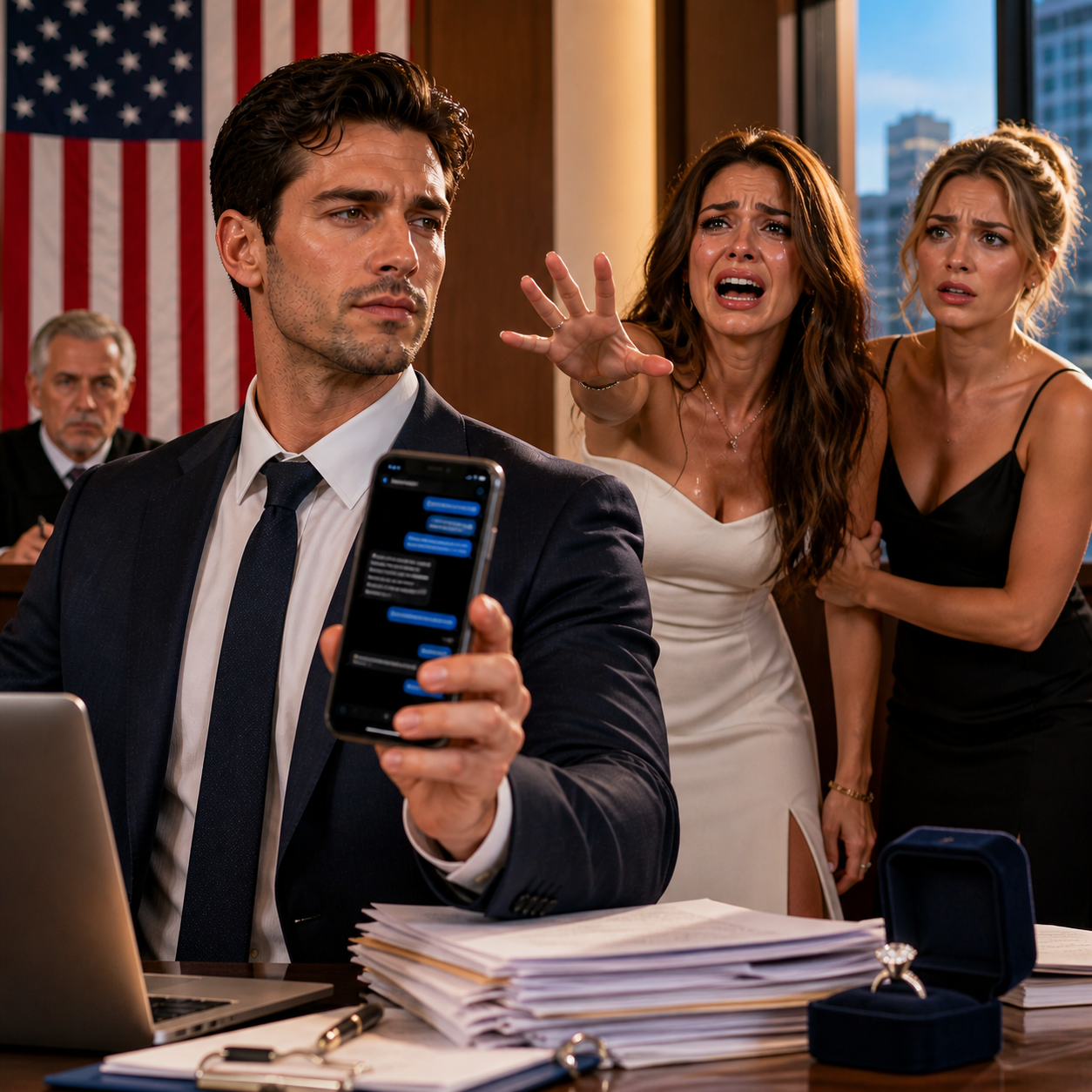
I knew something was wrong the moment Beth texted me.
It was a Tuesday night, and I was sitting on my couch with my laptop open, buried in a technical document for work. I’m an IT project manager, which means my brain naturally looks for patterns, dependencies, and risks. I’m not dramatic by default. I don’t assume the worst without evidence.
But when my phone buzzed and I saw Beth’s name, something in my stomach tightened.
Beth was my fiancée’s best friend. Not mine. We were friendly because Fiona loved her, but we were not the kind of people who casually texted each other at night.
The message said, “Hey you. Working hard?”
I stared at it for a second.
Hey you?
That was already strange.
I replied, “Hey Beth. Yeah, just wrapping up a project. What’s up?”
Her response came almost immediately.
“Nothing. Just bored. Fiona’s at yoga. I was thinking you’re always so nice.”
I leaned back against the couch.
A warning bell went off in my head.
“Uh, thanks. You okay?”
“I am now.”
I read that sentence three times.
Then the next message came.
“You know, Fiona is a very lucky woman. Sometimes I wonder if she really appreciates what she has.”
That was not casual.
That was not harmless.
That was not normal.
My first thought was not even that Beth was trying to hit on me. My first thought was simpler and colder.
This is a trap.
My name is Adam. I was thirty years old, and until that night, I was engaged to Fiona, twenty-eight. We were six months away from the wedding. We lived together in my condo, the one I owned before she moved in about a year earlier.
For the most part, I thought we were happy.
There was stress, sure. Wedding planning does that. We argued about napkins, seating charts, her mother adding random cousins to the guest list, and whether the DJ needed a fog machine. Normal things.
But Fiona had always been insecure in ways I tried to excuse.
If I smiled at a barista, she noticed.
“She always gives you extra foam,” Fiona would say.
If I liked a harmless photo on Instagram, she questioned it.
“Why did you like that?”
I brushed it off.
“Babe, it’s coffee.”
“Babe, I was scrolling.”
I told myself it was nerves. Pre-wedding anxiety. Maybe she was afraid of being hurt. I loved her, so I tried to reassure her.
Beth, her best friend, was always around. Loud, dramatic, and proud of being “protective.” She and Fiona had known each other since college, and sometimes it felt like they shared one brain. Beth was the person Fiona called after every disagreement. The person who always took her side. The person who seemed to enjoy conflict more than anyone should.
I never fully trusted her.
That night, when Beth’s texts turned strange, every instinct I had told me to slow down.
If I ignored her, she could deny it.
If I showed Fiona too soon, Beth could twist it.
So I did what I do for a living.
I gathered data.
I replied, “I’m not sure what you mean, Beth. I think Fiona and I have a great relationship.”
A minute passed.
Then she sent, “I’m sure. But hypothetically, if you ever felt unsatisfied, I just think you’re really hot. And I’m a lot more fun than she is. Just saying. Our secret.”
Then came a photo.
Not explicit, but suggestive. Pajamas. Duck face. The kind of picture that was childish and insulting at the same time.
I had enough.
I typed carefully.
“Beth, I’m going to be very clear. I love Fiona. I’m going to marry her. This conversation is wildly inappropriate, and it needs to stop. I’m going to pretend this didn’t happen for Fiona’s sake, but don’t ever text me like this again.”
I put the phone down and felt sick.
My fiancée’s best friend had just crossed a line. I knew I had to tell Fiona, and I hated the conversation before it even happened.
But twenty minutes later, my phone buzzed again.
Beth.
“Okay. You’re right. Sorry. I feel so stupid. Can I be honest?”
I stared at the screen.
Then I replied, “You probably should be.”
The answer came fast.
“Fiona made me do it. She’s been freaking out saying you’re too perfect and that she’s worried you’re too good at hiding things. She wanted me to test you. I told her it was crazy. Please don’t tell her I told you. She’ll kill me. She’s just really insecure. Be nice to her.”
I sat completely still.
The room felt colder.
This was not Beth betraying Fiona.
This was Fiona betraying me.
She had not trusted me. She had not talked to me. She had not admitted her fear and asked for reassurance like an adult.
She had sent her best friend to tempt me like I was some lab animal.
That changed everything.
When Fiona came home an hour later, she smelled like lavender from her yoga class and smiled like nothing in the world had shifted.
“Hey baby,” she said, kissing my cheek. “How was work?”
“Fine,” I said. “We need to talk about something.”
Her face tightened, but only slightly.
“What’s up?”
I took out my phone.
“I got some weird texts from Beth.”
I showed her the first half.
The flirting.
The photo.
My refusal.
I watched her face carefully.
Her eyes widened with practiced horror.
“Oh my God,” she said. “Adam, I can’t believe her. Is she drunk? I’m calling her right now. That snake.”
She reached for her phone.
“Don’t bother,” I said.
She paused.
“What? Why not? She needs to be held accountable.”
Then she slipped.
A tiny smirk pulled at the corner of her mouth.
“Wow, though,” she said. “You really told her off. That’s good, Adam. You passed.”
Passed.
The word landed like a stone.
“A test?” I asked.
Her tone changed immediately, soft and playful.
“Don’t be mad. It was just a silly girl thing. I knew you would pass. I just needed to be sure. Beth is always saying men can’t be trusted, and I wanted to prove her wrong. And you did. I’m proud of you.”
She leaned in to kiss me.
I held up my hand.
“Well,” I said, “it’s funny you say that, because I don’t think Beth is the one who failed.”
Her smile disappeared.
“What are you talking about?”
I scrolled down and handed her the phone again.
Her face changed as she read the rest.
“Fiona made me do it.”
“She wanted me to test you.”
“Please don’t tell her I told you.”
The color drained from Fiona’s face.
For the first time that night, she had no performance ready.
“So,” I said quietly, “we should probably talk about this silly girl thing. And about the wedding.”
Her silence lasted maybe ten seconds.
Then the screaming started.
Not apologizing.
Not explaining.
Rage.
“You trapped me,” she yelled. “You manipulated Beth into saying that. You backed her into a corner. You were supposed to say no and delete it. Why are you trying to ruin everything?”
I stared at her.
“I’m ruining everything? You had your best friend try to seduce me.”
“Grow up, Adam. Everyone does this.”
“No. Everyone does not do this.”
“How else was I supposed to know you weren’t lying?”
“By trusting the man you agreed to marry.”
She laughed bitterly.
“You were sneaky. You kept texting Beth behind my back to make her confess. You’re the one who turned this into something ugly.”
That was when I felt the love inside me change.
It did not explode.
It froze.
“I can’t marry you,” I said.
Her face went blank.
“What?”
“I cannot marry someone who thinks this is okay. I can’t even be with someone who thinks this is okay. The wedding is off.”
“No,” she snapped. “We are not breaking up over this. I am not letting you break up with me over this.”
“You don’t get to decide that.”
I packed a bag and left for a friend’s place while she screamed behind me.
The next day, the real war began.
The wedding was six months away, but money had already been spent. My parents had generously put down a twenty-thousand-dollar non-refundable deposit on the venue. Fiona’s parents had paid six thousand for her dress and four thousand for flowers.
The ring was mine. I paid twelve thousand dollars cash from my savings.
I called my parents and told them everything.
They were horrified, then furious, then calm in the way only people who love you can be calm when your life falls apart.
My father said, “Consider the deposit the cheapest divorce you’ll ever get.”
I assumed Fiona would tell her parents the truth.
She did not.
Instead, her mother Susan called me crying.
“Adam, what is going on? Fiona is devastated. She said you were inappropriate with Beth, and when she confronted you, you flew into a rage and canceled the wedding. She said you’re holding her things hostage. What did you do?”
My body went cold.
That was their move.
I was the villain now.
Not Fiona, who planned the test.
Not Beth, who executed it.
Me.
The unstable, aggressive fiancé who got caught and destroyed the wedding out of spite.
“Susan,” I said carefully, “that is the opposite of what happened. I need to meet with you and Mark in person. Without Fiona.”
“She’s very distraught, Adam.”
“I understand. But by the time we’re done talking, you will be too.”
We met at a coffee shop.
Mark arrived with his arms crossed and his jaw tight.
“Explain yourself,” he said. “You broke my daughter’s heart.”
I did not argue.
I placed my phone on the table and opened the text thread.
“Please read everything. From the top. Including the timestamps.”
They read.
Beth’s messages.
The picture.
My refusal.
Then Beth’s confession.
Fiona made me do it.
Susan covered her mouth.
Mark’s face shifted from anger to confusion to deep humiliation.
He read it again.
Then again.
Finally, he looked up.
“She lied to us.”
“I’m sorry,” I said. “I loved her. But I can’t marry her.”
Susan started crying quietly.
Mark said one word.
“Shameful.”
After that meeting, Fiona’s world changed fast.
Her father called her, and from what I heard later, it was not gentle.
She did not come to the condo for her things.
She sent Beth.
Beth showed up with swollen eyes and a stiff jaw.
“I’m here for Fiona’s stuff,” she muttered.
“It’s packed,” I said, pointing to the boxes by the door. “But I have one question. Why?”
She looked away.
“She’s my best friend.”
“So you helped her sabotage her own relationship? You tried to seduce her fiancé? What kind of friend is that?”
Beth’s face twisted.
“You don’t understand. You were supposed to say no and delete it. We would have laughed about it.”
“You were going to laugh about testing me?”
“You tricked me,” she snapped. “You tricked Fiona. You’re a psycho.”
The entitlement was breathtaking.
“Take the boxes,” I said. “And tell Fiona I want the ring back.”
Beth glared at me.
“She’s keeping it. You broke the engagement. You owe her. That ring is compensation for emotional distress.”
I watched her carry the first box out.
Then I called a lawyer and asked a simple question.
“How does the law treat engagement rings as conditional gifts?”
That question turned into three months of small claims court, legal fees, and the most exhausting bureaucratic revenge I never wanted.
Fiona refused to return the ring.
Her argument was simple. I ended the engagement, so the ring was hers.
My argument was also simple. The engagement ended because she orchestrated a manipulative loyalty test with her best friend, then lied about it to everyone. The marriage did not happen because of her bad faith.
We both lawyered up.
Fiona’s legal strategy was to paint me as controlling. She claimed I was financially abusive. I was not. I paid for the condo. She paid her car note. We split utilities. She claimed I isolated her from friends because I never liked Beth.
True, I did not like Beth.
Apparently, I had excellent instincts.
Their story was that Fiona had reason to be suspicious, that Beth was only trying to help her discover the truth, and that my reaction proved I was unstable.
It was scary.
Not because it was true, but because lies told confidently can still do damage.
At the hearing, Fiona arrived dressed like she was attending a charity luncheon. Beth sat behind her, smug and loyal.
My lawyer, Ms. Hayes, presented the text messages first. The full thread. She established the ring as a conditional gift and argued that Fiona’s manipulation voided the condition of marriage.
Then Fiona’s lawyer stood.
“Your honor, my client was a desperate woman in love. She had concerns about Mr. Adam’s fidelity. Her friend Beth was trying to help her get answers. It may have been misguided, but it was not malicious. Mr. Adam’s extreme reaction proves his instability.”
Then Beth took the stand.
And lied.
She claimed I had been inappropriate with her before. She claimed I had made comments. She claimed Fiona’s test was based on her reports of my behavior. She said I pressured her into saying Fiona made her do it.
For a moment, I felt the room tilt.
It was my word against hers.
Then Ms. Hayes stood.
“Your honor, we would like to call one more witness. Dylan Porter.”
Fiona froze.
Beth went pale.
Dylan Porter was Beth’s ex-boyfriend from two years earlier.
After everything happened, I had not been able to shake one thought.
This feels practiced.
So I searched. I found Beth’s old social media. Found Dylan. Sent him a message.
“Strange question. Did Beth ever do anything involving your friends to test you?”
A week later, he answered.
“You have no idea.”
Now he sat in court.
Ms. Hayes asked, “Mr. Porter, can you describe why your relationship with Beth ended?”
Dylan looked uncomfortable, but steady.
“She accused me of having a wandering eye. Then about a week later, my best friend Kyle showed me texts from Beth hitting on him. He was uncomfortable and shut her down.”
“What happened when you confronted Beth?”
“She said Kyle was lying. She claimed he hit on her. She said I was a monster for believing him. Then she broke up with me.”
“Did you ever learn the truth?”
“Yes. About six months later, Beth got drunk and admitted it. She said Fiona convinced her I was too good to be true and that she needed to test me. The test was to flirt with my best friend. When I got angry, Fiona told Beth that meant I was controlling and guilty.”
The courtroom went silent.
Dylan looked at me.
“They did the same thing to you, man. I’m sorry.”
Beth was shaking.
Fiona stared at the table.
Their entire narrative collapsed.
It was not insecurity.
It was a pattern.
The judge did not need long.
He looked directly at Fiona.
“Ma’am, what I see here is a documented pattern of malicious and manipulative behavior. You did not act in good faith. The cause for the dissolution of this engagement rests squarely on your actions.”
He ruled in my favor.
The ring had to be returned within forty-eight hours.
Fiona’s lawyer asked if she could pay in installments.
The judge refused.
I got the ring back.
I sold it immediately.
Fiona’s parents were furious. From what I heard, they made her start repaying the money they lost on the dress and flowers. Mark and Susan were humiliated, not just by the money, but by the lie.
Beth’s reputation detonated. Dylan’s testimony spread through their old friend group, and suddenly people began connecting dots from other relationships, other “tests,” other drama Fiona and Beth had created together.
They were not protective best friends.
They were a two-person sabotage committee.
As for me, I was still out a lot.
My parents lost the twenty-thousand-dollar venue deposit. I felt guilty about that, but they kept telling me it was worth every penny to keep me from marrying someone who thought manipulation was love.
And they were right.
That is the realistic part of the story.
I did not walk away untouched.
I lost money. Time. Trust. A future I thought was already planned.
But I also walked away before it became a marriage. Before there were children. Before assets were tangled. Before Fiona’s tests became bigger, crueler, and harder to escape.
My condo is quiet now.
At first, that quiet hurt.
Every room had a memory in it. Wedding samples on the counter. An empty space where her clothes used to be. Half-finished plans that suddenly meant nothing.
But slowly, the quiet changed.
It stopped feeling like loss.
It started feeling like peace.
A few months after court, Susan sent me a letter. Not from Fiona. From her.
She apologized. She said she was ashamed of believing the first story. She said Mark was too angry to write, but he agreed with every word. She said they hoped I would find someone who loved me without testing me.
I appreciated it.
I did not reply.
Some chapters need no extra conversation.
Fiona tried once, through a mutual friend, to send a message about closure. I declined. Beth tried to claim online that Dylan and I had teamed up to destroy women who “refuse to settle for suspicious men.” That post lasted about two hours before the comments reminded her of the testimony.
I did not respond to that either.
My life now is smaller than the wedding life I had planned.
But it is cleaner.
More honest.
More mine.
I am not dating seriously yet. Maybe one day. But when I do, I know what I will be looking for.
Not perfection.
Not someone without insecurity.
Everyone has fear.
I want someone who brings fear to the table instead of turning it into a trap.
Someone who says, “I’m scared,” instead of sending her best friend to test my loyalty like I am a suspect in my own relationship.
Fiona wanted proof that I would be faithful.
She got it.
Then she proved she was not trustworthy enough to receive it.
In the end, I passed her test.
But she failed mine.
And my test only had one question.
Can I trust you with my future?
The answer was no.
So I took the ring, took the lesson, and took my life back.
![[FULL STORY] I Caught My Fiancee "Time-Traveling" To Her Past At A Secret Party While I Was Home Planning Our Future Together.](https://social-media.rabedo.com/thumbnails/1776996672_R4.png)
![[FULL STORY] He Said I Would Never Leave Him—So I Quietly Became Someone Who Could](https://social-media.rabedo.com/thumbnails/1777456977_f20c22b8-e9f4-430b-ad41-263e53b77fd7.png)
![[FULL STORY] My Fiancée Mocked My “Pathetic Cubicle Job,” So I Took the Promotion and Left Without Her](https://social-media.rabedo.com/thumbnails/1777446353_ChatGPT Image 10_48_03 29 thg 4, 2026.png)
![[FULL STORY] During An Argument My Wife Yelled She Was Done Being Intimate. I Accepted It Calmly And ...](https://social-media.rabedo.com/thumbnails/1776396046_0e484b56-c43a-4b4a-a938-0166475056d1.png)
![[FULL STORY] My Fiancée's Dad Declared: "Agree to This Agreement for Her Education Debt, or the Marriage Is](https://social-media.rabedo.com/thumbnails/1776919022_8.png)