![[FULL STORY] She Called Me Weak in Front of Everyone… Then I Let Her Believe It Until Her Empire Collapsed](https://social-media.rabedo.com/thumbnails/1777749585_685840179_1929451148008051_4017313761116189838_n.jpg)
The first time Vanessa called me weak, she did not do it in private.
She did not say it during a fight, when anger might have made the words easier to excuse.
She said it across a polished glass dining table, under warm restaurant lights, in front of six of our colleagues.
“Ethan’s not really the decision-making type,” she said with a soft laugh, swirling her wine. “He’s steady. Predictable. Safe. Honestly, sometimes I wish he had a little more backbone.”
For half a second, the table went quiet.
Then someone chuckled.
Then another person laughed.
And just like that, my humiliation became part of the evening.
I remember the light reflecting off the table. I remember how perfectly aligned the silverware was. I remember Vanessa looking at me like she had said something harmless, something true, something I should be mature enough to accept.
I nodded.
Not because I agreed.
Not because I was too embarrassed to respond.
But because something inside me aligned in that moment.
I looked at her and said, “You’re right.”
She smiled.
Satisfied.
That was the moment she stopped seeing me as a threat.
And that was the biggest mistake she ever made.
Vanessa had always been ambitious.
That was one of the reasons I loved her in the beginning. She moved through the world like everything was within reach. She did not wait for doors to open. She found hinges.
When we started our consulting firm together six years earlier, it had been a real partnership.
Her vision.
My structure.
She built relationships.
I built systems.
She closed deals.
I made sure we could actually deliver on them.
And for a long time, it worked.
Perfectly.
But success has a dangerous way of rewriting memory.
Especially for people who need to believe they created everything alone.
Slowly, Vanessa began changing the story.
In meetings, my role became smaller.
During client calls, she spoke as if every strategy had come from her.
At events, she introduced me with phrases like, “Ethan handles the backend,” as if the backbone of the company was some minor administrative detail.
I did not correct her.
I did not want to seem petty.
And over time, she stopped expecting me to correct her at all.
Then came the financial changes.
Small at first.
A shift in account access.
A new approval process.
A revised authority structure.
She framed everything as efficiency.
Growth.
Necessary evolution.
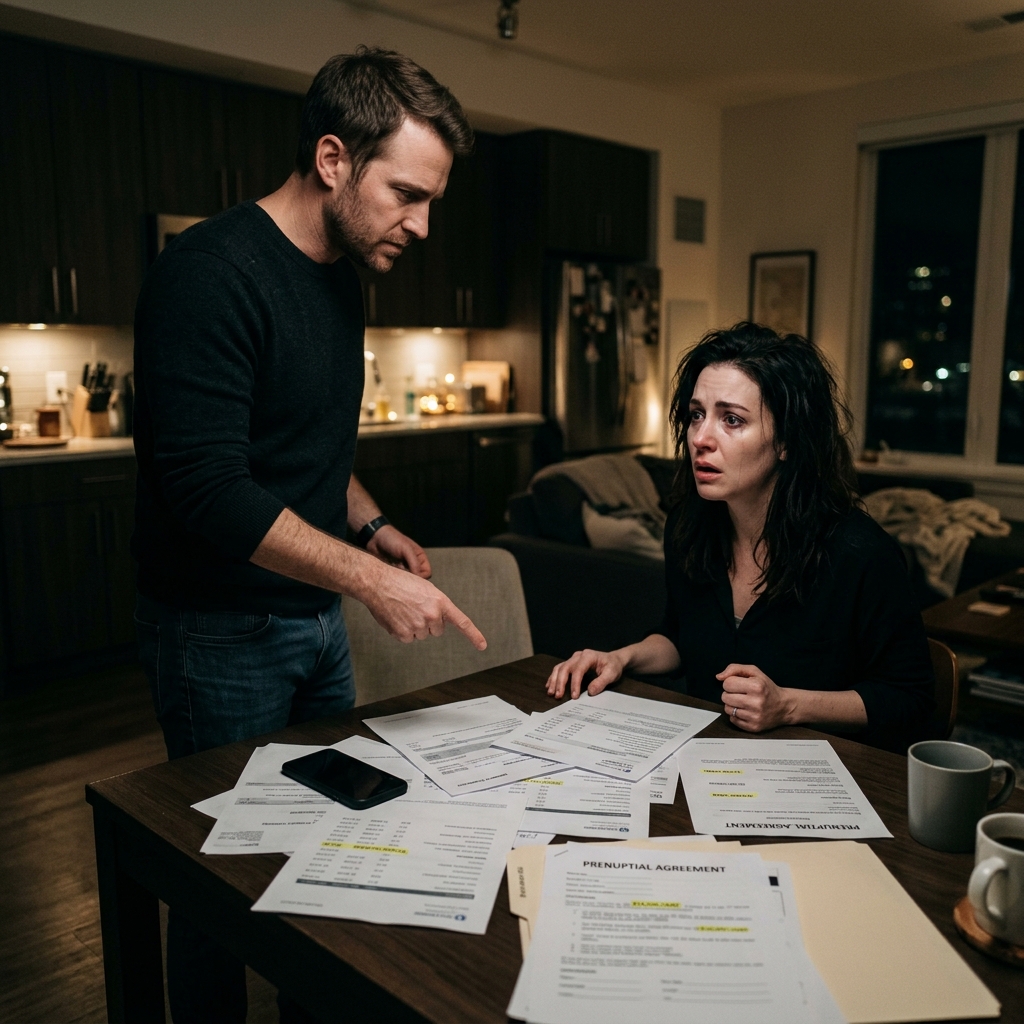
One evening, she slid a set of documents across the kitchen counter and said, “We need to streamline decision-making. Too many cooks slow things down.”
I skimmed the pages.
The language was clean.
Professional.
But the meaning underneath was obvious.
Final approvals were being funneled through her. Control was being redistributed. My access was becoming conditional.
I looked up at her.
She was waiting.
Not worried.
Certain.
So I signed.
Her shoulders relaxed immediately.
That became the pattern.
Every time she pushed further, I agreed.
Every time she tightened her grip, I stepped back.
From the outside, it looked like I was fading into the background.
In reality, I was stepping into a different role entirely.
What Vanessa never understood was that silence is not absence.
Just because I was not arguing did not mean I was not observing.
And I observed everything.
Unauthorized transfers she justified as temporary reallocations.
Clients redirected into side agreements.
Emails where she positioned herself as the sole founder.
Contracts with wording that quietly erased my contributions.
Internal notes that treated me less like a partner and more like an obstacle she had already solved.
I did not confront her.
I documented.
I archived.
I built a timeline so precise it did not rely on emotion.
Only facts.
Dates.
Numbers.
Signatures.
Patterns.
While Vanessa was busy consolidating power, I was making sure that power had a paper trail attached to it.
But evidence alone is not enough.
Evidence needs timing.
It needs context.
It needs an audience that matters.
Vanessa no longer cared what I thought. That much was clear. But she cared deeply about perception. Reputation. Control. The image of being the brilliant woman at the center of everything.
So I waited.
I let her continue.
I let her believe every step was unchallenged.
That dinner where she called me weak had not been the beginning.
It was confirmation.
Confirmation that she had fully committed to the version of reality where I posed no risk.
And once people believe you are harmless, they stop hiding.
Three months later, the opportunity arrived.
Vanessa announced a company-wide event.
A formal gathering with investors, major clients, and key partners. A celebration of growth, she called it. A strategic reveal of our next phase.
I knew what it was the moment she described the agenda.
She was going to position herself as the sole driving force behind the company and publicly frame a restructuring that was not legally finalized yet.
A power move.
Calculated.
Clean.
Difficult to challenge without making me look unstable.
And she expected me to stand beside her and nod.
Like always.
When she told me the plan, she watched my face carefully.
I gave her nothing.
I nodded, asked a few neutral questions, and said, “Sounds like the right direction.”
The relief in her expression came quickly.
“I knew you’d understand,” she said.
Of course she did.
By then, I had trained her to expect agreement.
She did not see my calm as something to question.
She saw it as proof that she was right.
The weeks leading up to the event were busy for her.
Branding.
Messaging.
Guest lists.
Talking points.
For me, they were finalization.
I worked with a legal team she did not know existed. Professionals who specialized in corporate fraud, fiduciary breaches, and ownership disputes.
I gave them everything.
Every document.
Every record.
Every inconsistency.
They did not need speculation.
They had proof.
More importantly, they had a strategy.
If we moved too early, Vanessa could call it retaliation.
If we moved too late, her narrative would already be planted.
It had to happen at the exact moment she felt most secure.
The night of the event, everything looked exactly the way Vanessa wanted it.
Floor-to-ceiling windows overlooking the city.
Soft lighting.
Expensive wine.
A low hum of conversation and anticipation.
She moved through the room like she owned every inch of it. Greeting investors. Shaking hands. Laughing at the right moments. Controlling the energy without seeming to try.
I stayed slightly behind her.
Present.
Unobtrusive.
Exactly where she expected me to be.
People greeted me politely, but their attention always shifted back to Vanessa.
That was fine.
That was part of the design.
When it was time for the main presentation, Vanessa stepped onto the stage with effortless confidence.
She spoke about growth.
Vision.
Leadership.
She told the story of the company in a way that placed herself at the center of every success.
If you did not know better, it sounded convincing.
Even impressive.
Then she reached the pivot.
The announcement of structural changes.
That was when I stood up.
At first, no one noticed.
Then a few heads turned.
Vanessa paused just slightly, her expression tightening for a fraction of a second before she recovered.
“Ethan?” she said, her tone light but edged underneath.
I walked toward the stage.
Steady.
Unhurried.
The room grew quieter with every step.
By the time I reached her, the attention had shifted completely.
“I just need a minute,” I said.
My voice was calm, carrying easily through the room.
For the first time in a long time, Vanessa looked unsure.
But she handed me the microphone anyway.
Because why wouldn’t she?
I was the weak one.
The predictable one.
The one who never disrupted anything.
“I won’t take long,” I said, turning toward the audience. “Vanessa is right about one thing. I haven’t been making many decisions lately.”
A few people smiled, expecting self-deprecation.
I let the pause stretch.
“But that wasn’t because I couldn’t. It was because I was waiting.”
The room changed.
Subtly.
Undeniably.
Vanessa’s posture stiffened beside me.
“I’ve spent the last six months reviewing our company’s financial and operational structure,” I continued, reaching into my jacket and pulling out a slim folder. “Not out of suspicion. Out of responsibility.”
I placed the folder on the podium.
“What I found was not a difference in leadership style. It was a pattern. One that has now been independently verified.”
Vanessa tried to interrupt.
“Ethan, this isn’t—”
“This is exactly the place,” I said, not loudly, but firmly enough that she stopped. “Because this is where the narrative was supposed to be finalized.”
I looked at her then.
Really looked at her.
For the first time, she was not in control of the moment.
“You said I was weak,” I said. “And you were right about one thing. I didn’t fight you.”
Then I turned back to the audience.
“But not fighting is not the same as losing.”
My legal team moved next.
Quietly.
Professionally.
Copies of documents were distributed to investors and key partners. Transfers. Unauthorized agreements. Misrepresented ownership claims. Side deals. Emails. Internal notes. Each piece clear. Each one dated. Each one tied to the next.
I did not need to raise my voice.
The documents spoke in a language Vanessa could not spin.
At first, people looked confused.
Then concerned.
Then angry.
Investors began asking questions before the presentation was even finished. Partners who had smiled beside Vanessa minutes earlier started stepping away from her. Daniel from finance pulled out his phone and left the room. Two clients asked for immediate clarification on contracts Vanessa had represented as already approved.
Vanessa stood beside me, face pale, her mouth opening and closing like she was trying to find the version of herself that could still control the room.
She never found it.
“This is a private matter,” she said finally, voice tight.
I shook my head.
“No. A private matter is a disagreement. Unauthorized financial movement and misrepresented ownership are not private.”
That sentence ended the performance.
The event did not collapse loudly.
It collapsed quietly.
That was worse for her.
No screaming.
No dramatic exit.
Just people reading, whispering, stepping away, making calls, and realizing the woman who had walked in as the future of the company had just become a liability.
Vanessa had expected applause.
She got an internal review.
I left before the room finished unraveling.
There was nothing left for me to prove.
Outside, the city lights stretched across the night, and for the first time in months, I felt still.
Not victorious.
Not satisfied.
Clear.
The days that followed were brutal for Vanessa.
The restructuring was frozen.
Her access was restricted.
The investors demanded a formal investigation.
Clients requested contract reviews.
The side agreements she thought were clever became evidence. The transfers she thought I would never notice became questions she could not answer.
At first, she tried to blame confusion.
Then urgency.
Then me.
She said I had humiliated her. That I had waited for the most damaging possible moment. That I could have handled things privately.
I almost laughed when my lawyer read that email to me.
Privately was exactly where people like Vanessa won.
Privately, she could reframe.
Privately, she could soften.
Privately, she could turn facts into feelings and consequences into cruelty.
Publicly, she had to answer to documents.
Within months, she was removed from operational control. The firm survived, but not as the kingdom she tried to build around herself. Investors pushed for oversight. Agreements were corrected. My ownership was restored and protected.
I did not take everything.
I took what was mine.
That was enough.
Vanessa called me once after the investigation began.
I answered because my lawyer advised me to keep everything calm and documented.
Her voice was different.
Still proud.
But tired.
“You enjoyed that,” she said.
“No,” I replied. “I prepared for it.”
“You made me look like a criminal.”
“You made choices that looked criminal when placed in order.”
She went silent.
Then she said, “You could have fought me earlier.”
“I know.”
“Then why didn’t you?”
I looked out my office window at the workshop floor below, at the employees moving through systems I had designed, systems she once called background work.
“Because you needed to believe I wouldn’t.”
She hung up.
I never spoke to her directly again.
A year later, the company looked different.
Smaller.
Cleaner.
Stronger.
I stayed involved, but not in the shadows anymore. People finally saw what had always been there. The systems. The structure. The quiet work that had held everything together while Vanessa took the spotlight.
I did not become louder.
I did not become crueler.
I simply stopped hiding my competence to make someone else feel larger.
That was the real freedom.
One evening, long after the investigation closed, I found an old photo from the early years of the company.
Vanessa and me standing in an empty office, both of us exhausted and smiling, pizza boxes on the floor, laptops open on folding tables.
Back then, it had been real.
At least I think it was.
That is the part people never tell you about betrayal. Sometimes the thing that dies was once alive. Sometimes the person who tried to erase you was once the person you trusted most.
I let myself grieve that version.
Then I put the photo away.
Not in anger.
Just in the past.
Vanessa once needed me to be weak so she could feel strong.
So I let her believe it.
I let her laugh.
I let her underestimate me.
I let her build the trap carefully around herself.
And when the time came, I did not need revenge.
I only needed the truth, organized properly, delivered at the one moment she could not escape it.
She called me predictable.
Maybe she was right.
Because once I saw the pattern, I followed it all the way to the end.

![[FULL STORY] My Girlfriend Hopped On Her Best Friend’s Shoulders At A Festival To Humiliate Me, So I Left Her There And Ruined Their Lives.](https://social-media.rabedo.com/thumbnails/1777359415_B28.png)
![[FULL STORY] She Sent Me a $1,000 Invoice for Watching My Son — So I Handed Her Family a $126,000 Reality Check](https://social-media.rabedo.com/thumbnails/1776830869_72b50153-ce9c-4ac5-97a4-09ac2dadf32e.png)
![[FULL STORY] The Night I Finally Stood Up and Took My Place](https://social-media.rabedo.com/thumbnails/1777150409_8fd73784-9a8d-417e-a5d2-a721ff4b977d.png)
![[FULL STORY] My Girlfriend Told Me Her Ex Was Moving Into My Apartment… and Said I Should “Learn Something” From Him](https://social-media.rabedo.com/thumbnails/1776415466_667824664_975580614994141_2843723636644699728_n.jpg)